7 Best Practices for AI Integration in Mid-Sized Companies (2026)
Vijay Vamja
7-8 mins
AI as a system has matured from experimental pilots to reliable, autonomous execution in 2026. For mid-sized enterprises (MSEs), competitive advantage now lies in the architectural sophistication of AI integration services and solutions, shifting from the human-supervised 'Co-pilot' model to the specialized 'Autopilot' or Agentic model.
This blog outlines seven definitive best practices for AI integration in 2026, resting on three pillars: Specialization, Orchestration, and Governance. For a deeper analysis of the ROI on these pillars, refer to our AI Integration Services Guide. The following roadmap details how to transform into an AI-native organization.
Best Practice 1: Architecting for Agentic Orchestration and Composite Systems
In 2026, the composite AI system is the standard architecture and it can be realized only through Multi-Agent Systems (MAS). Single LLMs cannot handle diverse AI integration use cases for companies due to context window limits, potential for conflicting instructions, and lack of specialized reasoning. These limitations require a modular approach to solve, therefore, agentic AI integration best handles it.
1.1 The Shift from Linear Chains to Multi-Agent Graphs
Early AI implementations used simple linear chains (Prompt A → Prompt B). These fail in dynamic environments where the next step depends on the previous outcome. The 2026 standard is Graph-Based Orchestration, where the system state determines execution flow-a key concept in AI-native workflows.
The Agentic Orchestration Patterns
Architects must distinguish between levels of autonomy. Three primary patterns are now industry standards:
- Sequential Orchestration:
It applies to deterministic workflows with known dependency graphs.
- Mechanism: An agent completes a task (e.g., 'Extract Invoice Data') and passes structured output to the next agent (e.g., 'Reconcile with PO').
- 2026 Evolution: Modern sequential patterns include 'self-healing' nodes. If an agent fails, it triggers a feedback loop to retry with a modified prompt or alternative model. Tools facilitating N8N AI Agent Integration are frequently used here to bind these sequential steps into reliable pipelines.
- Concurrent 'Fan-Out/Fan-In' Orchestration:
This is used for multifaceted decision-making, such as loan approvals or supplier vetting.
Mechanism: A central orchestrator decomposes the task and triggers multiple agents in parallel.
- Agent A (Legal): Reviews contracts.
- Agent B (Financial): Analyzes credit.
- Agent C (Market): Assesses risk.
Manager-Led Dynamic Orchestration:
It is required for complex, high-uncertainty tasks like Incident Response.
- Mechanism: A 'Manager Agent' maintains a dynamic task ledger. It receives a high-level goal, then:
- Plans: Creates a list of necessary steps.
- Delegates: Assigns specific sub-tasks to specialized agents (e.g., Log Agent, Metrics Agent).
- Reflects: Updates the plan based on findings.
- Role of Ciphernutz: Designing these systems requires expertise in prompt engineering for planners to prevent loops. AI agent development services from partners like Ciphernutz specialize in tuning these control loops for specific business domains.
1.2 The 'Intent Router' as the Architectural Gateway
The Intent Router is a critical component sitting between the user interface and backend agents. It is a fundamental part of a robust AI implementation strategy for businesses.
- Semantic Routing Logic: The router uses an embedding model to map user queries into vector space and classifies them against specific intent clusters, rather than using keyword matching.
- Cost-Performance Optimization:
- Routine Queries (Tier 1): Simple requests (e.g., password reset) go to cached responses or fast Small Language Models (SLMs).
- Complex Reasoning (Tier 2): High-level tasks (e.g., supply chain analysis) go to reasoning agents powered by high-compute models.
- Actionable Tasks (Tier 3): Specific actions (e.g., booking meetings) go to deterministic API agents.
- Impact: This architecture prevents using expensive models for simple tasks, effectively controlling AI operational costs.
1.3 State Management and Thread Persistence
State Management is now a deliberate engineering requirement for autonomous AI systems for businesses.
- The Checkpointing Pattern: Long-running workflows utilize database checkpointing. Every decision and tool output is serialized and stored. This allows the system to resume from a failure point, which is essential for reliability.
- Graph Memory: Advanced agents build a Knowledge Graph of the current session. They track entities and relationships dynamically, handling non-linear context (e.g., recalling a constraint mentioned earlier because it links to the current entity).
Evolution of AI Orchestration Architectures
| Feature | 2024 Architecture | 2026 Agentic Architecture |
|---|---|---|
| Control Flow | Linear Chain | Dynamic Graph |
| Decision Making | Hardcoded logic | Autonomous Planner |
| Error Handling | Fail and Stop | Reflexion & Self-Correction |
| State | Ephemeral Context | Persistent Thread & Graph |
| Latency | Single Inference | Parallel Execution |
| Ideal Partner | Generalist Dev Shop | Specialized Consultant (e.g., Ciphernutz) |
Best Practice 2: Strategic Deployment of Small Language Models (SLMs)
Mid-sized companies should aggressively adopt Small Language Models (SLMs) for most workloads. While large models exist, the effective strategy for generative AI integration services is 'Specialized Intelligence.'
2.1 The Economic and Technical Case for SLMs
By 2026, models with fewer parameters (e.g., Phi-4, Llama-4 8B) have achieved reasoning capabilities comparable to older large models but at a fraction of the compute cost. This shift is one of the key AI integration trends 2026.
- Zero Latency & Edge Inference: Operations requiring low latency (e.g., manufacturing quality control) cannot wait for cloud round-trips. SLMs run locally on Neural Processing Units (NPUs) in enterprise hardware, enabling instant interaction.
- Privacy & Data Sovereignty: For sectors like legal and healthcare, sending data to public APIs is risky. SLMs can be self-hosted within a Virtual Private Cloud (VPC) or on air-gapped hardware, ensuring sensitive data never leaves the controlled environment.
- Cost Predictability: Hosting an SLM offers a flat cost structure (hardware plus electricity) regardless of query volume, unlike token-based pricing. This yields significant ROI for high-volume applications.
2.2 The 'Specialist' Fine-Tuning Strategy
SLMs are most effective when adapted to specific domains through expert generative ai development services.
- Parameter-Efficient Fine-Tuning (PEFT):
- Techniques like LoRA (Low-Rank Adaptation) allow companies to fine-tune models on internal documents without retraining the entire model.
- Implementation: A logistics firm needs a model that understands specific terminology like 'Bill of Lading,' not general poetry. A 7B parameter model fine-tuned on this data will outperform a generic large model because it is grounded in the company's specific ontology.
- The Adapter Pattern: A single base model can serve multiple departments by swapping LoRA Adapters. An HR Adapter loads for personnel queries, while a Sales Adapter loads for CRM tasks, keeping infrastructure requirements minimal.
The Adapter Pattern: A single base model can serve multiple departments by swapping LoRA Adapters. An HR Adapter loads for personnel queries, while a Sales Adapter loads for CRM tasks, keeping infrastructure requirements minimal.
2.3 Benchmarks and Model Selection (2026)
Model selection requires careful analysis of current benchmarks:
- Reasoning Heavy: Models like Phi-4 (14B) lead in logic and math-heavy tasks within the small category.
- General Purpose / Chat: Llama-4 8B provides a balance of fluency and instruction following.
- Multilingual: Mistral variants remain strong for European languages and code generation.
- Integration: Partners like Ciphernutz manage the data curation and fine-tuning pipelines required to transform raw open-source models into corporate assets.
Best Practice 3: Next-Generation RAG: From Vectors to Knowledge Graphs
Retrieval-Augmented Generation (RAG) grounds AI in corporate data. However, simple text chunking and vector similarity ('Naive RAG') are insufficient for complex reasoning. 2026 requires Agentic RAG backed by Knowledge Graphs (GraphRAG).
3.1 The Limitations of Vector Search
Vector databases excel at finding semantically similar text but struggle with specific AI integration challenges for mid-sized companies:
- Multi-hop Reasoning: Vector search may find documents regarding two separate events but fails to identify the causal relationship between them if it isn't explicitly stated in a single chunk.
- Global Summarization: Vector search retrieves specific data points but cannot aggregate them into themes without retrieving the entire dataset.
3.2 The GraphRAG Solution
GraphRAG structures data into a network of entities and relationships.
- Semantic Clustering: The system extracts entities (People, Projects, Dates) and links them explicitly (e.g., Sarah → Project X).
- Graph Traversal: The AI traverses the graph to answer queries. It can trace connections from one node to another, providing deterministic retrieval and verifiable logic.
- Community Detection: Algorithms detect clusters in the graph, allowing the AI to summarize entire topics or 'communities' rather than just individual documents.
3.3 Agentic Retrieval Workflows
Retrieval in 2026 is an agentic workflow, not a single query.
- Query Decomposition: A Planner Agent breaks complex questions into sub-queries. For example, for a contract comparison, the agent decomposes the task into retrieving Contract A, extracting clauses, retrieving Contract B, extracting clauses, and then comparing.
- Reflexion & Retry: If the retrieval agent returns results with low relevance, a Critic Agent rejects them and reformulates the search query (e.g., expanding acronyms). This loop continues until high-quality context is found, reducing errors.
3.4 Data Lineage and Data Engineering
RAG relies entirely on data quality and data readiness for AI adoption.
- Automated Lineage: Tools like Atlan are essential for tracking data provenance. If a source file updates, the lineage system triggers a pipeline to re-process only that file, ensuring the system remains current.
- Semantic Chunking: Instead of fixed-size splitting, 2026 best practices use Semantic Chunking, where a small AI model identifies natural topic breaks to create self-contained data chunks.
RAG Maturity Model (2026)
| Level | Technology | Capability | Use Case |
|---|---|---|---|
| Level 1 | Vector DB + Naive Chunking | Keyword Search | Simple FAQ |
| Level 2 | Hybrid Search + Reranking | Better Precision | Knowledge Base |
| Level 3 | Query Decomposition | Complex Q&A | Research Assistant |
| Level 4 | Knowledge Graph | Global Reasoning | Strategic Intelligence |
Best Practice 4: Engineering Reliability: LLMOps & Evaluation Frameworks
Subjective evaluation ('looks good') is not acceptable in professional settings. Mid-sized companies must adopt LLMOps, applying software engineering rigor to AI model deployment in production.
4.1 CI/CD for Prompts and Chains
Prompts define system behavior and must be treated as code.
- Version Control: All prompts and agent configurations must be stored in version control systems.
- Automated Regression Testing: Changes must pass a CI/CD pipeline before deployment.
- The 'Golden Dataset': Companies maintain a dataset of historical queries with verified correct answers.
- Automated Execution: The modified agent runs against this dataset.
- Metric Check: If accuracy drops below a set threshold, deployment is blocked. This prevents performance drift.
4.2 The 'LLM-as-a-Judge' Evaluation Pattern
Human evaluation is too slow for continuous integration. The industry standard is 'LLM-as-a-Judge.'
- Mechanism: A high-reasoning model is given a rubric and the agent's output. It scores the output on specific metrics:
- Faithfulness: Is the answer derived solely from retrieved context?
- Relevance: Does the answer address the query?
- Tone/Style: Does it adhere to brand guidelines?
- Tooling: Frameworks allow developers to write unit tests for agents, integrating these checks into existing development workflows, effectively bringing MLOps for business teams.
4.3 Observability and Distributed Tracing
Debugging multi-agent systems requires visibility.
- Tracing Platforms: Tools provide insight into agent execution. They generate trace trees showing every step: router classification, search terms, retrieved documents, and final generation.
- Production Monitoring: Live monitors track metrics like hallucination rates, user sentiment, and token costs. Anomalies trigger alerts to the engineering team.
Best Practice 5: Governance, Security, and ISO 42001 Compliance
As AI agents take actions, AI governance and compliance becomes mandatory. ISO/IEC 42001 (Artificial Intelligence Management System) provides the framework for 2026.
5.1 Implementing ISO 42001
This standard requires an AI Management System (AIMS) for responsible AI implementation.
- AI Risk Assessment: Every agent must undergo a documented risk assessment.
- High Risk: Hiring algorithms, financial approvals.
- Low Risk: Internal informational bots.
- Human Oversight Protocols:
- Human-in-the-loop (HITL): Required for high-risk actions. The agent drafts; a human approves.
- Human-on-the-loop (HOTL): The agent acts, but a human monitors and can intervene via a 'Kill Switch.'
- Transparency: Users must know they are interacting with AI. Decisions must be explainable via observability tools.
5.2 Security: Defending the OWASP Top 10 (2025/2026)
Mid-sized companies face specific security threats, requiring robust AI security and risk management.
- Prompt Injection: Attackers manipulate input to override instructions.
- Defense: Use Instruction Hierarchies where System Roles prioritize over User Roles. Guardrail Agents scan inputs and outputs for injection patterns.
- Data Poisoning: Injecting false data into the RAG source to manipulate answers.
- Defense: Strict access controls on the Knowledge Base and hashing/signing of source documents.
5.3 Differential Privacy for Fine-Tuning
When fine-tuning SLMs on internal data, privacy is a risk.
- Technique: Differential Privacy (DP-SGD) adds statistical noise to gradients during training. This ensures the model learns general data patterns without memorizing specific private records.
Best Practice 6: Data Engineering for Reliability
Data Quality is the primary lever for improving model performance. Mid-sized companies often struggle with fragmented data, making legacy system AI integration a challenge.
6.1 Data-Centric AI Pipelines
The focus has shifted from tweaking models to fixing data.
- Automated Cleaning: Tools use 'Confident Learning' algorithms to detect label errors and outliers in training data. Identifying and fixing mislabeled data yields higher accuracy gains than increasing model size.
6.2 Synthetic Data Generation
Mid-sized companies often lack the massive datasets needed for fine-tuning.
- Data Synthesis: Use a large 'Teacher Model' to generate high-quality synthetic data.
- Process: Provide a small set of 'Golden Examples.' The Teacher Model generates thousands of variations covering edge cases.
- Distillation: This synthetic dataset trains a smaller, cheaper 'Student' SLM. The Student learns to mimic the Teacher's reasoning at a fraction of the cost.
6.3 The Data Fabric Solution
Building point-to-point integrations for every agent is unscalable. This is particularly relevant for sectors with sensitive data environments, such as those discussed in our analysis of AI Integration in Existing EHR/EMR Systems.
- Data Fabric: Implement a virtualization layer. This allows agents to query data via a unified API without replicating physical data. The Fabric translates semantic queries into the specific SQL or API calls required by legacy systems (e.g., SAP, Salesforce).
Best Practice 7: The Build vs. Buy vs. Partner Equation & Change Management
The complexity of the 2026 AI stack creates a skills gap for mid-sized enterprises. Companies must decide whether to hire AI agent developer teams internally or seek external enterprise AI integration solutions.
7.1 The Hidden Costs of Building Internal Teams
Building in-house offers control but carries substantial costs.
- Talent Scarcity: Hiring competent AI Architects and LLMOps Engineers is expensive and difficult. A minimum team can cost upwards of $1M/year.
- Infrastructure Overhead: Maintaining the Ops stack (Vector DBs, Tracing tools, GPUs) often exceeds inference costs, complicating AI infrastructure planning.
- Time-to-Value: Internal teams typically take 6-9 months to reach production reliability.
7.2 The Strategic Partnership Model
Collaborating with specialized integration architects is often more efficient. For a curated list of capable partners, you can review the Top AI Integration & Automation Service Providers.
- Accelerator Effect: Partners bring 'Agent Blueprints'-pre-validated architectures for common workflows. This reduces time-to-market to weeks.
- Governance-as-a-Service: Partners provide compliant templates and guardrails ready for ISO 42001 audit.
- Soft Positioning: Engaging a partner allows the internal IT team to focus on business rules while the partner handles the cognitive architecture.
7.3 Human-Centric Change Management
Agentic AI changes employee roles.
- Role Redefinition: Staff must be upskilled from 'doers' to 'Agent Supervisors' who audit and manage digital workers.
- The 'Glass Box' Principle: AI interfaces should be transparent to combat resistance. Showing the 'thought process' (e.g., 'Searching CRM...', 'Drafting Email...') builds trust and helps employees feel in control.
Internal Team vs. Strategic Partner (Ciphernutz) Cost/Benefit
| Metric | Internal Build | Strategic Partner (e.g., Ciphernutz) |
|---|---|---|
| Upfront Cost | High (Hiring, Tooling) | Moderate (Project-based) |
| Time to Production | 6-12 Months | 6-12 Weeks |
| Governance Risk | High | Low (Pre-certified Frameworks) |
| Maintenance | Full Internal Burden | Managed Services |
| Scalability | Limited by Headcount | Elastic |
Conclusion
The AI integration services and solutions landscape of 2026 offers mid-sized companies the opportunity to improve efficiency significantly. By moving to Composite, Agentic Systems, organizations can automate complex workflows.
However, this requires architectural discipline:
- Orchestrate agents using modular AI architecture patterns.
- Deploy efficient SLMs at the edge.
- Ground intelligence in Knowledge Graphs.
- Operationalize via rigorous LLMOps.
- Govern with ISO 42001 standards.
- Sanitize data with automated pipelines.
- Partner strategically to accelerate execution.
The era of subjective AI is over. The era of Engineering AI is here. For those prepared to adopt these best AI integration practices for growing companies, the path to being an AI-Native Enterprise is open.
Frequently Asked Questions
How does Agentic AI integration differ from standard API automation?
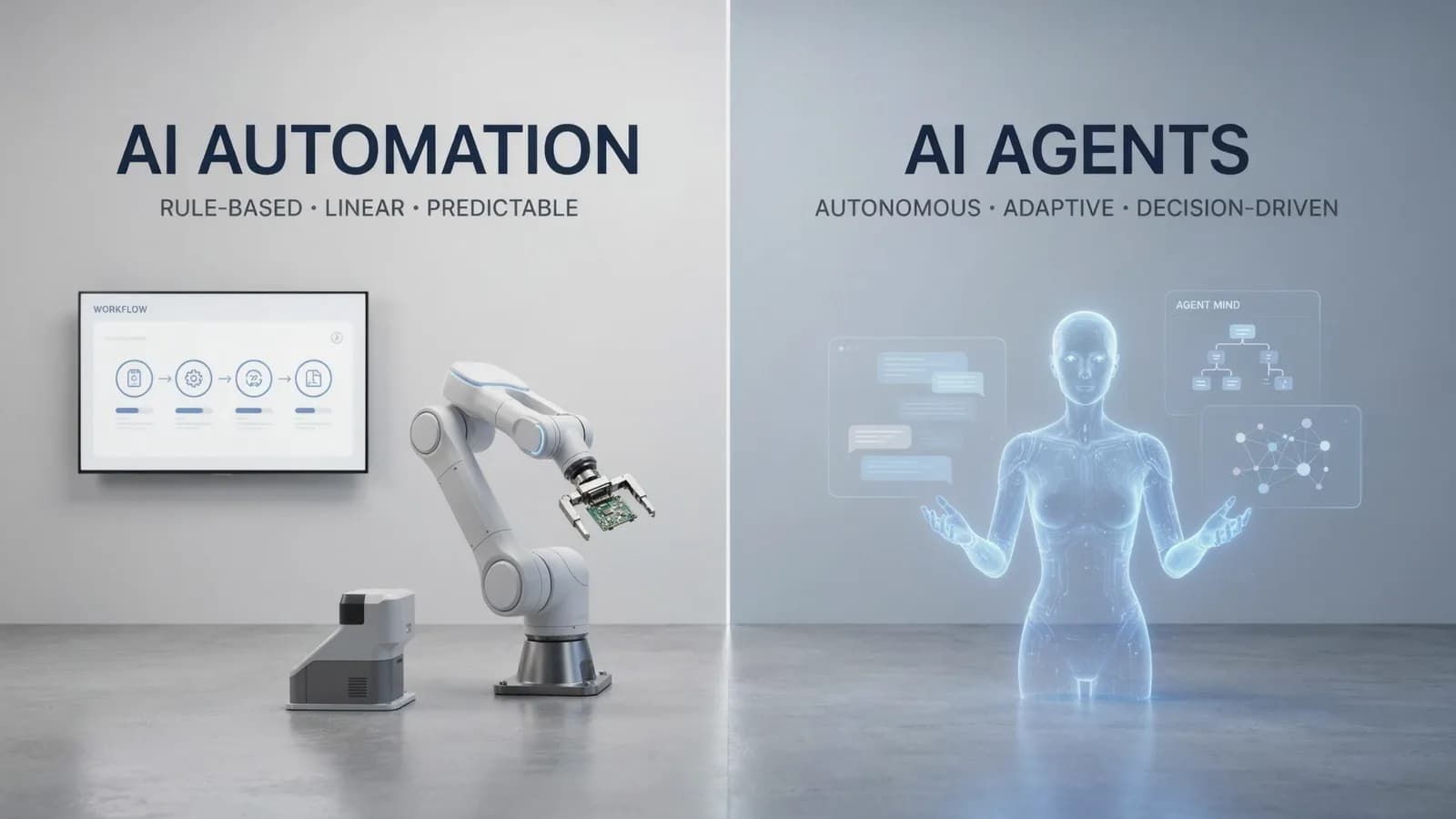
Standard automation follows a linear, pre-defined instruction path (A → B → C). In contrast, AI integration services and solutions in 2026 utilize agentic architectures where systems determine their own path based on the context. Using 'Intent Routers' and dynamic graphs, these agents can handle complex, non-linear workflows-such as resolving a customer dispute or planning logistics-that previously required human intervention.
Where does N8N fit into an enterprise AI architecture?
N8N AI Agent Integration is best utilized for 'Sequential Orchestration.' It serves as the middleware that reliably binds distinct AI agents together. In 2026, we use N8N to create 'self-healing' pipelines where, if an agent fails to extract data, the workflow automatically triggers a retry loop or switches to a backup model, ensuring production-grade reliability for enterprise processes.
Is it better to build an internal team or use external AI agent development services?
This is a 'Time-to-Value' versus 'Control' decision. While building internally offers total control, it requires hiring expensive talent (Architects, LLMOps Engineers) and maintaining complex infrastructure. Partnering with a specialized provider for AI agent development services typically reduces deployment time from 9 months to 9 weeks, as they bring pre-validated 'Agent Blueprints' and established governance frameworks, avoiding the hidden costs of learning from scratch.
Why are mid-sized companies shifting to Small Language Models (SLMs) for Generative AI integration?
The industry trend for 2026 is 'Specialized Intelligence.' Generative AI integration services now focus on deploying SLMs (like Phi-4 or Llama 8B) fine-tuned on company data. These models offer three advantages over massive public LLMs: they run locally (ensuring data privacy), they operate with near-zero latency, and they provide a predictable, flat cost structure that doesn't fluctuate with token usage.
How do you integrate AI agents with legacy systems that lack APIs?
Connecting modern agents to legacy ERPs is one of the primary AI integration challenges for mid-sized companies. The best practice is to implement a 'Data Fabric' layer. This virtualization layer translates the agent's semantic intent into the specific SQL commands or file transfers required by the legacy system, allowing you to deploy enterprise AI integration solutions without ripping and replacing existing infrastructure.
How does GraphRAG improve the accuracy of business AI systems?
Standard vector search often fails at 'multi-hop reasoning'-Azerconnecting facts from two different documents. Generative AI development services in 2026 implement GraphRAG (Graph-based Retrieval), which maps data as entities and relationships. This allows the AI to explicitly 'walk' the connection between a contract clause and a project timeline, providing deterministic answers and significantly reducing hallucinations compared to older methods.
What governance is required before we hire an AI Agent Developer to build autonomous tools?
Before you hire an AI agent developer from a reputed AI integration company, you must establish an AI Management System aligned with ISO 42001. This includes defining risk levels for every agent (High vs. Low risk) and implementing 'Human-on-the-loop' protocols. Security measures must also include 'Instruction Hierarchies' to prevent prompt injection attacks, ensuring that your autonomous agents cannot be manipulated by external actors.
Is AI expensive for mid-sized companies?
It depends on the architecture. Old 'token-based' models were unpredictable and costly. Modern AI integration services and solutions focus on cost control by using 'Intent Routers.' This ensures simple tasks are handled by cheap, fast Small Language Models (SLMs) or cached responses, while expensive, high-reasoning models are only reserved for complex queries. This tiered approach transforms AI from an unpredictable expense into a manageable, flat operational cost.
How long does AI implementation take?
The timeline varies significantly based on your 'Build vs. Partner' strategy. Building an internal team to develop Enterprise AI Integration Solutions from scratch typically takes 6–9 months to reach production reliability. In contrast, partnering with an integration specialist who utilizes pre-validated 'Agent Blueprints' can accelerate deployment to just 6–12 weeks, delivering ROI much faster.
What departments should adopt AI first?
We recommend starting with high-volume, text-heavy functions where AI integration use cases for companies are most mature. Finance (for invoice reconciliation) and Customer Support (for triage) are ideal starting points. Using tools like N8N AI Agent Integration, you can automate these specific, rules-based workflows to prove value quickly before scaling to more complex, creative domains like Marketing or R&D.