Top 10 AI Technology Trends Shaping Businesses
Milind Barot
4-6 mins
Introduction
Artificial Intelligence is no longer an emerging technology, it's becoming the foundation of modern business operations. From customer service and software development to manufacturing, healthcare, logistics, finance, and retail, AI is transforming how organizations operate, make decisions, and deliver value.
According to the Stanford AI Index Report and McKinsey's State of AI Report, AI adoption continues to accelerate worldwide as businesses invest in automation, intelligent decision-making, and AI-powered customer experiences. Organizations are increasingly leveraging AI to improve productivity, reduce operational costs, automate repetitive workflows, and create entirely new business models.
In 2026, the conversation is no longer just about using ChatGPT or generating content. Businesses are exploring AI Agents, Agentic AI, Workflow Automation, AI Copilots, and Edge AI to build intelligent systems capable of executing complex tasks with minimal human intervention.
Understanding the latest AI Technology Trends helps business leaders identify new opportunities, future-proof their organizations, and make smarter technology investments.
In this guide, we'll explore the 10 most significant AI Technology Trends shaping businesses in 2026 and explain how organizations can leverage them to gain a competitive advantage.
Why AI Is Becoming Essential for Every Business
Artificial Intelligence is no longer limited to large enterprises with massive technology budgets. Today, businesses of every size can access powerful AI tools that automate operations, improve customer engagement, and accelerate growth.
Companies investing in AI are seeing benefits such as:
- Increased productivity
- Faster decision-making
- Reduced operational costs
- Better customer experiences
- Smarter data analysis
- Improved employee efficiency
- Competitive advantage
Rather than replacing people, modern AI enhances human capabilities by automating repetitive work and allowing teams to focus on strategic, creative, and high-value activities.
Top 10 AI Technology Trends in 2026
The AI landscape is evolving faster than ever. New technologies are enabling businesses to automate complex workflows, make data-driven decisions, and deliver more personalized customer experiences. Below are the ten AI technology trends expected to have the biggest business impact in 2026.
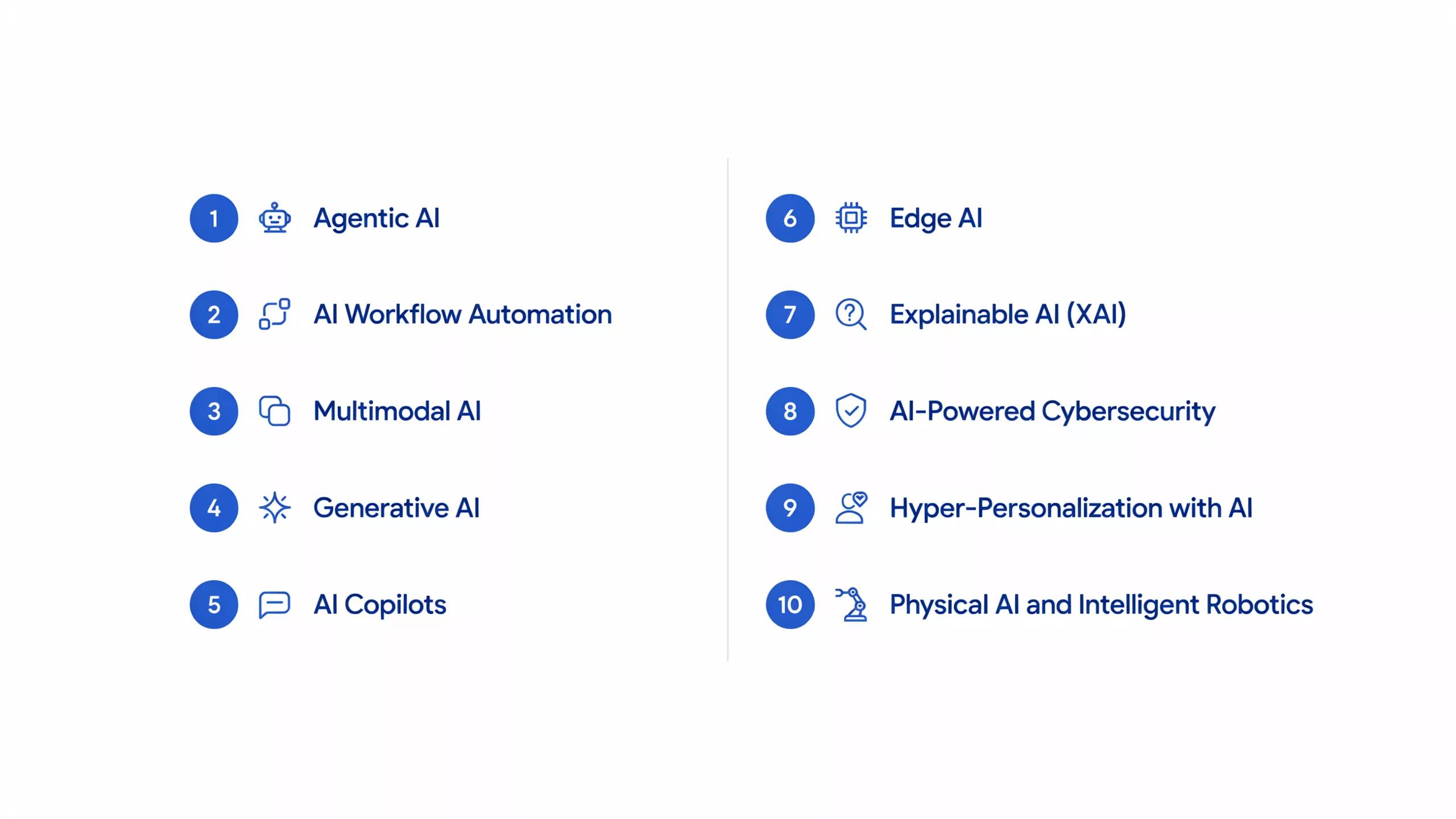
1. Agentic AI
One of the biggest AI Technology Trends in 2026 is Agentic AI. Unlike traditional AI systems that only respond to prompts, Agentic AI can independently plan tasks, make decisions, coordinate multiple tools, and execute complex workflows with minimal human intervention.
Businesses are increasingly adopting Agentic AI solutions to automate customer support, sales operations, internal business processes, research, and software development.
For example, an AI agent can receive a customer inquiry, search internal documentation, update a CRM, send an email, schedule a meeting, and notify a sales representative - all without manual intervention.
Business Benefits
- End-to-end task automation
- Faster business operations
- Reduced manual effort
- Improved customer experiences
- Better operational efficiency
2. AI Workflow Automation
Businesses are moving beyond simple automation toward intelligent workflows that combine AI with modern automation platforms. Instead of automating individual tasks, organizations are automating entire business processes across multiple applications.
Solutions such as n8n Workflow Automation Services enable businesses to connect CRM systems, ERP platforms, email, Slack, WhatsApp, Google Workspace, and hundreds of other business applications into intelligent automated workflows.
For example, a single AI workflow can qualify leads, update CRM records, generate proposals, notify sales teams, and schedule follow-up meetings automatically.
Business Benefits
- Reduced manual work
- Faster operations
- Higher productivity
- Improved data accuracy
- Better customer experiences
3. Multimodal AI
Multimodal AI is transforming how people interact with artificial intelligence by enabling systems to understand and process multiple types of data simultaneously, including text, images, audio, video, and voice. Instead of relying on a single input, multimodal AI delivers richer context, resulting in more accurate responses and intelligent decision-making.
Businesses are using multimodal AI to enhance customer support, automate document analysis, improve visual inspections, create interactive virtual assistants, and streamline content creation across multiple formats.
Business Benefits
- Better customer interactions
- More accurate AI responses
- Faster document processing
- Enhanced visual and voice recognition
- Improved operational efficiency
4. Generative AI
Generative AI continues to be one of the most influential AI Technology Trends in 2026. Businesses are using Generative AI to create marketing content, automate customer communication, generate software code, summarize documents, draft legal contracts, and accelerate product development.
Instead of spending hours creating content manually, organizations can leverage Generative AI Development Services to produce high-quality outputs in minutes while maintaining consistency and improving team productivity.
Business Benefits
- Faster content creation
- Increased employee productivity
- Reduced operational costs
- Better customer engagement
- Accelerated product development
5. AI Copilots
AI Copilots are becoming digital assistants for employees across every department. Unlike traditional chatbots, AI Copilots work alongside teams by providing recommendations, generating reports, answering business questions, assisting with coding, and automating repetitive tasks directly within existing business applications.
Whether it's Microsoft Copilot, GitHub Copilot, or custom AI copilots built for enterprise workflows, these intelligent assistants significantly improve employee productivity.
Business Benefits
- Increased employee efficiency
- Faster decision-making
- Reduced administrative work
- Better knowledge management
- Improved collaboration
Read more: AI Copilots vs Automation: What Should Startups Build First?
6. Edge AI
Edge AI allows artificial intelligence models to process data directly on local devices instead of relying entirely on cloud infrastructure. This enables real-time decision-making, lower latency, improved privacy, and reduced bandwidth usage.
Industries such as manufacturing, healthcare, logistics, automotive, and smart cities are increasingly adopting Edge AI to analyze data closer to its source.
Business Benefits
- Faster real-time processing
- Lower latency
- Enhanced data privacy
- Reduced cloud costs
- Improved system reliability
7. Explainable AI (XAI)
As AI becomes more deeply integrated into business operations, organizations need to understand how AI reaches its decisions. Explainable AI (XAI) focuses on making AI systems transparent, interpretable, and trustworthy.
Industries such as healthcare, finance, insurance, and government increasingly rely on Explainable AI to meet regulatory requirements while ensuring fair and ethical decision-making.
Business Benefits
- Greater transparency
- Increased customer trust
- Easier regulatory compliance
- Better decision-making
- Reduced AI bias
8. AI-Powered Cybersecurity
Cybersecurity threats continue to evolve, making traditional security solutions increasingly ineffective. AI-powered cybersecurity platforms continuously monitor networks, user behavior, applications, and endpoints to detect suspicious activities before they become serious security incidents.
AI can identify unusual behavior patterns, detect fraud, prevent phishing attacks, and automatically respond to potential threats much faster than traditional security systems.
Business Benefits
- Faster threat detection
- Reduced cybersecurity risks
- Automated incident response
- Improved fraud prevention
- Enhanced business continuity
9. Hyper-Personalization Using AI
Modern customers expect personalized experiences across every interaction. AI enables businesses to analyze customer behavior, preferences, purchase history, and engagement patterns to deliver highly personalized recommendations and communications.
From e-commerce and healthcare to banking and real estate, AI-powered personalization helps organizations improve customer satisfaction while increasing conversions and loyalty.
Business Benefits
- Higher customer engagement
- Better conversion rates
- Increased customer retention
- Personalized marketing campaigns
- Improved customer satisfaction
10. Physical AI and Intelligent Robotics
The next generation of AI is moving beyond software into the physical world. Intelligent robots powered by AI are transforming industries such as manufacturing, logistics, healthcare, agriculture, and warehouse management.
These systems combine computer vision, machine learning, robotics, and autonomous decision-making to perform complex physical tasks with greater speed and precision.
As AI technology continues to evolve, Physical AI is expected to become a key driver of industrial automation over the next decade.
Business Benefits
- Improved operational efficiency
- Increased workplace safety
- Higher production capacity
- Reduced labor costs
- Greater process accuracy
How Businesses Can Prepare for AI in 2026
Successfully adopting AI isn't about implementing every new technology at once. The most successful organizations begin with clearly defined business goals and focus on solving high-impact problems before scaling AI initiatives across the organization.
A practical AI adoption roadmap includes:
- Identify repetitive and time-consuming workflows.
- Prioritize AI use cases with measurable business impact.
- Start with a pilot project before large-scale implementation.
- Integrate AI with existing business systems such as CRM and ERP.
- Train employees to collaborate effectively with AI tools.
- Continuously monitor ROI and optimize AI solutions based on business outcomes.
Organizations that approach AI strategically are far more likely to achieve long-term success than those adopting technology without a clear roadmap.
How Ciphernutz Can Help You Adopt AI Successfully
Implementing AI isn't just about choosing the latest technology - it's about identifying the right business problems to solve. At Ciphernutz, we help startups, SMEs, and enterprises leverage Artificial Intelligence to automate workflows, improve operational efficiency, and build intelligent digital products.
Whether you're planning to develop AI-powered software from scratch or integrate AI into your existing applications, our team works closely with you from strategy to deployment.
Our AI expertise includes:
- AI Agent Development
- Generative AI Development Services
- AI Workflow Automation with n8n
- Custom AI Application Development
- AI Chatbots and Voice Agents
- AI-Powered CRM Development
- LLM Integration and RAG Solutions
- AI Consulting and Strategy
- Enterprise AI Automation
We help businesses reduce manual work, improve customer experiences, and unlock measurable ROI through practical AI solutions.
Conclusion
The key to successful AI adoption isn't implementing every new technology. It's identifying high-impact opportunities that align with your business objectives and scaling AI initiatives strategically over time.
Businesses that embrace these AI Technology Trends today will be better positioned to improve productivity, enhance customer experiences, and build a lasting competitive advantage in an increasingly AI-driven world.
Frequently Asked Questions (FAQs)
1. What are AI Technology Trends?
AI Technology Trends are the latest advancements in Artificial Intelligence that help businesses automate processes, improve decision-making, enhance customer experiences, and increase operational efficiency. Examples include Agentic AI, AI Agents, Generative AI, Workflow Automation, Edge AI, and AI Copilots.
2. Which AI technology trend offers the highest ROI for businesses?
The highest ROI depends on your business needs. For many organizations, AI Workflow Automation, AI Agents, and Generative AI deliver the fastest return by reducing manual work, improving productivity, and enhancing customer service.
3. What is the difference between Generative AI and Agentic AI?
Generative AI focuses on creating new content such as text, images, code, or documents based on prompts. Agentic AI goes a step further by planning, reasoning, making decisions, and executing multi-step tasks with minimal human intervention, making it ideal for automating complex business workflows.
4. Can small businesses benefit from AI?
Absolutely. AI is no longer limited to large enterprises. Small and medium-sized businesses can adopt AI incrementally by automating customer support, lead management, content creation, workflow automation, and business operations without significant upfront investment.
5. How can businesses start implementing AI?
The best approach is to identify repetitive tasks, define measurable business goals, and begin with a small pilot project. Many organizations start with AI-powered chatbots, workflow automation, or AI Agents before expanding AI across other business functions.