The Enterprise AI Orchestration Framework: Beyond AI Agents & Chatbots
Dharmesh Dave
6-8 mins
The enterprise AI landscape has officially fractured. On one side are organizations building isolated, low-code chatbots; on the other are enterprises architecting secure, multi-agent systems designed to autonomously execute core operational mandates. For Chief Operating Officers and technical leaders, the distinction is no longer theoretical-it is a matter of infrastructural survival.
According to McKinsey’s 2026 State of Organizations report, the enterprise sector is experiencing a definitive shift away from unchecked automation toward "controlled autonomy with traceability." Organizations do not want fully autonomous AI making unaccountable decisions; they require an enterprise AI orchestration framework that tightly governs how artificial intelligence interacts with proprietary databases and physical endpoints.
Furthermore, Gartner forecasts that while 40% of enterprise applications will embed task-specific AI agents by the end of 2026, over 40% of agentic AI projects will ultimately fail by 2027 due to runaway costs, inadequate risk controls, and agents violating operational policy.
The root cause of this failure rate is structural. Treating large language models (LLMs) as standalone operational tools rather than cognitive nodes within a broader enterprise AI orchestration framework leads to immediate systemic breakdown.
In order to convert raw technological potential into scalable operational leverage, organizations must discard the single-agent chatbot model. Instead, they must deploy a deterministic orchestration layer capable of securely managing concurrent workflows, enforcing API rate limits, and guaranteeing zero-error data routing.
The Illusion of Scale: Why Traditional Automation Fails at the Enterprise Level
Legacy automation platforms and simple AI wrappers create the illusion of operational scale. They excel at isolated tasks-drafting emails or summarizing meeting notes-but instantly shatter when subjected to the interdependent complexities of enterprise supply chains, financial reconciliation, or multi-tenant property management.
1. The Fundamental Flaw of Probabilistic AI in Operations
The core vulnerability of deploying isolated generative models into production environments lies in their underlying mathematics. Large Language Models are inherently probabilistic; their function is to predict the most statistically likely next token. While this probabilistic nature drives creative problem-solving, it is fundamentally incompatible with the absolute precision required for enterprise data execution.
2. LLM Hallucinations as a Financial Liability
In a low-stakes environment, an LLM hallucination is a software glitch. In a live enterprise environment, it is a critical financial liability and a compliance violation. You cannot permit a probabilistic model to guess a CRM field update, authorize a localized freight hold, or parse a legal lease abstraction without strict validation. When probabilistic AI is granted direct read/write access to production systems without a robust AI control plane acting as a firewall, organizations expose themselves to cascading data corruption.
The Bottlenecks of Single-Agent Architecture
Enterprise workflows-such as three-way invoice matching or dynamic freight routing-are rarely linear. Forcing a monolithic, single-agent architecture to handle complex, multi-step operations inevitably leads to context-window degradation. As the agent ingests more system variables, token limits are exhausted, latency spikes, and the model loses operational context, leading to processing failures.
A single AI model cannot concurrently query a database, validate KYC compliance, and push a Slack notification without extreme latency and a high probability of task hallucination. True scale requires distributing these workloads across a multi-agent system architecture.
n8n and the Necessity of Deterministic Control Planes
AI Agents
      ↓
Control Plane
      ↓
Validation Layer
      ↓
Enterprise Systems
(ERP • CRM • WMS • TMS)
To safely leverage the cognitive capabilities of AI, technical leaders must abstract the decision-making engine away from the execution layer. This is achieved by deploying a deterministic control plane. While the AI agents act as the cognitive layer-analyzing unstructured data and formulating solutions-platforms like n8n serve as the rigid, deterministic execution environment.
Bridging Cognitive Decisions with Rigid API Endpoints
n8n functions as the core infrastructural guardrail within an enterprise AI orchestration framework. Instead of granting an AI agent direct, raw access to enterprise APIs, n8n forces the agent to output its probabilistic decisions as strictly formatted, predictable JSON payloads.
The orchestration layer then parses this JSON, validates the syntax against pre-defined business logic, and securely executes the native API call. Deterministic routing ensures that if an agent hallucinates an unauthorized endpoint or attempts to exceed API rate limits, the control plane blocks the execution entirely, logging the error for engineering review rather than corrupting the database.
Engineering Human-in-the-Loop (HITL) Safeguards
Enterprise trust requires granular oversight. A robust orchestration architecture does not eliminate the human workforce; it elevates it to a governance role. Using n8n, architects can engineer precise Human-in-the-Loop (HITL) safeguards into the workflow.
If a validation agent cross-checking a vendor invoice detects a discrepancy, or if a predictive routing agent’s confidence score drops below an acceptable threshold, the automated execution is instantly paused. n8n then securely routes the contextual payload to a human manager via a Slack alert or a Microsoft Teams webhook for final authorization.
This guarantees that complex, high-stakes decisions remain firmly under human governance, satisfying strict enterprise compliance mandates.
Architecting the Multi-Agent Ecosystem: Core Industry Workflows
Whether an enterprise moves physical freight, manages commercial property portfolios, or distributes consumer goods, the operational backbones are structurally identical. Logistics, Real Estate, and Ecommerce all rely on the continuous processing of unstructured data, the rigorous validation of legal or financial documents, and the high-frequency distribution of physical resources.
In 2026, the Forrester reports that the single-agent model is rapidly becoming obsolete, identifying multi-agent systems as the breakthrough enterprise architecture. To support this scale, 30% of enterprise application vendors are launching Model Context Protocol (MCP) servers to enable secure, cross-platform agentic workflows. When an enterprise orchestration stack governs these interactions, organizations can deploy specialized AI swarms to automate their most complex operational bottlenecks.
Workflow 1: Intelligent Triage & Frontline Routing
The traditional frontline operational environment is defined by chaos: stuffed shared inboxes, endless Zendesk ticketing queues, and delayed human hand-offs. This reactive model scales expensively and severely degrades both the customer and operator experience.
Intent Parsing Across Omnichannel Inputs
An orchestrated multi-agent swarm replaces this chaos with silent, continuous efficiency. Instead of a linear queue, triage agents ingest unstructured omnichannel inputs-ranging from inbound emails and SMS to live webhooks. The cognitive agent parses the intent (e.g., an ecommerce WISMO request or a logistics delay notification), and the agentic workflow platform instantly spins up concurrent sub-tasks for specialized worker agents.
McKinsey 2026 operational automation data states that orchestrated AI handles these frontline interactions for $0.50 to $0.70 per touchpoint. Compared to the $6 to $8 financial burden of human agents, the result is instant intent mapping and deterministic routing without human bottlenecking.
Workflow 2: Automated Document & Data Reconciliation
Back-office operations suffer immensely from unstructured data extraction friction. Moving data from complex PDFs into enterprise resource planning (ERP) systems manually introduces latency and unacceptable error rates.
Zero-Trust OCR and Cross-Validation Pipelines
A robust multi-agent infrastructure tackles this through multi-agent cross-validation. For example, in a commercial real estate transaction, an Extraction Agent utilizes Optical Character Recognition (OCR) to parse a 50-page lease abstraction or KYC compliance packet.
Crucially, the system does not blindly trust this extraction. A separate Validation Agent concurrently runs a 3-way matching process against the central ERP database. Only when both agents agree does the deterministic control plane execute the final data entry. This guarantees zero-trust validation for high-liability financial and legal documentation.
Workflow 3: Predictive Resource & Asset Allocation
Most enterprises operate reactively-waiting for an asset to fail or a delay to occur before mobilizing a solution. Implementing an enterprise AI orchestration framework shifts the operational mindset from reactive damage control to proactive capacity planning.
Real-Time IoT and Telematics Ingestion
This level of orchestration impacts high-value physical assets, not just digital files.
- Logistics: Concurrent AI swarms ingest real-time telematics and weather data to dynamically reroute trucking fleets, effectively eliminating deadhead miles.
- Real Estate: Agents monitor IoT sensors to predict HVAC failures in commercial properties, dispatching maintenance contractors before catastrophic downtime occurs.
- Ecommerce: The automated framework analyzes regional demand spikes to reallocate warehouse shelf space and prevent stockouts, maximizing physical asset utilization globally.
Workflow 4: Algorithmic Margin & Dynamic Pricing Models
For revenue leaders and CFOs, dynamic pricing is not merely about changing numbers; it is an algorithmic defense mechanism designed to protect and capture microscopic margins at scale in highly volatile markets.
Deploying Competitor Analysis Swarms
Rather than relying on delayed market reports, a high-performance enterprise orchestration stack deploys concurrent scraping agents to monitor competitor inventory drops, spot freight rate fluctuations, or commercial real estate vacancy trends. These competitor analysis swarms calculate the exact discount or premium required to win the transaction.
The orchestration layer then securely pushes these updates to the pricing engine, utilizing strict API rate limits to prevent system overloads. This ensures the enterprise captures left-on-the-table revenue in real-time while strictly enforcing minimum profit thresholds.
Unstructured Inputs
      ↓
Specialized Agents
      ↓
Orchestration Layer
      ↓
Validated Actions
      ↓
Business Outcomes
Quantifying the ROI: 5 Enterprise Outcomes of Orchestrated AI
Operational leaders do not authorize budgets for technology; they authorize budgets for outcomes. As the market matures, the conversation surrounding artificial intelligence has shifted entirely away from technical mechanics and toward strict financial performance.
It is also found that while 88% of organizations now utilize AI in some capacity, only 39% report a significant improvement in Earnings Before Interest and Taxes (EBIT). The defining factor separating these high performers from the rest is their deployment of a structured enterprise AI orchestration framework.
By deploying deterministic AI automation platforms to govern multi-agent workflows, enterprises translate cognitive potential into five quantifiable operational KPIs.
1. Zero-Delay Resolution: Eliminating the Frontline Queue
The immediate financial impact of an orchestrated frontline is the drastic reduction in Cost-Per-Interaction (CPI). Legacy operations scale headcount linearly alongside ticket volume, creating expensive bottlenecks that degrade customer and driver retention.
By eliminating the top-of-funnel queue entirely, triage agents process inbound requests concurrently. McKinsey's 2026 data indicates that optimized agentic deployments reduce customer service operational costs by 30% to 40%. Instead of hiring additional human operators to handle WISMO (Where Is My Order) requests or real estate showing schedules, the multi-agent system architecture resolves tier-one queries autonomously, allowing human headcount to remain flat while operational volume scales.
2. Instant Reconciliation: The Zero-Error Back Office
Manual data entry is a direct drain on corporate liquidity. When invoices, bills of lading, or lease agreements sit in a human queue awaiting ERP entry, Days Sales Outstanding (DSO) expands, trapping capital.
An orchestrated back office achieves instant reconciliation. By utilizing concurrent extraction and validation agents governed by strict deterministic routing, enterprises eliminate human data-entry lag. This zero-error pipeline unblocks capital immediately, eliminates manual accounting discrepancies, and establishes an immutable, mathematically verifiable compliance trail for every transaction.
3. Predictive Yield Maximization: Proactive Asset Management
Physical assets-whether warehouse inventory, commercial real estate portfolios, or freight fleets-only generate ROI when utilization rates are maximized. Reacting to asset failure or logistical delays incurs emergency premiums.
Predictive yield maximization shifts operations from reactive to proactive. For example, a 2026 McKinsey analysis highlighted that logistics firms utilizing agentic AI routing and predictive operations achieved a 15% reduction in operating costs. By anticipating supply chain disruptions, an enterprise orchestration stack automatically reroutes trucks to eliminate deadhead miles, reallocates inventory to prevent stockouts, and dispatches preventative maintenance to avoid emergency property repair fees.
4. Algorithmic Margin Expansion: Dynamic Pricing at Scale
Protecting Gross Margin and maximizing RevPAR (Revenue Per Available Room/Unit) requires mathematical precision that human analysts cannot execute at high frequency. Dynamic pricing is not a race to the bottom; it is the algorithmic capture of left-on-the-table revenue.
Governed by a control plane, competitor analysis swarms execute continuous market scraping. They adjust transaction pricing in real-time, discounting exactly enough to win the buy box or secure the tenant, without sacrificing aggregate margins. McKinsey data from 2026 shows that enterprises implementing these AI-driven, hyper-personalized transaction models achieve up to a 15% to 35% improvement in conversion rates, expanding profitability across thousands of SKUs and leases securely.
5. Continuous Operational Resilience: The Self-Healing Ecosystem
The ultimate value proposition of a mature deployment is guaranteed operational uptime. By 2026, Gartner projects that the transition toward autonomous business ecosystems will force a complete overhaul of operational capabilities, with agentic AI taking over infrastructure management.
When a third-party CRM endpoint fails or a logistics API updates unexpectedly, traditional automations break, causing catastrophic data loss and system downtime.
However, a deterministic orchestrator monitors its own endpoint health. If a primary API fails, the diagnostic agent detects the latency, logs the error, and automatically executes a pre-approved fallback route. This self-healing capability guarantees that strict Uptime SLAs are met, ensuring zero operational downtime while the underlying software continues to function seamlessly.
The Implementation Bridge: Structuring Your AI Deployment
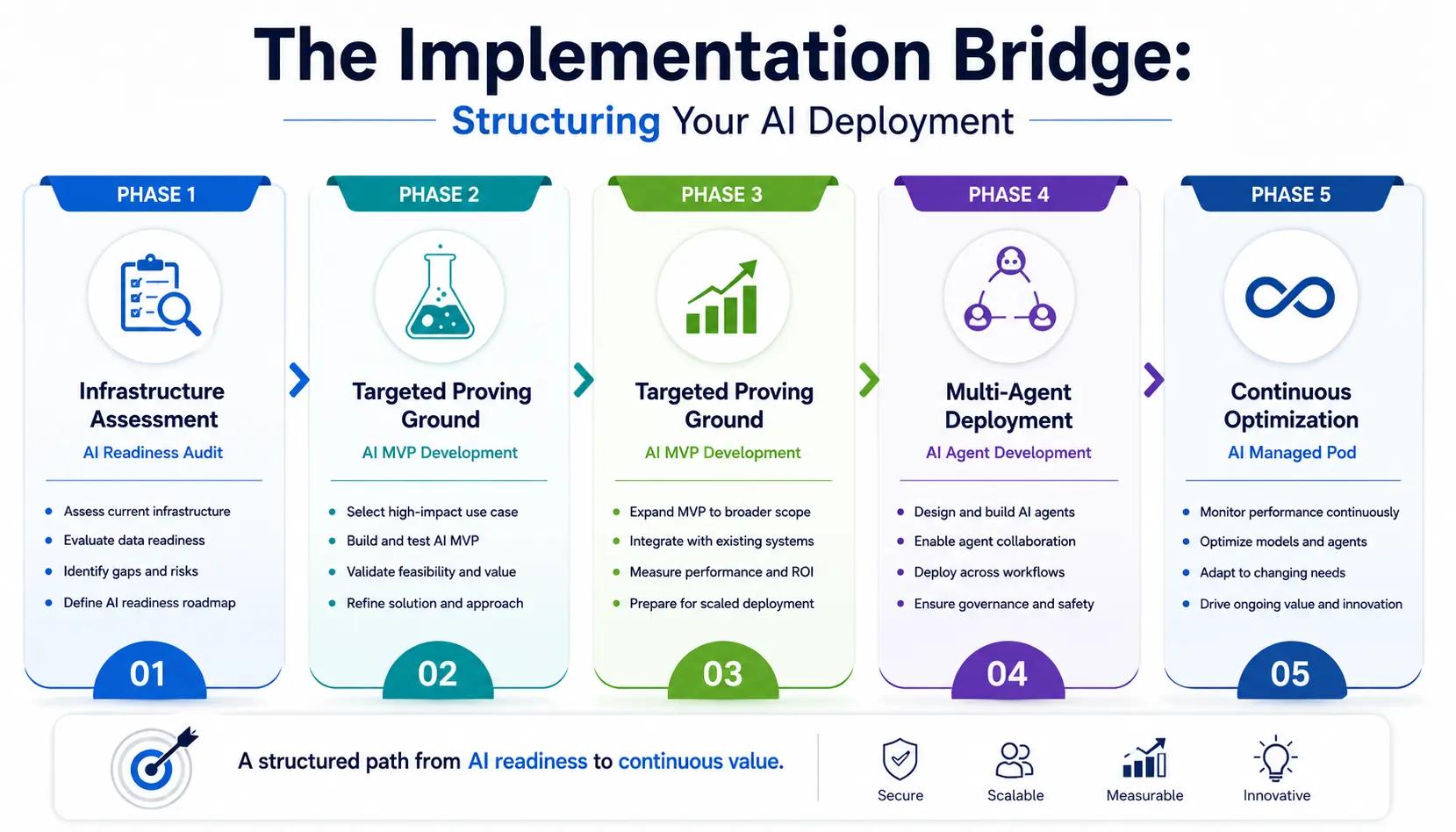
For capturing the financial returns of orchestrated AI, enterprises must abandon ad-hoc software implementations. Furthermore, from88% deployments, only 1% of C-suite respondents classify their generative AI rollouts as mature.
The primary cause of this failure rate is not a lack of capital, but a lack of structured engineering; enterprises attempt to deploy autonomous systems without modernizing their underlying data architecture first.
Hence, transitioning from manual bottlenecks to a fully autonomous enterprise AI orchestration framework requires a rigorous, phased engineering roadmap. This mitigates operational risk, validates ROI early, and prevents the accumulation of technical debt.
Phase 1: Infrastructure Assessment - AI Readiness Audit
You cannot automate what you do not comprehensively understand. Before a single line of code is written or an AI model is provisioned, organizations must map their existing digital terrain. Deploying cognitive agents into an unmapped legacy environment guarantees system failure.
An initial infrastructure assessment evaluates the integrity of existing databases, API rate limits, and compliance perimeters. This phase exposes disconnected data silos and identifies exactly which operational bottlenecks are structurally ready for automation. By starting with a rigorous enterprise AI audit checklist, organizations establish a baseline, ensuring that the eventual orchestration layer has secure, uninterrupted access to clean enterprise data.
Phase 2: Targeted Proving Ground - AI MVP Development
Enterprise software procurement is inherently risk-averse. Attempting a massive, organization-wide AI overhaul disrupts active operations and obscures measurable returns. The most successful implementations follow a land-and-expand methodology. Rather than attempting to automate an entire supply chain or real estate portfolio simultaneously, architects isolate a single, high-friction workflow-such as vendor invoice extraction or frontline triage.
By focusing strictly on AI MVP development for enterprise, engineering teams can deploy a targeted, single-workflow solution. This isolates the operational risk, validates the technology in a live environment, and proves clear, measurable ROI within weeks rather than month
Phase 3: Targeted Proving Ground - AI MVP Development
Once the initial proving ground validates the AI's cognitive capabilities, the system must be securely woven into the broader corporate software ecosystem. This is where the control plane is established. Connecting an AI model to an ERP or CRM requires absolute security. In this phase, engineers configure the deterministic guardrails that prevent probabilistic errors.
By deploying n8n AI agent workflows, the infrastructure forces the AI’s decisions through a secure integration layer. n8n translates cognitive intent into rigid API actions, ensuring that all data transfers are encrypted, authenticated, and logged, establishing the connective tissue between the AI and the existing tech stack.
Phase 4: Multi-Agent Deployment - AI Agent Development
With a secure deterministic foundation in place, the enterprise is ready to scale its intelligence. A single agent can extract a document, but a swarm of agents can run a department. During this phase, the architecture expands from linear automations to dynamic, concurrent operations.
Organizations deploy highly specialized digital workers-Extraction Agents, Routing Agents, and Margin Agents-that interact and cross-validate each other's outputs. Implementing a robust multi-agent system architecture allows the enterprise to execute complex, multi-step proprietary business logic autonomously, shifting the workforce from manual data handlers to strategic AI supervisors.
Phase 5: Continuous Optimization - AI Managed Pod
Enterprise AI is living software. Application Programming Interfaces (APIs) deprecate, third-party data structures change, and foundational language models require continuous updating. Treating an enterprise AI orchestration framework as a one-time software installation is a critical miscalculation. To guarantee operational resilience, the deployed architecture requires continuous diagnostic monitoring.
Gartner predicts that by 2027, over 40% of agentic AI projects will fail due to escalating maintenance costs and inadequate risk controls. To counter this, enterprises must secure a managed AI operations retainer. A dedicated engineering pod manages cloud workloads (such as GCP hosting), updates deprecated API endpoints, and fine-tunes models to ensure the self-healing ecosystem maintains strict uptime SLAs without burdening the internal IT department.
Securing the Operational AI Advantage
The transition from isolated chatbots to a comprehensive enterprise AI orchestration framework represents a permanent structural modification to how operational overhead scales against revenue. Manual operations scale linearly; for every thousand new logistics routes or commercial leases, the enterprise must hire proportional human headcount. Orchestrated AI severs this dependency, allowing revenue and transaction volume to scale exponentially while backend operational costs remain flat.
| Stage | Description |
|---|---|
| Level 1 | Chatbots |
| Level 2 | Workflow Automation |
| Level 3 | AI Agents |
| Level 4 | Multi-Agent Operations |
| Level 5 | Autonomous Enterprise Systems |
The competitive window for this architectural shift is narrow. The organizations that thrive in 2026 will not be those that simply buy AI tools, but those that architect deterministic, multi-agent control planes to govern them. The first step toward building this authority moat is understanding your current infrastructural limits.
| Capability | Chatbot | AI Agent | Multi-Agent System | Orchestrated AI |
|---|---|---|---|---|
| Single Task | ✓ | ✓ | ✓ | ✓ |
| Cross-System Workflows | ✗ | Limited | Moderate | ✓ |
| HITL Governance | ✗ | Limited | Moderate | ✓ |
| Enterprise Scale | ✗ | Limited | Moderate | ✓ |
Most organizations discover their biggest AI bottleneck isn't model selection. It's fragmented workflows, inaccessible data, and missing orchestration layers. An AI readiness assessment identifies those constraints before deployment begins.
FAQs
1. What is an enterprise AI orchestration framework?
An enterprise AI orchestration framework is a secure, deterministic infrastructure that manages how multiple AI agents interact with corporate databases and APIs. Unlike basic chatbots, an orchestration framework (using platforms like n8n) forces probabilistic AI outputs into structured rules, ensuring that tasks like CRM updates, document extraction, and logistics routing are executed securely and without hallucinations.
2. How does a multi-agent system architecture differ from traditional AI?
Traditional AI relies on a single, monolithic model to process prompts sequentially, which often leads to context degradation and system latency. A multi-agent system architecture distributes complex enterprise workloads across several highly specialized AI agents. For example, one agent parses a legal document while a concurrent agent cross-validates the extracted data against an ERP system, ensuring zero-trust accuracy at scale.
3. Why is n8n preferred for AI agent workflows in enterprise environments?
n8n acts as a deterministic control plane. Large Language Models (LLMs) are probabilistic and prone to hallucinating data. n8n forces the AI to output decisions as strict JSON payloads, validates the data, and securely triggers the physical API endpoint. This ensures that n8n AI agent workflows strictly adhere to enterprise security protocols, rate limits, and compliance mandates.
4. How much ROI can an enterprise expect from an AI managed pod?
While immediate returns vary by operational bottleneck, McKinsey data from 2026 shows that enterprises implementing orchestrated AI routing and automation achieve a 30% to 40% reduction in frontline operational costs. Engaging an AI managed pod ensures these returns do not degrade over time by providing continuous API maintenance, cloud workload optimization, and model fine-tuning to guarantee system uptime.
5. What is the first step in scoping an AI MVP development for an enterprise?
The first step is conducting a rigorous infrastructure assessment. Before beginning AI MVP development for enterprise, engineers must audit legacy data silos, API limitations, and security perimeters. By isolating a single, high-friction workflow (such as vendor invoice reconciliation) during the MVP phase, enterprises can validate the technology and prove ROI quickly without disrupting core operations.