10 Enterprise AI Trends Reshaping Business in 2026
Vijay Vamja
4-6 minutes
For the past several years, the dialogue around enterprise AI has been dominated by potential, pilots, and proof-of-concept projects. We have moved past the initial excitement of what AI can do. In 2026, the mandate from the boardroom to the engineering floor has fundamentally shifted. The new imperative is about scaled deployment, measurable ROI, and the deep integration of enterprise AI systems into core business architecture.
This transition is fracturing the "one-size-fits-all" model. A simple chatbot interface or a single, massive model in the cloud is no longer a sufficient strategy. We are observing a strategic move toward a diversified, specialized, and governed AI toolkit.
The New Enterprise AI Mandate
For CTOs, engineering leads, and product owners, navigating this shift is the principal challenge of the coming year. It requires moving from an R&D mindset to an industrial one, balancing innovation with the operational realities of security, cost, and compliance.
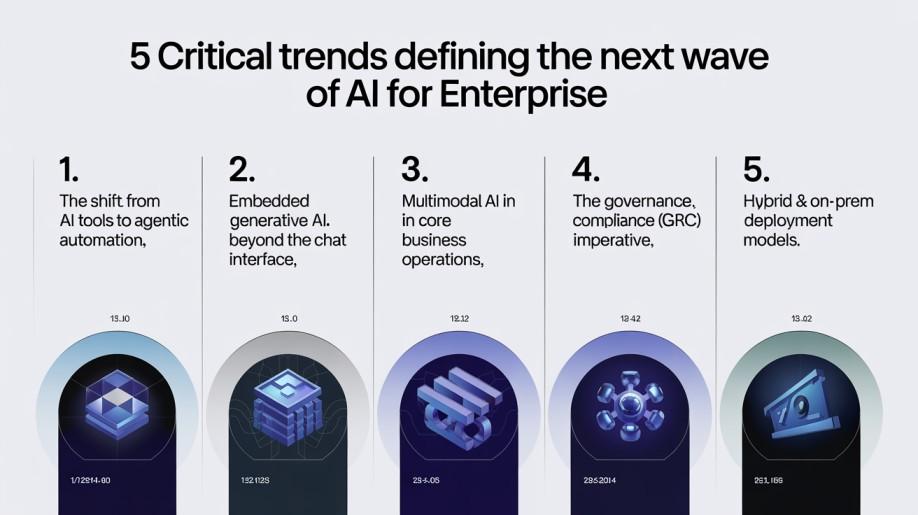
Based on our analysis of the market and emerging technological patterns, these are the five critical trends defining the next wave of AI for enterprise.
1. The Shift from AI Tools to Agentic Automation
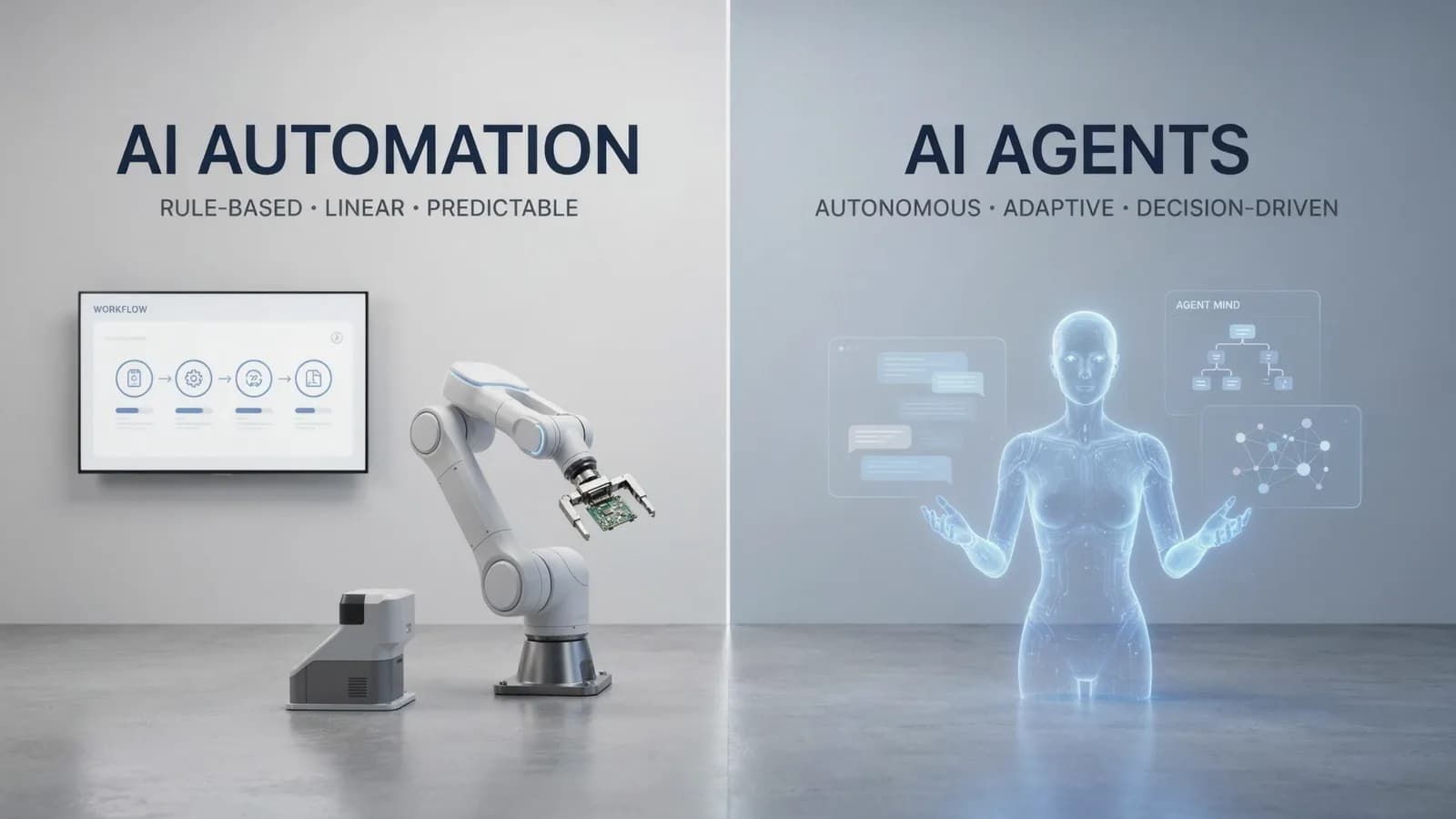
The most significant paradigm shift we are witnessing is the evolution from AI as a passive tool to AI as an active agent.
Generative AI, in its first iteration, required a human operator for every step - prompting, refining, and acting on the output. The next phase, agentic AI automation for enterprise, involves autonomous systems that can reason, plan, and execute complex, multi-step tasks with minimal human intervention.
These enterprise AI agents function less like a "copilot" and more like a digital employee. They can be delegated objectives such as "monitor supply chain data and re-route shipments based on weather and port delays." Next, they can then autonomously interact with multiple systems (APIs, databases, ERPs) to achieve that goal.
Implication for Leaders: This trend moves AI from a user-facing application to a new, intelligent automation layer within the tech stack. The challenge is no longer just prompt engineering; it's workflow orchestration, systems integration, and building the guardrails for autonomous decision-making. This is the core of modern AI Agent Development, creating systems that can act on your behalf.
2. Embedded Generative AI: Beyond the Chat Interface
The novelty of the standalone chatbot is wearing off. The future of enterprise generative AI is not in a separate window but as an invisible, embedded capability within the software employees already use.
In 2025, the focus is on API-driven integrations that bring AI-powered insights directly to the point of decision.
- In CRM: Natively summarizing client call transcripts and suggesting the next best action.
- In ERP: Proactively flagging anomalous transactions or forecasting inventory needs.
- In IDEs: Accelerating development with context-aware code generation and bug detection.
These enterprise AI applications win by reducing friction and enhancing existing workflows, rather than forcing users to adopt a new, separate tool. The value is measured in direct productivity gains and enriched data within legacy systems.
3. Multimodal AI in Core Business Operations
For years, enterprise AI has been largely bifurcated: computer vision models for one task, NLP models for another. The 2026 trend is the fusion of these modalities into single, cohesive enterprise AI solutions.
A multimodal system can understand context by processing text, images, audio, and sensor data simultaneously. This unlocks sophisticated use cases that were previously impossible.
- Logistics & Supply Chain: Analyzing satellite imagery, driver text reports, and IoT sensor data to create a holistic view of a shipment's status. This is a clear application for enterprise AI systems in geospatial decision-making.
- Customer Service: High-value AI voice assistants for enterprises can analyze not just the words a customer says, but also the tone of their voice, to detect urgency and sentiment, routing the call with full context to a human agent.
- Manufacturing: Combining video feeds from the factory floor with machine performance logs to predict maintenance needs before a failure occurs.
This requires a robust AI Voice Agent Development strategy and an architecture that can ingest and reason across heterogeneous data types.
4. The Governance, Risk, and Compliance (GRC) Imperative
As AI moves from the lab to live production, it transitions from a technological asset to a potential corporate liability. Consequently, 2026 is the year AI GRC becomes a non-negotiable, board-level concern. With regulations like the EU AI Act setting a global precedent, "move fast and break things" is no longer a viable strategy for enterprise artificial intelligence. Tech leaders are now responsible for:
- Data Provenance & Privacy: Ensuring training data is secure and that PII is not exposed in model outputs.
- Model Explainability: Being able to audit why an AI system made a particular decision, especially in regulated industries like finance and healthcare.
- Bias & Fairness: Actively monitoring and mitigating biases in models that could lead to discriminatory outcomes.
This has created a critical need for recommended AI compliance software for enterprises and robust MLOps platforms that embed governance, security, and monitoring into the entire model lifecycle.
Analyst Insight: As industry analysts at Gartner have noted, by 2026, organizations that operationalize AI transparency, trust, and security will see a 50% improvement in AI adoption, business goals, and user acceptance. Governance is no longer a barrier to innovation; it is the primary enabler of it.
5. Hybrid & On-Prem Deployment Models
The "cloud-only" AI strategy is facing a reality check. While public cloud offers immense scale, enterprises are now adopting a more nuanced hybrid approach driven by three key factors:
- Data Sovereignty & Security: Many industries (healthcare, finance, defense) have sensitive data that simply cannot leave their on-premise environment.
- Latency: Applications at the edge, like in-store retail analytics or factory-floor robotics, require millisecond-level inference times that a round-trip to the cloud cannot guarantee.
- Cost: For predictable, high-volume inference workloads, the long-term total cost of ownership (TCO) for on-prem hardware can be significantly lower than pay-per-API cloud models.
This trend doesn't mean the cloud is obsolete. It means the rise of a hybrid architecture where models are trained in the cloud but deployed on-prem, at the edge, or in a virtual private cloud to meet specific business, security, and performance requirements.
6. AI Maturity Now Means Redesigned Workflows and Auditable Governance
Deloitte's 2026 AI Pulse Check, which polled nearly 3,700 professionals, found that 48% of organizations have introduced AI without redesigning the workflows or roles it sits within. Only 12% report redesign at scale, backed by a new operating model.
Deploying a tool is no longer the milestone that matters. The research also points to a governance shift, from leaders approving every AI action toward leaders auditing AI performance after the fact. Organizations that start with reversible, low-stakes automation and measure results rigorously tend to earn the track record needed to expand autonomy safely. This is the same discipline built into every AI Readiness Audit engagement.
7. Shadow AI Is Forcing Enterprises Toward Formal Governance
A parallel pattern is shadow AI. Employees have been adopting generative AI tools on their own, often outside IT oversight, faster than enterprises have formalized policy around them. According to ABBYY's 2026 enterprise AI trends analysis, nearly two in five enterprises have introduced official AI platforms specifically in response to this bottom-up usage.
The fix is not banning unsanctioned tools; it is giving employees secure, authorized environments and clear usage policy before compliance gaps widen. This is the practical, day-to-day layer of the GRC imperative covered above, and it is where most enterprise AI systems are being tested first in 2026.
8. Knowledge Graphs and GraphRAG Are Grounding Agentic AI in Verifiable Data
As agentic automation scales, an agent's reliability depends on what it is grounded in. Industry analysis from Graphwise and Propel Software, published via Intelligent CIO in late 2025, points to GraphRAG, retrieval-augmented generation powered by a semantic knowledge graph, as an emerging backbone for trustworthy enterprise automation in 2026. A knowledge graph gives an agent a structured, traceable path back to source data, which is what separates a useful agent from a hallucinating one. For enterprises building multi-agent systems on top of existing ERPs and CRMs, this grounding layer is becoming as important as the model itself. It is the same principle behind the guardrails built into every AI Agent Development engagement.
9. Sovereign and Edge AI Infrastructure Investment Is Accelerating
The hybrid and on-prem shift described above has a 2026 sequel: sovereign AI. Deloitte defines sovereign AI as a country, and the companies within it, deploying AI under their own laws, infrastructure, and data controls, not simply ownership of the hardware.
Analysis from infrastructure vendor Spectro Cloud identifies sovereign AI investment, driven by governments and regulated industries, alongside continued edge AI adoption, as two of the strongest enterprise AI trends for 2026. For CTOs, this reinforces the same architecture decision from last year's framework: where a model runs is now as strategic as which model runs, particularly for regulated data.
10. Agent Adoption Has Outpaced Organizational ROI, and the Skills Gap Is Why
Agentic AI adoption has become close to universal at the executive level. WRITER's 2026 AI Adoption in the Enterprise survey, conducted with Workplace Intelligence across 1,200 executives and 1,200 employees, found that 97% of executives report their company deployed AI agents in the past year.
Yet Deloitte's 2026 State of AI in the Enterprise report found that just 34% of leaders say their organization is truly reimagining the business, even as twice as many report transformative impact compared to the prior year. That same Deloitte report names the AI skills gap as the single biggest barrier to integration, ahead of budget or infrastructure.
This is precisely why flexible resourcing, through Staff Augmentation or a Hire Dedicated team model, has moved from a hiring shortcut to a maturity strategy. For the full sourced dataset behind adoption and ROI figures like these, see our AI statistics roundup.
2026 Key Takeaways
- Maturity signal: Redesigned workflows and auditable governance now matter more than raw deployment numbers.
- Governance: Shadow AI adoption is pushing formal platform policy from a nice-to-have to a near-term requirement.
- Architecture: Knowledge graphs and GraphRAG are becoming the grounding layer that keeps agentic AI verifiable.
- Infrastructure: Sovereign and edge AI investment is extending last year's hybrid deployment logic into 2026.
- Talent: The skills gap, not budget, is the leading barrier standing between agent adoption and measurable ROI.
Strategic Implications for Tech Leaders
These five trends collectively signal a new era of maturity for enterprise AI. The challenge is no longer finding a use case; it's building a scalable, secure, and cost-effective AI-driven organization.
This shift demands a new set of capabilities. The skills required to build complex Agentic AI Solutions or architect a hybrid-cloud deployment are specialized and scarce. Many organizations are finding that their internal teams, already stretched thin, cannot keep up with this new pace of industrialization.
Navigating these complex trends, from architecture to governance, often requires a strategic partner. Engaging in AI Consulting can provide the necessary outside expertise to audit your current stack, identify high-ROI opportunities, and build a production-ready roadmap.
Building the Team for this New Era
The most significant bottleneck for executing on these trends is talent. The demand for engineers with experience in MLOps, AI governance, and distributed systems far outstrips the supply.
This is why flexible resourcing models have become a core strategic pillar. Rather than spending 6-9 months attempting to hire a single, niche expert, leaders are turning to Staff Augmentation and Hire Dedicated team models.
This approach allows an organization to immediately embed senior-level AI specialists into their existing teams, accelerating development while simultaneously upskilling their internal talent.
Key Takeaways
As we move through 2026, tech leaders must focus on:
- Automation: Evolving from simple task-assistance (GenAI) to autonomous workflow execution (Agentic AI).
- Integration: Embedding AI capabilities invisibly into existing tools rather than creating more application silos.
- Governance: Treating AI security, risk, and compliance as a foundational, non-negotiable layer of the tech stack.
- Architecture: Making deliberate, strategic choices about where AI models run (cloud, on-prem, or hybrid) based on cost, latency, and security.
The era of AI experimentation is over. The era of strategic, scaled, and governed deployment has begun.
FAQs
Q. How is enterprise AI evolving from tools to agentic automation?
Enterprise AI is transitioning from human-operated tools to autonomous, goal-driven systems capable of planning and executing multi-step tasks. These AI agents integrate directly into enterprise workflows through APIs, ERPs, and data systems, functioning like digital employees. This evolution demands robust orchestration frameworks and guardrails to ensure security, interpretability, and compliance within enterprise environments.
Q. What is the strategic advantage of embedded generative AI for enterprises?
Embedded generative AI moves beyond chatbots by integrating AI capabilities directly into core business software such as CRM, ERP, or IDEs. This design eliminates workflow disruption and drives measurable productivity. For instance, embedded AI in ERP systems can proactively detect anomalies or predict inventory requirements, enabling faster and more accurate decisions without changing user behavior or tools.
Q. Why are multimodal AI systems critical to enterprise operations in 2026?
Multimodal enterprise AI models can interpret and synthesize data from text, audio, images, and sensors simultaneously. This unified context awareness is essential for advanced decision-making in logistics, customer experience, and manufacturing. By merging modalities, enterprises gain situational intelligence - reducing downtime, improving accuracy, and enabling predictive insights that siloed models cannot achieve.
Q. How are governance, risk, and compliance (GRC) frameworks changing enterprise AI deployment?
AI governance in 2025 is shifting from an optional safeguard to a mandatory design principle. With regulations such as the EU AI Act, organizations must prioritize model explainability, bias mitigation, and data privacy throughout the AI lifecycle. Enterprise-grade GRC tools now integrate directly into MLOps pipelines to automate audit trails, monitor ethical standards, and ensure continuous compliance in production environments.
Q. What benefits do hybrid and on-prem AI deployment models offer enterprises?
Hybrid AI architectures enable organizations to balance the scalability of cloud computing with the control of on-prem or edge deployments. Sensitive industries such as healthcare and finance benefit from localized data sovereignty and low-latency inference. Additionally, predictable, high-volume inference workloads often achieve lower total cost of ownership (TCO) through optimized on-prem hardware, while still leveraging cloud-based model training.
Q. What is the biggest enterprise AI trend in 2026?
The clearest shift in 2026 is from AI deployment to AI accountability. Deloitte's 2026 AI Pulse Check found that most organizations introduced AI tools without redesigning the workflows around them, and only 12% restructured operations at scale. Enterprises now treat governance, workflow redesign, and measurable ROI as the real markers of AI maturity.
Q. Why do enterprise AI agents struggle to deliver measurable ROI?
Agent adoption has outpaced organizational readiness. WRITER's 2026 enterprise AI adoption survey found 97% of executives report agent deployment, yet Deloitte's 2026 State of AI in the Enterprise report found only 34% of leaders say their business is truly transformed. Deloitte identifies the AI skills gap, not budget or infrastructure, as the leading barrier.
Q. What is GraphRAG and why does it matter for enterprise AI?
GraphRAG is retrieval-augmented generation grounded in a knowledge graph rather than unstructured text alone. It gives an AI agent a traceable, structured path back to source data. Industry analysis featured by Intelligent CIO identifies GraphRAG as a key 2026 trend because it reduces hallucination risk and improves auditability in multi-agent enterprise systems.