Mobile App Development for Real Estate: Complete Guide
Dharmesh Dave
4-6 mins
The National Association of Realtors (NAR) recently reported that over 43% of homebuyers start their property search online, and they expect the experience to be instantaneous. If your brokerage or property management firm relies on a clunky website to capture these leads, you are actively losing deals to competitors with streamlined mobile experiences.
Today, mobile app development for real estate is not just about digitizing property listings. It is about building a scalable digital ecosystem that qualifies leads, automates agent workflows, and provides secure, 24/7 virtual access to your portfolio.
Whether you are a PropTech startup building a monetization platform or an established broker driving internal efficiency, this guide breaks down exactly what it takes to build a custom real estate mobile application that generates real revenue. For a broader look at how we approach this sector, explore our dedicated Real Estate Software Development Services.
The Multi-User Ecosystem Architecture
A critical mistake many firms make in real estate app development is treating the software as a single interface. A high-converting platform requires distinct user journeys operating within the same secure ecosystem. Depending on your business model, you must architect for these core personas:
1. The Customer/Buyer Portal: Focused entirely on discovery. This interface needs frictionless property search, saved favorites, instant chat, and secure mortgage pre-approval portals.
2. The Agent Dashboard: The operational engine. This side handles lead tracking, client communication metrics, secure document management, and real-time calendar syncing for showings.
3. The Tenant & Landlord Portals (Rental Models): If your app serves property management, the architecture shifts drastically. You must integrate automated rent processing (via gateways like Stripe), maintenance request ticketing, and lease renewal tracking workflows.
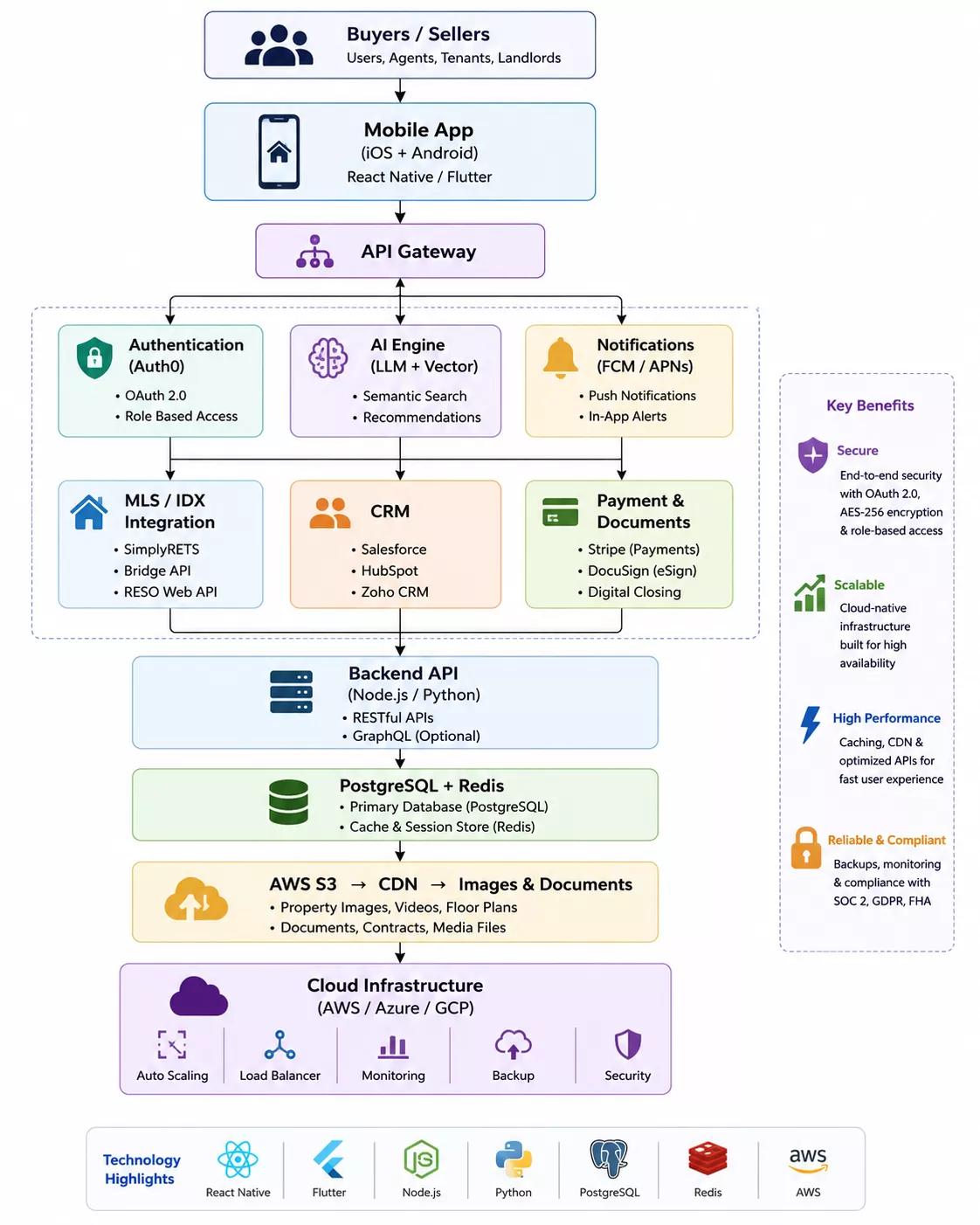
Mobile App Architecture and Tech Stack
Core Features of Real Estate Mobile Apps
To build a property listing app that users actually keep on their phones, you need to look past basic checkboxes. Here is what separates a world-class platform from a standard listing tool:
1. Semantic AI Search & Offline Functionality
Modern PropTech users expect natural language search capabilities. By integrating Vector Search / Semantic AI, users can type or speak complex queries like, "Show me mid-century modern homes in a quiet neighborhood with a dog-friendly backyard close to an elementary school," and the app understands contextual intent rather than just matching hard tags.
Furthermore, agents and buyers frequently tour concrete high-rises or rural properties with zero cellular reception. Implementing an Offline First Architecture ensures that previously loaded maps, property details, and saved documents remain accessible even in cellular "dead zones."
2. High-Fidelity Virtual Tours & AR
Integrating 360-degree virtual tours and Augmented Reality (AR) staging allows buyers to visualize themselves in the space, drastically reducing the number of physical showings required to close a deal.
3. Digital Closing & Transaction Orchestration
The user journey does not end when an offer is accepted. Best-in-class apps now feature Digital Closing Rooms. By integrating APIs like DocuSign or dotloop, alongside secure protocols for automated Earnest Money Deposits (EMD) and escrow milestone tracking, you keep buyers and sellers entirely within your app ecosystem through the entire transaction pipeline.
4. AI-Powered Automation
Machine learning algorithms can analyze a user’s search behavior to push hyper-personalized property recommendations. We have seen the impact of this firsthand. Check out our case study on AI-powered real estate sales automation to see how intelligent workflows drastically increase closed deals and reduce agent burnout.
The Build vs. Buy Dilemma: Off-the-Shelf Platforms vs. Custom Apps
Decision-makers constantly weigh the choice between licensing existing software and building a proprietary platform. While SaaS products offer quick deployment, a custom build becomes a highly valuable intellectual property (IP) asset.
Here is how a custom solution compares to the major legacy platforms in 2026:
| Platform | Best For | Core Advantage | Biggest Limitation |
|---|---|---|---|
| Zillow (Premier Agent) | Lead generation and marketing | Massive audience reach | You rent the leads; zero back-office control |
| AppFolio | Mid-to-large residential portfolios | Strong UX and native AI tools | Unit minimums and high scaling costs |
| Buildium | Small-to-mid residential PMs | Transparent pricing, easy setup | Rigid reporting; limited commercial tools |
| Propertyware | Single-family property management | Highly customizable fields | Dated UI and steep learning curve |
| Yardi (Voyager/Breeze) | Enterprise and complex commercial | Deep accounting and compliance | Heavy, clunky, and expensive to customize |
| Custom Real Estate App | Brokerages/PropTechs wanting IP | 100% control, custom workflows, no user limits | Requires initial CapEx investment |
Real Estate App Development: Tech Stack & Security
The technology powering your app determines its speed, scalability, and vulnerability.
Frameworks & Fast Loading Media
For cross-platform development, React Native and Flutter are industry standards. Flutter often holds a slight edge in PropTech due to its ability to render complex map integrations and interactive pins at a seamless 60 frames per second.
For the backend, property images cannot be hosted on a standard server. We utilize object storage (like AWS S3) routed through a Content Delivery Network (CDN) to ensure high-resolution photos load instantly, regardless of the user's location.
PropTech Security Architecture
Real estate applications process highly sensitive data, including financial details, social security numbers, and earnest money deposits. Establishing robust E-E-A-T means your app must feature AES-256 encryption for data at rest, TLS for data in transit, and secure API integrations (like Plaid) for financial verification.
The Hidden Complexity: MLS Integration Costs & Compliance
The biggest hurdle - and often the most significant hidden cost - in mobile app development for real estate is integrating local MLS and IDX feeds. Real estate data architecture is highly fragmented across hundreds of independent local boards.
1. Initial Engineering Costs (The Build)
The cost to wire the data feed directly correlates to how many markets you intend to serve. Every individual MLS board has local field variations (e.g., one board labels a property feature as "half-bath," while another uses "0.5 bath"). Your backend must intercept, clean, and normalize this data so it displays uniformly.
| Coverage Level | Estimated Engineering Cost | Scope of Work |
|---|---|---|
| Single Local MLS | $20,000 - $50,000 | Wiring a single RESO Web API feed, mapping local fields, and stabilizing for production. |
| Regional (5-10 MLSs) | $80,000 - $200,000 | Heavy backend data normalization to reconcile conflicting data formats across multiple boards. |
| National (50+ MLSs) | $300,000+ | At this scale, you integrate with massive data aggregators, requiring robust enterprise architecture to handle millions of daily API requests. |
2. Ongoing Data Licensing & API Fees (The Burn)
Building the connection is a one-time fee, but maintaining access to the data is an ongoing operational expense.
- Data Aggregator Subscriptions: To avoid connecting to 500+ individual MLS boards manually, developers route data through API gateways like SimplyRETS, Bridge Interactive, or Trestle. These third-party services range from $50 to $700+ per month.
- Direct MLS Board Fees: Many local boards charge an annual access fee simply to grant your app permission to use their feed. These range wildly from $1,000 to over $10,000 per year, per board.
- RESO Certification Fees: If building a proprietary platform, non-member certification fees scale based on your company's revenue, starting at roughly $625 to $15,000+ annually.
3. The Strict Compliance Rules
Accessing MLS data is a legal privilege. If your app violates board rules, they will sever your API connection overnight. Your team must architect the app to automatically enforce:
- The RESO Web API Standard: The industry has deprecated old RETS (XML) feeds. Your app must be built using modern RESTful APIs conforming to the RESO Web API standard.
- Display & Attribution Laws: You are legally required to display the original Listing Broker and Agent on every single property card. Many boards have strict UI requirements regarding font size and placement.
- Mandatory Data Refresh Rates: Most MLS boards legally mandate that your app must sync and update listings every 12 to 24 hours to prevent advertising sold homes as "Active."
- Fair Housing Act (FHA) Compliance: Your app’s search filters and AI algorithms cannot violate the Fair Housing Act by inadvertently steering certain demographics away from specific zip codes.
4. Total Cost of Ownership (TCO) & Post-Launch Maintenance
Budgeting stops too early for many PropTech startups. You must account for post-launch maintenance to keep the app operational. Standard industry practice requires budgeting 15% to 20% of your initial development cost annually for continuous OS updates (iOS/Android releases), server scaling, security patches, and third-party API version upgrades.
The Step-by-Step Development Process
Building a PropTech solution requires strict adherence to a tested workflow. For a deeper dive into this lifecycle, bookmark our dedicated post on how to build a real estate app.
1.Market Research & Strategy:Defining scope, audience, and monetization.
We map out the core problem, determine revenue models, and establish the necessary MLS and legal data compliances required for your specific market.
2.UX/UI Design & Prototyping:Mapping the dual user journey.
Real estate is highly visual. We create wireframes focusing on intuitive map navigation, fast-loading image galleries, and frictionless contact forms.
3.Backend Architecture & Coding:Scalability and infrastructure.
Our engineering team builds a secure backend capable of handling thousands of high-res images and real-time database queries. Learn more about our technical execution via our mobile application development services.
4.QA Testing & Security Audits:Eliminating bugs and legal risks.
We rigorously test across devices, ensuring location services fire perfectly and stress-testing data encryption to meet compliance standards.
How Much Does Mobile App Development for Real Estate Cost?
The cost of mobile app development for real estate depends on your business model, required features, third-party integrations, AI capabilities, and the number of platforms (iOS, Android, or both). A simple property listing app can be developed at a relatively low cost, while a feature-rich custom real estate app with MLS integration, AI-powered recommendations, payment gateways, CRM automation, and virtual tours requires a significantly higher investment.
For most businesses, building a scalable application should be viewed as a long-term investment rather than a one-time expense. A well-designed app can automate lead management, improve agent productivity, increase customer engagement, and generate recurring revenue for years.
Estimated Real Estate App Development Cost (2026)
| App Type | Estimated Cost | Development Timeline |
|---|---|---|
| MVP Property Listing App | $20,000 – $40,000 | 2–3 Months |
| Standard Real Estate App | $40,000 – $80,000 | 3–5 Months |
| Advanced Brokerage App | $80,000 – $150,000 | 5–8 Months |
| Enterprise PropTech Platform | $150,000 – $350,000+ | 8–12+ Months |
| Note: These estimates vary depending on the number of features, integrations, and custom business workflows.
Third-Party Integration Costs
Real estate applications rely on numerous external services.
| Integration | Estimated Cost |
|---|---|
| Google Maps API | Usage-based |
| MLS / IDX Integration | $20,000–$300,000+ |
| Stripe Payments | Transaction Fees |
| Twilio SMS | Usage-based |
| Firebase/Auth0 Authentication | Subscription |
| DocuSign | Subscription |
| CRM Integration | $2,000–$15,000 |
| AI Services (OpenAI, Claude, Gemini) | Usage-based |
MLS integration is often the most expensive component because every board has different compliance rules and data formats. Businesses targeting multiple regions should also budget for ongoing licensing and API subscription fees.
Cost Waterfall
Discovery & Planning
        ↓
UI/UX Design
        ↓
Frontend Development
        ↓
Backend Development
        ↓
MLS Integration
        ↓
AI Features
        ↓
Testing & QA
        ↓
Deployment
        ↓
Annual Maintenance
The ROI of Custom Automation: A Real-World Example
Tying technical capabilities directly to business outcomes is how you justify CapEx. Here is a standard workflow transformation we see when migrating a brokerage from legacy software to a custom AI-powered app:
Phase 1: Manual Lead Routing (The Problem)
A buyer requests a showing at 9 PM on a Saturday. The request sits in an inbox until 9 AM Monday. An admin manually assigns it to an agent based on a spreadsheet rotation.
Phase 2: AI Qualification (The Solution)
The custom app instantly ingests the inquiry, references the buyer's in-app search history, pre-qualifies their budget via API, and automatically routes the lead to the top-performing agent in that specific zip code via push notification.
Phase 3: Time Saved
36 hours of lead-response delay eliminated; 1.5 hours of administrative routing time saved per day.
Phase 4: Conversion Increase
Responding to leads within 5 minutes increases conversion rates by up to 391%. The agent engages the buyer while their intent is at its absolute peak.
Phase 5: Revenue Impact
Converting just two additional leads per month on a $500k average home price yields a massive ROI, entirely paying for the custom app's development within the first quarter of deployment.
Post-Launch: Acquisition & App Store Optimization (ASO)
Development is only half the battle. Once your app is live, you need a strategy to drive downloads. For real estate apps, acquisition requires a blend of digital optimization and physical-world integration:
- Physical-to-Digital Growth Loops: Real estate is uniquely tied to the physical world. Deploy dynamic QR codes on physical property yard signs. When scanned, Deep Linking technology routes the user directly to that exact listing inside the app (or prompts an app store download if not installed), bridging the gap between foot traffic and digital acquisition.
- Localized Keyword Targeting: Bidding on broad terms like "real estate app" is too expensive. Instead, optimize your title, subtitle, and keyword metadata for hyper-local intent (e.g., "Austin Luxury Homes" or "Miami Condo Finder").
- Visual Assets & Screenshots: Users make download decisions in seconds. Your screenshots must immediately highlight high-value features-showcase the 3D map view, the AR staging tool, or the instant chat interface, rather than just a generic login screen.
- Review Velocity: The App Store algorithm heavily weights recent, positive reviews. Prompt users to leave a review immediately after a positive interaction, such as saving their first property or successfully contacting an agent.
Strategic Summary & Future-Proofing
Navigating the PropTech landscape requires more than just good code; it requires a strategic alignment of technology, operations, and capital.
- Technology Trends: The market is rapidly shifting away from static searches. Semantic AI, offline-first architectures, and digital transaction rooms are the new baselines for consumer expectations.
- Operational Advantages: A custom app eliminates the friction of legacy systems. By centralizing data and automating manual lead routing, you reclaim thousands of hours of agent and admin time annually.
- Investment Considerations: While platforms like Zillow and AppFolio offer quick fixes, they trap you in endless licensing fees and rented audiences. Building a custom application requires upfront CapEx and an understanding of Total Cost of Ownership (TCO), but it transforms your tech stack from a monthly expense into proprietary intellectual property.
Conclusion
Mobile app development for real estate isn't a one-and-done project; it’s an evolving digital asset. The companies capturing the most market share right now are the ones utilizing data and automation to work smarter, not harder.
Before you write a single line of code, you need to know if your current operations can actually support next-gen features like automated valuation models or conversational AI agents.
Stop guessing and start scaling. Take our AI Readiness Audit today to discover exactly how automation and custom mobile technology can multiply your real estate revenue.
FAQs
Should a mid-sized brokerage build a unified mobile application or deploy separate apps for buyers and agents?
Mid-sized brokerages should build a single, unified app that dynamically switches UI based on authenticated roles. This unified structure reduces development costs by roughly 35% and streamlines App Store Optimization. Leverage Auth0 or Firebase Authentication to securely partition permissions. Avoid separate buyer and agent apps to minimize codebase fragmentation and long-term maintenance overhead.
When does custom PropTech development become financially viable compared to licensing enterprise platforms?
Custom PropTech development becomes financially viable once a firm manages 500+ units or employs 50+ active agents. While licensing platforms like Yardi Voyager or AppFolio offer quick deployment, scaling incurs aggressive per-seat fees. Custom builds eliminate recurring user licenses and generate proprietary intellectual property. Transitioning to custom software typically yields a positive ROI within 18 months.
How is secure user authentication and data privacy managed in a custom real estate application?
Real estate apps must secure sensitive financial data using OAuth 2.0 protocols managed through enterprise identity systems like Amazon Cognito. Ensure the backend architecture achieves SOC 2 Type II certification and encrypts all data via AES-256. To minimize liability, integrate Plaid early in the pipeline to offload bank verifications directly to secure financial networks.
How should offline functionality be technically architected to prevent app crashes in cellular dead zones?
High-performance apps must deploy an offline-first architecture utilizing local relational databases like SQLite or Realm, paired with background synchronization. This prevents crashes in dead zones by reading cached property and vector map details locally. Implement background delta-sync operations to push offline updates to the primary cloud server immediately once connectivity is restored.
What drives the ongoing annual maintenance cost of a custom real estate application after deployment?
Ongoing annual maintenance costs typically average 15% to 20% of the initial development budget. These costs are driven by mandatory iOS/Android OS updates and third-party API deprecations (like Google Maps or local MLS endpoint shifts). Establish a dedicated support retainer post-launch; ignoring routine environment updates will rapidly introduce critical security vulnerabilities and feature breaks.
What specific third-party API subscriptions and data aggregator fees should a PropTech startup budget for?
A PropTech startup must budget $300 to $1,500 monthly for third-party API infrastructure. Core operational expenses include MLS data gateways like SimplyRETS or Bridge Interactive ($50–$700/month), geocoding services like Mapbox, and SMS gateways like Twilio. Startups should utilize tiered API pricing models during the MVP phase to minimize fixed costs before scaling nationwide.
What compliance errors most frequently cause a brokerage to have their MLS data access revoked?
Brokerages most frequently lose MLS data access due to delayed synchronization frequencies and missing copyright attributions. The RESO Web API standard legally mandates refreshing local listings every 12 to 24 hours to prevent consumer misinformation. Implement automated backend data validation scripts to immediately flag out-of-date records before regional board audits trigger severe financial penalties.
How do vector databases enable semantic AI search over traditional keyword filters in property apps?
Vector databases like Pinecone or Milvus enable semantic search by converting unstructured text into multi-dimensional embeddings rather than rigid keyword queries. This allows apps to comprehend subjective queries like "sunlit mid-century home." Integrate vector indexing alongside traditional relational databases early to create a hybrid search engine balancing strict budget filters with intuitive discovery.
Can conversational AI agents completely automate lead qualification without human intervention?
Conversational AI agents can automate up to 80% of initial lead qualification via integrated messaging channels like WhatsApp. Utilizing LLMs, virtual assistants instantly extract budgets, timelines, and financing readiness. However, complex human negotiations remain strictly for licensed agents. Deploy AI as a triage layer to automatically populate CRMs and route high-value prospects to humans within five minutes.
How does a traditional IDX data feed differ practically from a direct RESO Web API integration?
A direct RESO Web API integration queries real-time property data via secure RESTful endpoints, whereas traditional IDX systems rely on downloading massive local database replications. The modern RESO standard utilizes OData protocols, which drastically reduces server storage overhead by 60% and accelerates mobile query speeds. Developers must phase out legacy IDX architectures completely to prevent ballooning cloud bills.
Will spatial computing and AR replace traditional photography in real estate applications?
By 2030, Augmented Reality (AR) and spatial computing will become the mandatory primary tier for high-value property listings, though they will not entirely replace traditional photography. Integrating frameworks like Apple Vision Pro allows remote investors to digitally stage spaces and inspect structural layouts. Design mobile media pipelines today to support 3D asset hosting, avoiding costly re-engineering later.