How SaaS Companies Automate Multi-Tenant Platforms Using n8n Workflows
Vijay Vamja
6-8 mins
Twelve months ago, workflow automation was an add-on, yet today, it delivers high-stakes capabilities in the most competitive verticals of SaaS application development. Customers buying B2B SaaS products in 2026 want a database with a well-designed UI and their toolstack to talk to each other automatically.
Simultaneously, their operations must run without human intervention, and their workflows to adapt dynamically to changing data. Platforms that deliver this can win enterprise deals. Whereas those that don't, lose them to competitors that do.
The question about modern SaaS application development services is how to include workflow automation and how to build it in a way that scales securely across enterprise customers. You have three options: build it from scratch, license a third-party embedded iPaaS, or embed a self-hosted automation engine like n8n.
Why n8n Workflow Automation Is Now a Core Layer in SaaS Application Development
Embedding a self-hosted automation engine like n8n has become the dominant choice among engineering-led product teams. It is primarily because n8n delivers 80% of what it would take two years to build, while keeping 100% of the infrastructure control in your hands.
However, embedding n8n into a multi-tenant SaaS product is not as simple as spinning up a container and writing some workflows. When you serve multiple enterprise customers from the same platform, the automation layer must enforce rigorous isolation, security, and resource governance - per tenant. That is precisely what this guide addresses, from database schema decisions to Kubernetes pod affinity rules.
Why Multi-Tenant n8n Workflow Automation for SaaS Is Difficult?
Multi-tenancy is well understood in relational databases and REST API design. Applying it to a n8n workflow automation engine introduces specific failure modes that don't exist in a standard CRUD application. Each of the following challenges directly shapes an architectural decision - understand them before writing a single line of infrastructure configuration.
The most defensible SaaS products in 2026 are automation platforms. Embedding n8n workflow automation for SaaS is a feature addition and also the layer that makes your product indispensable. It can be operationally embedded in your customers' daily processes in enterprise SaaS implementations.
Multi-tenancy is well understood in relational databases and REST API design. Applying it to a n8n workflow automation engine introduces specific failure modes that don't exist in a standard CRUD application. Each of the following challenges directly shapes an architectural decision, i.e., to understand them before writing a single line of infrastructure configuration.
Challenge 1: Workflows Execute With Credentials
Every workflow in n8n runs with credentials, be it API keys, OAuth tokens, database connection strings, or webhook secrets. In a single-tenant product, these are naturally scoped. In a multi-tenant SaaS software development platform, the same n8n infrastructure executes workflows for hundreds or thousands of tenants, each holding their own secrets.
An imperfect credential isolation at any layer means the Tenant A's API keys become theoretically reachable from Tenant B's execution context. In enterprise SaaS development workflows, this is a business-ending security failure.
Related: How to Add an OpenAI API Key to an n8n Node?
Challenge 2: Execution Is Stateful and Long-Running
Unlike a REST endpoint that resolves in milliseconds, workflow executions are stateful processes that can run for minutes or hours. This is typically due to webhook waits, human-in-the-loop pauses, and large-dataset iteration.
A multi-tenant platform must maintain execution state per tenant while ensuring that one tenant's hung process cannot consume all available workers or corrupt another tenant's execution context.
Challenge 3: The Blast Radius of Misconfiguration Is Wide
An incorrect RBAC assignment in a typical SaaS app might expose one data record. The same mistake in an n8n multi-tenant environment can allow a user to access workflows that connect to another tenant's Salesforce instance, Stripe account, or internal database.
The blast radius, hence, scales with the number of integrations your platform supports and if you're offering n8n workflow automation services, that number is large - by design.
Challenge 4: Compliance Requirements Differ Per Tenant
Enterprise buyers increasingly have diverging compliance postures to manage. One may require GDPR-compliant EU data residency, whereas another may mandate SOC 2 Type II, and a third may even require HIPAA-eligible infrastructure.
A monolithic n8n instance shared by all tenants cannot satisfy all three simultaneously. Still, your architecture must support per-tenant infrastructure placement, which is a level of modularity most teams significantly underestimate when scoping the project.
How To Develop Multi-Tenant SaaS Architecture For n8n Deployment
Before designing the n8n automation layer, settle the foundational decisions of your broader multi-tenant SaaS architecture. n8n's isolation model must reflect the isolation model of your core application. Teams that skip this alignment step spend months reconciling the two layers in production. Here are the canonical database and compute segregation models, and how each one shapes your n8n strategy.
Database Isolation: Three Models and Their n8n Implications
| Model | Description | n8n Fit | Compliance | Operational Cost |
|---|---|---|---|---|
| Separate Database | Each tenant gets a dedicated database instance | ✓ Ideal | Strongest | Highest |
| Shared DB, Separate Schema | One cluster, each tenant has its own schema namespace | ✓ Recommended | Moderate | Moderate |
| Shared DB, Shared Schema | All tenants share tables with a tenant_id discriminator | ⚠ Complex | Weakest | Lowest |
For most production saas application development services, the shared database, separate schema model is the pragmatic sweet spot. PostgreSQL is n8n's strongly recommended production database because it handles multiple schemas within a single cluster elegantly.
The n8n's DB_POSTGRESDB_SCHEMA environment variable points each tenant's workspace to a dedicated schema, achieving meaningful data isolation without the operational overhead of separate database instances per tenant.
Compute Segregation Patterns
The key question on the infrastructure layer is whether each tenant's workflow executions run on dedicated or shared compute. This determines whether a burst from one tenant can degrade another's time-sensitive automations.
- Dedicated VPC per tenant: Maximum isolation. Each tenant's n8n instance runs in its own network boundary. Required for regulated industries and high-value enterprise accounts with strict data sovereignty requirements.
- Shared Kubernetes cluster, namespace isolation: All tenants share infrastructure. Isolation is enforced via Kubernetes namespaces, Network Policies, and PodSecurityAdmission. The right fit for the majority of B2B SaaS tenants on standard commercial tiers.
- Hybrid tier model: Standard tenants share infrastructure; enterprise tenants get dedicated nodes or namespaces. This is the commercially dominant pattern for scaling enterprise SaaS development platforms beyond the initial cohort.
n8n Multi-Tenant Architecture Best Tips: Choosing Isolation Model
The most consequential architectural decision in any n8n workflow automation for SaaS implementation is the isolation model. This single choice determines your security posture, operational complexity, compliance capability, and infrastructure cost at scale.
Here are the two canonical models and the hybrid reality most production platforms settle on the foundation of best n8n multi-tenant best practices.
| Model A: Instance-Per-Tenant Each tenant gets a fully independent n8n process: separate database schema, separate credentials vault, separate execution environment. Tenants share nothing at the application layer. | Model B: Shared Instance with Logical Isolation One n8n cluster serves all tenants. Isolation is enforced through Projects, RBAC, and credential scoping. Cost-efficient at scale; demands disciplined access-control engineering. |
|---|
Model A: Instance-Per-Tenant (Dedicated Isolation)
In this n8n multi-tenant architecture pattern, each tenant receives a fully isolated n8n process with their own database schema, credentials vault, worker pool, and execution environment. Nothing is shared across tenant boundaries.
Best for: Platforms with a small number of high-value enterprise customers, regulated industries (HIPAA, FedRAMP, GDPR Art. 25), or any context where inter-tenant data exposure would be catastrophic to the business and brand.
Watch out for: Kubernetes or container orchestration is not optional here. You need it for tenant lifecycle management. Without it, this model becomes operationally unsustainable beyond a handful of tenants.
Model B: Shared Instance With Logical Isolation
One or a horizontally scaled cluster of n8n instances serves all tenants. Isolation is enforced logically through n8n's Projects feature, RBAC role assignments, and credential scoping. This is the dominant model for n8n workflow automation services companies serving dozens to thousands of business tenants.
Best for: B2B SaaS platforms with dozens to thousands of business tenants, commercial compliance requirements, and teams that want centralized n8n operations rather than managing per-tenant instance fleets.
Hybrid Model: What Production SaaS Platforms Actually Use
Most mature platforms offering n8n workflow automation for SaaS at scale adopt a hybrid: standard-tier tenants share infrastructure (Model B), while enterprise-tier customers receive dedicated instances (Model A).
The tenant's tier attribute in your platform database drives the provisioning automation and the system selects the correct infrastructure path at signup. This helps upgrades to seamlessly migrate between tiers.
Why n8n Self-Hosted Is Non-Negotiable for Multi-Tenant SaaS Products
There is no viable path to a production multi-tenant SaaS platform using n8n Cloud. This is an architectural constraint, not a value judgment. When your SaaS application development project must serve multiple enterprise customers with distinct compliance postures, white-label branding, and data sovereignty guarantees. Therefore, only a n8n self-hosted deployment provides the control the architecture demands.
Read more about n8n Cloud vs Self Hosting here.
1. Data Sovereignty
Control exactly which server, data center, and geography processes each tenant's workflow data - essential for GDPR Art. 25, HIPAA, and enterprise DPA obligations.
2. White-Label Branding
Self-hosted n8n embeds within your product under your brand. Tenants interact with your platform, not n8n's. Structurally impossible on n8n Cloud.
3. Infrastructure Control
Full control over resource allocation, worker concurrency, database tuning, network egress filtering, and storage backends are all required for production multi-tenant performance.
4. Custom SSO Integration
Connect to your platform's IdP (Okta, Auth0, Azure AD) via SAML or OIDC. Tenants authenticate with corporate identity - no separate n8n accounts.
5. Per-Tenant Quotas
Implement execution limits, concurrency caps, and storage quotas per tier - the infrastructure behind usage-based pricing in modern SaaS application development.
6. Private Network Access
Workflows reach tenant on-premise systems and private databases via VPN or peering - impossible with any cloud-hosted automation service.
n8n Enterprise Features That Make Multi-Tenancy Possible
In a multi-tenant SaaS application development context, several n8n enterprise features move from "nice to have" to "architectural requirement." Without them, you build fragile compensating controls in the application layer that will fail under their first serious security audit. Here is each feature, its exact role, and how to configure it correctly.
1. Role-Based Access Control (RBAC)
n8n's RBAC system enforces granular permissions at the instance, project, and resource level. In a multi-tenant platform, RBAC is the mechanism that guarantees a user from Tenant A has zero access (read or write) to Tenant B's workflows, credentials, or execution history. The role-to-tenant mapping:
- Instance Owner: Reserved for your platform engineering team exclusively. No tenant user ever holds this role.
- Project Admin: Full access within a single project (tenant workspace). Maps to the customer's designated admin user.
- Project Editor: Can create and modify workflows and credentials within the project. Maps to tenant power users and automation builders.
- Project Viewer: Read-only access. Maps to tenant stakeholders who need visibility without modification rights.
2. Single Sign-On (SSO) - SAML 2.0 and OIDC
Enterprise customers authenticate through their corporate IdP - Okta, Azure AD, Google Workspace, Auth0 - rather than managing a separate n8n credential. n8n Enterprise supports SAML 2.0 and OIDC. Two SSO configuration patterns apply in multi-tenant SaaS:
- Platform-level SSO: Your SaaS platform operates a single IdP. n8n's SSO is configured once to trust your identity layer. Tenant isolation is enforced post-authentication through RBAC. The correct starting point for most saas application development services.
- Per-tenant SSO (Bring Your Own IdP): Enterprise customers bring their own Okta or Azure AD. Requires either instance-per-tenant, or an SSO proxy layer (Dex, Keycloak) federating multiple upstream IdPs into a single SAML endpoint for n8n.
3. Audit Logs
n8n Enterprise generates structured audit logs for every security-relevant event: user authentication, permission changes, credential access, workflow modifications, and execution triggers. For enterprise saas development platforms, audit logs serve three concrete purposes:
- Compliance: SOC 2 Type II, ISO 27001, and enterprise security questionnaires mandate demonstrable access and change logging.
- Forensics: When a tenant escalates a security concern, audit logs let you trace exactly which user, at what time, accessed or modified which resource.
- Usage billing: Execution audit logs become the authoritative source for metering — executions per tenant per billing cycle.
Stream n8n audit logs to your SIEM (Splunk, Datadog, Elastic) from day one, indexed by tenant_id. This capability is often the deciding factor in enterprise security reviews.
4. n8n Projects (Workspace Namespacing)
n8n Projects provide logical workspace isolation within a shared instance: each project has its own workflow library, scoped credentials vault, member access list, and execution history. In a multi-tenant context - one project per tenant. Tenant users log in via SSO and land directly in their project context, with no visibility into other projects' existence.
5. The Public API - Your Provisioning Control Plane
n8n's Public API (REST, with OpenAPI spec) is how you automate the full tenant lifecycle: creating projects on signup, deploying workflow templates, managing user invitations, rotating credentials, and deprovisioning on churn.
This is the primary integration surface for sound n8n integration services architecture - without it, multi-tenant operations require manual n8n admin work at a scale that simply cannot be sustained.
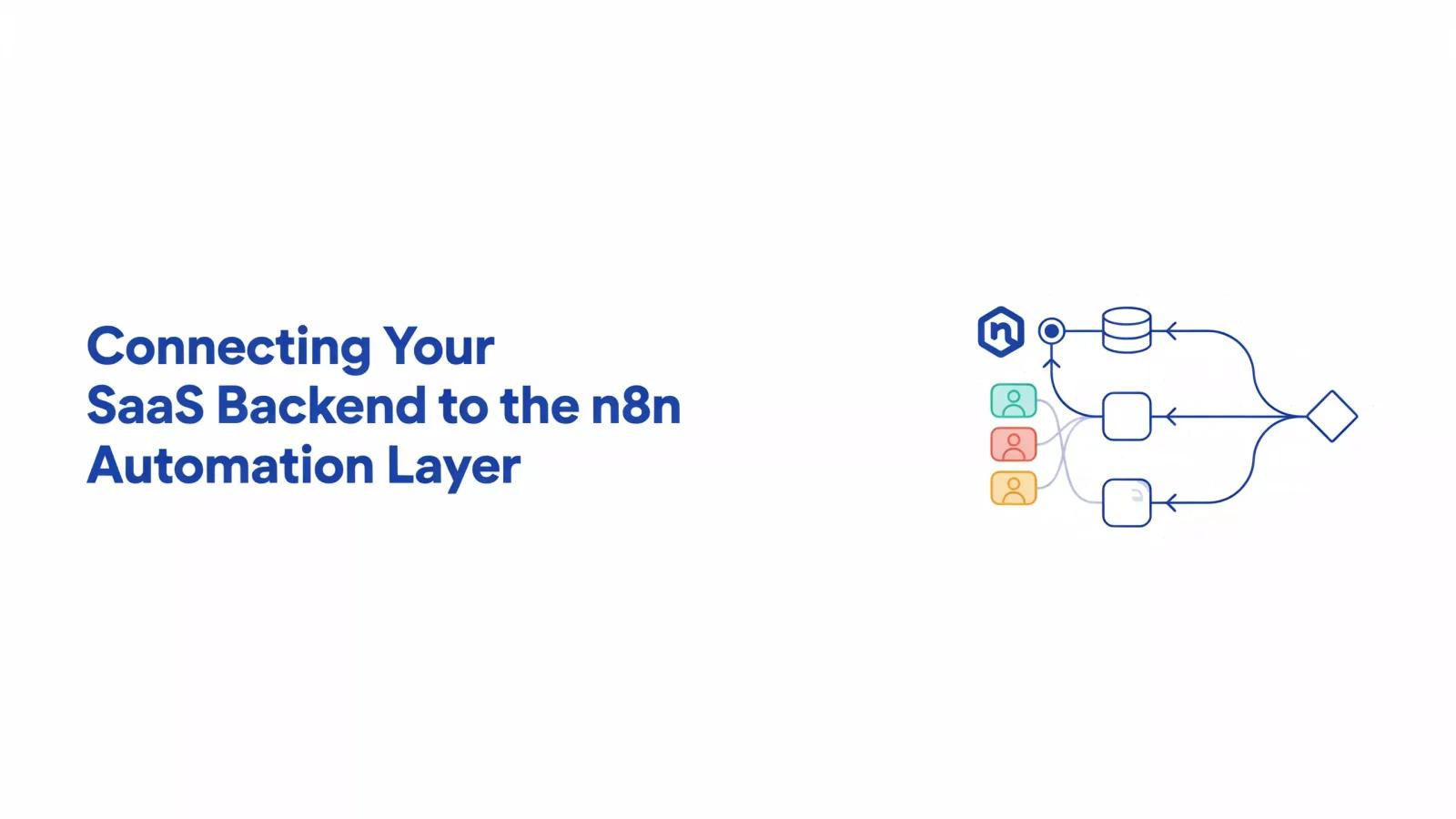
n8n Integration Services: Connecting Your SaaS Backend to the n8n Automation Layer
Effective n8n integration services go far beyond pointing a webhook at an n8n instance. The integration layer between your SaaS backend and n8n must handle tenant context propagation, authenticated execution triggering, result ingestion, webhook signature validation, and UI embedding. Here is the architecture production platforms use.
Tenant Context Propagation Pattern
Every workflow trigger must carry signed, verifiable tenant identity. When a user action in your SaaS application fires a workflow, n8n needs to know exactly which tenant context the execution belongs to:
3 n8n Embedding Patterns for SaaS Products
1. Full iFrame embedding: n8n editor runs inside an iFrame within your product shell. SSO handles authentication transparently. Fast to implement; limited branding control.
2. API-driven headless mode: Your platform's UI is custom-built; n8n runs as a pure backend engine managed entirely through the Public API. Maximum brand control; highest engineering investment. The correct choice for n8n workflow automation companies building white-label products.
3. Hybrid embedded shell: Custom workflow listing and management UI in your product, with deep-links into n8n's editor canvas. Balances speed with brand integration, the pragmatic choice for most early-stage SaaS platforms.
Credential Governance: The Highest-Stakes Layer in Multi-Tenant n8n
Credential isolation is the most security-critical decision in any n8n multi-tenant architecture best practices implementation. A breach at this layer doesn't expose one record - it potentially exposes an entire tenant's third-party integrations: their CRM, payment processor, internal database, communication stack. In the context of enterprise SaaS development, that is an incident that generates legal liability and permanently damages customer trust. Three architecturally sound patterns exist.
Pattern 1: n8n Projects Credential Scoping
The simplest pattern. Each tenant's credentials live within their n8n Project's scoped vault. n8n encrypts credentials at rest using N8N_ENCRYPTION_KEY. Credentials are accessible only to workflows executing within that project. Critical rule: establish a key rotation schedule and log all key management operations. In instance-per-tenant mode, encryption keys must be unique per tenant environment.
Pattern 2: External Secrets Management (Recommended for Enterprise)
Store all credentials in an external secrets manager — HashiCorp Vault, AWS Secrets Manager, or Azure Key Vault. Credentials are injected into workflow execution contexts at runtime via environment variables or a pre-execution hook. The right choice for any n8n workflow automation company building platforms with strong compliance requirements.
Pattern 3: Dynamic Credential Injection via Pre-Execution Hook
The most flexible pattern for large-scale platforms. A pre-execution middleware intercepts the workflow trigger, fetches tenant credentials from your secrets store based on the tenantId context, and injects them into the execution as typed inputs. Workflows receive credentials as inputs - they never store them statically.
When a tenant rotates a third-party key in your platform UI, all subsequent executions automatically pick up the new value. Clean separation between credential management and workflow logic.
Worker Scaling and Execution Resource Isolation
The noisy-neighbor problem is a fundamental challenge in shared multi-tenant infrastructure. In n8n workflow automation for SaaS platforms, this manifests as a tenant triggering a bulk automation job that saturates the worker pool, causing other tenants' time-sensitive workflows to queue, time out, and breach SLA commitments. Here is how production platforms prevent it.
1. Queue Mode: The Non-Negotiable Prerequisite
All multi-tenant n8n deployments must run in queue mode (EXECUTIONS_MODE=queue). In default mode, executions run inside the n8n server process - a long-running execution can block the event loop for all tenants simultaneously. Queue mode separates execution from the server: jobs are enqueued to Redis via Bull, and independent worker processes dequeue and execute them. This architectural separation is the prerequisite for every scaling strategy that follows.
| Strategy | Mechanism | Tenant Isolation | Engineering Complexity |
|---|---|---|---|
| Shared Worker Pool | All tenants compete for the same worker pods | None | Low |
| Per-Tier Worker Pools | Enterprise tenants get dedicated workers; standard share | Partial | Medium |
| Per-Tenant Queue + Rate Limits | Dedicated Redis queue with bounded concurrency per tenant | Strong | High |
| Per-Tenant Worker Pod | Dedicated Kubernetes worker pod(s) per tenant/tier | Maximum | Very High |
The recommended approach:
- Per-tier worker pools combined with per-tenant Redis queue rate limiting.
- Enterprise customers get dedicated worker pods with node affinity to isolated compute nodes
- Standard customers share workers but have per-tenant concurrency caps at the Bull queue level.
This combination covers 95% of multi-tenant resource governance requirements in production saas application development platforms.
Observability, Compliance Monitoring, and Data Retention
A multi-tenant n8n workflow automation platform without deep observability fails silently and always at the worst possible time. Beyond operational reliability, enterprise customers conducting vendor security assessments probe exactly how you log, monitor, and respond to events in your automation infrastructure. This is the observability stack your platform requires.
Four Observability Layers
- Infrastructure metrics: CPU, memory, disk I/O, and network per n8n instance and worker pod. Prometheus + Grafana, with per-tenant dashboards via tenant_id metric labels.
- Application metrics: Workflow execution rates, success/failure ratios, duration percentiles (p50, p95, p99), and queue depth - all by tenant. These directly feed SLA reporting dashboards for enterprise accounts and are the raw data for usage-based billing.
- Security audit logs: Stream n8n's structured audit events to your SIEM, indexed by tenant_id. Alert rules for: repeated authentication failures, unusual execution volumes, and RBAC permission changes.
- Business execution logs: For every workflow execution, record tenant, workflow ID, trigger source, outcome, and duration in your application database. This is your source of truth for billing, SLA adherence, and tenant health scoring.
Execution Data Retention Policy
Recommended Retention Configuration
Set EXECUTIONS_DATA_MAX_AGE aligned with your DPA commitments (typically 30–90 days for commercial SaaS). Enable EXECUTIONS_DATA_PRUNE and schedule cleanup during off-peak hours.
For GDPR compliance, build a "right to erasure" endpoint in your provisioning layer that calls n8n's Public API to delete all execution data associated with a specific tenant or user on demand. This is a non-optional feature for any SaaS application development services firm serving European enterprise customers.
Custom n8n Workflow Development for Multi-Tenant SaaS Platforms
The most successful n8n workflow automation for SaaS products don't just host n8n, they deliver value through carefully engineered, tenant-aware workflow libraries that become the automation layer customers actively rely on. Custom n8n workflow development is the craft of building production-grade, parameterized, version-controlled workflows that customers interact with as product features, not raw automation primitives.
Workflow Template Architecture
1. Canonical Templates (Platform-owned, Git-managed)
Master workflow definitions maintained in version control by your engineering team. Deployed to n8n via CI/CD pipeline through the Public API. Never manually edited in the n8n UI — all changes go through code review and staged deployment.
2. Tenant Instances (Auto-provisioned on feature activation)
When a tenant activates a feature, the provisioning service clones the canonical template into their project and applies per-tenant parameter overrides for webhook URLs, field mappings, notification targets, transformation rules.
3. Tenant Customizations (Optional, governed by approval flow)
Enterprise tenants can extend their workflow instances within defined boundaries. A change approval workflow (built in n8n itself) routes all modifications through review before activation, allowing change management without manual engineering involvement.
Workflow Version Propagation Policy
- Security patches: Auto-propagate to all tenant instances immediately, with admin notification. Non-negotiable.
- Feature updates: Canary deployment mode lets you push to 5% of tenants, monitor execution success rates for 24 hours, roll out progressively. Early access opt-in via your platform UI.
- Breaking changes: New template version with a migration script. Tenants stay on the previous version until they complete the self-service migration wizard by a defined deadline.
Who Should Build This: Why You Need to Hire an AI Agent Architecture Developer
After reading this guide, it should be clear that building a secure, production-grade multi-tenant n8n architecture for a SaaS product requires deep, specialized expertise across multiple engineering disciplines. The distinction between the profiles companies need (and the ones they often hire) directly determines whether the project succeeds or accumulates critical technical debt.
When companies say they want to hire an AI automation developer, they often attract candidates who build individual workflows using n8n's visual interface by connecting nodes, configuring triggers, and mapping data. That skillset is genuinely valuable. But it is categorically insufficient for multi-tenant production infrastructure.
What this architecture requires is someone who operates as an AI agent architecture developer. An engineer who combines workflow automation expertise with the systems engineering depth to design and build the full stack. It comprises the isolation model, the provisioning API, the secrets management layer, the Kubernetes configuration, the SSO integration, the CI/CD pipeline for workflow deployments, and the observability stack. These are fundamentally different professional profiles.
Required Competencies for This Work
- Distributed systems design: failure modes of message-queue architectures, exactly-once delivery semantics, and idempotent execution patterns
- Database access control: schema-level and row-level security in PostgreSQL, not just application-layer filtering
- Identity federation: SAML assertion structure, OIDC token claim mapping, IdP configuration for per-tenant SSO scenarios
- Container orchestration: Kubernetes RBAC, pod security standards, Network Policies, and namespace isolation
- Secrets management lifecycle: Vault or cloud-native secrets managers, rotation automation, and emergency revocation procedures
- Compliance frameworks: SOC 2, GDPR, HIPAA as they apply concretely to data processing systems and audit requirements
- n8n internals: execution engine, credential encryption model, webhook subsystem, and Public API capabilities and limitations
- AI agent workflow design: LangChain node configuration, prompt engineering for production reliability, vector store integration, and agent loop error handling
The consequences of getting multi-tenant isolation wrong are not debugging sessions - they are security incidents, enterprise customer churn, and compliance failures that take quarters to recover from.
Investing in the right SaaS application development services company from the start is categorically cheaper than learning these lessons in production.
Hire n8n Experts Who've Done This Before
Ciphernutz delivers end-to-end SaaS application development services with n8n workflow automation at the core from multi-tenant architecture design to RBAC configuration, SSO integration, and production-grade AI agent workflow development.
Whether you're starting a greenfield SaaS product, embedding n8n workflow automation for SaaS into an existing platform, or hardening a current deployment for enterprise customers, we have the depth to execute it correctly.
For teams that need specialized implementation support, you can hire n8n experts to design, build, and scale the automation architecture.
Don't outsource this to a generalist automation freelancer. Hire an AI agent architecture developer from Ciphernutz who understands the full stack - infrastructure, security, compliance, and workflow design at enterprise scale.
Frequently Asked Questions
Q. Why do SaaS application development services use n8n for workflow automation instead of building it from scratch?
Building workflow automation from scratch requires months of engineering investment - trigger management, execution queuing, retry logic, credential storage, audit logging, and a workflow designer UI.
n8n provides all of this as a battle-tested foundation. SaaS application development services that embed n8n cut time-to-market for automation features by 60–80% compared to custom builds, while keeping full infrastructure control through the self-hosted deployment model.
Q. Can n8n workflow automation for SaaS support multi-tenant platforms natively?
n8n does not ship with built-in multi-tenancy as a single toggle, but its self-hosted model combined with enterprise features (RBAC, SSO, the Public API, and Projects) gives engineering teams the full toolkit to architect robust multi-tenant systems. The approach (instance-per-tenant vs. shared instance with namespace isolation) depends on your scale, compliance requirements, and DevOps maturity.
Q. Should I hire an AI automation developer or an AI agent architecture developer for n8n SaaS projects?
For multi-tenant n8n SaaS platforms, you need an AI agent architecture developer, someone who understands distributed systems, database access control, identity federation, container orchestration, and compliance frameworks.
When you hire an AI automation developer, it typically entails workflow-building skills;. So, seek to hire an AI agent architecture developer, as they encompass the full-stack systems design competency required for production multi-tenant environments. These are meaningfully different roles, and the project outcome depends on hiring the right profile.
Q. What is the difference between instance-per-tenant and shared-instance n8n architectures?
Instance-per-tenant gives each client a fully isolated n8n process with its own database, credentials vault, and execution environment for maximum security, higher operational overhead.
Shared-instance runs one cluster serving all tenants, with logical isolation enforced through RBAC, project namespacing, and credential scoping. Most production platforms use a hybrid: standard tenants share infrastructure, enterprise tenants receive dedicated instances.
Q. Why is n8n self-hosted required for multi-tenant SaaS products?
n8n Cloud is a single-tenant managed service that cannot be white-labeled and sits outside your infrastructure control.
Multi-tenant SaaS products require data sovereignty, white-label branding, custom SSO integrations, and per-tenant resource quotas. All of these are only achievable with a self-hosted n8n deployment where your team controls the infrastructure, environment variables, and database configuration.
Q. What n8n enterprise features are essential for multi-tenant SaaS?
The critical n8n enterprise features for multi-tenancy are: SSO (SAML/OIDC) for federated identity management, RBAC for per-tenant permission boundaries, and Audit Logs for compliance & forensics. It also features the Public API for programmatic tenant provisioning, and n8n Projects for logical workspace isolation. Production deployments also require queue mode (Redis-backed) for workload isolation and external secrets management for credential sovereignty.
Q. How do you handle credential isolation in a multi-tenant n8n setup?
The following three patterns help to handle credential isolation.
(1) Per-tenant credential namespacing using n8n Projects each project has its own scoped credentials vault
(2) External secrets management via HashiCorp Vault or AWS Secrets Manager with runtime injection via environment variables
(3) Dynamic credential injection through a pre-execution hook that fetches tenant-specific secrets from your SaaS backend based on the tenant context.
The third pattern is the most flexible for large-scale platforms and cleanly separates credential management from workflow logic.
Q. How long does it take to set up a production-ready multi-tenant n8n architecture?
For an experienced team, 4–10 weeks depending on tenant count, compliance requirements (SOC 2, HIPAA, GDPR), and DevOps maturity. This covers infrastructure setup, SSO integration, RBAC configuration, CI/CD pipeline for workflow deployments, monitoring, and documentation. Rushing this phase creates technical debt that is very expensive to unwind at scale.