PoC vs MVP: What's the Key Difference in 2026?
Yuti Agarwal
5-7 mins
Most products don't fail because the idea was weak. They fail because nobody tested that idea before building the entire thing.
Two of the smartest ways to test an idea early are a proof of concept (PoC) and a minimum viable product (MVP).
Getting the PoC vs MVP decision right shapes how you validate, what you spend, and how fast you reach real users.
The problem is that many founders use these terms interchangeably. Some build a PoC when they should be launching an MVP. Others jump into development without validating the technology first. The result is wasted time, higher costs, and products that never gain traction.
Understanding the difference between a PoC and an MVP can help you reduce risk and make smarter product decisions from the start.
That confusion is exactly what this guide clears up.
In this guide, you'll learn:
- What a PoC is
- What an MVP is
- PoC vs MVP key differences
- Cost and timeline for each
- How to choose the right one
- Common mistakes to avoid
By the end of this guide, you'll know when to build a PoC, when to move to an MVP, and how to use both together for solid product idea validation without wasting time or money.
What Is a Proof of Concept (PoC)?
A proof of concept is a small, fast test that answers one question: Can this idea actually work? It checks whether a specific technology, integration, or technical approach is feasible before you commit real money to building a product.
A PoC stays internal, and real users never see it. It usually skips design, polish, and security, because its only job is to prove that the core concept holds up. The code is often rough and rarely reused later.
Think of it as a private experiment. If the concept survives, you move forward with confidence. If it breaks, you have just saved yourself months of wasted development.
How Does a PoC Work?
A PoC works by testing the most important part of your idea before building the full product. It helps you check if a feature, technology, or integration will work as expected. If it works, you can move forward with confidence. If it doesn't, you can fix the problem early and save time and money.
When Should You Build a PoC?
Build a PoC when your idea leans on something unproven. New technology, a complex integration, a tricky algorithm, or strict performance demands all call for one first.
It also helps when you need to convince technical stakeholders or investors that the hard part is solvable.
A working PoC turns "we think this can work" into "we have shown it works," which makes every later decision far easier.
What Is a Minimum Viable Product (MVP)?
A minimum viable product is the simplest working version of your product that real users can actually use. It ships with only the core features needed to solve one real problem, nothing more.
Unlike a PoC, an MVP faces the market. You release it to early adopters, watch how they behave, and learn whether people genuinely want what you built.
Eric Ries popularised this idea in The Lean Startup, where the goal is to start small, launch fast, and learn from real usage.
Each release teaches you something new, so you refine, add, or cut features based on real feedback instead of guesses.
How Does an MVP Work?
An MVP works by launching the simplest version of your product with only the core features. Real users use it, and their feedback helps you understand what works and what needs improvement. This allows you to improve the product based on real user needs instead of assumptions.
When Should You Build an MVP?
Build an MVP once you are confident the idea can work, and you need to know if people will use it or pay for it. This stage is about market validation, not technical proof.
It fits perfectly when you want early adopters, real usage data, and steady progress toward product-market fit.
Many founders kick off here with focused MVP development for startups, validating demand before they scale.
PoC vs Prototype vs MVP: Side-by-Side Comparison
Sometimes, one table makes the PoC vs MVP difference click faster than paragraphs. This PoC vs prototype vs MVP view adds the prototype so you can see all three at a glance.
| Factor | Proof of Concept (PoC) | Prototype | Minimum Viable Product (MVP) |
|---|---|---|---|
| Main question | Can it be built? | Does it feel right? | Do people want it? |
| Validates | Technical feasibility | Design and usability | Market demand |
| Audience | Internal team, investors | Stakeholders, test users | Early adopters, real users |
| Functionality | Minimal or none | Simulated, no backend | Working core features |
| Cost | Low | Low to moderate | Moderate to high |
| Timeline | Days to weeks | A few weeks | Weeks to months |
| Output | Go or no-go decision | Validated design | Real users and feedback |
PoC vs MVP: Key Differences
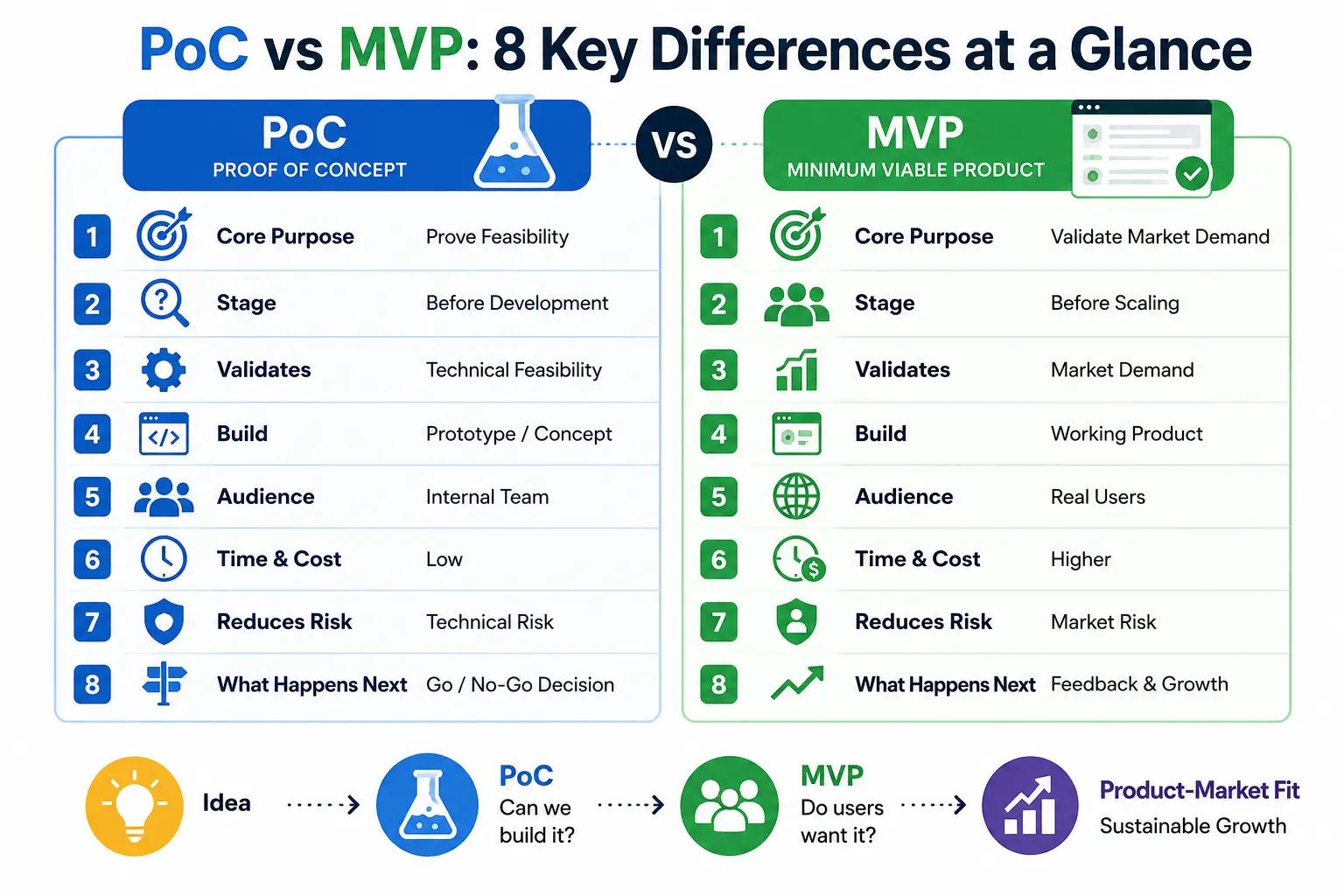
The difference between PoC and MVP comes down to purpose, timing, and what each one proves. These are the eight PoC vs MVP differences that matter most when you decide which to build.
1. Core Purpose
A PoC is built to answer one question: Can this idea actually be built? It helps teams test a specific technology, feature, or integration before investing in full development.
An MVP has a different goal. It is used to launch a simple version of the product and find out whether real users want it, use it, or are willing to pay for it.
2. Stage in the Product Journey
A PoC usually comes first in the product development process. It is used when there are technical uncertainties and the team needs to confirm that the idea is possible.
An MVP comes later, after the technical feasibility is clear. At this stage, the focus shifts from building the product to testing it with real users.
3. What Each One Validates
A PoC validates technical feasibility. It helps confirm that the technology, integrations, or complex functionality can work as expected.
An MVP validates market demand. It helps you understand whether users find value in the product and whether the idea has real business potential.
4. Functionality and Build Depth
A PoC includes only the minimum work needed to test a technical concept. It may not have a user interface and is often built with temporary code.
An MVP is a functional product with core features. While it remains simple, it is stable enough for real users to use and provide feedback.
5. Audience and Visibility
A PoC is usually kept internal and reviewed by developers, stakeholders, or investors. It is not designed for public use.
An MVP is shared with real users and early adopters. Their feedback helps shape future improvements and product decisions.
6. Time and Cost
A PoC is generally quick to build and requires a smaller budget because it focuses on testing a single idea or feature.
An MVP takes more time and investment since it involves building a usable product, testing it, and preparing it for real users. Read more about AI MVP examples and costs.
7. Risk It Reduces
A PoC reduces technical risk by identifying problems before development begins. This helps avoid spending money on an idea that may not work.
An MVP reduces market risk by testing the product with real users. It helps you avoid building a complete product that nobody wants.
8. What Happens Next
After a PoC, the team decides whether to continue, modify, or stop the project based on the technical results.
After an MVP, the focus shifts to gathering user feedback, improving features, and moving closer to product-market fit.
Where a Prototype Fits Between a PoC and an MVP?
A prototype comes after a PoC and before an MVP. It is a simple visual or clickable version of your product that shows how it will look and work. It helps you gather feedback on the design, user experience, and overall flow before development starts.
Think of it this way: a PoC checks if the idea can be built, a prototype checks if the product is easy to use, and an MVP checks if people actually want it. Each one helps validate a different part of your product idea.
PoC vs MVP: Cost and Timeline Compared
Money and time often decide the PoC vs MVP question, so let's break down what each one typically takes.
A PoC is the lighter commitment. Because it tests one technical assumption with rough code, it usually runs from a few days to two or three weeks, at a modest cost. A prototype sits slightly higher, since design work and iteration take a few weeks.
An MVP is the bigger investment. Real features, backend work, testing, and deployment push it into weeks or months, with a budget to match. The exact figure depends on complexity, integrations, and how clean your data is.
| Stage | Typical Timeline | Relative Cost | Main Cost Driver |
|---|---|---|---|
| Proof of Concept | Days to 2-3 weeks | Low | Technical complexity |
| Prototype | 2 to 4 weeks | Low to moderate | Design iterations |
| MVP | 6 weeks to 3 months | Moderate to high | Features and integrations |
Now that you've seen the cost and timeline of each, let's look at how a PoC, prototype, and MVP fit together in the right order.
How a PoC, Prototype, and MVP Work Together?
A PoC, prototype, and MVP can work together to reduce risk before you invest heavily in a product.
- First, a PoC checks whether the idea can actually be built.
- Next, a prototype shows how the product will look and work, helping you improve the user experience.
- Finally, an MVP is a working version of the product that real users can use, helping you test whether there is market demand.
You do not always need all three. If the technology is already proven, you can skip the PoC. If you only want feedback on the design, a prototype may be enough.
Use all three when you need to validate both the technology and the market before moving forward.
How to Choose Between a PoC and an MVP
The proof of concept vs MVP choice comes down to one question: What is your biggest unknown right now?
- Choose PoC: If your main worry is technical, whether the thing can even be built, start. And it is the fastest, cheapest way to remove that doubt before you invest further.
- Choose MVP: If the technology is already proven, and your real question is whether people want it. There is little point proving feasibility for something you know works, so validate demand instead.
Now that you know how to pick the right approach, let's look at the mistakes that quietly derail PoC vs MVP projects.
Also Read: How to Choose the Right MVP Development Company?
7 Common Mistakes to Avoid with a PoC and an MVP
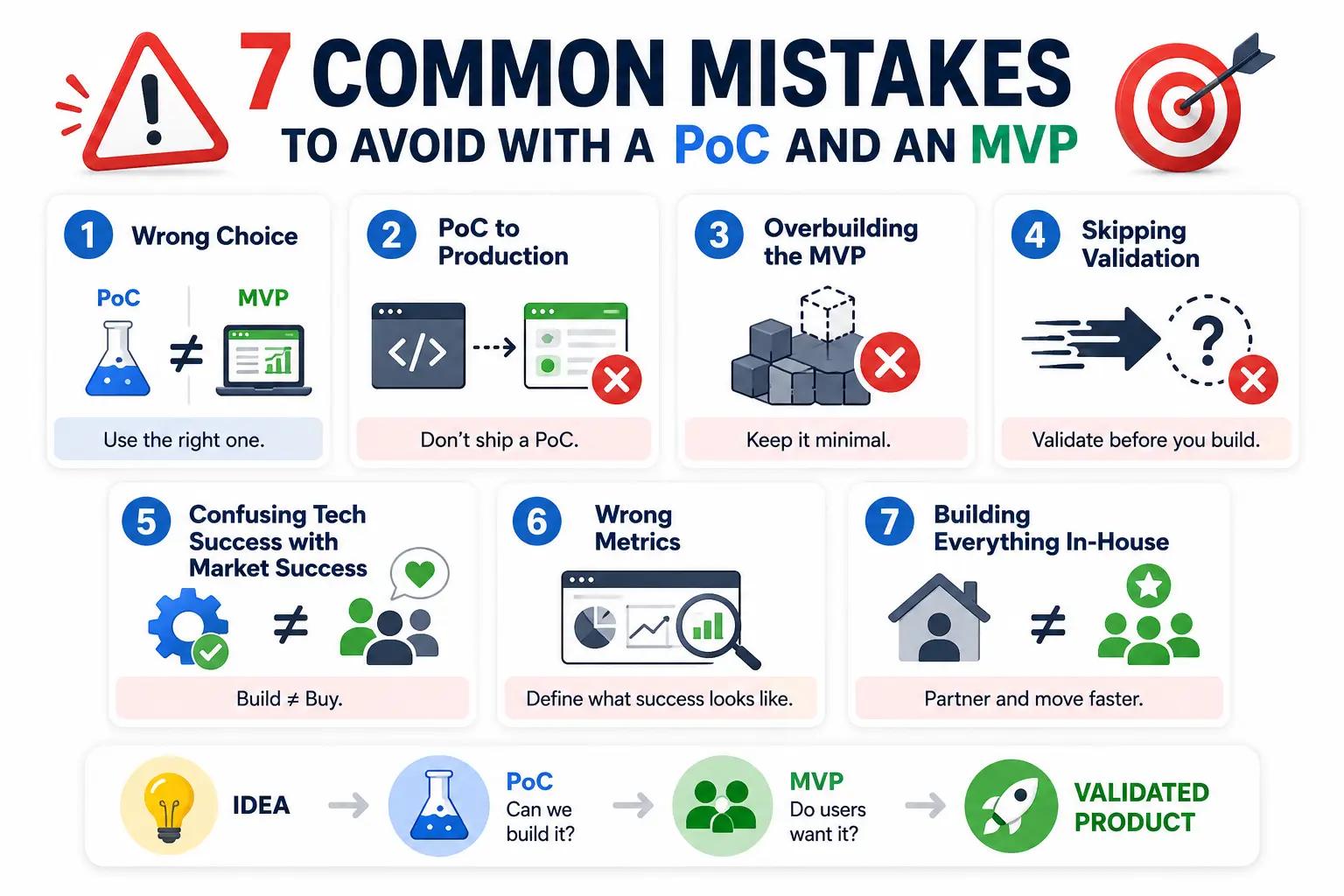
Here are seven common mistakes to avoid while choosing between PoC and MVP:
1. Building a PoC When You Already Need an MVP
If your technology is proven, a PoC just wastes time. You end up testing something you already know works, while your real question, market demand, goes unanswered. Skip ahead to an MVP and start learning from actual users instead.
2. Turning a PoC Into Production Code
A PoC is built to be thrown away, not shipped. Its code is rough, insecure, and never meant for real users. Trying to grow it into a live product creates technical debt that haunts you for months, so rebuild properly once feasibility is proven.
3. Overbuilding the MVP
The word "minimum" gets ignored far too often. Teams pack in extra features, delay the launch, and blur the one thing they meant to test. Ship the core value first, then let real feedback decide what comes next.
4. Skipping Validation to Save Time
Rushing straight into full development feels faster, but it is the costliest gamble of all. Without a PoC or MVP, you might build for months only to learn the idea never worked. A little validation upfront saves a fortune later.
5. Confusing Technical Success With Market Success
A working PoC proves you can build it, nothing more. Many founders read that as proof that people will buy it, which is a completely different question. Always follow technical proof with real market validation before you celebrate.
6. Choosing the Wrong Success Metrics
If you cannot measure it, you cannot improve it. Teams often launch a PoC or MVP with no clear targets, then argue over whether it worked. Define what success looks like, in real numbers, before you start building.
7. Trying to Build Everything In-House
Early validation needs specialised skills that most small teams don't keep on hand. Hiring and training a full crew for a short PoC or MVP is slow and expensive. Partnering with an experienced product team gets you moving faster and avoids costly early missteps.
How AI Is Reshaping PoC and MVP Development?
The PoC vs MVP playbook is changing fast, and AI is the reason. What once took weeks now takes days, which shifts how founders validate ideas.
On the PoC side, AI lets teams test feasibility almost instantly. You can wire up AI integration services, prompt a model, and confirm a technical approach in hours rather than across a full sprint.
MVPs are moving faster, too. Modern minimum viable product development leans on AI to handle boilerplate code, generate interfaces, and draft content.
A small team can now ship a working product in a fraction of the old timeline. Teams building multi-agent AI systems now fold them straight into early products.
Why Choose Ciphernutz to Build Your PoC or MVP?
You can plan the perfect PoC vs MVP strategy, but execution is where most ideas live or die. That is exactly where the right build partner matters.
Ciphernutz turns early ideas into production-ready products, fast. We help founders and teams validate the hard parts, ship lean MVPs, and scale only what works, without bloated timelines or runaway budgets.
What makes us a strong fit:
- 60+ clients served across the US, UK, and the Middle East
- Fixed-scope, production-ready delivery in 3 to 6 weeks
- 98% client retention with a presence in 20+ countries
- Custom-built around your actual stack, never templated
Ready to turn your idea into a real product? Book a free consultation and get a clear validation roadmap from our experts.
Conclusion
The PoC vs MVP choice is not about which one is better. It is about which question you need to answer first.
A PoC proves your idea can be built, and an MVP proves people actually want it. Used in the right order, they take you from a risky guess to a validated product without wasting time or money.
We hope this guide helped you understand the PoC vs MVP difference, when to use each, and how they work together. Now it's your turn to look at your own idea and decide which question matters most right now.
When you are ready to build, connect with our experts to turn your idea into a validated, market-ready product.
FAQs
1. Is a PoC the same as an MVP?
No, they are not the same thing. A PoC tests whether your idea is technically possible and stays internal. An MVP is a working product released to real users to test market demand.
2. Should I build a PoC or an MVP first?
It depends on your biggest risk. If the technology is unproven, start with a PoC. If you already know it works and only need to test demand, go straight to an MVP.
3. Where does a prototype fit in the PoC vs MVP journey?
A prototype sits between the two. It tests design and usability, showing how the product looks and feels before you build the working MVP that goes to market.
4. How long does a PoC take compared to an MVP?
A PoC usually takes a few days to two or three weeks. An MVP needs more time, often six weeks to three months, because it involves real development, testing, and deployment.
5. Can a PoC become an MVP?
Not directly, and forcing it is risky. A PoC uses rough, throwaway code that is not built for users, so once feasibility is proven, you should rebuild the product properly.
6. Is an MVP more expensive than a PoC?
Yes, an MVP usually costs more. A PoC is cheap because it tests one technical assumption, while an MVP ships real features, a working backend, and a usable experience for customers.
7. Do I always need a PoC, prototype, and MVP?
You don't always need all three. Use all three only when both the technology and the market are uncertain. Skip the PoC when the tech is proven, and use just a prototype when refining an existing product.
8. What comes after an MVP?
After an MVP usually comes a pilot, which is a more controlled launch, followed by full-scale development. This is where a lean MVP grows into a complete, market-ready product.