Voice-Enabled Solutions for Clinical Documentation Workflows
Vijay Vamja
5-6 mins
Introduction
Clinicians have been spending excessive time on manual charting, delaying prompt care needs, and increasing their burnout. Recognizing this bottleneck isn't new, even for custom healthcare software development companies. It's why AI voice solutions and AI voice assistants are developed specifically for the healthcare IT sector.
Considering the global market for virtual assistants in healthcare will rise by 28.5% between 2023 and 2031, now's really the time to implement clinical workflow automation. By leveraging conversational AI in healthcare and advanced natural language processing, the clinical documentation software transforms workflows into automated, seamless processes.
Why Do Voice-Enabled Solutions Matter?
It will be easier to understand why the voice-enabled solutions can make a difference after we understand what they can do with clarity.
What are Voice-Enabled Solutions?

The voice-enabled solutions utilize speech recognition and natural language processing technologies powered by AI to capture spoken inputs and convert them into structured, coded data. In healthcare, the clinician's spoken words taken as input will transform into accurate coded data to update the electronic health records.
Integration of voice-enabled solutions with EHR platforms through secure APIs can help automate clinical documentation and aid in real‑time decision‑making possibilities. In this manner, manual charting and transcription errors can be reduced with voice‑enabled solutions, enhancing clinician efficiency, data quality, and patient care outcomes.
Now, here's a brief overview of why this solution matters, especially in today's time.
1. Immediacy of Clinical Workflow Automation
Clinicians spend over 30% of their day on administrative tasks, deterring them from being available for patient care duties. Upon adopting clinical workflow automation, healthcare organizations can reallocate staff time evenly, with their focus directed at care. Implementing AI voice solutions further accelerates documentation speed to enhance satisfaction among care teams.
2. Main Role of AI Voice Assistants
AI Voice assistants trained on medical lexicons can handle voice-driven charting and dictation in real-time without requiring complex hardware. Integrating this data with electronic health record (EHR) systems via a conversational AI solution enables adapting to specialty‑specific terminology while supporting actionable voice prompts. In turn, this reinforces clinical decision capabilities to deliver timely patient care.
3. Align with Vision
Deploying AI voice solutions with the help of a healthcare IT consulting company positions your organization as a trusted partner, looking forward to delivering the best-in-class care. Investing in an AI-powered clinical documentation software also reduces operational costs while supporting necessary compliance standards.
The Burden of EHRs on Clinician Workflows
- A 2024 survey by the American Medical Association (AMA) discovered that 63% of physicians spend over half of their day on EHR-related tasks, including their after-work hours or 'pajama time.'
Considering this fact, it's evident to conclude that administrative overhead surpasses patient-facing time, whose emotional toll is significant.
- Clinical burnout has reached 53% in specific specialities, with EHR usability ranked among the top three contributing factors. (Medscape 2024 Physician Burnout & Depression Report)
As a result, reduced patient satisfaction and increased risk of medical errors are on the rise. Traditional EHR interfaces (keyboard-driven, click-clutter, and workflow-inflexibility) are at odds with the dynamic environment of clinical practice.
In this system, integrating voice-enabled EHRs is not an upgrade but an immediate necessity that's becoming urgent every day.
Voice EHR Real-World Use Cases To Reduce Physician Burnout
1. Hands-Free Data Charting
Instead of having to type notes during or after a consultation, physicians can freely engage in patient interactions while the voice agent listens and transcribes. The inputs and structured notes will be placed into the correct respective EHR sections.
Example Use Case: An orthopedic surgeon uses a voice agent on a handheld to chart notes while examining the patient. It can reduce after-documentation time up to 45%.
2. Medical Dictation with Intelligent Structuring
AI-powered dictation interprets context and organizes notes by SOAP format, condition, or complaint. This is something that's not possible with traditional dictation tools.
Example Use Case: A primary care provider will dictate a follow-up summary, which the AI automatically logs information into appropriate sections, such as assessment and plan.
3. Instant Patient Summary Retrieval
When you need patient records, voice agents can pull them instantly via a query. Expect to retrieve their latest lab results, allergy history, recent imaging notes, and so on.
Example Use Case: During a telehealth visit, the physician may ask, 'What were the patient's recent hemoglobin levels?' and the voice agent will display it live in seconds.
4. Order Entry via Voice
Clinicians can verbally execute orders for lab tests, imaging, or prescriptions without having to navigate complex EHR menus. The medical dictation will be transcribed and received as a command to execute.
Example Use Case: An ER physician says - 'Order a CBC and chest X-ray for Room 8' and the EHR processes the request in the background.
5. Real-Time Coding & Billing Support
AI voice agents can identify billable codes and modifiers from the clinician's spoken documentation while flagging incomplete elements to ensure compliant charting.
Example Use Case: A cardiologist's voice documentation triggers automatic ICD-10 coding and billing draft generation, cutting down claim denials by 30%.
Technical Architecture and Implementation of Voice AI
By now, we are aware of the positives of adopting Voice AI in Healthcare, but here is how to build them correctly!
1. Modular Architecture for Scalability
It is easier to deploy targeted updates and continue parallel development when the system is built on a modular architecture. Its key modules will usually include:
- Speech Capture Service for low-latency audio capturing
- Transcription Engine to convert speech-to-text optimized via token-tuning
- NLP Module to develop layers for processing clinical language and extracting coded data
- Integration Layer to enable FHIR-based communication with EHRs.
2. Achieving Domain‑Specific Accuracy with Token-Tuning
Typical transcription models will inevitably misinterpret medical terms. Token-tuning solves this problem by refining the Voice AI assistant's performance through:
- Aggregating Clinical Corpora: Decode and identify clinical notes, discharge summaries, and consult reports.
- Define Custom Token Sets: Configure voice AI to understand drug names, procedure codes, and anatomical terms.
- Fine‑Tune Labeled Data: Align audio segments to become gold‑standard transcripts to improve recognition occurrences and overall text accuracy.
3. Securing Data Pipeline and Compliance
Healthcare data must possess end‑to‑end encryption and full auditability. Thus, developing a compliant pipeline will involve:
- Encrypted Audio Streaming: All voice data is transmitted over TLS channels from the device to the cloud gateway.
- HIPAA‑Compliant Processing Environments: Make speech‑to‑text and NLP run in isolated containers with AES‑256 encryption.
- FHIR‑Compliant Integration: Get SMART on FHIR authentication via OAuth 2, ensuring the AI voice assistant will securely exchange clinical data with EHRs.
Establishing the above will make the AI solution architecture satisfy stringent security standards while enabling real‑time operations.
4. Step-by-Step Implementations
1. Discovery & Planning
Conduct a workshop to map existing documentation processes, identify pain points, and define user personas. Collaborate with the healthcare IT consulting company to guide your team through learning and defining regulatory requirements and particular integration constraints.
2. Prototype and Pilot(s)
Deploy an initial AI voice solution demo using open‑source speech‑to‑text frameworks to gather clinician feedback. Check the extent of delivered voice interactions, latency, and transcription accuracy within your clinical documentation software sandbox.
3. Token‑Tuning Iterations
Generate synthetic audio to recognize and talk back about rare clinical terms. Fine-tune the NLP module with this updated corpus and then validate the accuracy of results against curated, de‑identified transcripts. Iterate further until error rates fall below the established thresholds.
4. Integration Testing
Connect the AI voice assistant to a test EHR environment and use FHIR APIs for structured data exchange. Perform end-to-end testing via industry-standard methods to ascertain that the clinical workflow automation matches SLAs for throughput and uptime.
5. Phased Rollout and Monitoring
Create a step-by-step rollout plan and release the solution in waves, starting with high-impact departments like emergency medicine. Next, monitor the adoption metrics, including transcription accuracy and system logs. Lastly, collect and use the insights back in the development pipeline for continuous improvement or CICD.
Impact and ROI of Voice AI Solutions
To recognize the impact and improve upon it, understanding the involved KPIs is essential, and here's how they fare!
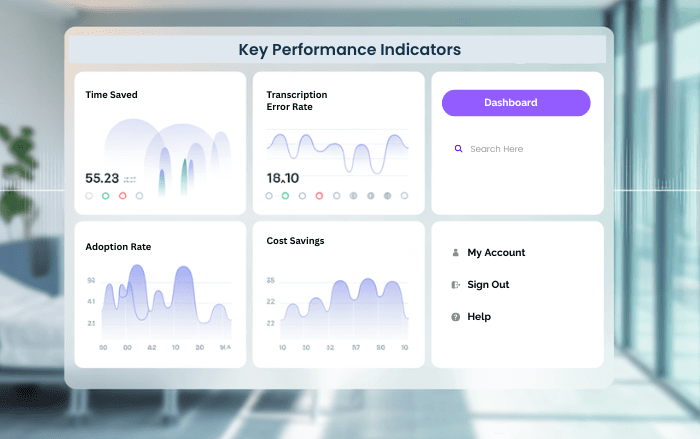
1. Key Performance Indicators of Voice AI in Healthcare
- Time Saved per Encounter: Check for reduction in charting time with AI voice solutions
- Transcription Error Rate: Identify pre- and post‑deployment accuracy comparisons
- Adoption Rate: Look up the percentage of clinicians actively using the AI voice assistant
- Cost Savings: Labor cost reductions versus investment in custom healthcare software development company services
2. Strategic Insights From Enterprise Adoption
Build momentum by leveraging early wins through deployment in pilot areas. Not only does it position your organization as a leader in workflow clinical automation, but it also improves your ROI. Further showcasing case studies on your healthcare IT consulting partner page affirms authenticity and facilitates knowledge transfer to achieve excellence with ongoing updates.
Benefits of Voice AI Solution for Documentation
1. Elevated Clinician Productivity
Offloading manual charting tasks to an AI voice assistant has helped clinicians reclaim about two hours per shift. Such an efficiency gain is instrumental in enhancing patient engagement while reducing burnout.
2. Improved Data Quality
Processing of clinical natural language into structured and coded data in healthcare improves data management and downstream analytics generation to fortify decision support strategies.
3. Rapid Customization and Scaling
Modular architecture in a clinical documentation software allows for making swift upgrades to individual services. Whether it's about integrating new AI models or expanding extra specialities, updates can be deployed without interrupting core operations to a halt.
4. Competitive Advantage
Offering a voice-enabled clinical workflow automation environment is a demonstration of innovation and preparedness. Owning and successfully running such technology differentiates your organization from others and further prepares you to adopt future tech earlier than the rest.
Why Traditional Voice Tools Fall Short in Healthcare?
In the past decade, there have been dozens of health systems driven by dictation, but they lacked something critical - intelligence, context, and automation.
| Tool Type | Limitation |
|---|---|
| Basic Dictation | Requires manual formatting. Doesn't structure notes |
| Voice Dictation | Limited to pre-recorded templates; lacks adaptability |
| Speech-to-Text Systems | No integration with EHRs, manual copy-paste needed |
In contrast to pre-modern healthcare systems, AI voice agents in EHR are interactive, contextual, and integrated with systems, automating not just transcriptions but also key actions.
Challenges for Voice-Enabled Solutions in Documentation
Everything comes with its own pros and cons, and the voice-enabled solutions are no different, especially when adopting them in healthcare. However, with the help of an expert AI voice agent development company, you can mitigate the following challenges without hard and fast measures.
1. Maintaining Data Privacy and Compliance
Voice data contains PHI, which must be protected with robust encryption, container isolation, and rigorous audit logs. Compliance with HIPAA and GDPR collectively demands ongoing governance checks and regular infrastructure investment to scale the system.
2. Controlling Model Drift
Incorporating all of the rapidly evolving clinical terminologies required regular training and tuning to maintain the best transcription accuracy. Hence, continuous monitoring and scheduled retraining cycles must be set in place to prevent system architecture and results from deteriorating over time.
3. Pushing User Adoption
Clinicians may resist shifting from keyboard-based input to voice input to update EHR records. In such scenarios, specialized programs offering hands-on training and support materials can help to make everyone a power-user champion.
4. Solving Integration Complexities
The legacy EHR systems vary in API maturity, often causing discrepancies in FHIR endpoints regarding data models mapping and version handling. However, setting up detailed and robust error‑handling mechanisms can solve this challenge.
Implementation Roadmap: Integrating AI Voice Agents into EHRs
Establishing cross-functional coordination is essential when adopting voice-enabled EHRs. Its typical implementation workflow looks like the following:
Step 1: Workflow Assessment
Audit current EHR usage patterns, pain points, and specialty-specific documentation needs.
Step 2: Define Use Cases
Prioritize voice agent applications such as charting, retrieval, order entry, and coding, along with defining clear success metrics.
Step 3: Partner with Voice AI Development Experts
Collaborate with a voice AI development partner skilled in integrating AI agents with your existing EHR infrastructure.
Step 4: Pilot & Validate
Launch a limited-run pilot with enthusiastic clinicians, gathering feedback on accuracy, usability, and time saved.
Step 5: System Integration
Access and secure APIs (FHIR, REST, GraphQL) and middleware platforms to embed voice agents into the EHR environment.
Step 6: Training & Support
Onboard physicians with a tailored training model with defined KPIs to monitor voice recognition accuracy, false positives, and feedback loops, and apply required changes accordingly.
Step 7: Scale Across the Organization
Based on pilot success, deploy iteratively across departments and then in regions, adjusting the AI agent logic and UI as needed.
Future-Proofing: The Evolving Role of AI Agents in Clinical Care
Voice-enabled EHRs are just the surface solution with a deeper impact, but it's not the end-all solution by a long stretch. The future of AI agents in healthcare includes:
- Ambient Listening: Get auto-charts without explicit prompts.
- Predictive AI voice agents: Suggest clinical decisions based on history.
- Voice biometrics: To elevate authentication and user access control.
- Multilingual voice support: Improves care delivery in diverse populations.
Final Thoughts
Ready to automate & simplify your clinical documentation workflows with AI voice solutions or an AI voice assistant? Partner with our expert team at Ciphernutz IT Services for a tailored pilot integration & deployment!
Schedule a Demo or Contact Our AI Consultants
FAQs
Q. What are AI voice solutions for clinical documentation software?
The AI voice solutions for healthcare combine speech recognition, clinical natural language processing, and secure EHR integrations. Ultimately, this solution can help to automate the documentation workflow for clinicians and healthcare staff with high accuracy.
Q. How does an AI voice assistant differ from general voice‑to‑text services?
AI voice assistants in healthcare are optimized for understanding and processing medical terminology and structured data extraction. It uses domain‑specific token‑tuning and FHIR‑based integration, unlike generic voice‑to‑text platforms that read common terms only.
Q. Can conversational AI in healthcare adapt to different specialties?
Yes. Collecting specialty‑specific corpora and maintaining separate token‑tuning pipelines allows conversational AI models to support cardiology, oncology, emergency medicine, and more with tailored accuracy.
Q. What is the role of a custom healthcare software development company in healthcare?
Such a company provides end‑to‑end services to develop transformative AI-powered solutions that help automate healthcare management. They will work on discovery and prototype development, followed by token‑tuning, integration with existing EHRs, and pilot deployment to make clinical workflows seamless with voice-enabled AI solutions.
Q. How do healthcare IT solutions ensure HIPAA compliance?
All the voice data is transmitted over encrypted channels and is processed inside isolated and audited containers. Authentication to access such data is backed using SMART on FHIR and OAuth2, while role-based access controls and OAuth2 with audit logs together maintain governance.