AI Automation Adoption in 2026: Statistics, Trends, ROI, and Enterprise Challenges
Dharmesh Dave
4-6 mins
AI adoption statistics cannot match up to the record high growth of AI as organizations are investing billions into automation, generative AI development, and intelligent workflows. On paper, the numbers paint a clear picture: AI is becoming a business necessity, yet behind many of those statistics is a more complex reality.
It's noteworthy to remember that AI adoption does not always translate into business value - because productivity gains are often difficult to measure. So, if the AI and automation statistics only reveal important trends, about where the market is heading, wouldn't you like to know better?
For instance, critical details about execution, data quality, organizational readiness, and long-term ROI are crucial to learn. Understanding both sides is essential for leaders making AI investment decisions. Hence, this article examines what today's AI and automation statistics (2026) truly reveal, what they often conceal, and how organizations can interpret them more effectively.
AI Automation Adoption in 2026: The Surface Numbers vs. Execution Reality
What the Adoption Rate Statistics Actually Reveal
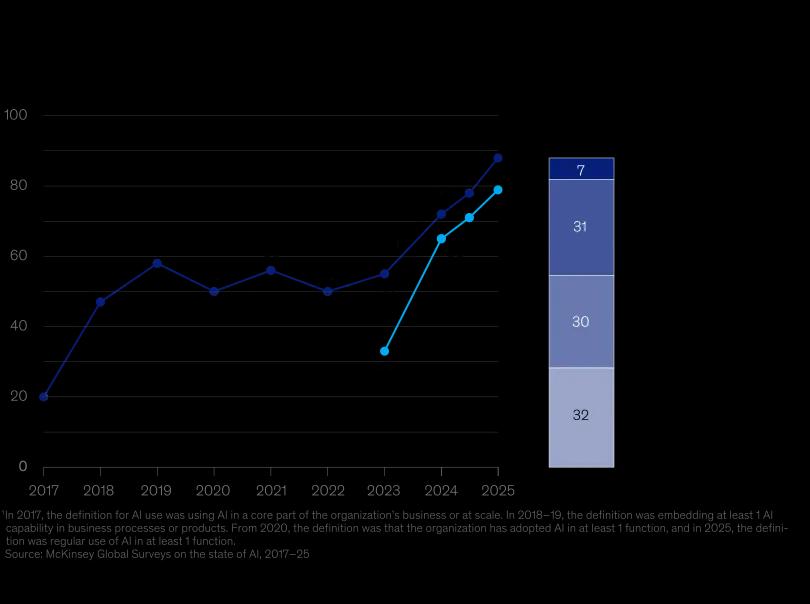
In 2026, 88% of organizations will use AI automation in at least one business function, up from 78% in 2024 and 55% in 2023. Enterprise AI adoption sits at 72%, while SMB adoption reached 38%-nearly doubling from 22% in 2024.
The global AI automation market hit $169.46 billion in 2026, growing at a 31.4% CAGR toward $1.14 trillion by 2033.
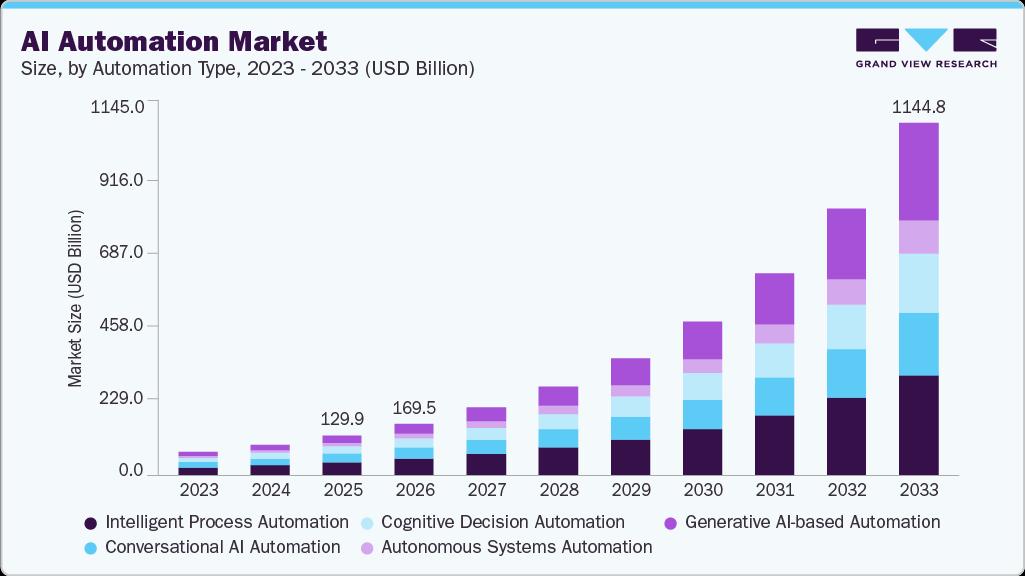
What this reveals: AI automation has crossed from experimentation into mainstream infrastructure. The steep adoption curve shows market confidence in AI reliability and falling implementation costs.
What this hides: Only 33% of organizations have scaled AI deployment beyond pilots. Another study shows just 21% (approx.) organizations run AI workflows at enterprise scale. The gap between "using AI" and "running on AI" is massive-most companies are stuck in limited rollouts.
Why that matters: Adoption rates mask an execution crisis. Leaders seeing 88% adoption might assume their competitors are already winning with AI. In reality, most are still troubleshooting data fragmentation, workflow gaps, and governance issues.
What decision-makers should do: Don't benchmark against the 88% adoption figure. Benchmark against the 33% who've scaled. Ask your team: "Are we piloting or producing?" If the answer isn't clear, you're likely in the hidden 67%.
The Agentic AI Shift-What's Changing Under the Hood
40% of enterprise applications will include task-specific AI agents by the end of 2026, up from less than 5% in 2025. 51% of companies have already deployed AI agents, and nearly 79% report some form of AI agent adoption. 48% of enterprises are deploying agentic systems in production, not just testing.
What this reveals: Organizations are moving from "one big agent" to coordinated multi-agent systems with role separation and cooperative task execution. Agentic AI is becoming the preferred pattern for enterprise automation.
What this hides: 93% of business leaders believe scaling AI agents gives competitive advantage, creating intense pressure to move from pilot to production. But only 5% of generative AI pilots deliver sustained value at scale according to MIT research.
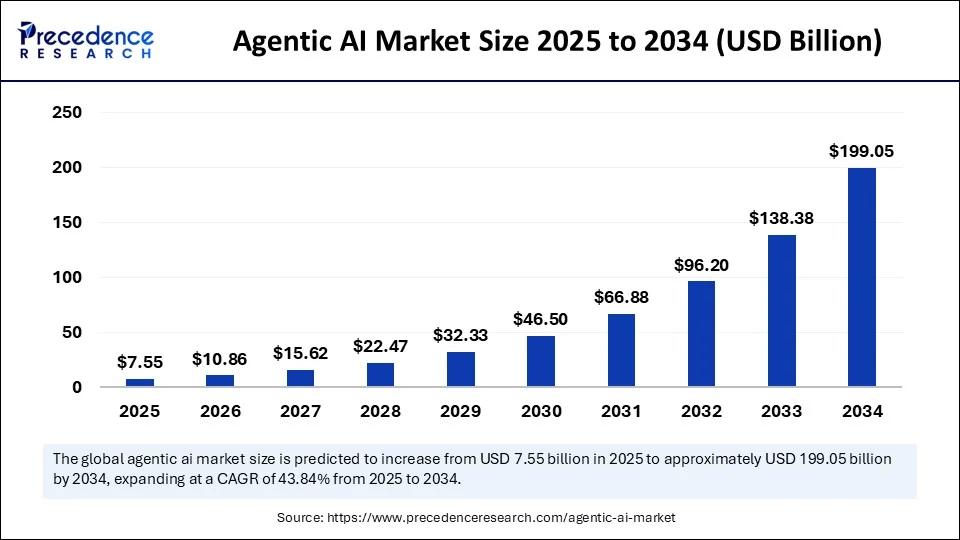
Why that matters: The agentic AI market is valued at $10.8 billion in 2026, growing at 43.8% CAGR. This explosive growth masks a truth: most organizations lack the data infrastructure, governance frameworks, and workflow integration needed for agents to function reliably at scale.
What decision-makers should do: Before deploying agentic AI, audit your data quality, semantic layers, and knowledge graphs. Enterprises adopting context layers and knowledge fabrics support agents better and achieve higher explainability. Start with narrow, high-volume use cases-not enterprise-wide agent ecosystems.
AI Automation Statistics on ROI: The Math That Looks Good Until You Dig Deeper
The Promising ROI Numbers
84% of organizations investing in AI report positive ROI. Companies see a 330% ROI over three years from intelligent automation, with payback in less than six months. AI customer service delivers $3.50 for every $1 invested, climbing to 124%+ ROI by year three. The average business saves 35% on operational costs within the first year of AI automation adoption.
What this reveals: When AI automation works, the financial impact is substantial. Customer service automation shows 340% ROI in 6 months, and data entry automation shows 290% ROI in 4 months.
What this hides: Only 39% of enterprises report measurable EBIT impact from AI, and most say the contribution is still below 5%. Gartner finds only 1 in 50 AI investments delivers transformational value-just 2%. 95% of corporate AI pilots showed no measurable impact on profit and loss per MIT's Project NANDA.
Why that matters: The ROI statistics are real-but they're skewed toward the disciplined few who treat AI as system-level transformation. Most companies are stymied by legacy technology, process debt, and data debt that prevent scaling.
What decision-makers should do: Stop asking "What's the ROI of AI?" Start asking "What's preventing our ROI?" The barriers are structural: data fragmentation limits output accuracy, workflow gaps prevent AI insights from translating into action, and lack of governance reduces trust. Address these first, then measure ROI.
Cost Savings That Actually Matter (and Where They Don't Show Up)
AI costs $0.50 to $0.70 per customer interaction, versus $6 to $8 for human agents-roughly a 12x cost advantage. Contact centers using AI report 30% reduction in operational costs. AI automation saves teams about 13 hours per person per week, equating to roughly $4,739 per month in productivity gains.
What this reveals: Customer service is where AI automation has the most momentum, with the AI customer service market hitting $15.12 billion in 2026. 43% of contact centers have already adopted AI technologies.
What this hides: 51% of customers prefer bots for immediate service, but 79% still want humans for complex support. Pure AI strategies fail here. The winning model is hybrid-AI handles routine stuff, humans step in for tricky situations.
Why that matters: Conversational AI is expected to reduce contact center labor costs by $80 billion globally. But this only materializes when organizations design for hybrid workflows, not full automation.
What decision-makers should do: Map your customer journey to identify high-volume, low-complexity touchpoints for AI. Don't automate everything-automate the 73% of calls that are routine (that's what top performers achieve). Keep humans for edge cases.
The Hidden Barriers: Why 90% of Enterprise AI Implementations Fail
The Failure Rate Statistics Nobody Talks About
95% failure rate for enterprise generative AI projects, defined as not having shown measurable financial returns within six months. 62% of organizations have not progressed their AI initiatives beyond the pilot stage-pouring resources into projects without achieving operational scale. Fewer than 30% of CEOs expressed satisfaction with returns from AI investments, yet spending continues surging.
What this reveals: The gap isn't technological-it's a leadership accountability crisis. Organizations are investing more in AI than ever, yet returns fall short of expectations.
What this hides: The barriers are structural, not strategic:
- Data fragmentation limits accuracy and usability of AI outputs
- Workflow gaps prevent AI insights from translating into action
- Lack of governance reduces trust and adoption
- Tool-first strategies lead to underutilized investments
Why that matters: Companies are gearing up to increase AI expenditures in 2026, raising average from 0.8% to 1.7% of revenue. Spending rises even as license counts fall-reflecting a move toward targeted access and measurable ROI rather than mass enablement.
What decision-makers should do: Before buying more AI tools, audit your data infrastructure, process maturity, and governance frameworks. AI ROI is finally real in 2026-but only for the disciplined few who treat it as system-level transformation. If you're tool-first, you'll join the 95% failure rate.
Organizational Readiness Factors That Determine Success or Failure
71% of enterprises use generative AI, but only about a third have moved beyond experimentation into full-scale production. 90% of large enterprises are prioritizing hyperautomation initiatives-combining AI, machine learning, and RPA to transform entire operational ecosystems. Yet only 21% run AI workflows at enterprise scale.
What this reveals: In 2026, enterprise AI moves from pilots to production. Leaders are narrowing AI access while increasing spend, building governance that ties models to ROI.
What this hides: Introducing AI to a workforce that does not comprehend its purpose, lacks trust in its decision-making processes, and has not been trained to collaborate with it will inevitably lead to high failure rates. 89% of US employees say they feel more satisfied after automation is introduced-people like spending less time on repetitive tasks. But without training, satisfaction turns to resistance.
Why that matters: 86% of businesses report productivity gains from RPA, along with 59% cost reductions and 92% improved compliance. But these gains require change management, not just technology deployment.
What decision-makers should do: Invest in workforce training before scaling AI. 75% of software developers will use AI coding agents by 2028, up from less than 10% in 2023. The shift is happening across every function. Prepare your people, or your technology will sit underutilized.
Industry-Specific AI Automation Statistics: Where Adoption Is Real vs. Hype
Sector-by-Sector Breakdown of What's Working
| Industry | Adoption Rate | Top Use Case | Avg. Hours Saved/Week |
|---|---|---|---|
| Accounting | 52% | Invoice processing | 18 |
| Healthcare | 45% | Appointment scheduling | 12 |
| Real estate | 41% | Lead follow-up | 10 |
| Legal services | 34% | Document review | 15 |
| Restaurants | 31% | Order management | 9 |
What this reveals: Customer-facing and back-office automation show fastest ROI. 46% of enterprise adoption focuses on procurement, HR, and finance, while 65% of SMB adoption centers on sales and marketing automation.
What this hides: Healthcare, manufacturing, and IT sectors show most dramatic year-over-year increases in AI adoption, particularly for generative AI. But regulated industries face stricter governance requirements, slowing production deployment.
Why that matters: By 2027, an estimated 50% of all SMBs will use at least one AI-powered workflow. Early adopters are seeing 2-3x returns within 18 months. Businesses that adopt AI automation early report a 6-month head start on competitors in operational efficiency.
What decision-makers should do: Don't wait for industry-wide adoption. If your top use case is invoice processing or lead follow-up, you're in the highest-ROI category. Start now, not when "everyone else" is doing it.
Geographic and Size-Based Adoption Patterns
North America holds 32.7% of the global AI automation market, leading in both adoption and investment. Large enterprises account for 67.5% of the AI automation market, but SMBs are catching up fast, especially in ecommerce. North America leads at 41% market share, followed by Europe at 28% and Asia-Pacific at 24%.
What this reveals: The fastest-growing segments are AI-powered customer service (31% CAGR), intelligent document processing (28% CAGR), and workflow automation for SMBs (26% CAGR).
What this hides: Asia-Pacific shows fastest growth for autonomous agents, even though North America remains the largest market. Mid-market retailers are adopting AI chatbots 3x faster than small sellers and enterprise retailers.
Why that matters: AI automation market is growing at 23.4% CAGR, reaching $19.6B by 2026. Geographic and size-based patterns show where the competitive window is still open.
What decision-makers should do: If you're in Asia-Pacific or mid-market retail, you're in a high-growth zone where early adoption yields disproportionate advantage. Don't let enterprise-sized competitors intimidate you-agility is your edge.
Workforce Impact: What AI Automation Statistics Hide About Jobs and Skills
Job Displacement vs. Job Creation-The Full Picture
85 million jobs are expected to be displaced globally by AI and automation by the end of 2026. But the World Economic Forum also projects 97 to 170 million new roles will be created by 2030. Administration faces highest displacement risk at 26% of jobs, customer service ranks second at 20%.
What this reveals: 7.5 million data-entry and admin jobs could disappear by 2027-roles most vulnerable to automation. AI job postings are 134% above 2020 levels.
What this hides: 40% of employers expect workforce reductions due to AI, but the same companies are also investing in reskilling programs. The net effect is a shift in job types available, not simple reduction.
Why that matters: 34% productivity increase for lower-skilled workers using AI tools-AI levels the playing field by giving every employee access to better decision-making support. Over 70% of employees report that automation tools accelerate their workflow.
What decision-makers should do: Invest in reskilling before layoffs. AI agents will function as autonomous, goal-driven employees within the enterprise. Your workforce needs to learn to collaborate with agents, not compete against them.
What Decision-Makers Should Do With This Knowledge in 2026
AI automation adoption is no longer optional for businesses that want to stay competitive. The statistics reveal a market at inflection point: 84% of companies planning AI investment in next 12 months, 67% citing AI as top strategic priority, yet 95% of pilots failing to deliver measurable returns.
The Execution Playbook for 2026
- Start narrow, scale fast: Pick one high-volume use case (customer service, invoice processing, lead follow-up). Most businesses see full AI automation ROI within 3 to 6 months.
- Fix data before buying tools: Data fragmentation is the #1 barrier to ROI. Build semantic layers and knowledge graphs before deploying agents.
- Measure what matters: Don't track "AI usage"-track EBIT impact, operational cost reduction, and workflow cycle time. Only 39% of enterprises report measurable EBIT impact. Be in that 39%.
- Design for hybrid workflows: AI resolves 73% of calls automatically in top performers. Keep humans for the 27% that are complex.
- Invest in governance now: Enterprises are moving toward unified AI platforms combining knowledge retrieval, reasoning, workflow orchestration, and observability. Point solutions won't scale.
The Conclusion
The AI and automation statistics for 2026 tell two stories: one of explosive market growth and one of an execution crisis. The gap between them is where competitive advantage lives and where Ciphernutz can help your organization scale with AI.
Organizations that interpret these statistics deeply-uncovering what's hidden, understanding trade-offs, and acting on readiness factors-will be the disciplined few who finally realize AI ROI in 2026.