What Is an AI Readiness Assessment? A Complete Guide for Businesses
Dharmesh Dave
3-4 mins
Many companies invest in AI tools like ChatGPT, Microsoft Copilot, or custom AI agents only to discover that their data, processes, and systems aren't ready to support successful implementation. An AI readiness assessment helps identify technical, operational, and organizational gaps before AI initiatives begin.
To bridge the gap between pilot projects and long-term, scalable AI adoption, organizations must first understand their current capabilities. At Ciphernutz, we treat an AI readiness assessment as a critical diagnostic phase that evaluates your business, technology, and data landscape before building a sustainable AI strategy.
Defining the AI Readiness Assessment
An AI Readiness Assessment is a structured evaluation that measures whether an organization is prepared to adopt, deploy, and scale artificial intelligence successfully. It identifies technical, operational, and organizational gaps that could delay implementation or reduce return on investment.
Rather than focusing solely on AI technology, an AI readiness assessment evaluates the entire business ecosystem, including data quality, system integration, governance policies, employee readiness, compliance requirements, and business objectives.
The assessment helps organizations answer critical questions such as:
- Is our data suitable for AI?
- Are our systems capable of integrating AI models?
- Do we have the right governance policies?
- Which AI use cases deliver the highest business value?
- What must be improved before implementation begins?
The outcome is a prioritized roadmap that reduces implementation risks while accelerating AI adoption.
Benefits of an AI Readiness Assessment
Conducting an AI readiness assessment before implementation helps organizations reduce risks, improve decision-making, and build a strong foundation for scalable AI adoption. The key benefits include:
- Identify High-Impact AI Opportunities
- Reduce Implementation Risks
- Improve Data Readiness
- Strengthen AI Governance
- Accelerate AI Adoption
- Maximize Return on Investment
The 5-Pillar AI Readiness Framework
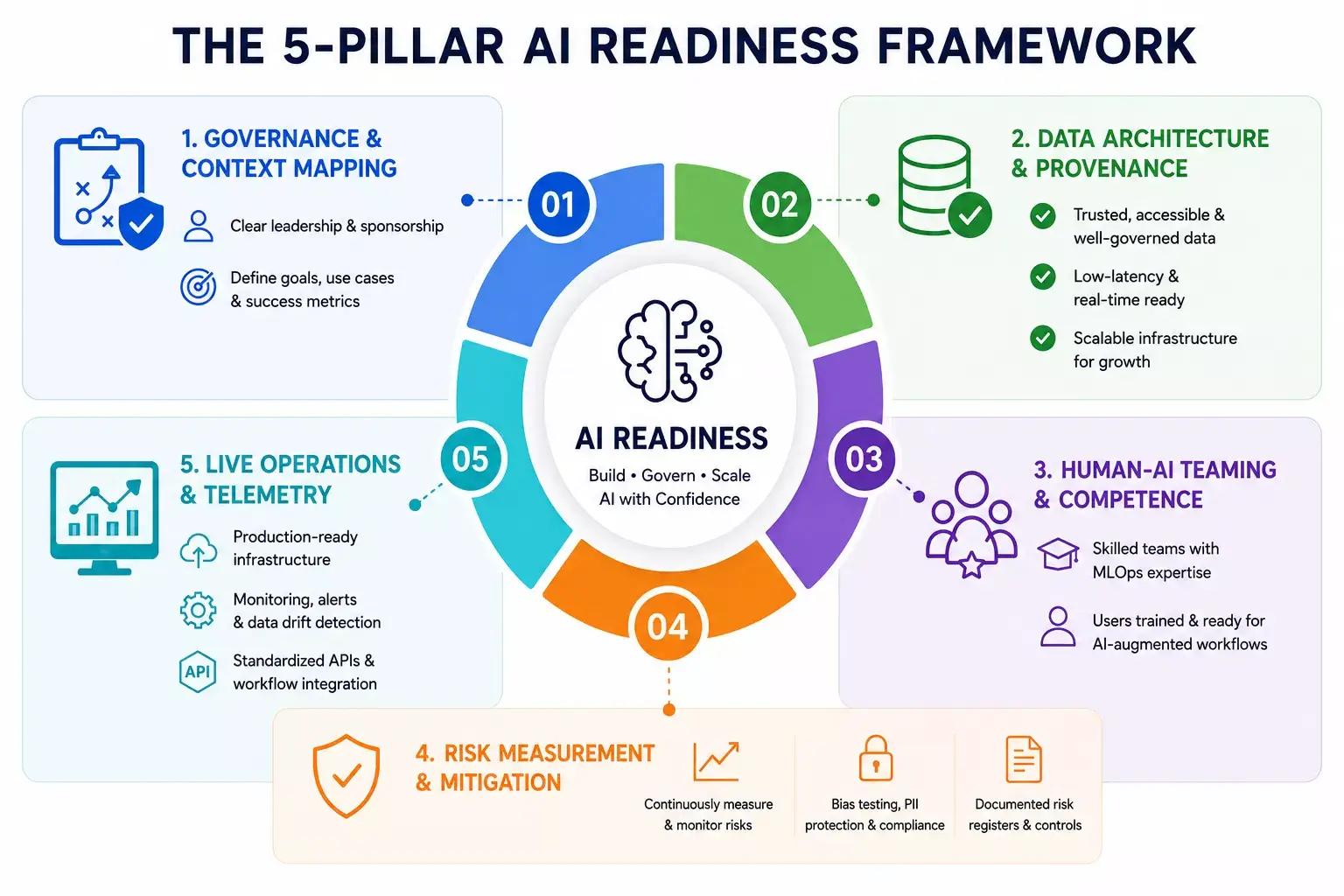
Many traditional readiness frameworks evaluate AI readiness through high-level business abstractions. To avoid pilot failure, organizations must align their evaluations directly with established technical standards like the NIST AI Risk Management Framework (AI RMF) and ISO/IEC 42001. A rigorous diagnostic evaluates readiness across five grounded domains to ensure structural alignment with these global standards.
1. Foundational Governance and Context Mapping
In the NIST AI RMF, "Govern" is the cross-cutting foundation that dictates risk management, while the "Map" function establishes the context, intended use, and limitations of the AI system before it is built. This pillar evaluates executive sponsorship and whether the business case has been strictly mapped to operational reality. If leadership cannot clearly articulate the measurable problem the AI is meant to solve-or lacks the governance protocols to oversee it-the organization is not ready to proceed.
2. Data Architecture and Provenance
Algorithms are only as effective as the data pipelines feeding them. Aligning directly with ISO/IEC 42001 Annex A controls for Data and Information (A.7), this phase establishes rigorous data provenance and latency standards:
- Data Lineage: Can you trace the origin, transformation, and storage of your core operational data to satisfy a compliance audit?
- Latency and Sync: Can your infrastructure deliver data to an endpoint with low enough latency to support the model's required inference speed?
- Infrastructure Scalability: Do you have the flexible cloud architecture necessary to handle sudden spikes in processing compute?
3. Human-AI Teaming and Competence
ISO 42001 mandates specific organizational competence and resource allocations for AI management (Clause 7). The most cited reason for deployment failure is a lack of change management. This pillar assesses whether your engineering team possesses the required MLOps skills to maintain the infrastructure, and whether end-users have been trained to navigate the socio-technical impacts of automated workflows rather than bypassing them out of frustration.
4. Continuous Risk Measurement and Mitigation
The NIST AI RMF explicitly designs "Measure" and "Manage" not as sequential, pre-launch gates, but as continuous, iterative loops throughout the AI lifecycle. This domain audits the mechanisms used to sustain those loops. Assessors review quantitative bias-testing protocols, automated PII-sanitization layers, and documented risk registers to ensure the system remains safe, rigorously tested, and legally compliant from initial sandbox to live deployment.
5. Live Operations and Telemetry
Executing continuous risk management requires robust infrastructure. Aligning with ISO 42001 Clause 8 (Operation), this final pillar measures the operational reality of sustaining AI in production. It examines API standardization, workflow handoffs, and live telemetry. An AI model that suffers data drift in production without triggering an automated engineering alert represents a failure in both infrastructure and risk management.
Ready to Evaluate Your AI Readiness?
Every successful AI initiative starts with a clear understanding of your organization's current capabilities. Our expert AI consultants assess your data, infrastructure, and processes to identify readiness gaps and deliver a practical roadmap for successful AI implementation.
Some Real-World AI Readiness Assessment Examples
1. Real Estate
A real estate agency used an AI readiness assessment to evaluate CRM data quality and automate lead qualification, reducing manual effort while improving response times. Case Study: AI-Powered Real Estate CRM & Sales Automation
2. Healthcare
A healthcare provider evaluated AI for patient scheduling. The assessment identified HIPAA compliance requirements and strengthened governance before implementation.
3. Logistics
A logistics company planned an AI-powered routing system but discovered that legacy ERP software lacked real-time APIs. Addressing infrastructure limitations before deployment prevented costly project delays.
4. Manufacturing
A manufacturer wanted predictive maintenance but discovered sensor data was incomplete and inconsistent. The readiness assessment prioritized data standardization before AI deployment, improving implementation success.
How to Assess AI Readiness: The Verifiable Diagnostic
A readiness checklist is only useful if it forces hard engineering truths. If your IT and engineering leads cannot confidently answer "Yes" to the following operational questions, you have identified immediate capability gaps:
1. Scope and Context Mapping: Have you formally documented the AI system's intended use, operational boundaries, and impacted stakeholders, or is the team simply "testing AI to see what it can do"?
2. Data Latency & Sync: Can your infrastructure feed data to a central endpoint fast enough to support the model's required inference speed (e.g., real-time event streaming vs. daily batch syncs)?
3. API Contracts: Are the internal systems that will consume the AI's output accessible via fully documented, bidirectional APIs?
Security Sanitization: Do you have an automated middleware layer that strips Personally Identifiable Information (PII) from your data before it hits an external LLM or AI endpoint?
4. Telemetry & Fallback: Do you have an automated monitoring system in place to detect model drift, alongside a documented protocol for human override when the system generates an anomalous output?
Conclusion: Establishing a Technical Baseline
The era of casual AI experimentation is rapidly closing. As autonomous systems become a foundational requirement for competitive businesses, the operational risk of poor infrastructure and weak governance compounds exponentially.
Before pursuing a major deployment, technical leaders must evaluate infrastructure scalability, map cloud environments, and untangle legacy data dependencies. For teams looking to secure an objective starting point, exploring an engineering-led AI Readiness Audit provides the necessary, step-by-step technical execution plan to ensure systems are truly prepared for scale.
Frequently Asked Questions
1. What is an AI readiness assessment?
An AI readiness assessment is a structured evaluation that determines whether an organization has the data, technology, governance, processes, and workforce needed to successfully implement artificial intelligence. It identifies capability gaps, prioritizes AI opportunities, and provides a roadmap for scalable AI adoption while reducing implementation risks.
2. Why is AI readiness important?
AI readiness is important because successful AI implementation depends on more than choosing the right tools. Organizations need reliable data, integrated systems, clear governance, and defined business objectives. Assessing readiness before deployment helps reduce project failures, improve ROI, and accelerate AI adoption.
3. What does an AI readiness assessment include?
A comprehensive AI readiness assessment typically evaluates business strategy, leadership alignment, data quality, infrastructure, system integration, AI governance, security, compliance, workforce readiness, and potential AI use cases. The outcome is a gap analysis and a prioritized implementation roadmap.
4. Who should perform an AI readiness assessment?
An AI readiness assessment should be conducted by experienced AI consultants or cross-functional teams that understand business strategy, data architecture, cloud infrastructure, cybersecurity, and AI governance. An independent assessment also provides an objective view of organizational readiness and implementation challenges.
5. What frameworks are commonly used for AI readiness assessments?
Leading AI readiness assessments are commonly aligned with recognized frameworks such as the NIST AI Risk Management Framework (AI RMF) and ISO/IEC 42001. Many organizations also use customized engineering frameworks that evaluate governance, data architecture, infrastructure, risk management, and operational readiness.
6. How long does an AI readiness assessment take?
The duration depends on the size and complexity of the organization. Small and mid-sized businesses can often complete an assessment within one to three weeks, while large enterprises with multiple systems, business units, and compliance requirements may require four to eight weeks for a comprehensive evaluation.
7. What happens after an AI readiness assessment?
After the assessment, organizations receive a detailed report outlining their current AI maturity, identified capability gaps, prioritized AI opportunities, and recommended next steps. This roadmap helps leadership prioritize investments, improve technical readiness, and implement AI projects with greater confidence and lower risk.