AI Readiness Audit vs AI Consulting: What’s the Difference?
Dharmesh Dave
8-10 mins
AI Readiness Audit vs AI Consulting: What's the Difference?
Many B2B teams use AI Readiness Audit, AI Readiness Assessment, and AI Consulting interchangeably - a clear fundamental lack of clarity between AI Readiness Audit vs AI Consulting. This creates confusion early in the buying process because each engagement is designed to answer a different question, produce different outputs, and reduce a different type of risk.
An AI Readiness Audit tells you whether your organization is actually prepared to support AI systems in production. It examines the current state of your data, systems, workflows, governance, and operational constraints to identify what will block AI adoption before implementation begins.
AI Consulting, by contrast, is about decision-making. It takes that current-state picture and helps leadership determine what to build, what to buy, what to prioritize, and how to structure the implementation roadmap.
The distinction is simple:
- An audit tells you where you stand
- Consulting tells you what to do next
That difference matters because buying the wrong engagement creates predictable failure modes:
- If you go straight into consulting without understanding actual readiness, the strategy can end up resting on assumptions.
- If you stop at the audit, you may get a useful diagnostic report with no clear roadmap, architecture direction, or implementation priorities attached to it.
This guide breaks down AI Readiness Audit vs AI Consulting across scope, deliverables, governance, sequencing, and the cost of skipping either one, so you can decide which engagement your business actually needs first.
AI Readiness Audit vs AI Consulting at a Glance
| Aspect | AI Readiness Audit / AI Readiness Assessment | AI Consulting |
|---|---|---|
| Core question answered | Where do we stand today? | What should we build, buy, or prioritize next? |
| Primary output | Diagnostic report with readiness scoring, risks, and gap analysis | AI roadmap, architecture recommendations, prioritization, and build-vs-buy guidance |
| Primary lens | Current-state evaluation | Future-state planning and decision-making |
| Best fit for | Organizations that do not fully understand their AI readiness | Organizations that understand the current state but need a strategy and execution path |
| Governance role | Evaluates governance maturity and operational controls | Designs governance requirements for future AI systems and workflows |
| Typical duration | Fixed-scope assessment, often 3–6 weeks | Strategy sprint, roadmap engagement, or ongoing advisory relationship |
| What happens if skipped | AI strategy gets built on assumptions instead of evidence | Audit findings never become a practical roadmap or implementation sequence |
| Typical sequencing | Usually first | Usually second, though it can stand alone if the current state is already clear |
AI Readiness Audit vs AI Consulting Framework
Question 1: Is the current-state environment understood?
Question 2: Are data, systems, and governance constraints validated?
Question 3: Is the real blocker readiness or prioritization?
Question 4: Are AI decisions recurring or one-off?
Then map outcomes:
- unclear foundation → audit
- clear foundation, unclear roadmap → consulting
- recurring decisions → managed pod
AI Readiness Audit vs AI Consulting: Which One Should You Start With?
If you only need the short answer, use this rule:
Start with an AI Readiness Audit If:
- your data quality or accessibility is unclear
- the workflow you want to automate spans fragmented systems
- governance, security, or approval controls are not well documented
- previous AI or automation projects stalled because of integration, process, or ownership issues
- leadership wants to invest in AI, but there is no reliable picture of current-state readiness
Start with AI Consulting If:
- your systems, data, and workflow constraints are already well understood
- the real blocker is prioritization, architecture, or build-vs-buy decisions
- leadership needs a roadmap, use-case sequence, or vendor strategy
- multiple AI opportunities are competing for budget and someone needs to decide what happens first
Most organizations need both, just not at the same time
A common sequencing model is:
- Run an AI Readiness Audit to understand current-state gaps
- Use AI Consulting to convert those findings into architecture decisions, use-case prioritization, and an implementation roadmap
That sequencing reduces the chance of building strategy on assumptions while ensuring the audit does not stop at a report that no one operationalizes.
What Is an AI Readiness Audit?
An AI Readiness Audit is a structured assessment of whether your organization’s current environment can support AI, automation, or AI agents in production.
Its purpose is not to recommend a vendor or sell a future-state architecture. Its job is to test whether the foundation underneath that future architecture is strong enough to support it.
In practice, an AI readiness audit examines whether the business has the operational and technical prerequisites required for AI adoption, such as:
- usable and accessible data
- stable systems and integration paths
- repeatable workflows that can be automated without amplifying chaos
- governance, oversight, and escalation controls for production use
- enough operational maturity to support AI beyond a pilot
An AI readiness audit is often the right first step when the business is interested in AI but has not yet validated whether the underlying environment can support it.
What an AI Readiness Audit Evaluates & Does
A strong AI Readiness Assessment should go beyond generic innovation checklists and examine the operational layers that determine whether AI can work in production.’
1) Data readiness
This covers the quality, accessibility, structure, and reliability of the data AI systems would depend on.
Typical questions include:
- Is there a usable source of truth for the target workflow?
- Is the data complete and reliable enough for AI-driven decisions?
- Are records standardized or fragmented across multiple systems?
- Can the required data be accessed through APIs, databases, or stable internal integrations?
2) Systems and integration readiness
This focuses on whether the technical stack can support orchestration, automation, or AI-driven workflows without brittle workarounds.
Typical questions include:
- Are the core systems accessible programmatically?
- Are critical integrations already available, or would they require heavy custom work?
- Are the target workflows spread across too many disconnected tools?
- Is the current stack stable enough to support automation at production scale?
3) Process and operational readiness
AI projects often fail because the underlying workflow is unstable before automation even begins. This part of the assessment tests whether the process itself is mature enough to automate.
Typical questions include:
- Is the workflow already defined and repeatable?
- Are exceptions, approval steps, and escalation paths documented?
- Is ownership of the workflow clear?
- Would automation simplify the process or simply amplify existing operational disorder?
4) Governance, security, and risk readiness
This evaluates whether the business has the controls required to deploy AI responsibly.
Typical questions include:
- Are access controls and approval boundaries in place?
- Is there logging for sensitive actions, outputs, or workflow decisions?
- Are escalation paths defined for failed outputs or incorrect automation behavior?
- Do security, legal, compliance, or operations teams have a clear review path?
5) Existing AI and automation performance
If the business already has AI pilots, workflow automation, copilots, or internal agents in place, the audit should assess how those systems are performing today.
That includes:
- output reliability
- failure patterns
- override rates
- escalation paths
- operational blind spots
- governance or monitoring gaps
What an AI Readiness Audit Delivers
An AI Readiness Audit should produce a diagnostic output, not just observations.
Typical deliverables include:
- readiness scoring across data, systems, workflows, and governance
- a current-state gap analysis
- risk flags and implementation blockers
- remediation priorities before implementation
- a recommendation on whether the business is ready to move into roadmap design, pilot execution, or foundational cleanup first
That is why an audit should be treated as a diagnostic layer rather than a substitute for strategy.
What an AI Readiness Audit Does Not Do
An AI readiness audit can inform downstream decisions, but it does not replace strategic AI advisory.
It is not designed to decide:
- which AI use case should be funded first
- which vendor should be shortlisted
- whether a use case needs an AI agent, workflow automation, or a simpler deterministic system
- what your future AI architecture should look like in detail
- what the long-term roadmap should be across multiple business units
Those are consulting decisions. The primary output of an audit is evidence: what is working, what is broken, and what needs remediation before implementation starts.
What Is AI Consulting?
AI Consulting is an advisory engagement focused on helping the business decide what to build, what to buy, what to prioritize, and how to move from AI ambition to implementation decisions.
Where an AI Readiness Audit evaluates the current state, AI Consulting uses that context to make forward-looking choices.
The consulting question is not “Are we ready?” It is:
- Which use cases are worth pursuing?
- Which AI or automation pattern fits each one?
- What should be built internally versus purchased externally?
- What should happen first, second, and third?
- What governance and operating model decisions are required before implementation begins?
This is the layer that translates readiness into action.
What AI Consulting Helps You Decide
1) Use-case prioritization and solution design
AI consulting helps the business determine which opportunities deserve investment and what type of solution each one actually needs.
Examples include:
- Should this problem be solved with workflow automation, an AI copilot, or an AI agent?
- Does the use case require an orchestrated multi-step workflow or a narrower deterministic process?
- Where should humans remain in the loop?
- Which opportunities are too unstable, too low-value, or too risky to automate right now?
2) Build vs buy vs hybrid decisions
Once the use case is clear, the next question is how to source the solution.
AI consulting helps answer:
- Should the business build a custom system, buy a platform, or combine both?
- Which vendor category fits the use case best?
- What should remain proprietary versus outsourced?
- What are the long-term trade-offs in cost, flexibility, lock-in, and governance?
3) Roadmap and sequencing decisions
Consulting also turns scattered AI opportunities into a practical execution plan.
That usually includes:
- prioritizing use cases by value, feasibility, and operational risk
- sequencing initiatives across teams or business units
- aligning architecture choices with budget and resourcing constraints
- defining what needs to happen before implementation can start
The output is not a diagnostic score. It is a decision-ready roadmap.
What AI Consulting Delivers
A typical AI consulting engagement may produce:
- an AI opportunity map or use-case portfolio
- architecture recommendations by use case
- build-vs-buy guidance
- vendor evaluation criteria or shortlists
- implementation sequencing and roadmap logic
- governance recommendations for future AI systems
- business case inputs for leadership approval
The exact format varies by engagement, but the output is fundamentally strategic and decision-oriented.
AI Readiness Audit vs AI Consulting: 5 Core Differences
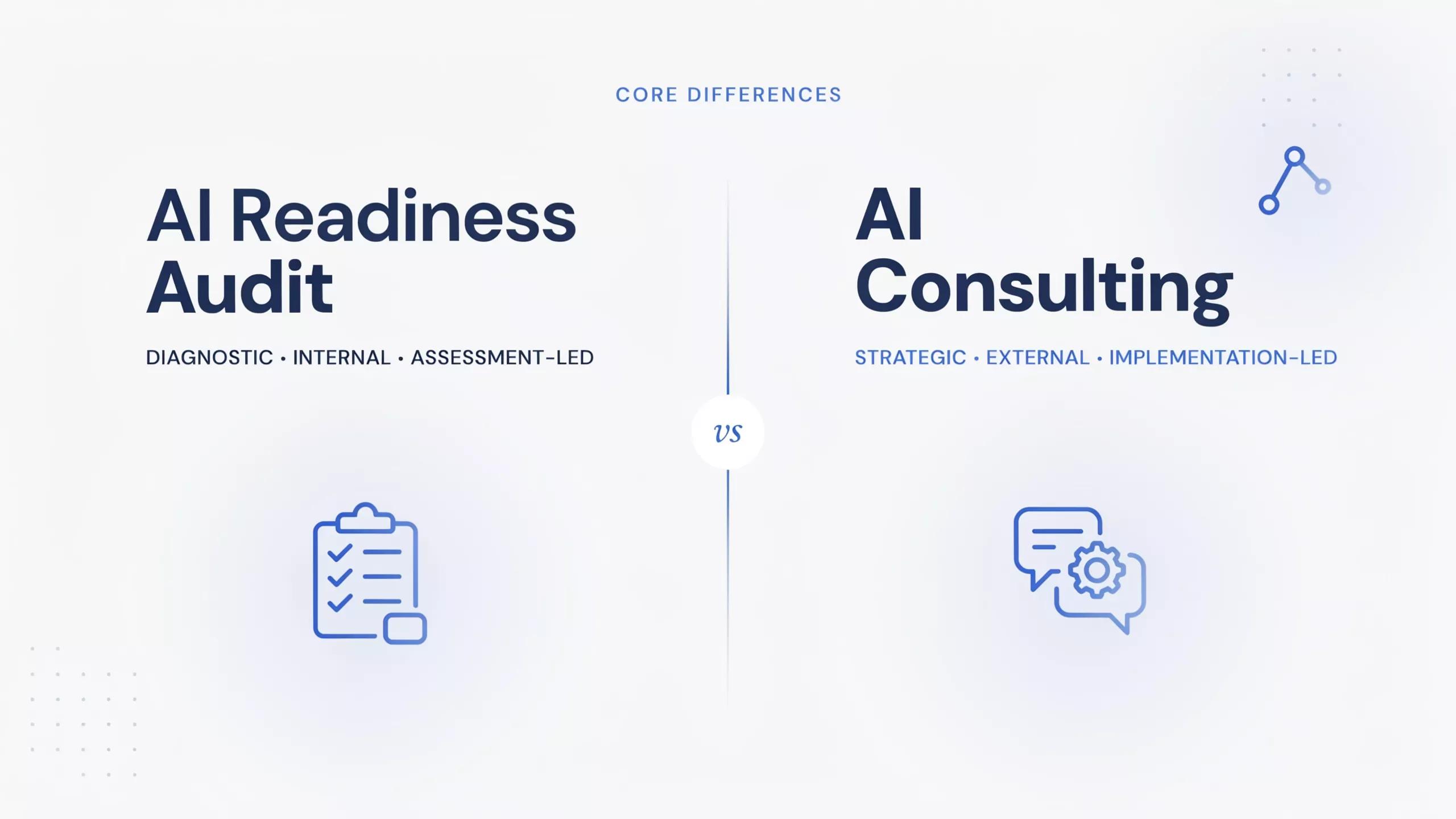
Both engagements can touch the same domains, such as data, workflows, systems, and governance. The difference is not whether they overlap. The difference is what they are designed to produce.
1) Current-state evidence vs future-state decisions
An AI Readiness Audit gathers current-state evidence. It tests whether the business can support AI reliably today.
AI Consulting makes future-state decisions. It uses the current-state picture to decide what should be built, bought, governed, and prioritized next.
2) Diagnostic output vs roadmap output
An audit produces a diagnostic:
- what is working
- what is broken
- where the risks are
- what must be fixed before implementation
Consulting produces a roadmap:
- which use cases to pursue
- which architecture fits each one
- what to build vs buy
- what the implementation sequence should be
3) Readiness evaluation vs implementation planning
An audit evaluates whether the business is ready for AI. Consulting plans how AI should be adopted, governed, and operationalized once the business knows where it stands.
4) Governance assessment vs governance design
In an audit, governance is assessed for current maturity. In consulting, governance is designed for future use cases, operating models, approval flows, and risk controls.
5) Fixed-scope assessment vs flexible advisory model
An audit is usually a bounded, fixed-scope diagnostic engagement. Consulting is more elastic. It may be a short strategy sprint, a phased roadmap project, a vendor evaluation engagement, or an ongoing advisory relationship.
AI Readiness Audit vs AI Strategy Consulting: How Governance Differs
Governance is one of the clearest places where the difference between AI Readiness Audit and AI Strategy Consulting becomes visible.
In an AI Readiness Audit, governance is assessed
The audit looks at what already exists, including:
- access controls
- approval boundaries
- audit logging
- incident response paths
- policy maturity
- operational accountability
The question is whether governance is mature enough to support AI safely today.
In AI Consulting, governance is designed for what comes next
Consulting takes a forward-looking view and helps define:
- what level of oversight different AI use cases need
- where human approval should be required
- which workflows need monitoring, logging, and escalation controls
- what governance model should exist before rollout
The audit asks: How mature is governance right now?
Consulting asks, "What governance model do we need for the systems we are about to deploy?"
When Should a Business Choose an AI Readiness Audit First?
Choose an AI Readiness Audit first if your biggest uncertainty is the foundation.
That usually means one or more of the following are true:
- you do not trust the quality or accessibility of the data behind the workflow
- the systems involved are fragmented or poorly documented
- governance, security, or approval controls are unclear
- prior AI or automation efforts stalled because of integration, process, or ownership issues
- leadership wants to move into AI, but the business still lacks a credible current-state picture
If the blocker is readiness uncertainty, start with the audit.
When Should a Business Choose AI Consulting First?
Choose AI Consulting first if the current state is already reasonably understood and the real blocker is strategic decision-making.
That usually means:
- the data and systems landscape is already known
- the business already understands the main readiness constraints
- leadership needs help prioritizing use cases or sequencing initiatives
- the key decision is build vs buy, architecture selection, or vendor strategy
- multiple AI opportunities are competing for budget and someone needs to determine what moves first
If the blocker is what to do next, start with consulting.
What Happens If You Skip the AI Readiness Audit?
When a business goes straight into strategy or implementation without validating readiness, the roadmap often gets built on assumptions rather than facts.
That can lead to:
- AI recommendations that depend on data that is not actually usable
- workflow designs that ignore broken operational handoffs
- architecture decisions based on integrations that are harder than expected
- governance requirements discovered late, after technical work has already started
- implementation delays caused by foundational issues that should have been surfaced earlier
Skipping the audit does not always fail immediately. But it increases the odds that the business rediscovers basic readiness gaps halfway through implementation, when they are more expensive to fix.
What Happens If You Skip AI Consulting?
The opposite failure mode is also common.
A business runs a solid readiness audit, identifies real gaps, and then never converts that information into a practical set of architecture, prioritization, or implementation decisions.
That usually leads to:
- no clear answer on what should be built first
- no architecture direction for the use cases that passed the audit
- no build-vs-buy decision framework
- no ownership of the next phase
- a diagnostic report that never becomes an implementation roadmap
An audit can tell you what needs to be fixed. It cannot decide what your AI roadmap should be.
Where an AI Managed Pod Fits In
An AI Managed Pod is not a replacement for an AI Readiness Audit or AI Consulting. It is a different operating model for organizations that expect these decisions to keep recurring.
A managed pod makes sense when the business is not facing a single AI decision, but a continuing stream of them: new use cases, vendor evaluations, architecture trade-offs, governance reviews, and periodic readiness reassessments.
In that model:
- the audit function becomes a recurring readiness review rather than a one-time snapshot
- the consulting function becomes an ongoing decision layer rather than a one-time roadmap exercise
This is most useful for organizations that:
- do not have an internal AI strategy or AI architecture leadership function
- expect AI use cases to expand across multiple departments
- need recurring governance and vendor decisions as adoption scales
- want a standing external team to keep architecture, readiness, and implementation decisions current
If the organization has one bounded use case and a clear internal owner, a one-time audit, consulting engagement, or both may be enough. A managed pod becomes more relevant once AI decision-making stops being episodic and starts becoming operational.
AI Readiness Audit vs AI Consulting vs AI Managed Pod
| Engagement | Primary question answered | Operating model | Best when |
|---|---|---|---|
| AI Readiness Audit | Where do we stand today? | One-time, fixed-scope assessment | You do not fully understand the readiness of your data, systems, workflows, or governance |
| AI Consulting | What should we build, buy, or prioritize next? | Strategy sprint, project-based advisory, or phased roadmap engagement | You understand the current state but need architecture, roadmap, or build-vs-buy decisions |
| AI Managed Pod | How do we keep architecture, governance, and readiness decisions current as AI use cases expand? | Ongoing advisory and review model | AI decisions are recurring, cross-functional, and too frequent for one-off projects |
How Ciphernutz Approaches AI Readiness Audits and AI Consulting
At Ciphernutz, we treat AI Readiness Audits and AI Consulting as connected but distinct layers of AI adoption.
Our view is simple: diagnosis and decision-making should not be collapsed into vague “AI strategy” language. Businesses need to know whether the foundation is viable before they invest in architecture, orchestration, automation, or AI agent development.
That is why our work typically separates three functions:
1) AI Readiness Audit
We assess whether your current environment can support AI in production across:
- data quality and accessibility
- systems and integration readiness
- workflow stability and operational maturity
- governance, approval, and risk controls
2) AI Consulting
Once the current state is understood, we help teams decide:
- which use cases to prioritize
- where AI agents make sense versus deterministic automation
- what should be built, bought, or combined
- how the roadmap should be sequenced around technical and operational constraints
3) AI Managed Pod support
For teams that need recurring architecture, governance, and implementation guidance, we can support the process through a more continuous delivery and advisory model.
The goal is not to push every company into the same engagement. It is to match the engagement to the actual uncertainty blocking progress.
Why This Distinction Matters for AI Adoption
Treating AI Readiness Audit and AI Consulting as interchangeable usually creates one of two problems.
Problem 1: You get recommendations without evidence
If the business buys a consulting engagement while expecting a diagnostic, it may receive a roadmap that looks sensible on paper but is not grounded in the reality of its data, integrations, governance, or workflow maturity.
Problem 2: You get a diagnosis without a decision
If the business runs an audit but never moves into consulting or implementation planning, it may end up with a useful report that never becomes an actual roadmap.
That is why it helps to treat the two engagements as distinct functions even when the same partner provides both. One protects the quality of the diagnosis. The other turns that diagnosis into action.
Need Help Deciding Between an AI Readiness Audit and AI Consulting?
If you are not sure whether your business needs an AI Readiness Audit, AI Consulting, or both, the fastest way to decide is to identify the source of uncertainty.
- If you do not know whether the current environment can support AI reliably, start with the audit.
- If you already understand the current state and the real question is architecture, prioritization, or build vs buy, start with consulting.
- If those decisions keep recurring across multiple teams and use cases, a managed advisory model may be the better fit.
Ciphernutz helps B2B teams separate readiness problems, strategy problems, and implementation sequencing problems before they commit to the wrong engagement.
Get an expert opinion on where your AI roadmap is getting blocked.
Talk to Ciphernutz about an AI Readiness Audit or AI Consulting engagement.
Frequently Asked Questions
Do I need an AI Readiness Audit before AI Consulting?
Not always. If your data, systems, workflows, and governance are already well understood, you can move directly into AI Consulting. But when the current state is unclear, an AI Readiness Audit gives consulting a factual starting point instead of assumptions.
What is the difference between an AI Readiness Audit and an AI Readiness Assessment?
In practice, many companies use AI Readiness Audit and AI Readiness Assessment to describe the same type of engagement: a structured evaluation of whether the organization is prepared to support AI in production. Some firms use “audit” to imply a more formal scoring and gap-analysis process, while “assessment” can be positioned more broadly, but the underlying purpose is usually the same.
What is the main difference between AI Readiness Audit and AI Consulting?
An AI Readiness Audit evaluates whether your organization is prepared to support AI in production across data, systems, workflows, and governance. AI Consulting uses that context to decide what to build, what to buy, what to prioritize, and how to structure the roadmap.
Can a company skip the AI Readiness Audit and go straight to AI Consulting?
Yes, if the organization already has a clear and reliable picture of its current environment. The risk is that consulting recommendations may end up based on incomplete assumptions if the underlying systems, data, and governance are not as well understood as expected.
How does governance differ between an AI Readiness Audit and AI Consulting?
In an AI Readiness Audit, governance is evaluated for current maturity. In AI Consulting, governance is designed for future use cases, including approval models, oversight requirements, risk tiers, and production controls.
Which should a B2B company start with: AI Readiness Audit or AI Consulting?
Start with an AI Readiness Audit if the current-state foundation is unclear. Start with AI Consulting if the foundation is already understood and the real blocker is deciding what to build, buy, prioritize, or govern next.
When does an AI Managed Pod make sense?
An AI Managed Pod is most useful when AI decisions are recurring rather than one-off. That includes environments where the business expects repeated architecture decisions, vendor evaluations, governance reviews, and readiness reassessments across multiple use cases.