10 AI Transformation Trends GCC Enterprises Cannot Ignore in 2026
Milind Barot
4-6 mins
Introduction
Artificial intelligence is rapidly becoming a strategic priority across the Gulf Cooperation Council (GCC). What was once viewed as an emerging technology is now a core component of national economic strategies, enterprise modernization initiatives, and long-term business growth plans.
Governments across the region are actively investing in AI infrastructure, digital innovation, and advanced technologies to accelerate economic diversification and reduce dependence on traditional industries. The UAE has positioned itself as a global AI leader through ambitious national programs and investments, while Saudi Arabia's Vision 2030 continues to drive large-scale digital transformation initiatives across both public and private sectors.
This momentum is creating a significant shift in how organizations approach technology adoption. Rather than focusing solely on digitization, enterprises are now exploring how AI can improve operational efficiency, enhance customer experiences, optimize decision-making, and unlock new revenue opportunities.
At the same time, rising customer expectations, increasing competition, and the growing availability of enterprise AI solutions are placing pressure on organizations to modernize faster than ever before. Businesses that delay transformation risk falling behind competitors that are already leveraging intelligent automation, predictive analytics, and AI-powered decision support systems.
As a result, enterprises across the UAE, Saudi Arabia, and the broader GCC are moving beyond experimentation and adopting structured AI transformation strategies designed to deliver measurable business outcomes.
In this article, we explore the key AI transformation trends shaping the GCC in 2026 and examine how forward-thinking organizations are building the foundations for long-term innovation, resilience, and growth.
Top 10 AI Transformation Trends GCC Enterprises
The transition toward automated operations requires shifting from isolated point solutions to systemic, integrated ecosystems. The following ten trends represent the macro movements driving enterprise adoption across the UAE, Saudi Arabia, and the broader regional landscape.
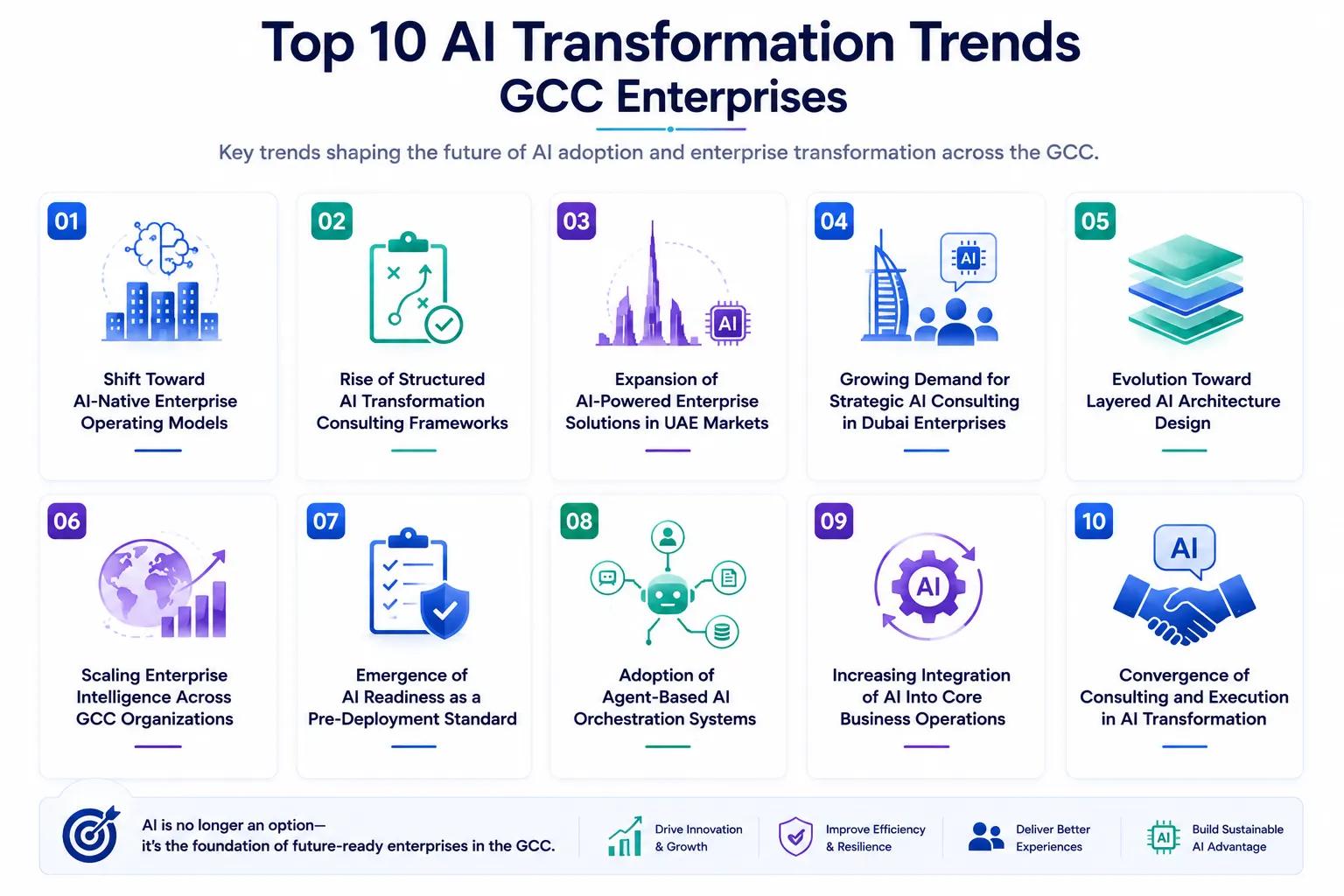
1. Shift Toward AI-Native Enterprise Operating Models
From Traditional Digitization to AI-First Enterprise Systems
For years, digital transformation meant migrating legacy workloads to the cloud or replacing paper processes with static digital dashboards. Today, enterprises are transitioning to true AI-native operating models. In this setup, intelligence is embedded directly into the core workflows rather than layered on top as an afterthought.
Instead of relying on fixed business logic that requires constant manual updates, modern systems use adaptive learning pipelines. These frameworks continuously ingest real-time operational data, allowing workflows to dynamically optimize their own performance, predict supply chain bottlenecks, and adjust resources without human intervention.
2. Rise of Structured AI Transformation Consulting Frameworks
Replacing Fragmented Adoption with Enterprise Consulting Models
One of the largest historical friction points in enterprise automation has been fragmented adoption-where individual departments deploy mismatched tools that cannot communicate. To solve this, Middle East organizations are prioritizing comprehensive AI consulting frameworks to govern their evolution.
These structured models provide a unified blueprint for scaling intelligence safely across multi-entity corporations. They typically establish clear guardrails for:
- Modernizing legacy data warehouses into AI-ready repositories.
- Sequencing integration tasks based on operational dependencies.
- Standardizing data governance protocols to maintain cross-department security.
3. Expansion of AI-Powered Enterprise Solutions in UAE Markets
Operational Automation Becoming a Competitive Necessity
The UAE continues to serve as the regional epicenter for advanced technological deployment. Across the Emirates, implementing an AI-powered business solution is no longer seen as an optional innovation project, but as a baseline requirement for maintaining market share.
High-volume sectors such as logistics, healthcare administration, and corporate finance are leading this charge. Enterprises are aggressively investing in custom software engines that automate manual verification steps, optimize multi-tenant infrastructure routing, and eliminate administrative friction points that traditionally slow down service delivery.
Read more: Top 10 AI Development Companies in Dubai
4. Growing Demand for Strategic AI Consulting in Dubai Enterprises
Structured Roadmaps Replacing Ad-Hoc AI Experimentation
In Dubai’s highly competitive corporate landscape, ad-hoc experimentation with standalone machine learning models is rapidly disappearing. Organizations are shifting toward formalized strategy consulting to plan multi-year digital transformation roadmaps.
The focus is squarely on long-term architecture rather than immediate novelty. Enterprise leaders are collaborating with technical consultants to build multi-phase rollout plans, map out complex integration touchpoints with existing enterprise resource planning (ERP) platforms, and establish clear corporate risk mitigation frameworks before code is even written.
5. Evolution Toward Layered AI Architecture Design
From Monolithic Systems to Modular Intelligence Stacks
To avoid vendor lock-in and minimize systemic risk, modern enterprises are abandoning monolithic software architectures. The trend is moving toward modular, layered AI architecture designs.
| 1. Data Ingestion & Processing Layer |
|---|
| 2. Orchestration & Workflow Layer |
| 3. AI Decision Intelligence Layer |
| 4. Execution & Automation Layer |
This decoupled approach ensures that an enterprise can upgrade its underlying machine learning models or swap out an automation engine without breaking the foundational data pipeline.
6. Scaling Enterprise Intelligence Across GCC Organizations
Designing Systems for High-Volume, Multi-Entity Environments
Large conglomerates and state-backed entities across the GCC operate in unique, highly complex environments characterized by massive transaction volumes and multi-tenant organizational structures. Consequently, the trend is shifting toward highly scalable transformation models.
Engineering teams are prioritizing systems that can handle cross-border data flows, distinct regional regulatory requirements, and localized compliance mandates simultaneously. This ensures that as a parent company expands its footprint, the underlying intelligence stack can scale horizontally without requiring a complete architectural overhaul.
7. Emergence of AI Readiness as a Pre-Deployment Standard
Evaluating Infrastructure Maturity Before AI Adoption
Deploying advanced algorithms on top of fractured, unstructured data is a recipe for project failure. Recognizing this, Middle East organizations are adopting rigorous readiness evaluation frameworks as a mandatory pre-deployment gate.
These evaluations assess an organization's maturity across several critical engineering metrics:
- Data Accessibility: Ensuring data is clean, indexed, and accessible via secure APIs rather than trapped in siloed legacy systems.
- Cloud Architecture: Verifying that the underlying cloud environment (such as GCP) can support high-throughput processing.
- Workflow Compatibility: Confirming that existing operational processes can easily integrate webhook triggers and automated data loops.
AI Audit Frameworks in UAE Enterprises for Compliance Alignment
In highly regulated sectors like banking and healthcare, UAE enterprises are taking readiness a step further by implementing formalized AI audit frameworks. These internal audits ensure that data privacy, algorithmic transparency, and local data residency laws are fully respected before any automation model goes live.
8. Adoption of Agent-Based AI Orchestration Systems
Moving from Single-Model AI to Distributed Agent Ecosystems
The industry is evolving past the use of a single, monolithic language model to handle diverse corporate tasks. Instead, the market is adopting distributed AI agent orchestration frameworks.
In this distributed model, an enterprise deploys multiple specialized, lightweight agents that work in parallel. For instance, an independent CRM agent handles contact data cleanup, a financial agent monitors ledger anomalies, and an operational workflow agent routes internal tickets. This modular delegation significantly improves overall system resilience and processing speed.
9. Increasing Integration of AI Into Core Business Operations
AI Becoming Embedded in Enterprise Decision-Making Layers
AI is rapidly migrating out of isolated IT testing environments and moving directly into the executive decision-making layer. Modern organizations are embedding analytical models into daily core business operations.
Instead of relying on retrospective end-of-month reporting, leadership teams use continuous intelligence engines to forecast market changes, dynamically adjust operational budgets, and run predictive risk simulations. This marks a structural evolution toward proactive, data-driven corporate governance.
10. Convergence of Consulting and Execution in AI Transformation
Strategy and Implementation Becoming a Unified System
The traditional divide between strategic business consulting and deep technical software engineering is narrowing. Organizations have realized that a brilliant strategy document is useless without accurate engineering execution, and vice-versa.
Modern enterprise transformation models now unify roadmap design, technical architecture planning, and implementation guidance into a single, continuous delivery pipeline. This structural convergence reduces friction, minimizes technical debt, and accelerates the time it takes to move a project from initial concept to a production-ready environment.
Read more: AI-Driven Digital Transformation in the Middle East
Which Industries Are Leading AI Adoption in the GCC?
Artificial intelligence adoption is accelerating across the GCC, driven by national digital transformation initiatives, increasing competitive pressures, and the need for greater operational efficiency. While AI is creating opportunities across nearly every sector, several industries are emerging as clear leaders in enterprise adoption.
1. Healthcare
Healthcare organizations across the UAE and Saudi Arabia are investing heavily in AI to improve patient outcomes, streamline operations, and reduce administrative burdens.
Key adoption areas include:
- Intelligent patient scheduling and appointment management
- Clinical decision support systems
- Medical imaging and diagnostic assistance
- Predictive patient risk assessment
- Healthcare contact center automation
As healthcare providers face growing patient volumes and increasing pressure to improve service quality, AI is becoming an essential component of modern healthcare delivery.
Read more: AI Appointment Agent for Clinic
2. Logistics and Supply Chain
The GCC's position as a global trade and transportation hub makes logistics one of the most active sectors for AI transformation.
Organizations are using AI to:
- Optimize route planning and fleet utilization
- Predict supply chain disruptions
- Improve warehouse operations
- Forecast demand fluctuations
- Automate shipment tracking and customer communication
With large-scale infrastructure projects and expanding regional trade networks, logistics companies are leveraging AI to improve visibility, efficiency, and operational resilience.
3. Real Estate
Real estate developers, property management firms, and brokerage companies are increasingly adopting AI to improve customer experiences and streamline business operations.
Common use cases include:
- Lead qualification and lead scoring
- Property recommendation engines
- AI-powered customer support
- Market trend analysis and forecasting
- Smart property management systems
As competition intensifies across major markets such as Dubai, Abu Dhabi, Riyadh, and Jeddah, AI is helping real estate businesses make faster decisions and deliver more personalized customer experiences.
4. Financial Services
Banks, insurance providers, and fintech organizations have been among the earliest adopters of AI across the region.
Leading applications include:
- Fraud detection and risk monitoring
- Credit scoring and underwriting automation
- Customer service automation
- Regulatory compliance monitoring
- Personalized financial recommendations
Financial institutions are increasingly embedding AI into core business processes to enhance security, improve customer engagement, and support data-driven decision-making.
5. Government and Public Sector
Government-led digital transformation initiatives continue to be one of the strongest drivers of AI adoption throughout the GCC.
Public sector organizations are investing in AI to:
- Enhance citizen services
- Automate administrative workflows
- Improve public safety operations
- Support smart city initiatives
- Strengthen data-driven policymaking
National strategies such as the UAE Artificial Intelligence Strategy and Saudi Vision 2030 have accelerated investment in AI-powered infrastructure and innovation programs, positioning the region as a global leader in public-sector digital transformation.
Strategic Takeaway: Enterprise AI Transformation Is Becoming Systemic
The evolution of AI across Middle East organizations is no longer a temporary trend cycle-it is a foundational restructuring of how modern business is conducted. Organizations that succeed in this environment are those that treat intelligence as a structural infrastructure layer rather than a series of isolated software patches.
By focusing on modular architectures, rigorous pre-deployment audits, and cohesive consulting frameworks, regional enterprises are successfully shifting away from ad-hoc experimentation and building the resilient, automated systems required to secure long-term market leadership.
Assess to Know Your Organization's AI Readiness?
At Ciphernutz, we help organizations across the UAE, Saudi Arabia, and the GCC evaluate their AI readiness, identify high-impact use cases, and build practical transformation roadmaps that align with business goals.
Frequently Asked Questions (FAQs)
What is the difference between digitization and an AI-native operating model?
Digitization converts manual or analog data into digital formats, resulting in static processes. An AI-native operating model embeds intelligent automation directly into the workflow architecture, creating self-optimizing pipelines that dynamically adapt and learn from real-time data flows without constant human reconfiguration.
Why are modular, layered AI architectures preferred over monolithic systems?
Modular architectures divide system functions into distinct, decoupled layers (such as ingestion, orchestration, and execution). This limits systemic risk, prevents single points of failure, and allows enterprises to update individual components or machine learning models without disrupting the entire operational infrastructure.
How do regional data residency laws impact AI deployment in the UAE and GCC?
Regulated industries across the UAE and GCC must adhere to strict data localization and privacy mandates. This requires enterprises to implement rigorous AI readiness audits and select flexible cloud architectures (such as localized GCP zones) to ensure all data processing and storage comply fully with regional governance frameworks.