AI Voice Agent vs. Traditional IVR Systems: Which One Should You Choose?
Milind Barot
8-10 mins
Every phone call is either an opportunity to acquire or lose a customer.
However, some companies still use the old-fashioned voice menus, obliging the callers to press buttons, spend time waiting in queues and repeat the same thing again and again. This leads to unhappy clients and extra expenses.
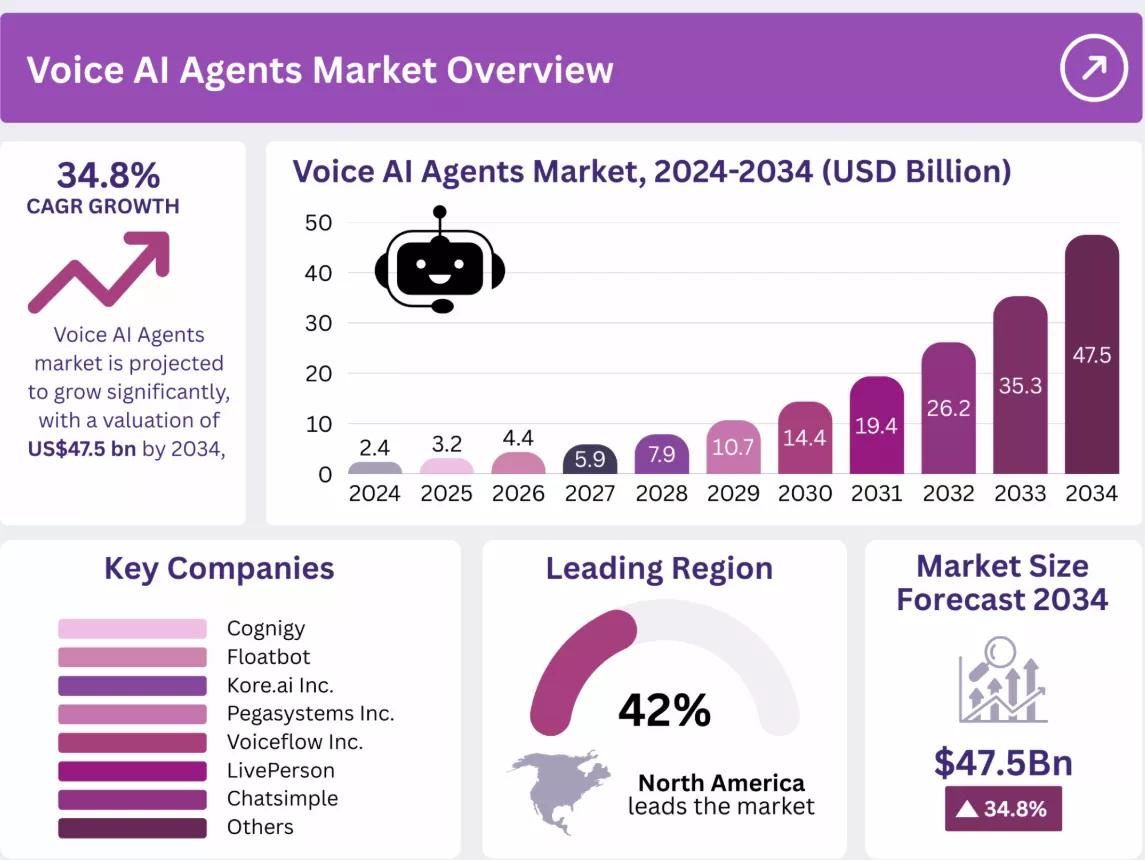
According to the latest statistics provided in the report, the global Voice AI Agents market is estimated to expand to $47.5 billion by 2034, showing a CAGR of 34.8%.
This clearly shows that more enterprises choose to implement AI voice agents to optimize processes and save money.
That is why the choice between an AI voice agent vs. traditional IVR has become quite a significant point of discussion now.
A traditional IVR system navigates the calls following a certain menu. On the other hand, AI voice agents perceive the conversation and respond in a natural way, answering the questions and completing the tasks, as well as updating the data in your CRM or booking system automatically.
Both have their place. But choosing the wrong one can increase costs and hurt customer experience. The key is understanding where each one performs best and what the real costs look like beyond the initial investment.
In this guide, you'll learn:
- What traditional IVR systems and AI voice agents are
- The 12 biggest differences between them
- How AI voice agents work behind the scenes
- Cost, ROI, benefits, and industry use cases
- When IVR is still the better choice
- Real-World Case Study
- How to migrate without disrupting your customer experience
By the end, you'll have a clear framework for deciding which solution best fits your business, budget, call volume, and long-term customer service strategy.
AI Voice Agent vs. Traditional IVR Systems: Quick Comparison
Here is the whole AI voice agent vs. traditional IVR systems debate compressed into one scannable view:
| Capability | Traditional IVR System | AI Voice Agent |
|---|---|---|
| Core logic | Deterministic rule tree | Probabilistic intent detection |
| Caller input | Keypad presses, fixed commands | Free-form natural speech |
| Understanding | Keyword and tone matching | Contextual intent extraction |
| Memory | None across the call | Full conversation context |
| Main job | Route the call | Resolve the call |
| Multilingual | Separate recorded library per language | Automatic detection and mid-call switching |
| Integration | Basic database lookups | Live API reads and writes |
| Personalization | Static, scripted greeting | Adaptive, history-aware |
| Off-script handling | Falls back or transfers | Clarifies and recovers |
| Changes | Reprogramme and re-record | Configuration update |
| Analytics | Menu paths and call duration | Transcripts, intent, sentiment, outcomes |
| Build time | 6 to 12 weeks | 3 to 6 weeks |
| Best for | Simple, high-volume routing | Varied, high-value conversations |
Not Sure Which Solution Fits Your Business?
Every business has different call volumes, workflows, compliance requirements, and customer expectations. Our AI consultants can evaluate your existing IVR or contact center and recommend whether a Traditional IVR, AI Voice Agent, or Hybrid solution will deliver the best ROI.
What Is a Traditional IVR System?
Traditional IVR (Interactive Voice Response) is a telephone-based system which handles calls and provides customers with information through pre-recorded menus. Instead of communicating with a live operator right away, customers choose the right department by pressing numbers on their keypads or using voice instructions.
It is likely you have used it many times already:
"Press 1 for Sales. Press 2 for Support. Press 3 for Billing."
Traditional IVR uses a predetermined decision tree. All customers pass through the same paths that were predefined beforehand. The system is predictable, reliable and consistent.
This makes traditional IVR perfect for dealing with routine tasks like routing calls, providing information about business opening hours and directing customers to the right department.
IVR Workflow
Customer

↓
Press 1
↓
Press 3
↓
Wait
↓
Agent
What Is an AI Voice Agent?
An AI voice agent refers to an intelligent automated voice assistant on the telephone that comprehends conversations naturally and accomplishes various tasks without relying on menu navigation and keypad operations.
The voice assistant no longer asks the user to "Press 1 for Sales," but rather asks the user how it can be of assistance. The users get to talk to the assistant normally while the AI processes the intention of the person and performs the action accordingly by answering questions, booking appointments, looking at the account status, and making changes to the system.
It utilizes speech recognition, natural language understanding, and language models to comprehend the intentions of the person speaking to it and provide a response that feels natural in the conversation.
How an AI Voice Agent Actually Works
AI voice agents integrate different technologies in order to understand callers, make natural responses, and perform actions on their own. Here is how it happens:
  Customer
      │
 Phone Call
      │
 Telephony Provider
      │
 Speech-to-Text
      │
     LLM
      │
 Business Logic
      │
 CRM / ERP / Calendar
      │
 Text-to-Speech
      │
   Customer
1. Receives the Call
Once a customer calls your company, the phone system connects the incoming call to an AI voice agent. The latter receives the call just like a human operator does and may transfer the call to a person if necessary.
2. Converts Speech Into Text
The AI listens to the caller and converts their spoken words into text in real time. This allows it to understand the conversation as the caller is speaking.
3. Understands the Customer's Request
With the help of speech recognition, NLU, and LLMs, the AI determines the customer's requirements. They can include making an appointment, ordering products, or amending accounts, for example.
4. Decides the Best Response
Taking into consideration the customer's request and following business logic, the AI defines what to do next. Should it fail to understand something, the call gets transferred to a human agent automatically.
5. Connects With Business Systems
The artificial intelligence is able to connect to your CRM, ERP, EHR, scheduling application, payments solution or any other business software using APIs. It will help the system to gather information, make updates and perform customer requests.
6. Responds Naturally
Having gathered all the necessary information, the artificial intelligence is able to provide the answer in the form of speech.
7. Learns and Improves Over Time
Each call is being recorded and then reviewed. Companies can learn from common mistakes and train their artificial intelligence.
Related Blog: AI Voice Agents: The Future of 24/7 Customer Service & Support
AI Voice Agent vs. Traditional IVR Systems: 7 Key Differences Explained
Most breakdowns cover four or five points. These are the twelve differences in AI voice agent vs. traditional IVR systems that actually change your outcome, explained side by side.
1. Core Logic: Deterministic Rules vs Probabilistic Intent
An IVR runs on fixed logic. Input one always leads to branch one, which makes behavior perfectly repeatable and perfectly rigid at the same time.
An AI voice agent reasons instead of matching. It evaluates several readings of what the caller said, scores them against context, then commits to the strongest one. That is how it copes with phrasing nobody anticipated.
2. Interaction Model: Keypad Menus vs Natural Speech
With an AI voice agent, the caller simply talks. There is no list to memorise, no hierarchy to decode, and no penalty for describing a problem in messy human language.
Traditional IVR flips that burden onto the caller. You have to listen to every option, translate your problem into the company's categories, and then press the right key before you forget option one.
3. Language Understanding: Keyword Matching vs Intent Detection
IVR listens for triggers. Say a word outside the accepted list, and the system either loops the menu or gives up on you entirely.
Intent detection is a different mechanism. The agent extracts meaning from an incomplete, mid-thought sentence like "yeah so the thing about my bill," then asks one clarifying question and moves forward.
4. Conversation Memory and Context Retention
Ask an AI voice agent for a follow-up, and it remembers everything already said. Callers pivot from scheduling to insurance to billing inside one conversation without ever restarting.
An IVR has no memory at all. Each branch is a fresh start, which is precisely why callers repeat their account number three times in a single interaction.
5. Task Handling: Routing a Call vs Resolving a Call
Routing is the entire IVR job description. It collects a number, plays your hours, drops the caller in a queue, and hands the real work to a person.
Resolution is where the AI voice agent earns its budget. It books the appointment, verifies the coverage, updates the record, and ends the call with the task genuinely finished.
6. Multilingual Support and Language Switching
Every extra language on an IVR means another recorded prompt library, another maintenance burden, and another menu layer bolted onto the front.
An AI voice agent detects the language from the caller's opening words and responds in it. If someone switches mid-sentence, which is normal in multilingual communities, the agent follows without breaking stride.
7. System Integration and Real-Time Data Access
Integration is where the two diverge most sharply in practice. An AI voice agent reads and writes live through APIs. It can quote a real invoice balance or a real open appointment slot mid-conversation.
Most IVR deployments manage only shallow database lookups. Anything richer needs custom development, and the answer still comes back generic because the system cannot interpret what it retrieved.
Real-World Example: Healthcare Provider Reduced Call Volume by 68%
Client Profile
A healthcare provider in the United States was receiving over 18,000 patient calls every month. Appointment scheduling overwhelmed reception staff, leading to long hold times and missed calls. We implemented an AI Voice Agent integrated with their scheduling platform and CRM. Within 90 days, call containment increased from 18% to 71%, while average handle time dropped from 7 minutes to just over 3 minutes.
Challenge
- Long wait times
- Appointment scheduling overload
- High receptionist workload
Solution
- AI Voice Agent
- CRM integration
- Appointment booking automation
- Human escalation for complex cases
Results after 90 Days
| Metric | Before | After |
|---|---|---|
| Call Containment | 18% | 71% |
| Average Handle Time | 7m 10s | 3m 12s |
| Missed Calls | 15% | 2% |
| CSAT | 3.8 | 4.6 |
Decision Frameworks & Matrix
| If your business has... | Recommended |
|---|---|
| Less than 100 calls/day | Traditional IVR |
| Complex conversations | AI Voice Agent |
| Multiple languages | AI Voice Agent |
| Limited budget | IVR |
| Customer support at scale | AI Voice Agent |
| Healthcare workflows | AI Voice Agent |
| High compliance needs | Hybrid |
5 Industry Use Cases for AI Voice Agents
There are several use cases in different industries where AI voice agents are applicable, particularly to organizations that receive many similar customer phone calls.
- Healthcare: Schedule appointments, answer patient queries, verify insurance, deliver medication reminder notifications, and take prescription refill requests.
- Human Resources & Recruiting: Pre-screen candidates, conduct pre-qualification interviews, book candidate appointments, and automatically update candidate records.
- Customer Support in SaaS Companies: Manage password resets, answer billing queries, manage subscriptions and account updates, and resolve other common queries.
- Real Estate: Qualify leads, answer property inquiries, book property visits, and automatically update lead information in CRM. Read more: AI Voice Agents for Real Estate
- Logistics & Delivery: Track orders, inform customers about delivery, deliver shipment status updates, and answer "Where is my order?" calls without any human interaction.
Now that you know where these systems pay off, let's take a look at what each one actually costs to build and run.
AI Voice Agent vs. Traditional IVR Systems: Cost Comparison
Cost is where most AI voice agent vs. traditional IVR systems decisions get made badly, because teams compare purchase prices instead of total cost per outcome.
1. What a Traditional IVR System Costs
IVR front-loads your spend. You pay for licensing, professional services, and flow design upfront, then a modest per-minute rate forever after.
| Cost Component | Typical Range |
|---|---|
| Setup and licensing | $15,000 to $75,000 |
| Monthly platform | $2,000 to $5,000 |
| Per-minute usage | $0.01 to $0.03 |
| Major flow change | $2,000 to $10,000 each |
| Build timeline | 6 to 12 weeks |
The quiet cost has changed. Every policy update, new department, or seasonal campaign means another professional services ticket and another re-recording cycle.
2. What an AI Voice Agent Costs to Build and Run
Voice agents invert the shape. Lower entry cost, higher per-conversation cost, and dramatically cheaper iteration once you are live.
| Cost Component | Typical Range |
|---|---|
| Discovery and conversation design | $3,000 to $10,000 |
| Build and integration | $10,000 to $60,000 |
| Monthly platform and infrastructure | $1,000 to $4,000 |
| Per-conversation cost | $0.40 to $2.00 |
| Annual tuning and monitoring | 15% to 25% of the build |
| Build timeline | 3 to 6 weeks |
Integration depth drives the build range more than anything else. A single-intent agent on one calendar sits at the bottom, while a multi-intent agent across EHR, CRM, and billing sits at the top.
3. Total Cost of Ownership Side by Side
Model a realistic month, not a price list. Here are 10,000 inbound calls with both systems doing their honest best.
| Line Item | Traditional IVR | AI Voice Agent |
|---|---|---|
| Platform and usage | $2,500 to $6,500 | $6,000 to $23,000 |
| Calls reaching humans | 30% to 40% | 10% to 15% |
| Human handling cost | $15,000 to $25,000 | $5,000 to $8,000 |
| Change requests | $2,000 to $10,000 | Included in tuning |
| Total monthly | $19,500 to $41,500 | $11,000 to $31,000 |
| Calls actually resolved | Routing only | End to end |
The lesson sits in the escalation row. IVR looks cheaper until you price the humans it hands work to, and that is the line most vendor comparisons leave out.
Why Businesses Choose Ciphernutz for AI Voice Agent Development
You can win the AI voice agent vs. traditional IVR systems argument on paper and still end up with an agent your customers avoid. Execution is what separates a working phone line from an expensive experiment.
That is where Ciphernutz makes the difference. We build production-grade voice agents that resolve calls end to end, wired into your actual stack rather than a demo environment.
Our AI agent development team designs around your call data, not a template. We start with the intents that carry your volume, run parallel deployment so nothing breaks, and hand you the containment numbers before you retire anything.
What makes us stand out:
- Fixed-scope delivery: Production-ready voice agents in 3 to 6 weeks, not open-ended discovery
- Deep integration work: Live connections into EHR, CRM, ERP, and scheduling systems
- Compliance-ready builds: HIPAA-aligned architecture and self-hosted deployment for data sovereignty
- Measurable outcomes: 10K+ hours saved annually across live automation deployments
- Zero templates: Every agent built around your stack, your callers, and your escalation rules
Transform Your Customer Calls with AI Voice Agents
Whether you're replacing an outdated IVR system or building an AI-powered customer service experience from scratch, our team can help you design, develop, integrate, and deploy production-ready AI Voice Agents tailored to your business.
Conclusion
The decision between an AI voice agent and a traditional IVR system is not really about technology. It is about what you want your phone system to do: route callers or resolve their problems.
IVR still earns its place when your volume is low, your language is single, and your calls fit a clean tree. The moment your callers go off-script, speak different languages, or hang up before they reach anyone, that tree becomes the thing costing you customers.
We hope this guide helped you understand how AI voice agents vs. traditional IVR systems actually differ, what each one costs over time, and how to switch without breaking what already works.
Now it's your turn to look at your own call data. Pull three months of it, find the three intents that carry your volume, and price what those calls cost you today.
Then connect with our experts to map your top intents and model the honest return. We will build you a voice agent that finishes the call instead of passing it on.
Frequently Asked Questions
1. What is the main difference between an AI voice agent and a traditional IVR system?
AI voice agent vs. traditional IVR systems comes down to one thing. An IVR routes calls through fixed keypad menus, while an AI voice agent understands natural speech and resolves the request itself. That gap between routing and resolution shows up in your handle times and abandonment rate.
2. Can an AI voice agent fully replace my IVR system?
Usually, yes, but not all on day one. Most groups keep the IVR system around for queueing, holding, and overflow routing while the agent takes care of the conversational logic. The other branches are gradually decommissioned with containment.
3. How expensive is it to develop an AI voice agent?
An agent with a single intent and one integration costs between $10,000 and $25,000. An agent that uses EHR, CRM, and Billing costs more – around $60,000. The cost is dictated by how deep the integrations are, not conversation design.
4. How quickly can we deploy an AI voice agent?
A well-targeted agent that covers the top three intents should be deployed within 3 to 6 weeks, assuming we have clearly defined requirements. More complex agents with deeper integrations may require additional time, but access to integration is the biggest constraint.
5. Are AI voice agents HIPAA, TCPA, and FDCPA compliant?
Yes, if developed properly. Compliance involves a signed business associate agreement, end-to-end encryption of all data, and outbound calling window enforcement, along with consent tracking and audit.
6. What happens when an AI voice agent cannot answer a question?
A well-built agent recognizes its own limits, says so plainly, and transfers to a human with the full conversation summary attached. That escalation design matters more than raw accuracy, because callers forgive a clean handoff and never forgive a confident wrong answer.
7. Can AI Voice Agents integrate with CRM and business software?
Yes. Modern AI Voice Agents can integrate with CRM, ERP, EHR, scheduling, ticketing, payment, and helpdesk platforms through APIs. This allows the agent to retrieve customer information, update records, schedule appointments, create support tickets, process payments, and automate workflows without requiring manual intervention. The more seamlessly your business systems are connected, the greater the efficiency and customer experience improvements.
8. What industries benefit the most from AI Voice Agents?
AI Voice Agents deliver the highest ROI in industries that handle large volumes of repetitive customer calls. Healthcare, real estate, logistics, banking, insurance, SaaS, retail, and field service businesses commonly use AI Voice Agents to automate appointment scheduling, lead qualification, order tracking, payment reminders, customer support, and account management while reducing operational costs and improving customer satisfaction.
9. Can AI Voice Agents make outbound calls?
Yes. AI Voice Agents can automate outbound calls for appointment reminders, payment collections, lead qualification, customer follow-ups, surveys, renewals, and sales outreach. They can personalize conversations using CRM data and transfer qualified prospects or complex requests to human agents whenever required, helping businesses improve efficiency while maintaining a better customer experience.