Assistive AI vs Generative AI: What's the Difference?
Vijay Vamja
8-10 mins
Artificial intelligence is no longer one single concept. It has evolved into different forms, each solving a different kind of problem.
This is where most businesses get confused.
They hear terms like Assistive AI and Generative AI development used interchangeably, even though both use advanced machine learning, yet they serve very different purposes.
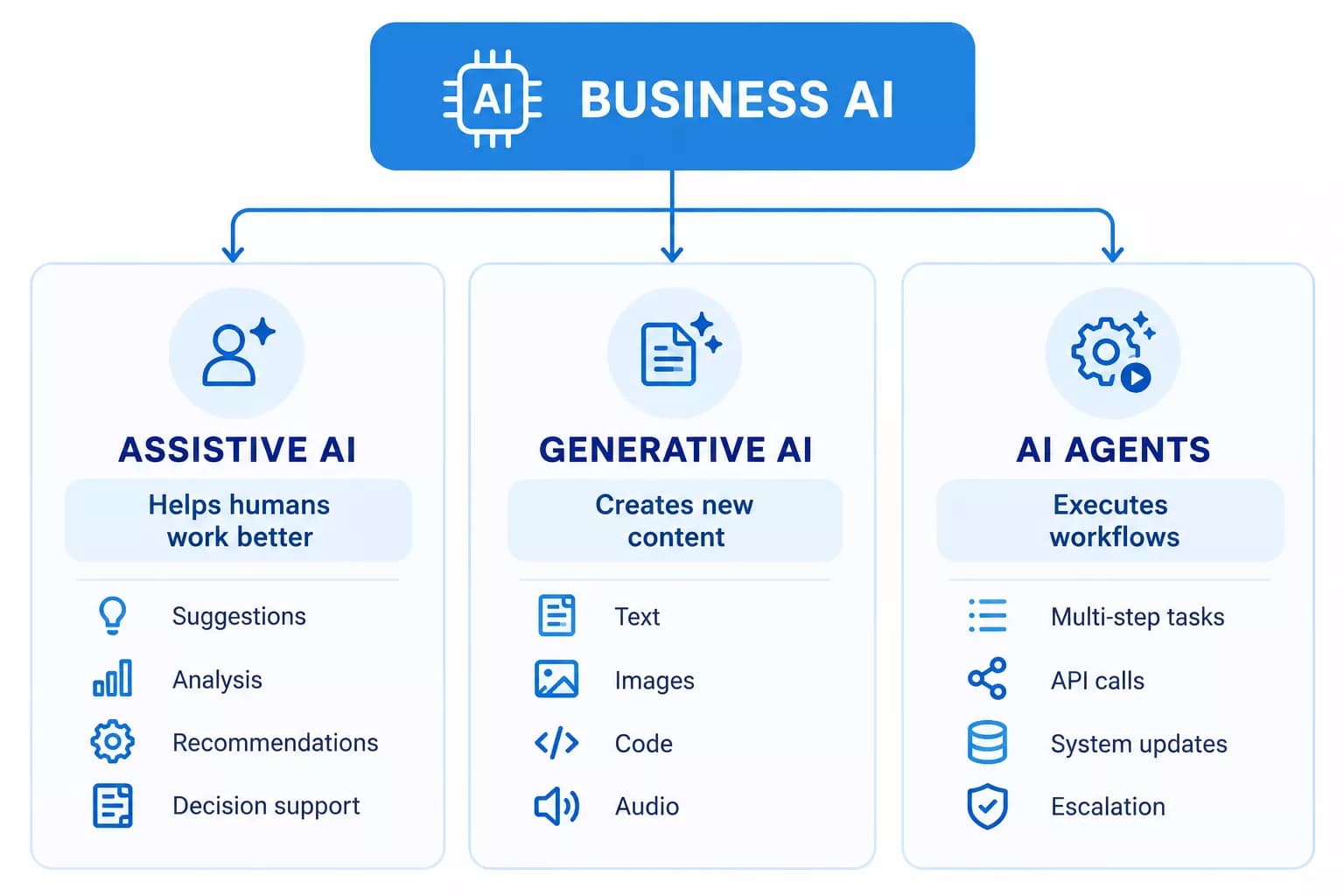
Assistive AI is designed to enhance human productivity. It works by automating routine tasks, organizing information, and refining existing work. The goal is efficiency. It supports people without taking control away from them.
While Generative AI works differently. It creates entirely new content, such as text, images, code, or ideas based on user prompts. Instead of refining what already exists, it produces original output on demand.
What is Assistive AI?
Assistive AI is a type of artificial intelligence designed to help people work better. Its role is to support people during tasks by improving speed, accuracy, and decision-making while keeping full human control.
You can think of it as a digital co-pilot that helps people work faster and with more confidence.
Instead of generating entirely new outputs, Assistive AI focuses on enhancing existing work. It automates repetitive steps, organizes information, highlights insights, and provides recommendations when needed.
What makes Assistive AI valuable is how it fits into real workflows. It does not disrupt processes or replace roles. It quietly removes friction and reduces effort.
Tools like grammar checkers or data analysis assistants are common examples where AI supports the user without taking control.
How Does Assistive AI Work?
Assistive AI works by observing, understanding, and supporting human actions in real time. It does not operate independently. It responds to the user's input and enhances their work.
How it works:
- Collects input: Takes data from text, voice, images, on-screen actions, or sensors.
- Understands intent: Uses machine learning to recognize patterns and user intent.
- Processes information: Applies Natural Language Processing to interpret spoken or written input. And uses computer vision to analyze images, visuals, or surroundings.
- Adds context: Learns from user behavior and preferences over time.
- Delivers assistance: Provides suggestions, corrections, summaries, or guidance.
Overall, Assistive AI exists to support humans, not replace them. It enhances work in real time while keeping control and decisions firmly with people.
What is Generative AI?
Generative AI is a type of artificial intelligence that creates new content. It can generate text, images, code, audio, and video by learning patterns from very large datasets.
Instead of analyzing or classifying existing data, Generative AI learns patterns from very large datasets and then uses those patterns to produce new output. The content it generated did not exist before the prompt was given.
Unlike traditional AI systems that focus on analyzing, sorting, or classifying information, Generative AI is designed for creation. It uses advanced deep learning techniques to understand structure, context, and relationships in data.
Which allows it to generate content that feels natural, creative, and often close to human-made work.
This is what separates Generative AI from traditional AI systems. Traditional AI focuses on prediction, classification, or decision support. Generative AI focuses on creation.
Businesses looking to identify practical use cases and determine how Generative AI can fit into their operations can benefit from AI consulting services.
How Does Generative AI Work?
Generative AI works by learning how content is created and then using that learning to produce new, original output when prompted.
Here's how it works:
- Data collection: Generative AI relies on large and diverse datasets such as text, images, or audio to learn patterns and structure.
- Model training: The collected data is used to train the model, helping it understand relationships and generalize beyond specific examples.
- Neural networks: Neural networks process the data through multiple layers, enabling the model to capture complex patterns and dependencies.
- Latent representation: The model compresses learned information into an internal representation that captures essential features and variations.
- Variational Autoencoders: VAEs introduce probability into generation, allowing the model to create multiple varied outputs from the same input.
- Generative Adversarial Networks: GANs use two competing networks, one generating content and the other judging realism, to improve output quality.
- Iterative refinement: The model continuously improves through feedback, adjusting parameters to produce more accurate and natural results.
- Output generation: After training, the model generates original content based on learned patterns and the user’s input prompt.
In short, Generative AI learns from existing data and creates new content when prompted. Humans provide direction, and the AI produces the output.
Assistive AI vs Generative AI: Key Differences
Assistive AI vs Generative AI are not competing choices. Each serves a different purpose and can even work together. To choose the right approach, it is important to understand how they differ in goals, behavior, and real-world use.
Here's the detailed comparison between them:
1. Core Purpose
Assistive AI is designed to help humans perform tasks better by improving accuracy, speed, and decision quality. It works within clear boundaries and supports existing workflows.
Generative AI is designed to create new content by learning patterns from large datasets and producing original output.
2. Uses
Assistive AI is used where support and reliability matter, such as analysis, recommendations, and accessibility tools. It enhances how people work without changing ownership of outcomes.
Generative AI is used where creation is needed, such as content generation, design, code writing, and idea exploration.
3. Performance and Efficiency
Assistive AI is efficient because it focuses on specific tasks and delivers predictable results. It requires less computing power and responds quickly in real-time scenarios.
Generative AI consumes more resources due to complex models and longer processing for creative output.
4. Data Requirements
Assistive AI can operate effectively with smaller and more structured datasets. It often relies on task context and user signals rather than massive training data.
Generative AI depends on very large and diverse datasets to learn patterns and generate high-quality output.
5. Human Control and Oversight
Assistive AI keeps humans in full control throughout the process. It provides suggestions and insights but does not act independently.
Generative AI generates output on its own after a prompt, which makes human review essential before use.
6. Technologies
Assistive AI commonly uses machine learning, natural language understanding, and computer vision to interpret data and support tasks. These technologies focus on analysis and assistance.
Generative AI relies on deep learning models built specifically for content creation and pattern generation.
7. Example Usage
Assistive AI is seen in grammar tools, voice-to-text systems, analytics dashboards, and accessibility software. It improves existing work without replacing it.
Generative AI is seen in chat systems, image generators, code generators, and creative platforms.
8. Input Dependency
Assistive AI depends on continuous user input, context, and interaction to remain effective. It responds as the user works.
Generative AI depends mainly on prompts and generates output independently once triggered.
9. Challenges and Risks
Assistive AI carries a lower risk because its output is limited to guidance and support. Mistakes usually affect efficiency rather than outcomes.
Generative AI carries a higher risk due to hallucinations, bias, and misuse if outputs are not carefully reviewed.
10. Future
Assistive AI will grow as a trusted productivity layer embedded across tools and systems. It will focus on reliability and control.
Generative AI will continue expanding creative capabilities while requiring stronger governance and oversight.
Assistive AI vs Generative AI: Pros and Cons
Here are some pros and cons of Assistive AI and Generative AI:
Assistive AI Pros and Cons
Pros
- Boosts productivity and focus: Assistive AI takes care of repetitive work. This gives people more time for thinking, planning, and making better decisions.
- Improves accuracy and consistency: It reduces everyday mistakes in routine tasks. Results stay more stable over time.
- Supports accessibility and inclusion: Voice tools, screen readers, and captions help more people use technology with ease.
- Provides continuous support: Assistive AI works without breaks. It remains available even outside normal working hours.
- Adapts to how people work: Over time, it learns user behavior. This helps it offer more relevant guidance.
Cons
- Alters the way work roles change: Some work tasks can be automated. This means teams have to retrain and readjust work roles.
- Raises data privacy issues: Assistive AI operates on user data. This can be a problem if not handled properly and can result in security breaches.
- May contain existing biases: If the data used to train it is biased, the output will also reflect this.
- Lacks human understanding: Assistive AI cannot provide empathy or sound judgment in difficult situations.
- May cause overdependence: Overdependence on assistive AI can cause a loss of critical thinking and problem-solving skills.
Generative AI Pros and Cons
Pros
- Speeds up content creation: Generative AI creates text, images, and code quickly. This saves hours of manual work.
- Helps generate new ideas: It supports brainstorming and early drafts. Teams can explore more options in less time.
- Scales output easily: Generative AI can produce large volumes of content. This is useful for growing teams and campaigns.
- Supports learning and understanding: It explains complex topics in simple terms. This helps users learn faster.
- Enables personalization: Generative AI adjusts output based on user input. Content feels more relevant to each user.
Cons
- Generates incorrect information: Some generated information may seem correct, but is not true. This always requires human verification.
- May contain bias: If the training data is biased, the output may contain the same bias.
- May be misused: Generative AI may be used for spreading misinformation or generating fake content. This requires proper regulation.
- Impacts certain job roles: Certain creative and content-related jobs may be impacted. Users may need to reskill and adapt to new requirements.
- High cost and energy consumption: These systems require high computing power. This increases costs.
Assistive AI vs Generative AI: Transforming Industries
Here’s how Assistive AI vs Generative AI transforms major industries:
| Industry | Assistive AI | Generative AI |
|---|---|---|
| Healthcare | Supports diagnosis, risk detection, and patient management | Generates medical reports and research insights |
| Finance | Detects fraud and assists with risk analysis | Creates financial reports and customer content |
| Retail & Ecommerce | Recommends products and manages inventory demand | Generates product content and marketing creatives |
| Manufacturing | Predicts equipment failures and detects defects | Creates design variations and process simulations |
| Education | Assists with grading and supports student learning | Generates lessons, quizzes, and study material |
| Marketing & Media | Analyzes campaign performance and customer behavior | Generates blogs, ads, and creative ideas |
Not sure which type of AI fits your business?
Assistive, generative or agentic - the right choice depends on your workflows, not the hype. Our AI Readiness Audit tells you where AI will actually pay off.
Assistive AI vs Generative AI: Real Use Cases
Assistive AI vs Generative AI use cases highlight how each is used in the real world. Let’s dive in!
Assistive AI
- Healthcare decision support: Helps doctors review reports and scans faster. Doctors use this support to make better treatment decisions.
- Clinical documentation and scribing: Writes medical notes during patient visits automatically. Doctors spend less time on paperwork.
- Business productivity support: Helps with emails, meeting summaries, and task planning. Teams focus more on important work.
- Customer support assistance: Answers common questions and sorts support tickets. Humans handle complex cases.
- Accessibility tools: Converts speech to text and reads screens aloud. This helps people use technology independently.
- Predictive monitoring and maintenance: Detects early signs of system or machine failure. This prevents breakdowns and downtime.
Generative AI
- Content creation at scale: Helps teams write content and create visuals fast. No need to start from a blank page.
- Customer service and virtual agents: Answer customer questions anytime. Keeps support fast and consistent.
- Software development and coding: Helps write and fix code. Saves developer time on repetitive tasks.
- Design and creative production: Creates design ideas and visuals quickly. Speeds up early creative work.
- Drug discovery and research: Suggests new molecules and research ideas. Helps teams move faster in healthcare.
- Data analysis and summarization: Turns long information into short insights. Makes data easier to understand.
Assistive AI and Generative AI in 2026: What the Data Shows
Enterprise AI Adoption Has Shifted from Pilots to Production
The gap between assistive AI and generative AI now shows up in hard adoption numbers, not just definitions. Stanford HAI's 2026 AI Index Report found that organizational AI adoption reached 88%, with generative AI specifically in regular use in at least one business function at 70% of organizations. Three years ago, most companies were still running pilots.
The Technical Difference Between Assistive AI and Generative AI
The two categories still rest on different technical foundations. Assistive AI often runs on narrow AI models or rule-based systems built for one job, like flagging a fraudulent transaction or scoring a sales lead. Generative AI relies on large language models trained to produce new text, images, code, or audio from a prompt. This LLM vs rule-based AI split, and the broader narrow AI vs generative AI divide, still shapes how procurement and IT teams run an AI automation comparison before buying either type of tool.
Market Growth and Business Value Continue to Accelerate
The value gap is widening too. Stanford HAI's 2026 report estimated that generative AI delivered 172 billion dollars in annual consumer surplus in the United States by early 2026, up from 112 billion dollars a year earlier, with the median value per user roughly tripling. On the assistive AI side, Microsoft told investors on its fiscal Q3 2026 earnings call, held April 29, 2026, that Microsoft 365 Copilot had passed 20 million paid seats, up from 15 million the previous quarter, showing how fast copilot AI has moved into daily workplace use.
Assistive AI Tools for Productivity in 2026
Businesses researching assistive AI tools for productivity in 2026 tend to start with tools that sit inside a workflow they already use, rather than tools that replace it. This is AI augmentation in practice: the software extends a person's judgment instead of acting on its own.
- Microsoft 365 Copilot: embedded in Word, Excel, Outlook, and Teams; Microsoft reported over 20 million paid seats as of its April 2026 earnings call.
- GitHub Copilot: an assistive coding tool that suggests code for a developer to review and approve, rather than shipping code unsupervised.
- Grammarly Business: reviews tone, clarity, and grammar while keeping a human writer as the final decision-maker.
- Meeting assistants such as Otter.ai: transcribe calls, tag speakers, and surface action items without generating new decisions on a team's behalf.
Each of these tools performs AI decision support rather than autonomous content creation, which is the defining trait of assistive AI: it improves a task a person is already doing. Businesses that need a custom assistive layer built around their own data, rather than an off-the-shelf tool, typically work with a partner on AI agent development or agentic AI solutions.
Generative AI Examples for Business in 2026
Generative AI examples for business have moved well beyond chatbots. McKinsey's State of AI survey (2025) found that 63% of organizations using generative AI apply it to create text outputs, while more than a third generate images and more than a quarter generate code.
- Marketing content creation: drafting blog posts, ad copy, and email sequences from a brief, then editing for brand voice before publishing.
- Software development: generating first-draft code and documentation that a developer reviews before it ships.
- Customer service drafting: producing draft responses that a support agent edits and approves before a customer sees them.
- Synthetic data generation: creating privacy-safe data to fill gaps in a dataset. Gartner projects 75% of businesses will use generative AI for synthetic customer data by 2026, up from under 5% in 2023.
These generative AI examples for business only pay off when a company redesigns the workflow around the tool instead of layering it onto an existing process. McKinsey's research found that workflow redesign has the single biggest effect on whether a company sees measurable financial impact from generative AI. Businesses testing a first use case can start with a scoped generative AI development engagement rather than a company-wide rollout.
Choosing Between Assistive AI and Generative AI for Your Business
Match the AI Model to the Nature of the Work
The difference between assistive and generative AI comes down to one question: does the task need a human to stay in the loop, or does it need new content produced at scale? Assistive AI fits work where accuracy and accountability matter more than speed, such as compliance review, data validation, or decision support. Generative AI fits work where original output at volume matters more, such as content creation, code drafting, or campaign variation.
Why Most Organizations Need Both Assistive and Generative AI
Most businesses will not choose only one. Many assistive AI tools already run on generative AI or LLM-based components underneath, so the practical question for 2026 is less assistive AI vs generative AI and more about where each type of AI belongs in a workflow, and who reviews its output before it reaches a customer.
Assess AI Readiness Before Scaling Enterprise Adoption
For businesses still mapping that decision, a short structured audit is usually faster than trial and error. Book an AI Readiness Audit to identify which workflows are ready for assistive AI, which are ready for generative AI, and where the two should work together.
Turn the theory into a plan
Get a clear, prioritised AI roadmap for your business with our fixed-price USD 999 AI Readiness Audit.
Conclusion
Assistive AI vs Generative AI serve very different roles. One helps people work better. The other creates new content. Understanding this difference is what helps businesses make the right choice.
We hope this guide helped you clearly understand what Assistive AI and Generative AI are, how they work, where they fit, and how to choose between them with confidence.
Choose the AI approach that fits your needs today, and hire AI developers to handle your AI project from planning and development to deployment.
FAQs
What is the core difference between Assistive AI and Generative AI?
Assistive AI is built to help people do their work better. It supports tasks, reduces effort, and improves accuracy while humans stay in control. Generative AI works differently. It creates new content like text, images, or code based on a prompt.
How do I decide whether my business needs Assistive AI or Generative AI?
Start by looking at your daily work. If your teams need help with efficiency, reviews, or decision support, Assistive AI is the right fit. If your business needs content, ideas, or output at scale, Generative AI makes more sense. Many companies use both for different needs.
Is Generative AI riskier than Assistive AI for business use?
Yes, it can be. Generative AI may sometimes produce information that sounds correct but is not. This makes human review important. Assistive AI is usually safer because it supports people instead of acting on its own.
Can Assistive AI and Generative AI be used together?
Yes. In fact, many teams already do this. Assistive AI helps manage workflows and decisions. Generative AI helps create content and ideas. Used together, they balance speed with control.
Does Generative AI replace human jobs or creativity?
No. Generative AI supports people rather than replacing them. Humans still guide the work, review outputs, and make final decisions. Creativity and judgment remain human strengths.
Which AI type works better for regulated industries like healthcare or finance?
Assistive AI is usually the safer option in regulated fields. It helps professionals without taking control away from them. Generative AI can be used, but only with strong checks and approvals.
Why does Generative AI require more data and computing power?
Generative AI needs to learn from very large datasets to create realistic output. Training and running these models requires strong computing resources, which makes them more complex and costly.
What is the biggest mistake businesses make when adopting AI today?
The biggest mistake is treating all AI as the same. Without understanding the difference between Assistive AI and Generative AI, businesses often choose the wrong approach and miss real value.