Enterprise AI Readiness Audit: What Organizations Get Wrong Before They Build
Dharmesh Dave
4-6 minutes
Most enterprise AI initiatives do not fail because the technology did not perform. They fail because the organization was not structurally prepared to support the technology when it did. Such fragmented data environments, undefined workflows, absent governance controls, and integration surfaces were only assumed functional but had never been tested under AI workloads.
These are the fault lines that swallow AI pilots. An enterprise AI readiness audit is a structured process for identifying such faults and flaws in an integrated AI system or AI architecture.
This blog covers what the audit actually measures, along with where most organizations sit on the AI maturity spectrum.
The Operational AI Readiness Gap: A Framework for What's Actually Failing
Before examining what an enterprise AI readiness audit covers, it is worth naming the underlying problem precisely.
Most organizations approaching AI deployment operate under a set of working assumptions:
- that their data is reasonably clean,
- that their workflows are documentable,
- that their infrastructure can support the integration requirements,
- and that governance can be addressed after the pilot succeeds.
The distance between these assumptions and operational reality is what we call the Operational AI Readiness Gap (OARG).
Again, the OARG is not a technology gap but a structural gap, and it is measurable across four dimensions:
- Data Coherence Index: The degree to which your data environment produces consistent, lineage-traceable inputs that AI systems can act on reliably.
- Infrastructure Interoperability Quotient: Whether your current AI infrastructure and connected systems can coordinate at the format, latency, and authentication requirements that modern AI workflows demand.
- Process Formalization Rate: The percentage of target workflows that are documented, exception-mapped, and defined clearly enough to support automation.
- Governance Activation Level: Whether governance controls (logging, permissions, escalation paths, compliance mapping) are implemented architecturally, not just written as policy.
Organizations that score below threshold in two or more of these dimensions are at structural risk of AI deployment failure. An enterprise AI readiness audit measures each dimension, identifies the specific gaps, and produces a remediation sequence before capital is committed to implementation.
What an Enterprise AI Readiness Audit Actually Examines
An AI readiness assessment is a multi-layer diagnostic process. Each layer is examined for whether it can independently block an AI initiative. Typically, audits that fail to surface real problems are examining only one or two of these layers.
Layer 1: Data Environment and Source-of-Truth Fragmentation
Every AI deployment depends on the quality, consistency, and accessibility of the data it operates on. This is the layer organizations most reliably overestimate. 60% of AI projects will collapse/abandon by the end of 2026 if unsupported by AI-ready data.
Hence, a rigorous AI data audit evaluates:
- Where primary data assets live and who controls schema updates
- Whether data pipelines support the real-time or near-real-time inference your use cases require
- Conflict rates between systems of record and how discrepancies are currently resolved
- Whether data lineage is documented to a level that supports model traceability and compliance audit
- Whether existing data governance policies are compatible with LLM ingestion requirements and token-level access controls
Source-of-truth fragmentation is one of the most underestimated failure vectors in enterprise AI.
When your CRM and your ERP disagree on the same customer record, your AI system will choose one. It will not flag the conflict. It will not ask for clarification. It will act, and neither team will know which source it trusted.
Layer 2: AI Infrastructure and Integration Architecture
As per a study, more than 80% of corporate AI projects never scale beyond proof-of-concept due to execution/architecture gaps. This is because a functional AI infrastructure is not simply a matter of compute capacity.
What's essential is whether your systems can coordinate at the protocols, authentication models, and data serialization formats that AI orchestration requires.
This layer of the enterprise AI readiness audit evaluates:
- API availability, versioning stability, and rate-limit tolerance across core platforms
- Webhook support and event-driven capabilities in legacy or heavily customized systems
- Latency tolerance between your processing layer and the AI systems that depend on it
- Authentication and authorization protocols at system-to-system boundaries
- Whether your current architecture can support structured tool calling without custom middleware for every integration point
Organizations with legacy ERP systems or deeply customized platforms consistently discover that their integration surface area is significantly more constrained than their vendor agreements suggest. This discovery from an AI systems audit costs far less in week one than it costs in week twelve of an implementation.
Layer 3: Workflow Orchestration and Process Definition
The principle here is direct: you cannot automate what has not been defined. This is the clause most enterprise AI strategies violate most often. Case in point, 88% of organizations use AI regularly, but only ~33% have scaled AI programs. This establishes that the blocker is operational/workflow readiness, not model capability.
Solving this problem requires a robust workflow intelligence infrastructure. It consists of developing the correct combination of orchestration tooling, formal decision logic, and exception management architecture that makes AI automation sustainable rather than brittle.
The enterprise AI readiness audit for this layer examines your target workflows for:
- Whether processes exist as documented decision trees or only as tribal knowledge
- The exception handling paths that currently involve human judgment and the criteria that trigger them
- Multi-system coordination requirements within single workflow executions
- Approval hierarchies and escalation triggers that must be preserved under automation
- Steps that require contextual organizational judgment that AI cannot replicate
When an organization attempts to automate an undefined process, the result is automated confusion at scale. The audit separates automation-ready workflows from those requiring process formalization first, and sequences the work accordingly.
Layer 4: Agent Architecture and Permission Surface
If your enterprise AI strategy includes autonomous agents, the readiness requirements increase substantially. Agents operating with broad tool access and no defined permission boundaries are not autonomous systems; they are unmonitored ones.
Only 1 in 5 companies (20%) has a mature governance model for autonomous AI agents, meaning over 80% of companies are operating on the proverbial hail mary pass.
Thus, an AI agent performance audit also examines:
- What tool access each agent is configured to use and whether those permissions are scoped to minimum necessary access
- Whether multi-agent orchestration handles task coordination across concurrent executions without permission collisions
- How agent memory is managed across sessions and whether session context creates inappropriate persistence of sensitive data
- Whether agents have structured escalation paths for decisions that fall outside their operational parameters
- How agent outputs are logged with sufficient trace data to support audit and compliance review
Agent governance is an audit category that most AI framework assessments underweight. The permission surface of an agentic system is the total set of actions that system can take. Every tool access point is a potential failure mode or security exposure. Mapping that surface before deployment is not optional governance hygiene; it is foundational architecture.
Layer 5: Observability, Governance, and Compliance Architecture
The AI Governance Surface Area is the complete set of points in your AI architecture that dictates the actions to be taken at certain steps. For instance, it applies at points where a decision, data flow, or automated action can fail, be exploited, go unmonitored, or require human accountability.
Most organizations have not mapped this surface, because they have not yet needed to. For perspective, 63% of organisations that experienced AI-related breaches either have no AI governance policy or are still developing one, leaving systems severely vulnerable to threats.
Hence, this layer of the audit evaluates:
- Whether AI model outputs are logged with sufficient trace data for internal audit and external regulatory review
- How your compliance obligations (GDPR, HIPAA, SOC 2) map to the specific data flows within your proposed AI architecture
- Whether human-in-the-loop architecture is defined for high-stakes decision categories, and whether the trigger criteria are specific or vague
- How failure recovery is handled when an AI-driven process produces an incorrect or out-of-bounds output
- Whether token usage, model API costs, and inference calls are instrumented and visible to the teams responsible for financial and operational oversight
Governance is not a post-deployment concern to be addressed once the pilot proves value. It is an architectural decision. An enterprise AI readiness audit surfaces the governance gaps before they become operational incidents or regulatory exposure.
The AI Maturity Model: Where Organizations Actually Stand
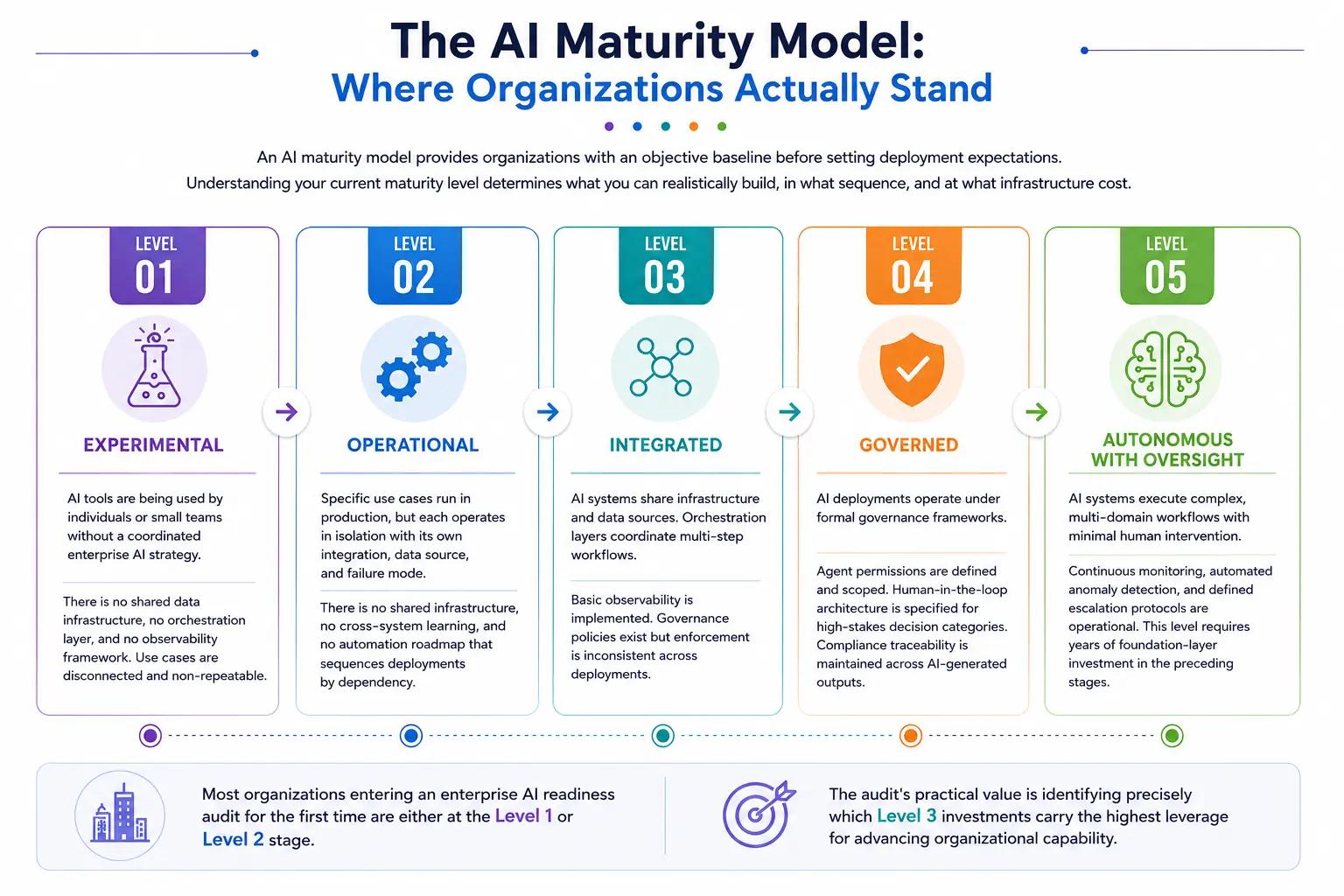
An AI maturity model provides organizations with an objective baseline before setting deployment expectations. Understanding your current maturity level determines what you can realistically build, in what sequence, and at what infrastructure cost.
Level 1: Experimental
AI tools are being used by individuals or small teams without a coordinated enterprise AI strategy. There is no shared data infrastructure, no orchestration layer, and no observability framework. Use cases are disconnected and non-repeatable.
Level 2: Operational
Specific use cases run in production, but each operates in isolation with its own integration, data source, and failure mode. There is no shared infrastructure, no cross-system learning, and no automation roadmap that sequences deployments by dependency.
Level 3: Integrated
AI systems share infrastructure and data sources. Orchestration layers coordinate multi-step workflows. Basic observability is implemented. Governance policies exist but enforcement is inconsistent across deployments.
Level 4: Governed
AI deployments operate under formal governance frameworks. Agent permissions are defined and scoped. Human-in-the-loop architecture is specified for high-stakes decision categories. Compliance traceability is maintained across AI-generated outputs.
Level 5: Autonomous with Oversight
AI systems execute complex, multi-domain workflows with minimal human intervention. Continuous monitoring, automated anomaly detection, and defined escalation protocols are operational. This level requires years of foundation-layer investment in the preceding stages.
Most organizations entering an enterprise AI readiness audit for the first time are either at the Level 1 or Level 2 stage.
The audit's practical value is identifying precisely which Level 3 investments carry the highest leverage for advancing organizational capability.
Five Questions the Audit Must Answer
A credible enterprise AI readiness audit produces clear, evidence-based answers to the following. If your current assessment process cannot answer these with operational specificity, it is discovery work, not a readiness audit.
- Which workflows are automation-ready today, and which require process definition before automation is viable?
- Where are the data gaps that will produce retrieval failures, hallucinated outputs, or stale context in production?
- What is the governance surface area of the proposed AI architecture, and which controls are currently absent?
- Which systems in the current stack will create integration bottlenecks, and what is the remediation cost before AI deployment can proceed?
- What does the sequenced automation roadmap look like, ordered by technical dependencies and business impact?
The audit deliverable answers all five with operational evidence drawn from your actual systems, workflows, and data environment.
Building the Automation Roadmap After the Audit
The deliverable from a well-executed enterprise AI readiness audit is not an opportunity list. It is a sequenced automation roadmap: a phased deployment plan ordered by three criteria that matter in enterprise contexts.
Technical dependency determines the correct sequencing. A retrieval-augmented knowledge assistant requires a reliable data retrieval layer before it can be deployed. An autonomous agent requires scoped permissions, defined escalation logic, and observability instrumentation before it should operate in a production workflow. (Skipping these prerequisites does not accelerate delivery; it accelerates the timeline to a failed pilot.)
Business impact determines which automations justify early investment. Processes that carry high manual cost, high error risk, or direct revenue impact are prioritized over internal convenience automations that are easier to build but less valuable to operate.
Reversibility determines risk sequencing. High-stakes automations with low reversibility belong later in the roadmap, not earlier, regardless of their business impact score. The automation roadmap should be structured so that early wins produce compounding organizational confidence rather than compounding technical debt.
An AI framework assessment that produces a generic list of automation opportunities without dependency sequencing is not a strategic document. It is a marketing document for the implementation that follows.
How Ciphernutz Conducts an Enterprise AI Readiness Audit
Ciphernutz has built production AI systems, agentic workflows, and enterprise automation infrastructure across healthcare, SaaS, logistics, and e-commerce. Our enterprise AI readiness audit methodology is grounded in operational experience, not framework theory.
What the Audit Covers
Every enterprise AI readiness audit at Ciphernutz is conducted by engineers and AI architects who have deployed production systems, debugged workflow failures, and rebuilt architectures. This foundational step performs the following AI audit procedures across the four week timeline.
Week 1: Diagnostic and Data Environment Mapping
We audit your data pipelines, API surfaces, systems of record, and integration architecture. We map source-of-truth conflicts and identify retrieval gaps that would directly affect AI output quality in your target use cases.
Week 2: Workflow and Process Formalization Review
We assess your target workflows for automation readiness against the Process Formalization Rate dimension of the OARG Model. We document undefined decision points and flag processes that require standardization before automation is viable.
Week 3: Agent and Governance Architecture Assessment
We evaluate your existing or proposed AI agent configurations, tool access permissions, and escalation logic. We map your AI Governance Surface Area against your compliance obligations and identify the control gaps that represent the highest operational and regulatory risk.
Week 4: Readiness Report and Sequenced Automation Roadmap
We deliver a scored assessment across all four OARG dimensions, a gap remediation plan with prioritized actions, and a phased automation roadmap sequenced by technical dependencies and business impact.
Know If Your Organization Is Actually Ready for AI
Booking your Enterprise AI Readiness Audit with Ciphernutz is the quickest and best way to determine the operational clarity your implementation requires.
Frequently Asked Questions
What is an enterprise AI readiness audit?
An enterprise AI readiness audit is a structured operational assessment that evaluates whether an organization's data environment, infrastructure, workflows, and governance frameworks are capable of supporting AI deployment at the required scale and reliability. It is not a vendor evaluation or a technology demo; it is a diagnostic process that examines the foundational prerequisites for sustainable AI implementation before development begins.
How is an AI readiness assessment different from a strategy workshop?
A strategy workshop identifies what you want to do with AI. An AI readiness assessment determines whether your organization can actually do it, and at what structural cost. The assessment is diagnostic and evidence-based. The workshop is directional. Both have value, but in the wrong sequence, a strategy workshop becomes expensive guesswork followed by an expensive correction.
What governance gaps does the audit typically uncover?
Common findings include absent agent permission frameworks, missing observability and logging instrumentation, undefined human-in-the-loop triggers for high-stakes decision categories, compliance mismatches between AI data flows and regulatory requirements (GDPR, HIPAA, SOC 2), and no formal escalation path when AI-generated outputs fall outside expected operational parameters.
How does workflow orchestration affect AI readiness?
Workflow orchestration is the coordination layer that allows multiple AI tools, APIs, and human touchpoints to operate as a coherent system rather than isolated processes. Organizations without a functional orchestration layer, or with workflows that exist only as institutional knowledge, cannot support multi-step AI automation at an enterprise level. The audit identifies which workflows require orchestration infrastructure and which require process formalization before orchestration becomes possible.
What does the AI maturity model tell us about deployment timing?
The AI maturity model gives organizations an objective baseline for deployment expectations. Organizations at Level 1 or 2 attempting Level 4 or 5 architectures without the prerequisite infrastructure will almost always fail. The model helps set realistic sequencing for what gets built, in what order, and what enabling investments are required before the next level is viable.
How does an AI agent performance audit differ from a general AI systems audit?
An AI agent performance audit focuses specifically on agent-level configurations: tool access scope, memory management across sessions, multi-agent coordination logic, escalation path definitions, and permission surface mapping. A general AI systems audit covers the broader infrastructure, data environment, and governance architecture. A complete enterprise AI readiness audit includes both.
Is an enterprise AI readiness audit necessary if we have already started a pilot?
Yes, particularly if the pilot was initiated without a formal readiness process. A mid-deployment audit surfaces the structural risks that the pilot has not yet encountered but will. It is significantly less expensive to identify and remediate these risks during a pilot than during a scaled production deployment. The audit is not only a pre-deployment instrument; it is also a course-correction instrument.