How Multi-Agent Systems Are Changing Enterprise Automation
Vijay Vamja
7-8 mins
Enterprise automation has evolved far beyond RPA bots and linear workflows after the rise of multi-agent AI in enterprise operations. The multi-agent AI is fundamentally an interconnected ecosystem of autonomous agents that think, reason, and collaborate in real time. Each agent in a multi-agent AI system performs a specific function but collectively contributes to shared business objectives, creating an intelligent, adaptive network.
This shift isn’t theoretical anymore, it’s practical and measurable. Leading organizations like Microsoft are already using multi-agent AI development services to decentralize decision-making, accelerate operational speed, and improve ROI through context-aware automation.
At Ciphernutz, we help global enterprises adopt this next-generation approach by building adaptive, multi-agent ecosystems that integrate logic, learning, and human judgment into a cohesive automation layer.
What Is a Multi-Agent AI System?
A multi-agent AI system is a distributed network of intelligent agents, i.e., autonomous software entities that perceive, reason, and act within a shared environment. Often, these systems are also referred to as Agentic AI systems.
Unlike a single AI model focused on one task, multi-agent systems break large objectives into smaller, cooperative subtasks handled by different agents.
Each agent is tasked to operate independently but also communicate with others to achieve broader and common goals. This coordination makes them ideal for enterprise automation, where multiple departments, APIs, and workflows must function harmoniously.
For example:
- In healthcare, one AI agent extracts patient data, another analyzes risk, and the third AI agent altogether coordinates appointment scheduling.
- In HR, one agent filters resumes, another ranks candidates, and the third AI agent initiates interviews via calendar sync.
This type of multi-agent AI architecture delivers scalability, resilience, and adaptability, which are all keys to achieve modern enterprise success.
If you’re exploring custom AI agent development services, hire an AI Development team to build such frameworks using cloud-native designs, ensuring each agent’s role, communication, and reasoning logic align with your business workflows.
Why Enterprises Are Shifting Toward Multi-Agent AI
Legacy automation tools are notorious for operating in silos, either due to licensing or revenue issues. Regardless of their limitations, they do perform specific tasks but they still struggle with cross-department logic or context transfer. A multi-agent AI system, on the other hand, acts as a connected cognitive layer.
The key drivers behind this shift towards multi-agent AI systems include:
- Scalability: Adding more agents is easier than expanding legacy or monolithic AI systems.
- Resilience: If one agent fails, others compensate dynamically.
- Parallelism: Multiple tasks can run simultaneously without human supervision.
- Context retention: Agents can share memory and learn from previous interactions.
- Human-in-the-loop adaptability: Humans can intervene without breaking workflows.
Enterprises using multi-agent AI development services experience faster process execution, reduced costs, and increased autonomy. These everyday efficiencies transform automation into an intelligent decision fabric rather than a set of static scripts completing tasks one by one.
Types of Hierarchies in Multi-Agent AI Systems
Building an enterprise-ready system requires establishing a well-defined hierarchy that can later also be tweaked or expanded as required. The choice ultimately depends on your organizational structure, compliance needs, data flow requirements, and other particular requirements.
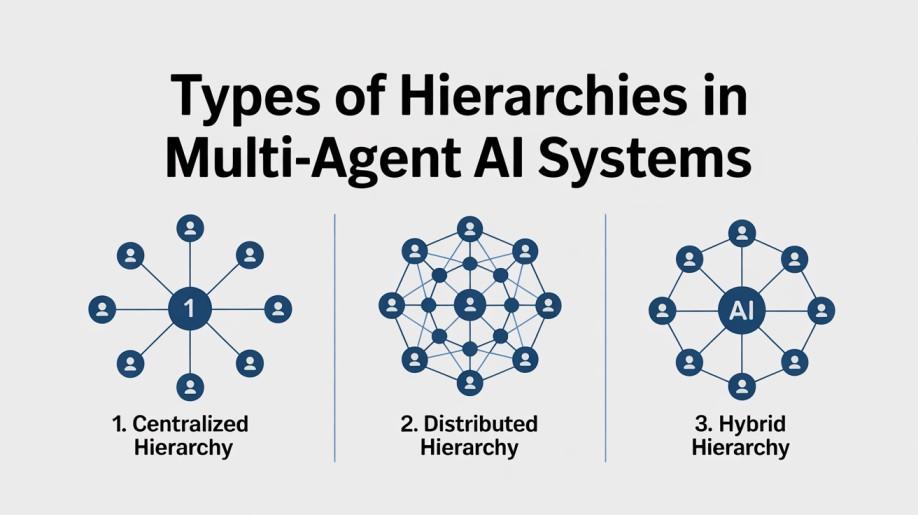
1. Centralized Hierarchy
A “master agent” oversees task distribution, error handling, and data aggregation. This setup ensures strict governance and visibility as they are essentials in industries like banking or healthcare.
2. Distributed Hierarchy
In such AI systems, no single agent dominates. Each AI agent operates independently while maintaining peer-to-peer communication. In turn, this enables rapid scalability and redundancy, making it perfect for SaaS ecosystems or large-scale data platforms.
3. Hybrid Hierarchy
It is the most practical enterprise model that combines centralized coordination with distributed execution. For instance, a supervisor agent assigns goals, but execution agents can act autonomously using internal reasoning after they are token-tuned and custom engineered.
Our AI Consulting Services framework helps clients determine the right hierarchy that balances control, autonomy, and compliance within your operational enterprise ecosystem.
The Core Building Blocks of Multi-Agent Systems
Designing an enterprise-ready multi-agent AI system primarily involves aligning architecture with operational goals. In this pursuit, the following components are essential:
1. Autonomous Agents
Each agent gets & has their own specialized goals (e.g., forecasting, classification, routing) and can adapt using reinforcement or supervised learning models.
2. Communication Protocols
Agents use defined languages (e.g., JSON schemas or custom ontologies) to exchange context efficiently. This ensures real-time collaboration and data consistency between connected global systems.
3. Shared Knowledge Base
A centralized or distributed database that stores memory, experiences, and task history elevates the performance of multi-agent AI systems. This enables agentic AI behavior where agents reason using historical knowledge to collaborate better.
4. Coordination Layer
It handles decision conflicts, prioritization, and task allocation. Some systems use token-based orchestration, whereas others rely on a “supervisory agent.”
5. Integration Layer
Bridges your AI agents with real-world systems such as CRMs, EHRs, APIs, and ERP tools. Here, n8n AI agent integrations play a crucial role by connecting logic flows without needing to hardcode dependencies.
Our Agentic AI Solutions and n8n AI agent workflows integrate these layers using LangGraph, OpenAI Agents SDK, and vector memory databases for ensuring observability and fault tolerance.
Benefits of Agentic AI in Enterprise Automation
Adopting agentic AI delivers enterprise-wide transformation that goes beyond efficiency. The various benefits that your enterprise can obtain by onboarding multi-agent AI system are as follows:
1. Intelligent Parallelism
Agents collaborate to execute parallel sub-tasks (e.g., handling multiple service requests simultaneously). This drastically reduces processing time and latency.
2. Contextual Decision-Making
Each agent is capable of recalling previous outcomes, adapting to new input, and acting in context. This bridges the gap between deterministic automation and reasoning-driven intelligence.
3. Scalability Without Re-Engineering
New agents can be introduced to the system seamlessly. Enterprises can evolve from 5 to 50 agents without needing to rewrite code or retrain models.
4. ROI and Cost Efficiency
Agentic AI ROI is significant when you consider you get lower operational costs, faster cycles, and enhanced customer satisfaction. One client in healthcare saw task turnaround drop from 90 minutes to under 10 using reasoning-based coordination.
Read more: ROI of Agentic AI in Healthcare Automation
5. Human-AI Collaboration
Agents don’t replace humans, they amplify them. For instance, conversational or voice AI recruitment agents can work alongside recruiters to screen candidates or conduct voice interviews through AI voice recruiters.
These advantages make the multi-agent AI development services the most practical path toward digital transformation with measurable returns.
The Role of n8n in Multi-Agent Workflows
n8n AI agent integration adds a crucial orchestration layer for enterprises using multi-agent systems. It enables agents to communicate via predefined workflows, APIs, and webhooks.
Some real-world n8n AI agent use cases include:
- Triggering CRM updates after agent-led email campaigns
- Automating knowledge retrieval through search APIs
- Coordinating between LLM-based and rule-based agents
- Connecting HR AI agents with applicant tracking systems
Ciphernutz leverages n8n AI agent workflows to unify backend logic and automate repetitive agent coordination, while also ensuring low-latency communication (often <300 ms).
Common Challenges in Multi-Agent AI Development
When building enterprise-grade multil-agent AI systems, it's only natural to learn about any possible difficulties that may come your way. Thus, despite the numerous benefits, multi-agent systems are known (for now) to present certain technical challenges:
1. Latency and Communication Overhead
Coordinating multiple agents can lead to delays when they are not configured correctly. Hence, optimizing event queues and shared memory are vital for reducing the response time.
2. Inter-Agent Trust and Security
In a multi-agent system, every agent must verify each other’s actions. For this, we implement TEE attestation and Merkle-chained audit logs that lay the foundation of verifiable trust chains in sensitive environments.
3. Failure Recovery
An agent crash shouldn’t halt the workflow, ever, no matter what. Thus, building redundant agents and having distributed checkpoints in place together ensure long-term and seamless continuity of operations.
4. Ethical and Compliance Factors
In sectors like healthcare or HR, ensuring auditability and GDPR/HIPAA compliance is essential. We help your organizations adhere to these regulatory compliance standards and others so your operations are never compromised.
At Ciphernutz IT Services, we mitigate these challenges and others through robust architecture and agent design, distributed execution logic, and pre-deployment simulation environments. These practices, our industry knowledge and a skilled AI agent development experts for hire, makes us a preferred multi-agent AI development company for enterprise-grade automation.
Ciphernutz’s Approach to Multi-Agent AI Development
We follow a 4-phase methodology that blends research, prototyping, and production-scale engineering:
Phase 1 – Discovery & Agent Design
We define each agent’s intent, role, and expected data boundaries carefully, with respect to their immediate and long-term purpose. This also includes determining if the AI agents require reasoning, memory, or human interaction.
Phase 2 – Rapid Prototyping (MVP)
Using MVP Development Services we create small-scale prototypes to validate agent behaviors and collaboration patterns. Learning from their behavior, we establish base systems that are built upon further to deliver you the expected outcomes reliably.
Phase 3 – Scalable Architecture
We deploy agents in isolated containers with shared Redis-based event buses, enabling parallel reasoning and zero-downtime scaling. This also helps to avoid late-stage challenges and bottlenecks.
Phase 4 – Continuous Optimization
We integrate analytics AI agents to monitor metrics like task success rates, latency, and energy efficiency. Clients can expand them thereon easily through our IT Staff Augmentation services or choosing our Hire Dedicated Developers options.
This modular and agile development approach ensures predictable deliveries as per timelines and keeps the AI agent development cost estimation transparent for enterprises.
Industry Use Cases of Multi-Agent AI System
1. Healthcare
Clinical triage agents, patient engagement chatbots, and insurance claim verifiers collaborate for faster and safer workflows.
Read more: Multi-Agent Triage Systems
2. HR & Recruitment
Recruitment AI agents automate candidate sourcing, while HR AI agents schedule interviews and conduct AI voice-based pre-screenings.
3. SaaS Operations
AI agents monitor analytics, automate onboarding, and assist support teams with contextual responses.
4. Education
AI tutors and feedback agents personalize learning paths based on student progress. Across all the industries, our AI agents development company framework serves to ensure reliability, interpretability, and audit trails.
Why Choose Ciphernutz as Your Multi-Agent AI Development Partner
We don’t just build AI systems, we architect adaptive ecosystems that mirror your business logic.
Here’s why clients choose Ciphernutz:
- End-to-end expertise: From AI agent developers to full-stack cloud engineers.
- Comprehensive integration: Including n8n AI agent workflows, LLM orchestration, and voice agent pipelines.
- Compliance-first mindset: Every agent interaction is logged and auditable for complete adherence.
- Scalable deployment: Optimized for GCP, AWS, and Azure environments.
- Cost transparency: Clear and modular AI agent development cost estimates contain no hidden fees or charges.
Whether you’re building a pilot or scaling enterprise-wide multi-agent AI development services, Ciphernutz ensures measurable business value and long-term maintainability.
The Future of Multi-Agent AI in Enterprise
The evolution and adoption of multi-agent AI is becoming more strategic than its mainstream identity of a technological luxury. Soon, agents won’t just automate, they’ll also negotiate, forecast, and collaborate autonomously across organizational systems.
Imagine sales, HR, and finance agents reasoning together to predict hiring gaps or budget needs - that’s where we’re heading. With adaptive reasoning models, low-latency APIs, and hybrid orchestration layers, multi-agent AI systems are set to become the operating backbone of digital enterprises.
At Ciphernutz, we’re pioneering the future transition of enterprise automation by turning complex automation into human-aligned intelligence. Our AI Agent Development Agentic AI Solutions and AI Voice Agent Development builds you AI solutions that are dynamic, decentralized, and human-aware - a living ecosystem of intelligence.
Frequently Asked Questions
Q. What is a multi-agent AI system?
A multi-agent AI system is a network of autonomous agents that collaborate to achieve shared or individual goals, combining reasoning, communication, and decision-making across enterprise workflows.
Q. How does multi-agent AI improve enterprise automation?
It replaces siloed automation with interconnected intelligence to enable context-aware workflows, real-time decision-making, and adaptive task coordination.
Q. What are the hierarchies in multi-agent systems?
They include centralized, distributed, and hybrid hierarchies. Hybrid structures are most common in enterprise settings for balancing governance and scalability.
Q. How much does AI agent development cost?
Costs depend on agent complexity, integrations, and data volume. Ciphernutz provides transparent, modular pricing for scalable AI agent development services.
Q. Can n8n be used in multi-agent AI systems?
Yes. n8n AI agent integrations connect various agents and APIs through visual workflows, making orchestration simpler and faster for enterprise automation.
Q. What industries benefit from multi-agent AI systems?
Healthcare, HRTech, SaaS, and Education benefit the most due to repetitive, context-heavy processes that require intelligent collaboration between systems.