N8N Healthcare Automation: How AI-Powered Workflows Improve Patient Care
Milind Barot
5-7 mins
In healthcare, data like lab results, vitals, and medical history carries the same weight as time and money. Getting it to the right person, in the right format, without manual re-entry, is what separates a well-run health system from one that's constantly playing catch-up.
That's the gap standards like HL7 and FHIR - and orchestration tools like n8n - are built to close. Used correctly, n8n can automate entire clinical and administrative workflows with the traceability, compliance, and scalability that healthcare demands.
This guide covers how n8n healthcare automation services works in practice, including how to architect them around HL7/FHIR-based clinical workflows, production use cases with real-world ROI considerations, HIPAA and security considerations for self-hosted deployments, and a step-by-step implementation roadmap for hospitals and health systems.
Key Takeaways
- n8n automates healthcare workflows without the license cost of enterprise integration engines like MuleSoft or a custom-built middleware layer.
- It natively supports HL7 and FHIR interoperability through its HTTP, webhook, and JSON transformation nodes.
- It connects EHRs, LIS, CRMs, billing systems, and patient communication platforms into a single orchestration layer.
- Self-hosting gives healthcare organizations infrastructure-level control over PHI, which is central to HIPAA-aligned deployment.
- Federal rules (CMS-0057-F) are pushing payers toward FHIR-based prior authorization APIs by January 1, 2027 - n8n is well-positioned to sit on either side of that exchange.
- Paired with AI agents, n8n moves from rule-based automation into context-aware triage, documentation support, and intelligent routing.
Why Does Healthcare Need n8n Automation?
The healthcare providers today have multiple challenges that can affect the efficiency, quality and safety of patient care. Yet still, an automation with n8n addresses all of these challenges head-on by simplifying complex workflows, reducing manual efforts, and enhancing system integration.
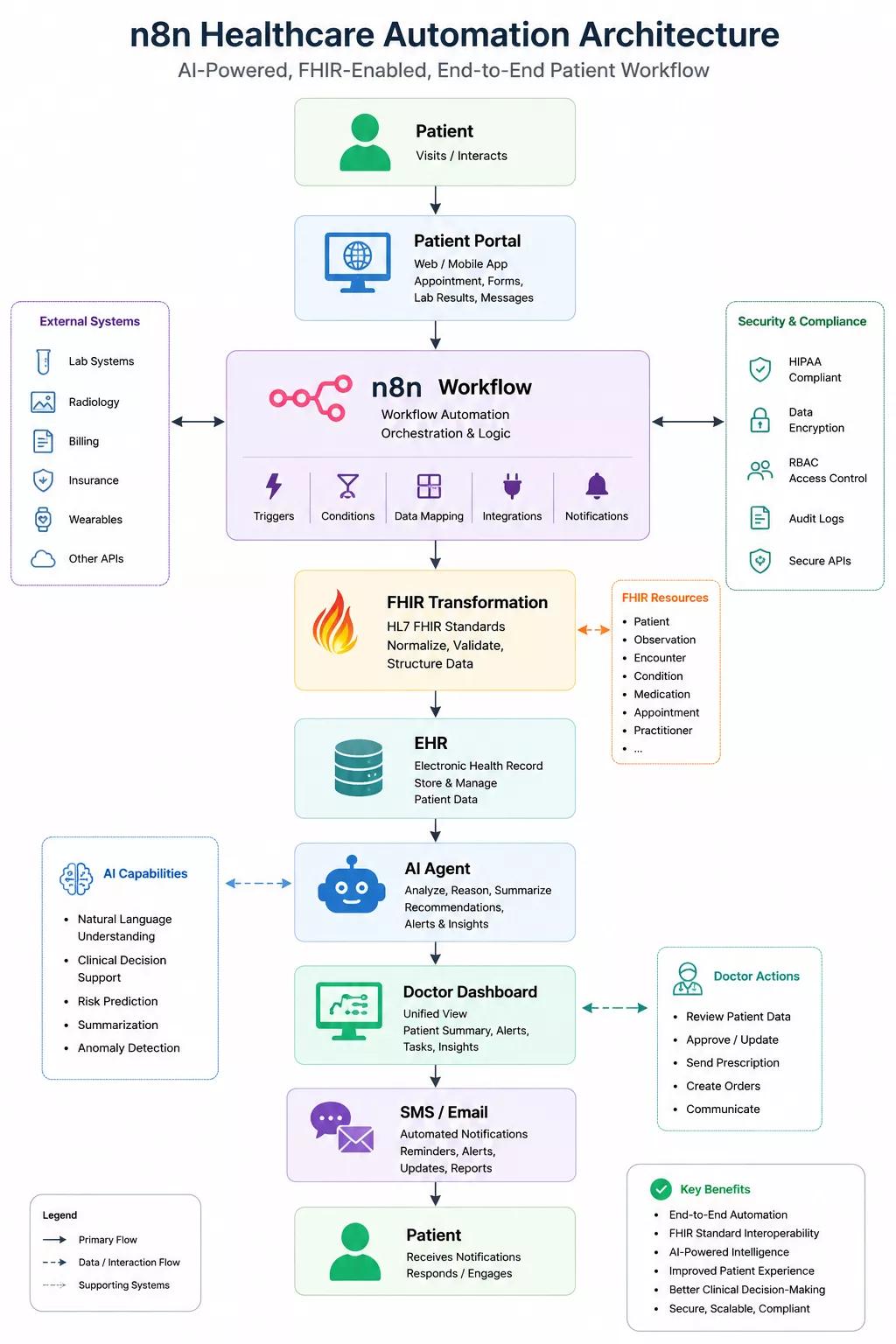
Here are additional reasons why healthcare needs n8n workflow automation.
1. EHR Fragmentation - #1 Healthcare Pain Point
Electronic Health Records (EHR) systems often pose difficulties in sharing patient data seamlessly across the healthcare department and to the providers. Operating as if in a silo, this fragmentation causes effort duplication, further delaying care and increasing data error possibilities.
Here, the n8n can adhere to multiple healthcare standards, including HL7 and FHIR, enabling smoother and regular automated data exchange between disparate EHR systems.
You can directly skip costly custom development by arranging pre-built connectors and low-code workflow orchestration to unify patient data. A cohesive experience is then yours to offer without surplus infrastructure additions.
Read more: How to Integrate N8N with EHR System
2. Staff Burnout - #2 Healthcare Pain Point
Overwhelming tasks like clinical data entry, appointment management, and manual modifications are leading causes of healthcare staff burnout. Such overhead also reduces the collective staff efficiency, effectively reducing patient care quality at once, if not constantly.
Contrarily, with an n8n automation in healthcare, the routine tasks are automated so patient-facing activities can be prioritized with better focus.
Moreover, reduction in manual work also lowers rate of errors and makes patient-data communication streamlined between the teams.
3. Manual Follow-ups - #3 Healthcare Pain Point
The delivery of timely follow-ups, test results and appointment reminders are necessary for developing positive health outcomes, but they are prone to delays and missed communication.
Using n8n, healthcare organizations can automate patient notifications across multiple channels like email, SMS, or phone calls.
Workflows, too, can be customized by applying conditional logic to prioritize urgent cases, track responses, and trigger escalations as required.
4. Compliance Bottlenecks - #4 Healthcare Pain Point
Healthcare providers must comply with strict industry regulations namely HIPAA and GDPR, which requires top-notch sensitive data handling and auditing capabilities. Inflexible systems in such scenarios can create bottlenecks and risk non-compliance.
But, with n8n supported self-hosting, your healthcare organization can have full control over the data environment, whose workflows will securely transfer the data without manual interventions.
You also get encrypted communications and audit trails to meet compliance needs without slowing down your operations or switching their flow.
Read more: How N8N Transformed Healthcare Data Handling
5. Inefficient Patient Journeys - #5 Healthcare Pain Point
Patients aren't new to encountering fragmented, slow, and confusing care journeys caused by disconnected systems and manual processes. This ultimately impacts their satisfaction and the care outcomes.
The n8n can solve this by enabling seamless integration across systems responsible for scheduling, clinical records syncing and communication systems. Automating data sharing and real-time updates delivery contributes to creating efficient, patient-centered workflows that improve engagement and care pathways.
Advantages of Using n8n in Healthcare Automation
1. Flexibility without Vendor Lock-In
Unlike Zapier or Make, n8n is open-source and self-hostable. You retain full control over data and logic with n8n, offering a critical advantage in a domain as sensitive as healthcare.
2. Cost-Effective Digital Transformation
Large-scale integrations can cost millions. whereas the n8n significantly reduces development and operational costs by enabling low-code automation at scale.
3. Enhance EHR Interoperability
Most EHRs are rigid in terms of their operability between connected systems, but n8n isn't. In hospitals, IT teams can build adaptive workflows that transform and route data using FHIR, HL7, or even custom APIs - all without altering the core EHR system.
4. High Adaptability
Whether the workflow demands scheduling, diagnostics, pharmacy management, or billing, n8n can bridge systems and automate end-to-end processes without requiring to begin from square one.
n8n Healthcare Automation Use Cases
n8n helps hospitals, clinics, and care providers orchestrate multi-system workflows with precision. The seventeen use cases below span the patient journey from first contact through discharge and reflect where n8n is actively reducing workflow latency, cutting manual steps, and improving clinical and financial decision-making.
A note on the numbers below: "Estimated operational impact" figures are directional, not verified per-organization benchmarks. They're grounded in the nature of the workflow (e.g., eliminating a manual re-entry step, or converting a phone-tag into an automated trigger) and in the industry data cited elsewhere in this guide. Actual results depend heavily on current baseline, patient volume, and how much of the workflow was already digitized before automation.
Patient Access & Intake
1. Patient Intake
- Business problem: Manual intake forms create data entry duplication between the patient, front desk, and EHR, and errors introduced at this stage propagate downstream into billing and clinical records.
- Workflow architecture: A digital intake form (web or SMS-triggered) submits to a webhook node → n8n validates required fields and formats the payload → data is mapped to FHIR Patient and Coverage resources → pushed to the EHR via API, with a parallel branch notifying front-desk staff of any missing fields.
- Connected systems & integrations: Patient portal or intake form tool, EHR (Epic MyChart, athenahealth, Cerner/Oracle Health PowerChart), insurance eligibility API.
- Business outcome: Reduces duplicate data entry and shortens time-to-chart for new patients.
- Estimated operational impact: Meaningful reduction in front-desk data entry time per patient; impact scales with new-patient volume.
2. Appointment Scheduling
- Business problem: Fragmented tools - calendars, CRM, manual phone confirmations - make scheduling slow and prone to double-booking.
- Workflow architecture: Time-based or event-driven triggers integrate with calendar and EHR appointment modules. When a patient confirms a booking, n8n cross-checks for overlaps, updates the clinician's calendar, sends a confirmation via SMS/email, and logs the event in the EHR. Reschedule requests re-trigger the same workflow with updated logic.
- Connected systems & integrations: Google Calendar, Calendly, EHR appointment modules, SMS gateway (Twilio or similar).
- Business outcome: Fewer scheduling conflicts and faster confirmation turnaround; when paired with an AI Agent, the same workflow can handle auto-rescheduling and follow-up via natural-language intent detection.
- Estimated operational impact: Fewer no-shows through automated reminder cadences; reduced front-desk phone volume.
3. Referral Management
- Business problem: Referrals routed manually between primary care and specialists get lost in fax queues or email, delaying care and creating leakage to out-of-network providers.
- Workflow architecture: Referral order in the EHR triggers a webhook → n8n formats the referral into a FHIR ServiceRequest resource → routes to the specialist's intake system or a shared referral inbox → status updates (accepted, scheduled, completed) sync back to the referring provider's EHR automatically.
- Connected systems & integrations: EHR order entry, specialist scheduling systems, fax-to-digital gateways where specialists haven't modernized.
- Business outcome: Closed-loop referral tracking instead of a black box after the referral is sent.
- Estimated operational impact: Reduced referral leakage and faster time-to-specialist-appointment.
Insurance & Financial Workflows
4. Insurance Verification
- Business problem: Manually checking coverage and benefits before a visit is slow and error-prone, and mistakes here create denied claims later.
- Workflow architecture: Appointment booking triggers an eligibility check via payer API (X12 270/271 or FHIR Coverage resource) → n8n parses the response → flags coverage gaps to front-desk staff before the visit → logs results in the EHR.
- Connected systems & integrations: Payer eligibility APIs, clearinghouses, EHR.
- Business outcome: Coverage issues surface before the visit instead of after the claim is denied.
- Estimated operational impact: According to the 2025 CAQH Index, eligibility and benefit verification is one of the more mature electronically-adopted transactions industry-wide, but manual workarounds still increase both cost and denial risk where adoption lags.
5. Prior Authorization
- Business problem: Prior authorization is consistently cited by physicians as one of healthcare's biggest administrative bottlenecks. The AMA's most recent survey found physicians complete an average of 40 prior authorizations per week, consuming roughly 13 hours of physician and staff time, and 94% say it contributes to burnout (AMA, 2025).
- Workflow architecture: Order for a PA-requiring service triggers a workflow → n8n submits diagnosis codes and clinical documentation to the payer via API → polls for status updates → routes approvals, denials, or additional-information requests to the appropriate staff queue → updates the billing dashboard.
- Connected systems & integrations: Payer prior-auth APIs (increasingly FHIR-based under CMS-0057-F), EHR, billing system.
- Business outcome: Fewer manual status-check calls to payers and faster escalation of denials.
- Estimated operational impact: Directional time savings scale with the share of the current 13-hours/week burden that's spent on manual status checks and re-submission versus clinical judgment calls - the former automates cleanly, the latter doesn't.
- Regulatory context: CMS-0057-F requires impacted payers to implement FHIR-based Prior Authorization APIs by January 1, 2027, with decision timeframes of 72 hours for urgent and 7 days for standard requests (CMS, CMS-0057-F Fact Sheet). Organizations building n8n-based PA workflows now are effectively building toward that deadline rather than away from it.
6. Medical Billing
- Business problem: Manual charge entry and claim scrubbing introduce errors that delay reimbursement and increase denial rates.
- Workflow architecture: Encounter completion in the EHR triggers charge capture → n8n validates codes against payer rules → formats and submits the claim (X12 837 or FHIR Claim resource) → routes rejections to a billing-staff queue with the specific error flagged.
- Connected systems & integrations: EHR, clearinghouse, practice management / billing system.
- Business outcome: Fewer clean-claim rejections due to formatting or coding errors caught before submission.
- Estimated operational impact: Reduced first-pass claim denial rate; magnitude depends heavily on current denial baseline.
7. Revenue Cycle Automation
- Business problem: Revenue cycle steps - charge capture, claim submission, remittance posting, denial management - are often handled by disconnected point solutions, creating visibility gaps for finance leadership.
- Workflow architecture: n8n orchestrates the full sequence end-to-end: charge capture → claim scrubbing → submission → remittance advice ingestion (X12 835) → automatic posting → denial routing, with a summary dashboard workflow aggregating status across all active claims.
- Connected systems & integrations: EHR, clearinghouse, billing system, accounting/ERP.
- Business outcome: A single orchestration layer replaces multiple disconnected revenue-cycle tools, improving visibility for finance leadership.
- Estimated operational impact: The CAQH Index estimates a remaining $21 billion in annual industry-wide savings from fully automating manual and partially-manual revenue-cycle transactions (CAQH, 2025 Index) - a useful ceiling for what full automation is worth at industry scale, not a per-organization guarantee.
8. Claims Processing
- Business problem: High claim volume with manual triage leads to slow turnaround and inconsistent handling of edge cases (partial denials, coordination of benefits).
- Workflow architecture: Claims ingested via clearinghouse feed → n8n applies rules-based triage (clean claim vs. needs review) → routes exceptions to staff, auto-processes clean claims → tracks status through adjudication.
- Connected systems & integrations: Clearinghouse, payer APIs, billing system.
- Business outcome: Staff time concentrates on genuinely complex claims instead of every claim getting equal manual attention.
- Estimated operational impact: Faster average claim turnaround for the subset of claims that qualify for straight-through processing.
Clinical & Care Operations
9. Clinical Documentation
- Business problem: Manual documentation and after-visit note completion is one of the most time-consuming parts of a clinician's day and a well-documented burnout driver.
- Workflow architecture: Visit completion triggers a workflow that pulls structured data (vitals, orders, diagnoses already in the EHR) into a documentation template → an AI Agent node drafts a summary from clinician dictation or structured inputs → routes to the clinician for review and sign-off before it's finalized in the chart.
- Connected systems & integrations: EHR, dictation/transcription tool, AI Agent node (OpenAI, Anthropic, or similar via n8n's LLM nodes).
- Business outcome: Less time spent on manual note assembly, with the clinician retained as the final reviewer - not replaced by the automation.
- Estimated operational impact: Directional reduction in after-hours documentation time; magnitude depends on how much of the note was already structured data versus free text.
10. Care Coordination
- Business problem: Patients with chronic conditions or complex care plans touch multiple providers and care managers who often aren't working from the same up-to-date picture.
- Workflow architecture: Care plan updates in any connected system trigger a sync workflow → n8n propagates changes to all care team members' task queues → flags gaps (e.g., an overdue follow-up) for the care manager.
- Connected systems & integrations: EHR, care management platform, task/CRM system.
- Business outcome: Care team members work from a consistent, current view of the patient's plan instead of finding out about changes secondhand.
- Estimated operational impact: Fewer missed follow-ups for patients on active care plans.
11. Remote Patient Monitoring
- Business problem: Wearable and home-monitoring data often sits in a separate vendor portal, disconnected from the clinical workflow that should act on it.
- Workflow architecture: Device data streams into n8n via API or webhook → thresholds trigger a decision node → abnormal readings generate an alert to the care team or auto-schedule a virtual consult; normal readings log silently to the chart.
- Connected systems & integrations: RPM device platforms, EHR, telehealth scheduling.
- Business outcome: Abnormal readings reach a clinician without requiring someone to manually check a separate dashboard.
- Estimated operational impact: Faster time-to-alert on abnormal readings versus manual portal checks.
12. Laboratory Workflows
- Business problem: Labs often rely on manual or semi-automated steps to get results into the EHR, which delays care delivery.
- Workflow architecture: A connected LIS triggers the workflow when a new result is generated → n8n fetches the report, formats it into structured data (JSON/CSV), and maps critical values against clinical thresholds → any anomaly triggers a decision node that sends a secure alert to the responsible physician (Slack, email, or EHR in-basket) → the result is converted into a FHIR DiagnosticReport resource and pushed to the patient's EHR automatically.
- Connected systems & integrations: LIS, EHR, secure messaging (Slack, encrypted email).
- Business outcome: Results reach both the chart and the physician faster, with abnormal values flagged automatically instead of relying on someone reviewing every report manually.
- Estimated operational impact: Reduced time from result generation to physician notification for flagged values.
13. AI-Assisted Triage
- Business problem: Symptom intake and initial triage - via phone, portal message, or chat - often waits in a queue for a nurse to review, even for cases that are either clearly urgent or clearly routine.
- Workflow architecture: Patient-submitted symptoms (portal, chat, or voice transcript) trigger a workflow → an AI Agent node reasons over the input alongside available context (medication history, recent diagnoses) rather than applying a flat if-else rule set → routes urgent cases to an immediate clinical queue, routine cases to standard scheduling, with a human reviewer able to override at any point.
- Connected systems & integrations: Patient portal or chat platform, EHR, AI Agent node.
- Business outcome: Urgent cases get flagged faster; routine cases don't consume nurse triage time unnecessarily. This is explicitly a decision-support layer - it should not be positioned or deployed as autonomous clinical judgment.
- Estimated operational impact: Faster time-to-triage for the subset of messages that are unambiguously urgent or unambiguously routine; ambiguous cases still require human review, so this doesn't eliminate triage staffing.
14. Medication Reminders
- Business problem: Medication non-adherence is a well-documented driver of preventable readmissions, and manual reminder calls don't scale.
- Workflow architecture: Prescription data from the EHR or pharmacy system triggers a scheduled reminder workflow → n8n sends reminders via the patient's preferred channel (SMS, app push, automated call) → non-response after a set window escalates to a care team member.
- Connected systems & integrations: EHR, pharmacy system, SMS/voice gateway.
- Business outcome: Consistent reminder cadence without dedicated staff time per patient.
- Estimated operational impact: Directional improvement in adherence-related follow-up consistency; clinical adherence outcomes themselves require a controlled study to attribute to the reminder system specifically, and we're not aware of a published, dated source isolating that effect for n8n-based workflows - flagging this rather than asserting a specific adherence-rate lift.
Communication & Access
15. Voice AI
- Business problem: Phone remains the dominant channel for patient scheduling and questions, but staffing a call center for every routine inquiry is expensive and inconsistent outside business hours.
- Workflow architecture: Inbound call triggers a voice AI node → n8n routes based on intent (scheduling, prescription refill, billing question, urgent) → handles routine intents end-to-end (e.g., booking an appointment) and escalates complex or urgent calls to a live staff member with context already gathered.
- Connected systems & integrations: Voice AI platform, EHR, scheduling system, call center software.
- Business outcome: Routine calls resolve without staff involvement; complex calls reach staff faster because intent and context are pre-gathered.
- Estimated operational impact: Reduced average handle time for staff-assisted calls, since routine intents are filtered out upstream.
16. Call Center Automation
- Business problem: Call centers juggling scheduling, billing questions, and clinical triage in one queue create long hold times and inconsistent routing.
- Workflow architecture: n8n sits behind the call center platform, using intent classification to route calls to the correct queue, pull relevant patient context from the EHR before the call connects to a human agent, and log call outcomes automatically.
- Connected systems & integrations: Call center platform (e.g., Genesys, Five9), EHR, CRM.
- Business outcome: Agents start each call with relevant context already surfaced instead of searching for it live.
- Estimated operational impact: Reduced average call handling time from context pre-fetch; hold-time impact depends on call volume relative to staffing.
Discharge & Continuity
17. Discharge Planning & Post-Discharge Follow-Up
- Business problem: Post-discharge and post-care management is usually disconnected from the rest of the hospital workflow, creating gaps exactly when patients are most vulnerable to readmission.
- Workflow architecture: Discharge summary logged in the EHR triggers the workflow → n8n schedules a follow-up survey (e.g., a 3-day post-discharge SMS check-in) → syncs responses to the care team dashboard → escalates any concerning responses to the care team automatically. More advanced flows integrate wearable data so that post-discharge vitals are monitored continuously; critical changes can trigger an alert or auto-schedule a virtual consult.
- Connected systems & integrations: EHR discharge module, SMS/survey platform, RPM device platform (for advanced flows), telehealth scheduling.
- Business outcome: Structured, automated follow-up instead of discharge instructions that assume the patient will self-manage.
- Estimated operational impact: Directional reduction in avoidable post-discharge readmissions attributable to earlier detection of deterioration - this is a plausible mechanism supported by the RPM literature broadly, but we don't have an n8n-specific, dated source to cite a precise readmission-rate figure, so we're flagging the mechanism rather than a number.
Automate your clinic's manual work
We design and build n8n workflows for intake, reminders and system sync - fixed scope, implementation included.
Why Is n8n + FHIR (and HL7) a Powerful Combination for Healthcare Automation?
FHIR (Fast Healthcare Interoperability Resources) is the standard protocol for modern healthcare data exchange, and HL7 remains the underlying standards body and, through HL7v2, still the messaging format many legacy systems run on. Most EHRs now support FHIR, but their APIs can still be complex and brittle in practice - this is where n8n acts as an orchestration layer rather than a replacement for either standard.
n8n's HTTP and JSON functions are typically used to:
- Pull structured patient data from third-party tools or legacy HL7v2 feeds.
- Transform that data into FHIR-compliant resources - Observation, Patient, Procedure, DiagnosticReport, Coverage, and others.
- Push the transformed data to certified EHR systems via RESTful FHIR APIs, or route HL7v2 messages through an interface engine where the legacy format still governs.
This modular approach makes it possible for a small IT team to drive real interoperability without deploying a dedicated integration engine - a meaningful option for hospitals working with a healthcare IT consulting Partner or exploring in-house automation before committing to a larger platform.
Why does Epic and Cerner (Oracle Health) specifically matter here?
Together, Epic and Oracle Health (formerly Cerner) control the large majority of the U.S. acute-care hospital EHR market. The most recent KLAS Research market-share report puts Epic at 43.7% of acute-care hospitals and 56.9% of beds. At the same time, Oracle Health is second at 21.9% of hospitals and 20.4% of beds.
This means that any n8n healthcare deployment at a mid-size or large U.S. hospital will very likely need to integrate with one of these two platforms (KLAS Research, "US Acute Care EHR Market Share 2026").
Both expose FHIR APIs (Epic via its App Orchard/FHIR APIs, Oracle Health via Cerner's Millennium FHIR APIs), which n8n connects to through standard HTTP Request and OAuth2 credential nodes rather than a proprietary connector - a meaningful difference from platforms that require a certified, paid connector per EHR vendor.
The Regulatory Tailwind
CMS-0057-F (the CMS Interoperability and Prior Authorization Final Rule) requires impacted payers to implement Patient Access, Provider Access, Payer-to-Payer, and Prior Authorization FHIR APIs by January 1, 2027, with faster decision timeframes (72 hours urgent, 7 days standard) already in effect from January 1, 2026 (CMS, CMS-0057-F Fact Sheet). That means the payer side of the ecosystem is being pushed toward FHIR regardless of what any individual provider organization does - which makes an n8n-based FHIR orchestration layer on the provider side increasingly future-proof rather than optional.
ROI of n8n Healthcare Automation
Healthcare leaders evaluating automation investment need a framework for the return, not just a list of benefits. This section lays out where the savings actually come from and states the assumptions behind each estimate explicitly, rather than presenting a single blended ROI number as universal.
Where do the savings come from?
| Category | Mechanism | Grounding |
|---|---|---|
| Administrative savings | Fewer manual transactions (eligibility checks, claim status, PA status calls) | 2025 CAQH Index: $258B avoided industry-wide in 2024 through electronic transactions; $21B in further savings still available from full automation |
| Staff productivity | Time reallocated from data entry/status-checking to patient-facing or judgment-based work | AMA 2025: PA alone consumes ~13 hours/week of physician and staff time per practice |
| Reduced manual errors | Fewer transcription errors between systems that previously required re-keying | Directional - scales with how many manual handoffs the workflow previously required |
| Integration cost reduction | Self-hosted, low-code orchestration vs. custom point-to-point integrations or enterprise engine licensing | Directional - depends on the alternative being displaced (custom dev is more expensive than a mature enterprise engine, which is itself more expensive than n8n at small-to-mid scale) |
| Faster patient processing | Automated intake, scheduling, and eligibility checks shorten time-to-visit | Directional |
| Improved patient experience | Fewer dropped follow-ups, faster callback/response times | Directional |
| Compliance improvements | Automated audit trails reduce the manual burden of demonstrating HIPAA compliance during audits | Directional - see HIPAA section below |
| Developer productivity | Low-code workflows reduce the engineering hours needed per integration compared to custom code | Directional |
A Note On Payback Period
Typical implementation payback period for n8n-based healthcare automation depends on three variables that we'd rather name explicitly than average away:
1. Transaction volume
A workflow processing thousands of prior authorizations a month pays back faster than one processing dozens, because the fixed cost of building the workflow amortizes over more transactions.
2. Current baseline
An organization automating a fully-manual process sees a larger delta than one automating a process that's already 70% electronic.
3. Build complexity
A single-EHR, single-payer workflow is a matter of weeks; a multi-EHR, multi-payer workflow with custom FHIR resource mapping is a matter of months.
Rather than publish a specific payback-period number that wouldn't hold across those variables, our standard approach in a scoping consultation is to model payback against your actual transaction volume and current automation baseline - that's a more honest number than an industry-average estimate would be.
HIPAA & Security Best Practices for n8n in Healthcare
n8n is not independently HIPAA-certified - no software platform is "HIPAA compliant" out of the box, because HIPAA compliance is a property of how an organization configures, operates, and governs a system, not a certification a vendor can sell you. Here's what that means in practice for an n8n deployment.
Self-hosting
For any workflow touching Protected Health Information (PHI), self-hosting n8n inside your own infrastructure (or a BAA-covered cloud environment) is the starting point, not an optional hardening step. n8n Cloud's standard tier does not include a Business Associate Agreement; check current BAA availability directly with n8n before assuming coverage.
Encryption
PHI should be encrypted both in transit (TLS for every API call, including internal ones between n8n and connected systems) and at rest (database-level encryption for n8n's own execution data store, since workflow execution logs can contain PHI payloads).
Audit Logging
Every workflow execution that touches PHI needs a durable, tamper-evident log of what ran, when, and what data it touched. n8n's execution history covers part of this, but for HIPAA audit purposes most organizations pair it with a dedicated logging/SIEM pipeline rather than relying on n8n's UI alone.
Role-based Access
Not every team member who can view a workflow's logic should be able to view its execution data (which may contain live PHI). n8n's enterprise tier supports role-based permissions at the workflow and credential level - a meaningful reason mid-size and larger deployments often move off the community edition.
Secrets Management
API keys, OAuth tokens, and database credentials belong in a dedicated secrets manager (HashiCorp Vault, AWS Secrets Manager, or n8n's built-in external secrets integration), not hardcoded into workflow nodes or environment variables checked into version control.
Credential Storage
n8n encrypts stored credentials at rest by default, but the encryption key itself needs to be managed with the same rigor as any other secret - losing it or storing it insecurely undermines the credential encryption entirely.
Protected Health Information (PHI) Handling
Map every workflow that touches PHI explicitly - which fields, which systems, which retention period - before building it, not after. This mapping is what makes a HIPAA risk assessment tractable later.
Backup Strategy
Workflow definitions and execution data both need backup, but PHI-containing execution data needs backup that respects the same encryption and access controls as the production system - a common oversight is backing up production data to a less-secured environment.
Disaster Recovery
Document and test failover for the n8n instance itself, plus every credential and webhook endpoint it depends on. An automation layer that goes down silently during a lab-result routing workflow is a patient-safety issue, not just an IT ticket.
Monitoring
Beyond audit logs, active monitoring should flag anomalous workflow behavior (unexpected execution volume, failed authentication attempts, unusual data volume in a single execution) as a security signal, not just an operational one.
API Authentication
Every external API n8n calls - EHR, payer, LIS - should use OAuth2 or equivalent token-based auth with short-lived tokens, not static API keys where the vendor offers a better option.
Least-privilege access. Service accounts used by n8n to connect to the EHR or other PHI systems should have the minimum scope needed for the specific workflow - a workflow that only reads lab results shouldn't have write access to the full chart.
Workflow governance
As the number of production workflows grows, someone needs explicit ownership of change management: who can modify a live PHI-touching workflow, how changes are tested before deployment, and how a broken workflow gets rolled back. This is an organizational process as much as a technical control, and it's the piece most self-hosted deployments underinvest in relative to the technical controls above.
For context on why this rigor matters financially, not just ethically:
healthcare breaches remain the most expensive of any industry, averaging $7.42 million per breach in IBM's most recent Cost of a Data Breach Report - and they take longer to detect and contain (279 days on average) than breaches in any other sector studied (IBM/Ponemon Institute, Cost of a Data Breach Report 2025).
Related: AI in Healthcare
How to Implement n8n in a Hospital or Health System
Start with MVP-style automation, not system-wide automation
Rather than automating everything at once, begin with a minimum viable process:
1. Workflow discovery
Inventory current manual workflows and identify which ones are high-volume, high-error, or high-burnout - that intersection is usually where automation pays back fastest.
2. Automation prioritization
Rank candidates by volume × current manual cost, not by technical interest. A low-volume workflow that's fun to build is a worse first project than a high-volume workflow that's tedious to build.
3. Architecture planning
Decide self-hosted vs. n8n Cloud, map which systems need FHIR vs. HL7v2 handling, and identify where a code node will be needed versus where built-in nodes suffice.
For complex healthcare workflows and integrations, organizations can hire n8n experts to design, build, and maintain production-ready automation workflows.
Build the interoperability layer
4. FHIR integration
Map target resources (Patient, Observation, Coverage, Claim, etc.) to your EHR's specific FHIR implementation - vendor FHIR APIs vary in which optional fields they populate, so this step always involves some vendor-specific discovery work, even against a "standard."
5. HL7 integration
For legacy systems still on HL7v2, budget for a parsing layer (either an n8n code node or a dedicated HL7 interface engine feeding into n8n) - v2 message segments are less forgiving of malformed input than FHIR's JSON structure.
6. API orchestration
Sequence the calls across systems, with explicit error handling for each external dependency - a scheduling workflow that silently fails when the SMS gateway is down is a worse outcome than the manual process it replaced.
Test before you trust it with PHI
7. Workflow testing
Test against synthetic or de-identified data first; never use live PHI in a development environment unless that environment meets the same HIPAA controls as production.
8. Validation
Validate against edge cases specifically - the malformed HL7 message, the patient with no insurance on file, the EHR API timeout - not just the happy path.
Deploy and keep it running
9. Deployment
Stage the rollout: pilot with one department or one payer before expanding hospital-wide.
10. Version control
Treat workflow definitions like code - version them, review changes, and maintain a rollback path.
11. Monitoring
Set up alerting for workflow failures, not just successes; a silently-failing PHI workflow is worse than a loudly-failing one.
12. Observability
Beyond uptime, track execution volume and latency trends so degradation is visible before it becomes an outage.
13. Maintenance
EHR vendors update their APIs; budget ongoing engineering time for workflows to keep pace, not just for the initial build.
14. Scaling
As workflow count grows, plan for n8n's queue mode and worker scaling rather than running everything on a single instance.
15. Governance and Operational Ownership
Assign a named owner - not just an IT department - for each production PHI-touching workflow, with clear escalation paths when something breaks.
Build the Right Team
For effective implementation in a regulated environment, you generally need people with experience in HL7/FHIR interoperability, healthcare automation pipelines specifically (not just general workflow automation), and role-based access/audit trail design. Working with a custom healthcare software development team can shorten the learning curve on both the technical and compliance sides.
Future Scope: AI Agents + n8n in Healthcare
The natural next step beyond rule-based automation is context-aware decision-making. Instead of a flat if-else rule to escalate abnormal vitals, an AI agent connected through n8n can reason across medication history, diagnosis codes, and other available context before deciding how to route a case - which is the mechanism behind the AI-Assisted Triage and Clinical Documentation use cases above.
This is genuinely useful, and it's also worth being precise about its limits: an AI agent embedded in an n8n workflow is a decision-support and administrative-automation layer, not an autonomous clinical decision-maker. Every use case in this guide that touches clinical judgment - triage, documentation, medication management - keeps a human reviewer in the loop by design, not as an afterthought.
If you're evaluating whether to build this in-house or bring in a partner, AI Agent Development support is worth considering specifically where the workflow requires reasoning over unstructured clinical context - that's the part that's genuinely harder to build correctly than the rule-based orchestration covered earlier in this guide.
Book a Healthcare Automation Consultation →
Frequently Asked Questions
What is n8n healthcare automation?
n8n healthcare automation is the use of the n8n workflow automation platform to connect and orchestrate healthcare systems - EHRs, lab systems, billing platforms, and patient communication tools - so that data moves between them automatically instead of through manual re-entry, using standards like HL7 and FHIR for clinical data exchange.
Can n8n integrate with Epic?
Yes. Epic exposes FHIR-based APIs (through its App Orchard developer program) that n8n connects to using standard HTTP Request and OAuth2 credential nodes. Epic is the largest U.S. acute-care EHR vendor by market share, so Epic integration is a common requirement for hospital-facing n8n deployments.
Can n8n integrate with Cerner (Oracle Health)?
Yes. Oracle Health (formerly Cerner) exposes FHIR APIs through its Millennium platform, and n8n connects to these the same way it does Epic's - via HTTP/OAuth2 nodes rather than a proprietary connector. Oracle Health is the second-largest U.S. acute-care EHR vendor by market share.
How does n8n support FHIR?
n8n doesn't have a dedicated "FHIR node" out of the box - support comes through its generic HTTP Request node (for calling FHIR REST APIs) and its JSON/Set nodes (for transforming data into and out of FHIR resource structures like Patient, Observation, and Coverage). This gives more flexibility than a purpose-built FHIR connector, at the cost of needing someone on the team who understands the FHIR spec well enough to map resources correctly.
Can hospitals self-host n8n?
Yes, and for any workflow touching PHI, self-hosting (or a cloud deployment covered by a signed BAA) is the standard recommended approach rather than using n8n Cloud's default tier. Self-hosting gives the hospital's IT team full control over encryption, network isolation, and audit logging at the infrastructure level.
Is n8n HIPAA compliant?
n8n itself is not independently HIPAA-certified - there's no such thing as an off-the-shelf "HIPAA compliant" software product. What matters is whether your specific deployment (self-hosted, encrypted, access-controlled, audit-logged, governed by clear policies) meets HIPAA's technical and administrative safeguard requirements. See the HIPAA & Security section above for the specific controls involved.
Can n8n automate patient intake?
Yes - this is one of the more common starting points. A digital intake form can trigger an n8n workflow that validates the data, maps it to FHIR Patient and Coverage resources, and pushes it to the EHR automatically, reducing duplicate entry between the patient-facing form and the chart.
Can n8n automate billing?
Yes, across multiple stages: charge capture validation, claim formatting and submission, remittance advice ingestion, and denial routing can all be orchestrated through n8n workflows connected to a clearinghouse and billing system.
What does implementation cost?
Cost depends heavily on scope: a single-workflow MVP (e.g., automating one appointment-reminder flow) is a matter of limited engineering hours, while a multi-EHR, multi-payer orchestration layer with custom FHIR mapping and enterprise-grade governance is a significantly larger engagement. We'd rather scope this against your specific systems and workflow count in a consultation than publish a single number that wouldn't be accurate for most organizations reading this.
How long does deployment take?
An MVP-style single workflow (one department, one integration) is typically a matter of weeks. A hospital-wide, multi-system rollout with proper testing, staged deployment, and governance is realistically a matter of months, not weeks - organizations that rush this timeline are usually the ones that end up with production incidents in a PHI-touching workflow.
What healthcare workflows are best suited for n8n?
High-volume, well-defined, rules-based workflows are the best fit to start: appointment scheduling, insurance eligibility checks, lab result routing, and patient reminders. Workflows requiring heavy clinical judgment are better suited to an AI-agent-assisted decision-support layer with a human reviewer, not full automation.
When should organizations choose custom development instead of n8n?
Custom development makes more sense when the integration is extremely high-volume and latency-sensitive (where a purpose-built service outperforms a general orchestration layer), when it requires deep, ongoing engineering investment that would benefit from full code ownership, or when a specific EHR's API has quirks that a low-code platform's generic nodes handle awkwardly. For most mid-volume administrative and clinical-support workflows, n8n's lower build and maintenance cost outweighs the flexibility trade-off.