How Real Estate Teams Save Hundreds of Hours with n8n Automation
Dharmesh Dave
3-4 mins
Earlier this year, most real estate companies were questioning the worth of integrating AI across their daily workflows. However, eight months later, AI now dominates (nearly) all the real estate tech discussions, globally, too.
From 35% of survey respondents reporting AI-agent adoption in 2023 to 92% of CRE teams already piloting AI or planning to start in 2026, the industry’s operating model is becoming decisive. Even to the extent that automation from tools like n8n can save real estate teams hundreds of hours? Yes.
For brokerages, developers, property managers, and real estate operators, the priority is not adopting AI for visibility. It is identifying the workflows where Real estate software development services A can reduce administrative friction, improve response times, and provide clearer operational visibility.
Real n8n Case Studies From Real Estate Operations
The following published n8n case studies show reported results from two different real estate workflows; they are examples, not universal benchmarks.
Flow AI: Voice-Driven, Compliant Outreach for Real Estate Agents
Flow AI built a voice-driven real estate outreach platform using self-hosted n8n.
The workflow manages the operational steps behind that request:
- Retrieves the relevant contact data.
- Checks communication permissions and consent requirements.
- Creates personalized outreach content.
- Sends messages through the appropriate email or SMS channel.
- Records activity to support auditing and follow-up.
According to n8n’s Flow AI case study, campaigns that once required days of coordination can be launched in under a minute. Flow AI also reports that users have saved hundreds of hours through the platform.
The workflow removes campaign administration while agents retain responsibility for client conversations and closing.
The Srama Group: WhatsApp, CRM, and Property-Data Automation
The Srama Group received key operational information through WhatsApp, including voice notes, but turning those messages into CRM and property-data updates required manual work. System AI has used n8n to identify text or voice messages, transcribe voice notes, classify requests, route updates to Zoho CRM or Google Sheets, send confirmations, and escalate exceptions.
In n8n’s published case study, System AI reported that one administrative task decreased from four to five minutes to roughly 10-20 seconds. It also estimated that the workflow saved about one workday per week. The case study reported a reduction in time from onboarding to property sale from 62 days to 44 days.
What These Results Do Show and Do Not Imply
These cases show where n8n is most effective: high-volume, rules-based work that moves across disconnected systems. They do not establish a universal savings benchmark.
Results can vary depending on workflow volume, process design, data quality, system access, team adoption, and the level of required human review.
Why Real Estate Teams Lose Time to Repetitive Operations
Real estate teams rarely lose time through one major failure. The loss accumulates across routine work: entering leads, checking existing records, assigning ownership, updating status, sending reminders, and retrieving information from message threads.
Inquiries arrive through forms, listing portals, campaigns, calls, email, WhatsApp, and referrals. Before anyone can act, staff may need to identify the contact, confirm ownership, understand the request, and update the CRM.
Each interaction then creates more work: notes, lead-stage changes, viewing coordination, follow-up tasks, and internal updates. When that information is split across inboxes, calendars, chat threads, spreadsheets, and CRM records, response slows, duplicate records increase, and pipeline visibility declines.
Why Use n8n in Real Estate?
n8n is a workflow automation platform that connects business systems and triggers defined actions when an event occurs.
For real estate teams, that can include:
- Capturing inquiries from forms, portals, inboxes, and messaging channels.
- Creating or updating CRM records.
- Assigning leads according to geography, property type, source, or availability.
- Triggering follow-up tasks and internal alerts.
- Coordinating viewing confirmations and reminders.
- Updating property trackers and reporting data.
- Routing document requests, approvals, and deadline alerts.
For teams that need more than a template-based integration, n8n workflow automation services can connect lead sources, CRM systems, messaging channels, property data, and internal reporting around the way the business already operates.
What n8n Can Connect
n8n can connect lead forms, CRMs, email and messaging platforms, calendars, property trackers, document systems, databases, and custom applications through integrations, APIs, webhooks, or connectors.
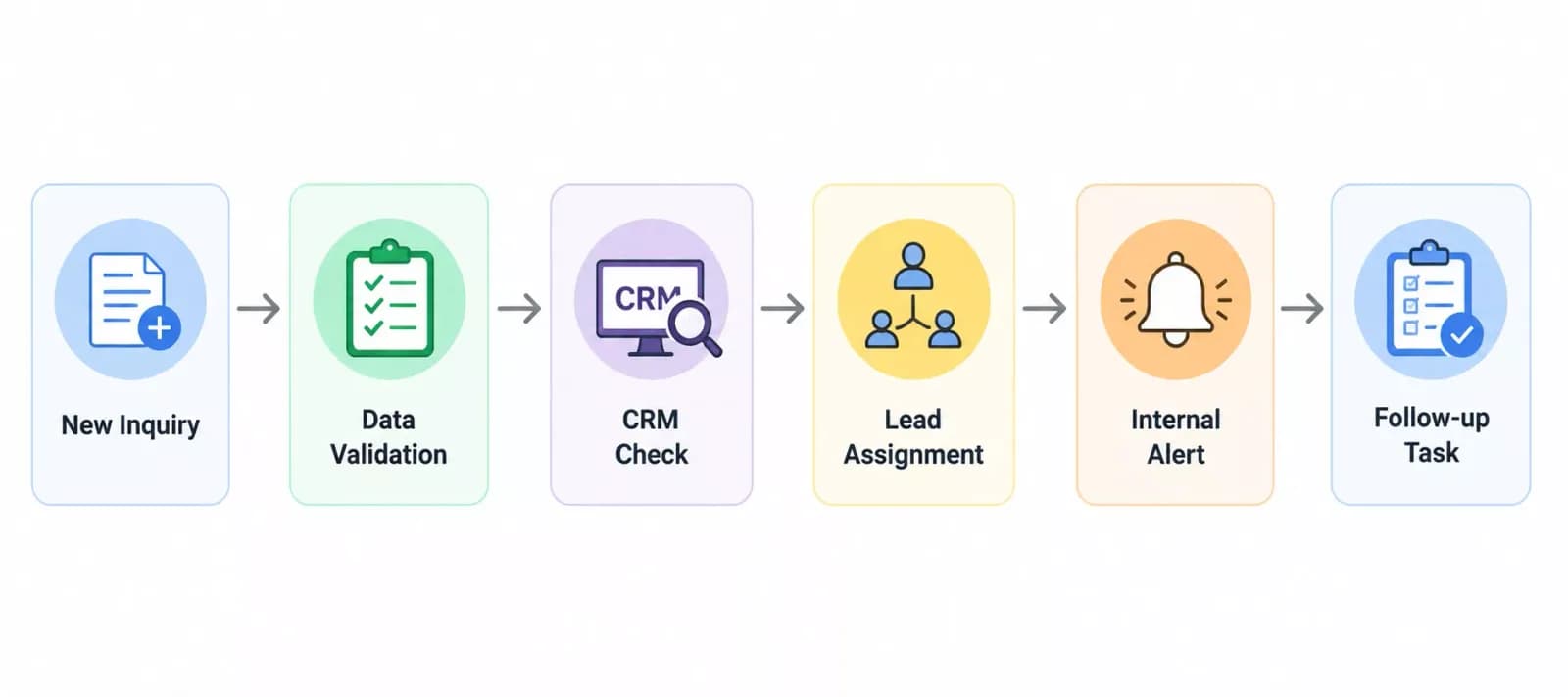
A basic workflow may look like this:
Workflow Automation vs. AI Agents
Workflow automation follows approved rules. For example, a confirmed viewing can create a calendar event, send reminders, and notify the assigned agent.
AI is useful when the input is unstructured: transcribing voice notes, summarizing messages, extracting buyer requirements, or classifying inquiries before routing. AI agent development services can add this layer where needed.
Pricing, negotiation, legal or financial communication, client commitments, and unusual exceptions should remain under human accountability.
Can n8n Really Save Real Estate Teams Hundreds of Hours?
It can, but only where a workflow has enough volume and enough manual work to remove.
Lead routing, CRM updates, viewing coordination, follow-up reminders, document collection, and recurring reporting are often strong candidates because they happen frequently and follow clear rules.
A basic capacity calculation is:
Annual hours saved=Weekly task volume×Minutes saved per task×52/60
For example, removing five minutes from 100 recurring updates each week reclaims about 433 hours annually.
That does not automatically mean 433 hours of direct labor-cost savings. Its value depends on what the business does with that capacity: faster lead response, better client service, cleaner pipeline data, fewer errors, more lead coverage, or less need for additional administrative support.
Before building, a structured AI automation audit can identify task volume, current handling time, integration requirements, and governance constraints that determine whether a use case is commercially viable. Once the right use case is identified, teams can hire AI automation developers to design, build, and maintain the workflow.
Are you Ready to Build Smarter Real Estate Automation?
Identify where AI can improve your real estate workflows, lead management, and customer operations with a strategy aligned to your business goals.
How to Measure the n8n ROI for a Real Estate Team
The best metrics are connected to the workflow you are improving. Avoid measuring “AI impact” as one broad number.
Instead, track practical changes such as:
- Average response time for new leads.
- Hours spent on the process each week.
- Percentage of inquiries receiving an initial follow-up.
- CRM completeness and duplicate-record rate.
- Viewing confirmation, reschedule, and no-show rates.
- Document turnaround time.
- Number of exceptions requiring human intervention.
- Adoption by agents, coordinators, and administrators.
Where possible, connect operational improvements to business outcomes. Faster lead response may improve lead coverage. Cleaner records may improve reporting. More reliable follow-up may help agents spend time on qualified conversations rather than administrative catch-up. Measure their before and after over a consistent period.
Start With a Workflow Audit, Not an Automation Platform
Real estate teams do not need to automate everything at once. The strongest first project is usually the process that causes recurring delays, inconsistent data, missed handoffs, or unnecessary administrative effort.
Choose one workflow. Measure it. Build with clear ownership and review rules. Train the team. Then use the evidence from that implementation to decide what comes next.
Start with a real estate AI workflow assessment to identify the process creating the greatest operational drag, then solve that first. Alternatively, consult our real estate software development team to learn how you can own an orchestrated workflow ecosystem scalable to your growth.
FAQs
How does n8n connect to a real estate CRM?
Yes, n8n can connect systems through available integrations, APIs, webhooks, databases, or custom connectors. The right approach depends on the CRM, its permissions, the data involved, and the actions the workflow needs to perform.
Can n8n automate lead follow-up for real estate agents?
n8n can automate stages of lead follow-up, including routing, task creation, reminders, approved response triggers, and escalation rules. Agents should remain involved in nuanced conversations, negotiations, and situations that require local market knowledge or professional judgment.
How n8n uses AI to qualify real estate leads?
It can support real estate lead qualification by extracting information from inquiries, summarizing messages, and routing leads according to approved criteria. Teams should review outputs, validate important information, and avoid using automated decisions alone for high-stakes customer outcomes.
How much time can n8n save a real estate team?
Savings vary by workflow and volume. Calculate potential capacity by measuring how many tasks occur each week and how many verified minutes automation removes from each task. Published case-study results are useful examples, not forecasts for every business.
What should a real estate team automate first?
Start with a repetitive process that has clear rules and a measurable problem. Lead intake, CRM updates, viewing reminders, document follow-up, and reporting are common starting points because they create recurring administrative work across multiple systems.