Real Estate App Development Cost in 2026: A Complete Pricing Breakdown

Published on July 15, 2026

10-12 mins

Written By

Pintu Soliya

Co-Founder & AI Solutions Architect

Real estate app development cost

Real estate app development costs in 2026 typically range from $25,000 for a basic MVP to $500,000+ for an enterprise-grade platform. The final investment depends on several factors, including app complexity, features, third-party integrations, technology stack, security, scalability, and long-term maintenance—not just the number of screens or functionalities.

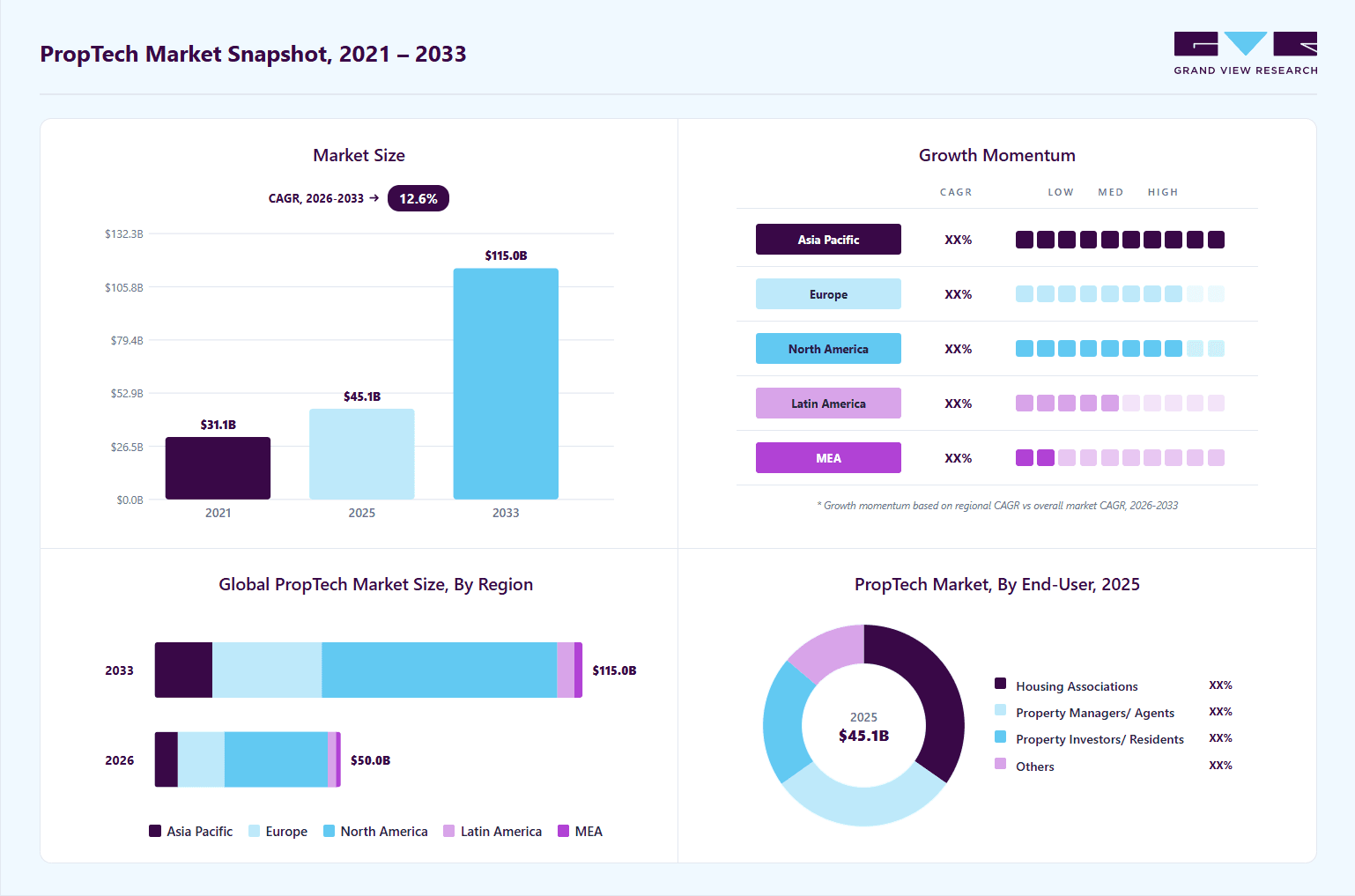
The demand for real estate technology continues to grow rapidly. According to Grand View Research, the global PropTech market is projected to reach $50.1 billion in 2026 and expand to $115 billion by 2033, driven by the adoption of AI, cloud computing, IoT, virtual reality, and mobile-first real estate solutions.

PropTech Industry Growth

  • $50.1 Billion – Estimated global PropTech market in 2026
  • $115 Billion – Expected market size by 2033
  • 12.6% CAGR – Forecast growth rate (2026–2033)

Source: Grand View Research
Modern real estate apps have evolved far beyond simple property listing platforms. Today's applications combine MLS/IDX integration, AI-powered property recommendations, interactive maps, virtual property tours, CRM integration, secure payment gateways, in-app messaging, cloud infrastructure, analytics, and compliance features to deliver seamless user experiences. Each of these technologies directly influences the overall development cost.

One of the biggest mistakes businesses make is estimating only the visible features while overlooking critical expenses such as third-party APIs, MLS/IDX licensing, cloud hosting, cybersecurity, regulatory compliance, quality assurance, and ongoing maintenance. These hidden costs can significantly increase the total cost of ownership over the application's lifecycle.

Whether you're building a property marketplace like Zillow, a rental platform, a brokerage application, or a property management solution, understanding the complete cost breakdown will help you allocate your budget effectively, prioritize the right features, and avoid unexpected expenses.

In this guide, you'll learn:

  • Real estate app development costs by app type and business model
  • The biggest factors that influence your development budget
  • Feature-by-feature pricing with estimated development costs
  • MLS and IDX integration costs, licensing, and ongoing fees
  • Development costs across every project stage
  • Hidden expenses and the 3-year total cost of ownership
  • Proven strategies to reduce development costs without compromising quality

By the end of this guide, you'll know how to estimate your budget realistically, compare vendor proposals with confidence, and invest in the features that deliver the highest return.

How We Estimated Real Estate App Development Costs

The pricing estimates in this guide are based on multiple industry data points and our experience delivering custom software projects.

Our estimates consider:

  • Average software development rates across North America, Europe, and Asia
  • UI/UX design effort
  • Mobile and backend development
  • QA testing and security validation
  • DevOps, deployment, and cloud infrastructure
  • MLS/IDX implementation complexity
  • Third-party integrations
  • Ongoing maintenance and support
  • Industry benchmarks from real estate software projects

Quick Overview: Real Estate App Development Cost

Real estate app development cost typically ranges from $25,000 to $500,000+, depending on app type, MLS scope, and how many user sides you build.

TierWhat You GetCost RangeTimeline
White-label rebrandExisting platform, your branding, light config$15,000 – $60,0004 – 10 weeks
MVP / Basic appListings, search, maps, profiles, inquiry forms$25,000 – $75,0008 – 14 weeks
Mid-range appSaved searches, chat, MLS sync, agent dashboard$75,000 – $180,0004 – 8 months
Advanced platformAI valuation, virtual tours, multi-role access$180,000 – $350,0008 – 14 months
Enterprise marketplaceMulti-MLS, national coverage, full monetization$350,000 – $1M+12 – 24 months

What Is Real Estate App Development?

Real estate app development is the process of building custom mobile and web applications that enable buyers, sellers, landlords, brokers, property managers, and investors to search, manage, buy, sell, rent, and administer properties digitally. 

A user can browse property listings, filter results, view photos, make appointments and communicate with realtors. At the backend, the app will be dealing with property information management, MLS/IDX integration, processing of user queries, listing updates, etc.

Why Do Businesses Invest in Real Estate Apps?

Real estate companies build custom applications to solve operational challenges and meet the growing demand for digital-first property experiences. A well-designed app can help businesses:

  • Generate and qualify more buyer and seller leads
  • Reduce manual work through workflow automation
  • Provide real-time property listings with MLS/IDX integration
  • Improve customer engagement with AI-powered recommendations and personalized search
  • Simplify scheduling, payments, document sharing, and communication
  • Increase operational efficiency for agents, brokers, and property managers
  • Create recurring revenue through subscriptions, premium listings, advertising, or transaction fees

For many PropTech startups, a mobile app is not just a marketing channel - it's the core product that drives business growth.

Who Uses Real Estate Apps?

A modern real estate platform typically serves multiple user groups, each with different goals and workflows.

User TypePrimary Purpose
BuyersSearch properties, save favorites, book property visits, contact agents
SellersList properties, manage inquiries, track offers
TenantsFind rental properties, submit applications, pay rent
Landlords & Property ManagersManage tenants, maintenance requests, leases, and rent collection
Real Estate Agents & BrokersManage listings, communicate with leads, schedule appointments, close deals
InvestorsAnalyze market trends, calculate ROI, monitor property portfolios

Supporting multiple user roles increases development complexity and directly impacts the overall project cost.

Common Business Models for Real Estate Apps

The monetization strategy you choose influences both your product roadmap and development budget. Common business models include:

  • Commission-Based Marketplace: Earn a percentage from successful property sales or rentals.
  • Subscription Model: Charge agents or agencies monthly for premium tools and listings.
  • Featured Listings & Advertising: Generate revenue by promoting properties or displaying sponsored ads.
  • Lead Generation Platform:  Sell qualified buyer or seller leads to agents and brokers.
  • Property Management SaaS:  Offer software subscriptions for landlords and property management companies.
  • Freemium Model:  Provide basic features for free while charging for premium analytics, AI tools, or advanced search capabilities.

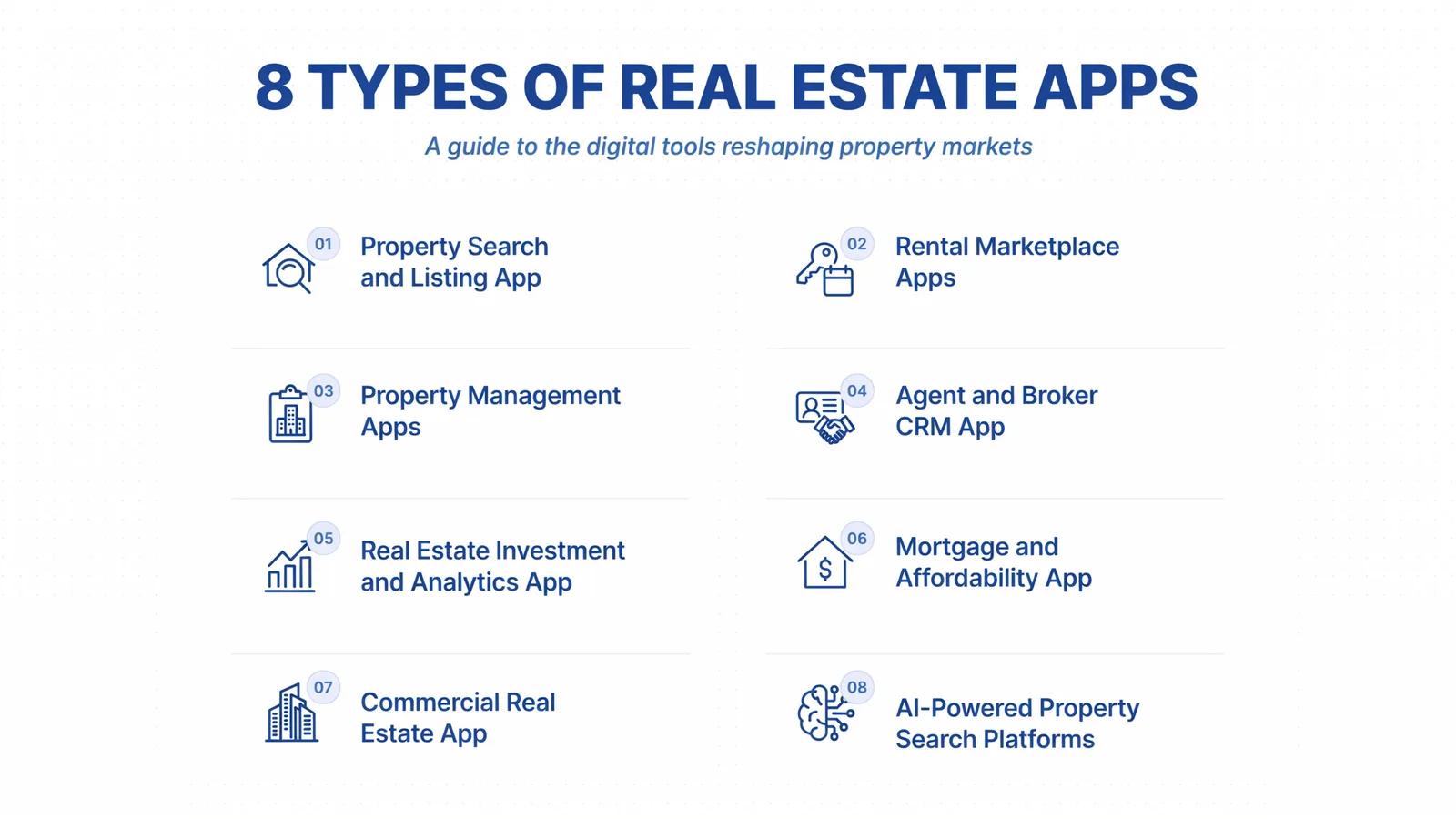
8 Types of Real Estate Apps and What Each One Costs

Not all real estate apps cost the same. The type of app you build has the biggest impact on your budget because each one requires different features, integrations, and levels of complexity.
1. Property Search and Listing App

This app allows users to look up properties, perform searches by location or by price, see images and contact agents. Expenses are determined by the complexity of the search feature, maps, and MLS integration.

Cost: $40,000 to $250,000 | Timeline: 3 to 10 months

2. Rental Marketplace App

A rental app helps tenants locate properties, fill out applications, sign lease agreements and pay rent. Payment gateways and tenant verification add to the development expenses.

Cost: $60,000 to $200,000 | Timeline: 4 to 9 months

3. Property Management App

Developed for landlords and property managers, these applications cover such aspects as rent payments, maintenance, communications with tenants, and accounting.

Cost: $80,000 to $300,000 | Timeline: 4 to 9 months

4. Agent and Broker CRM App

These applications facilitate the management of leads, clients, listings, appointments, etc. The cost is driven by CRM and third-party integrations.

Cost: $50,000 to $180,000 | Timeline: 3 to 7 months

Case Study: AI-Powered Real Estate CRM & Sales Automation

5. Real Estate Investment and Analytics App

Tailored for investors, these apps monitor portfolios, assess market trends, compute ROI, and make forecasts about the property.

Cost: $70,000 to $250,000 | Timeline: 4 to 8 months

6. Mortgage and Affordability App

The apps help users determine their eligibility for loans, compute EMIs, choose among different mortgages, and link to lenders for pre-approval.

Cost: $35,000 to $150,000 | Timeline: 3 to 6 months

7. Commercial Real Estate App

Commercial properties are handled by the app, which supports offices, retail, and industrial property listings along with lease management, investments, etc.

Cost: $90,000 to $350,000 | Timeline: 6 to 12 months

8. Full Property Marketplace Platform

A marketplace is an integrated app that has buyer, seller, agent, admin portals, MLS, artificial intelligence, payments, and monetization features.

Cost: $250,000 to $1M+ | Timeline: 12 to 24 months

Each app type has unique feature requirements, integrations, and infrastructure needs, which directly affect development cost.

 Key Takeaway: Before estimating your budget, define who your users are, how your app will generate revenue, and which business problem it solves. These three decisions have a greater impact on development costs than the technology stack alone  

Also Read: Top 15 Real Estate Mobile App Development Companies

10 Key Factors That Influence Real Estate App Development Cost

Every quote you receive is based on these ten variables with a number attached. Once you can read them, you can read any real estate app development cost proposal put in front of you.

1. App Type and Overall Scope

Before anyone talks about features, decide which of the eight types above you are actually building. A rental marketplace and an investor tool can carry identical feature lists and still differ by $150,000 in delivery. Vendors who quote before this is settled are guessing, and their guess becomes your change order later.

2. Feature Depth and Complexity

Feature count matters far less than feature behaviour, which is where most founders misjudge the budget. A filter that returns results is cheap. A filter that remembers your history, updates live, and personalises per user type is a different engineering problem. Each layer of intelligence multiplies testing surface as much as build time.

3. MLS and IDX Data Integration

This single factor separates a US property app from every other marketplace you might build. Listing data is licensed, not owned, so you pay to access it, pass certification to display it, and keep paying every year you operate. It is the most under-scoped line in the industry and deserves its own section below.

4. Platform Choice: iOS, Android, or Cross-Platform

Native development for both would double your development efforts, which doesn’t really make sense for most property applications. Cross-platform is the right default for mobile application development in this space unless there’s an absolute need for native due to heavy use of AR or camera functionality. 

| At Ciphernutz, we've found that startups launching MVPs with Flutter typically reduce development costs by 30–40% compared to building separate iOS and Android apps. Once product-market fit is achieved, native development can be considered for platform-specific requirements.

5. UI/UX Design Quality

Property apps are visual products, and weak design shows up as churn rather than complaints. Users judge trust in seconds based on how listings are presented, so this is not a place to economise. Budget 15% to 25% of your build here, and remember that Fair Housing review belongs in design, not just legal.

6. Backend Architecture and Scalability

Your backend decides whether growth feels like success or like a fire drill. Listing ingestion, search indexing, concurrent users, and sync logic are all settled early and expensive to unwind later. Teams that rush this stage pay for it twice, once in rework and once in downtime during peak traffic.

7. Third-Party API and Integration Load

Every connection you add brings its own contract, pricing model, and renewal date. Maps, payments, e-signature, messaging, and analytics each look small in isolation and add up fast in aggregate. The real cost is not the integration work; it is the metered billing that scales quietly with your traffic.

8. AI and Automation Layer

An AI layer has moved from differentiator to baseline expectation in property search. Valuation models, natural language search, and lead scoring each carry real infrastructure and retraining costs beyond the initial build. Skipping AI saves money today and costs you engagement against competitors who did not skip it.

9. Security, Privacy, and Fair Housing Compliance

The property app will have documents, financial information, as well as home addresses stored in it, which instantly makes it a high-priority application regarding security. Access control, encryption, fraud protection, and regional privacy laws are structural and not some add-ons that you can plug into your application later on. Fair Housing adds another layer that most teams find out about too late.

10. Development Team Location and Structure

Where your team sits can swing the same scope by 4x or more on rate alone. That said, rate is a poor proxy for value, because an experienced team ships fewer wrong decisions. Domain experience in property data usually saves more than a lower hourly rate ever will.

Real Estate App Feature Cost Breakdown: 15 Features Priced

Feature-level pricing is where a vague quote becomes a conversation you can actually have. Use this table to challenge any proposal line by line.

1. Core Features Every Real Estate App Needs

These carry your product. Cutting them does not save money; it just delays the spend.

FeatureCostBuild Time
Property listings and detail pages$10,000 – $22,0003 – 5 weeks
Advanced search and filters$8,000 – $18,0002 – 4 weeks
Map view with clustering$6,000 – $15,0002 – 4 weeks
User accounts and profiles$8,000 – $15,0002 – 3 weeks
Photo carousel with CDN optimisation$8,000 – $20,0002 – 4 weeks
Inquiry and contact flow$4,000 – $9,0001 – 2 weeks

2. Growth-Stage Features That Drive Retention

These are what bring users back. They rarely belong in a first release, and they always belong on the roadmap.

FeatureCostBuild Time
Saved searches and push alerts$10,000 – $20,0003 – 4 weeks
In-app messaging$15,000 – $40,0004 – 8 weeks
Mortgage and affordability calculator$4,000 – $10,0001 – 2 weeks
Agent profiles, reviews, and ratings$8,000 – $16,0002 – 4 weeks
Viewing scheduler and calendar$7,000 – $15,0002 – 4 weeks

3. Advanced Features That Move the Budget Most

This tier is where property app development cost stops being predictable, so choose each line deliberately.

FeatureCostBuild Time
Polygon "draw your area" search$8,000 – $18,0002 – 4 weeks
Virtual tour integration$5,000 – $18,0002 – 4 weeks
AR floor plan capture$20,000 – $60,0006 – 12 weeks
AI property recommendations$30,000 – $80,0008 – 16 weeks

A typical "must-have" stack adds $80,000 to $150,000 on top of your core build. That is the number founders miss when they approve a feature list without a price beside each row.

Key Takeaways 

  • Search is one of the biggest cost drivers.
  • MLS integration is usually underestimated.
  • AI should be introduced after MVP validation.

Want a Personalized Cost Estimate?

Every real estate app has different requirements. Instead of relying on generic estimates, get a tailored cost breakdown based on your business model, required features, MLS scope, and growth plans.

Cost Breakdown by User Portal (Buyer, Agent & Admin) 

Founders scope the consumer app, get a number, and plan around it. Then agents need tools, admins need oversight, and the budget doubles.

ComponentBuild CostShare of Total
Consumer app$80,000 – $300,00040% – 50%
Agent and broker app$60,000 – $200,00025% – 35%
Admin dashboard$40,000 – $150,00015% – 25%
Shared backend$40,000 – $120,00015% – 25%

1. The Consumer App

This is your most photo-heavy and design-sensitive surface, and it absorbs the largest share of spend. Buyers and renters judge credibility from the first screen, so search speed and image quality carry commercial weight. Everything users actually see lives here, which is why it rarely comes in under budget.

2. The Agent and Broker App

Agents work from their phones between showings, so this app is judged purely on efficiency. Lead routing, listing management, mobile e-signature, and CRM features all live here, and none of them are simple. Property management builds tilt heavily toward this side, which flips the usual cost ratio.

3. The Admin and Brokerage Dashboard

Usually web-based, this is where oversight, moderation, and reporting happen. It never gets demoed, and it always gets used, which is why underbuilding it creates support work forever. Compliance logging, listing approval queues, agent permissions, and dispute handling all sit here. Every one of them turns into manual staff hours the day you skip it.

4. The Shared Backend

One backend serves all three surfaces, so this cost is not multiplied by three. Listings database, MLS sync, messaging, and notifications are built once and consumed everywhere. Ask any vendor to show this as a separate line, because a padded quote often triples it quietly.

Now that you can see how the pieces divide up, let's take a look at how the money spreads across the build itself.

Real Estate App Development Cost Breakdown by Phase

This is where your budget actually gets spent. The shares below reflect a typical custom build with single-MLS coverage.

Stage 1. Discovery and Product Strategy (5% to 8%)

Start here, and treat it as the cheapest insurance you will ever buy. In this stage, you define who the app serves and which of the eight types you are building. You also settle your monetization model and which MLS markets you need on day one versus month twelve.

The output is a scoped feature list, a technical architecture, and a realistic budget. Teams that skip discovery do not save the money; they spend it later fixing decisions made blind.

Ask specifically for an MLS access plan here. If your vendor cannot tell you which boards you need and what they charge, they have not scoped your project.

Cost: $8,000 – $20,000 | Timeline: 2 – 4 weeks

Stage 2. UI/UX Design (10% to 15%)

It’s time to create something that people could actually use now. Start with wireframes, then proceed with user flows for all three target personas. Next, develop high-fidelity screens and create a clickable prototype for testing even without a line of code written.

Don’t forget about the listing card, map interaction, and inquiry trigger. These three touchpoints determine how successful your solution will be because they convert visitors into leads and nothing on the backend side helps once the design fails.

Build Fair Housing review into this stage. Your filters and recommendation logic are design decisions long before they are legal ones.

Cost: $15,000 – $40,000 | Timeline: 4 – 8 weeks

Stage 3. Mobile and Frontend Engineering (30% to 40%)

This is your single largest line, so understand what you are buying. Engineers build every screen, wire up search and filters, implement map clustering, and handle photo galleries. All of it has to perform on a mid-range phone with a weak signal.

Cross-platform is the sensible default for most property apps, and it keeps this stage roughly a third cheaper than dual-native. Reach for native only when AR capture or heavy camera work genuinely demands it.

Insist on real listing volumes during development. An app that feels fast with 50 properties can crawl at 50,000, and you want to know that now.

Cost: $60,000 – $130,000 | Timeline: 12 – 24 weeks

Stage 4. Backend and Database Architecture (15% to 22%)

While the frontend takes shape, your backend decides how far this thing can grow. Here you design the listings database, build search indexing, set up authentication, and structure notifications. You also plan how the system behaves when thousands of people search at once.

Get the data model right before listings start flowing in. Restructuring a live database with real traffic and real licensing obligations attached is the most expensive rework in this entire project.

If you are weighing hosting choices, our breakdown of cloud platforms and real GPU pricing is a useful reference for anyone planning an AI-heavy stack.

Cost: $30,000 – $60,000 | Timeline: 8 – 16 weeks

Stage 5. MLS and Third-Party Integrations (10% to 20%)

Now the outside world connects to your app, and sequencing matters more than the individual connections. MLS feeds, maps, payments, e-signature, and messaging all have to work together, and the ones planned last cause the most damage.

Start the MLS conversation early, because certification alone can add four to eight weeks per market. That approval sits on your critical path whether or not your engineering is ready.

Treat every metered API as a recurring cost from day one. Maps and messaging bills look harmless in staging and get real in production.

Cost: $25,000 – $70,000 | Timeline: 6 – 12 weeks

Stage 6. AI and Automation Layer (Optional, 10% to 25%)

If AI is part of the project, don’t start working on it until the data infrastructure is solid. It’s impossible to create good valuation models, semantic search, or lead scoring without properly structured property data.

According to McKinsey's State of AI report, AI adoption continues to increase across industries, making AI-powered search, recommendations, and automation an increasingly common expectation rather than a premium feature. 

For real estate platforms, this means capabilities such as personalized property recommendations, AI-powered chat assistants, automated lead scoring, and intelligent property valuation can significantly improve user engagement and conversion rates. 

Start with hosted models and APIs rather than training from scratch. Most teams discover their use case shifts once real users arrive, and you want that discovery to be cheap.

Our AI-powered MVP playbook walks through how to sequence an AI layer without overcommitting budget upfront.

Cost: $25,000 – $90,000 | Timeline: 8 – 16 weeks

Stage 7. QA, Security, and Compliance Testing (8% to 12%)

Property apps need testing that generic apps never require, so budget accordingly. Beyond functional QA, you verify listing sync accuracy, search reliability under load, payment security, notification delivery, and Fair Housing behaviour across filters.

A listing that shows available after it is sold is not a bug in this business; it is a trust problem that costs you and users. Test sync against real feed conditions, not clean sample data.

Security review belongs here too, since you are holding identity documents and financial details.

Cost: $15,000 – $30,000 | Timeline: 4 – 8 weeks

Stage 8. Deployment, Launch, and Maintenance (5% annually, 15% to 25%)

Launch is the smallest line and the one with the least room for error. You submit to both stores, complete MLS certification, configure production infrastructure, and set up monitoring so problems surface before users report them.

Then maintenance begins, and it never stops. Bug fixes, OS updates, API version changes, security patches, and RESO standards updates all recur. Together they run 15% to 25% of your build cost every year.

Maintenance keeps your app working. It does not keep your app competitive, and that gap is a separate budget line most founders forget.

Cost: $5,000 – $15,000 launch, then 15% – 25% annually

Real Estate App Developer Rates by Region and Team Model

Where and how you hire moves the same scope more than any feature decision on your list.

1. Hourly Developer Rates by Region

Rate differences are real, and they are not the whole story. A team that has built property platforms before will scope MLS correctly the first time, and that saves more than any discount.

RegionHourly Rate
USA and Canada$120 – $250
Western Europe$80 – $150
Eastern Europe$40 – $90
Latin America$40 – $100
India and South Asia$25 – $75

2. In-House vs Freelancers vs a Development Agency

Building in-house makes sense when a property platform is your core product for the next decade. You are hiring for salaries, onboarding, and marketplace experience that is hard to find. The first working version lands somewhere between six and twelve months out.

Freelancers work well for narrow, well-defined pieces where you already know the answer. They break down on data-heavy platforms, because nobody owns the architecture and a weak early decision becomes your problem to fix.

An agency buys you a team that has already solved MLS sync, photo scaling, and compliance on other projects. You trade some control for speed and predictability, which is why most first builds start here.

ModelTypical CostBest When
In-house team$300,000 – $600,000 first yearPlatform is your long-term core product
Freelancers$30,000 – $120,000Narrow scope, clear spec, low data complexity
Development agency$80,000 – $500,000First build, fixed scope, fast validation

3. What Offshore Development Actually Costs

Offshore rates cut your build meaningfully, and that is the easy part to understand. What decides your outcome is whether the team has shipped a listings platform before. MLS, photo scaling, and compliance are all learned the expensive way. Vet on portfolio depth in property, not on rate alone, and the savings hold.

10 Hidden Costs of Real Estate App Development

Building the app is only the beginning. These ongoing expenses are often missing from development quotes but can significantly increase your total cost over time.

  • MLS license renewal: Access to MLS data is associated with yearly licenses, which become more costly the more cities/regions you enter and sign new agreements with.
  • Storage and CDN costs: Real estate applications have millions of high-quality pictures and videos in cloud storage of the properties available. With growth in the number of listings and traffic, costs of storing them in the cloud grow every month.
  • Costs for third-party APIs: Such services as maps from Google, payment gateway services, messengers, statistics, and identity verification tools charge according to the level of usage. At first glance, such expenses might be minimal, but they will grow very quickly when the number of your clients increases.
  • App Store and MLS certification fees: Along with Apple and Google publishing fees, MLS services usually require certification, testing, and annual renewal fees before being able to show your listings.
  • Regular audit for compliance with regulations: Regulations like Fair Housing, GDPR, CCPA and others require regular audits. Each significant change in your application requires an additional legal review.
  • Detection of fake listings: User verification and other fraud protection and listing moderation tools require not only initial development but also monthly maintenance.
  • Scaling of infrastructure: The more users and listings there will be on your site – the bigger server capacity, database space, back-ups, and network throughput will be needed. Generally speaking, infrastructure costs increase proportionally with the growth of your platform.
  • RESO and MLS standard updates: Every year MLS providers improve their data standards and APIs. To stay compatible, you will have to make some changes that are not accounted for in the initial budgeting.
  • Updates for operating systems: Every year, both Apple and Google release updates for iOS and Android. You need to make sure that your application stays compatible and works properly.
  • Marketing and ASO: Having a great application does not mean having users. You will need to pay for ASO, advertising, SEO, content marketing, etc.

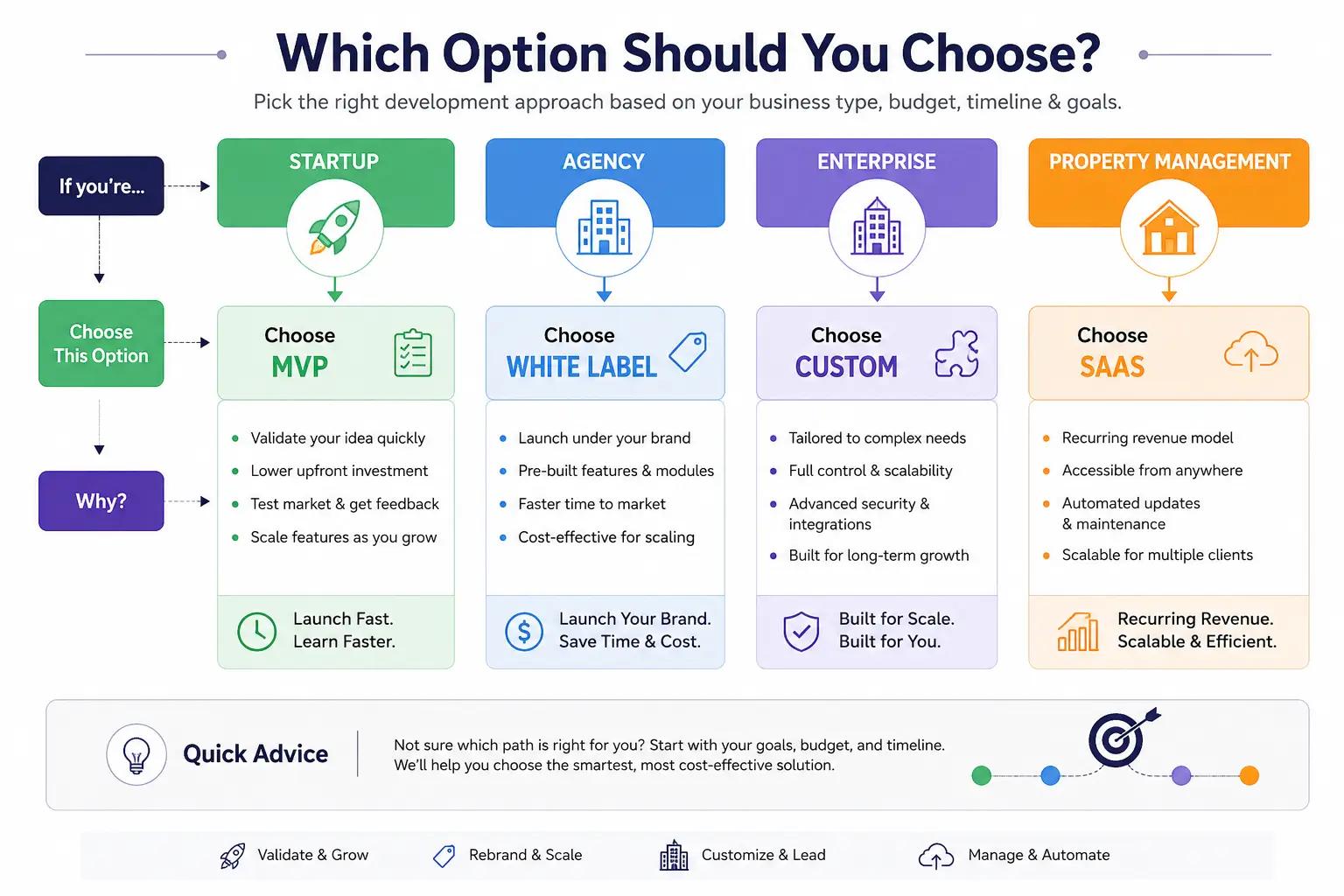
Custom vs White-Label Real Estate App Development Cost

Here’s the key difference between custom vs white-label real estate app development cost: 

PathInitial CostYear 1 TotalFits
White-label rebrand$5,000 – $20,000$15,000 – $50,000Single brokerage, agent productivity
White-label with customisation$20,000 – $80,000$40,000 – $120,000Light branding or workflow needs
Custom single-sided app$80,000 – $250,000$130,000 – $350,000Property management, investor tools
Custom 3-sided marketplace$250,000 – $500,000$400,000 – $700,000PropTech startups, multi-vertical
Custom national marketplace$500,000 – $1.5M+$800,000 – $2M+National marketplace ambitions

8 Costly Mistakes That Increase Real Estate App Development Costs

Many real estate app projects go over budget because of poor planning rather than poor development. Avoiding these common mistakes can save you thousands of dollars and prevent unexpected delays.

Mistake 1. Budgeting Only for the Customer App

It is often easy to neglect the agent portal, admin dashboard and backend while estimating the budget, but these elements are crucial for managing listings, users and transactions and could make the total cost of the project much higher.

Solution: Ask your developer to provide you with a separate price for each element such as customer app, agent portal, admin panel and backend.

Mistake 2. Ignoring MLS Licensing Costs

It is important to know that MLS integration is not just an API connection but also licensing, certification and approval by MLS providers that could be left out of development quotes.

Solution: Check your MLS licensing fees, costs of certification and time needed to get approval before making any agreements.

Mistake 3. Building Every Feature Before Validating Your Idea

Implementing AI recommendations, virtual tour options, advanced analytics and other premium features right at the beginning will greatly affect the budget of the project. Most of these features may not even be needed until your app has users.

Solution: Develop MVP first, with essential features only.

Mistake 4. Underestimating Image Storage Costs

The real estate platform involves lots of photographs and videos. As your listings and traffic grow, monthly fees for cloud storage and distribution go up.

Solution: Take into account the costs of image storage and data distribution while estimating the growth of your platform.

Mistake 5. Choosing the Cheapest Development Team

An attractive hourly fee will be cheaper initially, but inexperienced developers will make mistakes in terms of architecture and integration, which you will have to pay much more later to correct.

Solution: Find a professional development team with a portfolio of successful MLS solutions.

Mistake 6. Waiting Too Long to Plan Monetization

Subscriptions, listings, ads, referral systems, etc. have a huge impact on your platform's architecture. To implement them after launch, you will need additional expensive redesign and development.

Solution: Make sure your monetization strategy is ready before starting development.

Mistake 7. Ignoring Compliance Until the End

Real estate applications have to adhere to legal requirements like Fair Housing, GDPR, and CCPA. Any compliance-related modifications done after the development process will cost significantly more compared to planning for compliance from the very beginning.

Solution: Make sure legal and compliance checks are considered during design, development, and testing processes.

Mistake 8. Budgeting Only for Development

While the expense of development represents just the initial portion of your overall spending, hosting, maintenance, MLS renewals, cloud services, marketing, and other expenses are required well beyond the application’s launch date.

Solution: Budget at least for three years ahead of time.

How to Choose a Real Estate App Development Company: 7 Criteria

The right real estate app development company moves your budget more than any feature you cut. Use these seven filters before shortlisting anyone.

  • Property platform portfolio: Ask for shipped real estate apps with live listing data, not generic marketplace work. Adjacent experience does not transfer, and MLS specifically does not.
  • MLS and IDX track record: Have them name boards they have integrated and describe a certification they cleared. Vague answers here are the single loudest warning sign you will get.
  • Line-item transparency: Demand every component priced separately, including MLS, photo infrastructure, and each of the three app sides. Bundled quotes hide the variance that decides your budget.
  • Compliance fluency: They should raise Fair Housing before you do. A partner who treats it as your problem will hand you an expensive one later.
  • Scalability planning: Ask how their architecture behaves at 50,000 listings and what the infrastructure costs there. If they only answer for launch volume, they have not built at scale.
  • Post-launch commitment: Confirm what maintenance covers, what it costs annually, and who handles RESO and OS updates. Teams that disappear at launch leave you with a depreciating asset.
  • Communication and delivery rhythm: Expect sprint documentation, regular demos, and a named project manager on any build above $50,000. Predictability is worth more than a discount.

Why Do Businesses Choose Ciphernutz for Real Estate App Development?

You can model every number in this guide correctly and still lose the budget to poor execution. That is why the partner's decision outweighs the estimate.

That is where Ciphernutz makes the difference. We build property platforms around your actual operations and data sources, never from a template. We also price MLS as its own line before you sign anything.

What makes us stand out?

  • Proven experience: 100+ clients, 20+ countries, 98% client retention
  • Fixed-scope delivery: Production-ready builds shipped in 3 to 6 weeks
  • Real estate depth: Property management, CRM, listing platforms, MLS and ERP integrations
  • AI-native engineering: Valuation, semantic search, and lead scoring built in, not bolted on
  • Zero templates: Everything built for your stack, your markets, your workflows
  • Risk-free start: 1-week risk-free trial, flexible engagement models, strict NDA, dedicated project manager

Our Experience Building Real Estate Applications

Over the years, we've worked with startups, brokers, and enterprises building custom real estate platforms. One recurring pattern we've observed is that founders usually underestimate MLS licensing costs and backend scalability while overestimating the value of advanced AI features in the first release. We generally recommend validating the market with an MVP before investing in enterprise-level automation.

Get Your Real Estate App Cost Estimate

Planning to build a Zillow-like app, rental platform, brokerage solution, or property management system? Our experts will review your idea, recommend the right technology stack, estimate your development budget, and provide a detailed roadmap.

Conclusion

Real estate app development cost is never one number, because a property app is never one product either. It moves with your app type, your MLS footprint, and how many user sides you build. It also moves with whether you budgeted for the platform or just the launch.

Get those four right and your numbers hold. Get them wrong, and no amount of engineering discipline saves the budget, because the gap was in the plan, not the code.

We hope this guide helped you understand where the money in a property app actually goes. You now have the questions to put in front of every vendor you talk to.

Now it's your turn. Pick your app type, scope your MLS coverage honestly, model three years instead of three months, and price the build against reality.

Ready to move? Connect with our experts to turn your property app idea into a scoped, production-ready build.

FAQs

How much does real estate app development cost?

The cost of real estate app development typically ranges from $25,000 for a basic MVP to $500,000+ for an enterprise-grade marketplace. Most custom real estate apps fall between $80,000 and $250,000, depending on features, MLS/IDX integration, AI capabilities, security requirements, and the number of user portals.

What does it cost to build a real estate app like Zillow?

Developing an app similar to Zillow generally starts at $250,000 for a single-market solution and can exceed $1 million for a nationwide platform with multiple MLS integrations, AI-powered property recommendations, virtual tours, agent portals, and enterprise-level infrastructure.

Can I build a real estate app without MLS or IDX integration?

Yes. Many startups launch an MVP without MLS integration by allowing property owners or agents to upload listings manually. This approach reduces initial development costs and speeds up product validation. MLS/IDX integration can be added later as your platform expands into larger markets.

What is the cheapest way to build a real estate app?

The most affordable approach is to build a Minimum Viable Product (MVP) with essential features such as property listings, search filters, maps, user accounts, and inquiry forms. Advanced capabilities like AI recommendations, virtual tours, CRM automation, and multi-MLS support can be introduced after validating market demand.

How long does real estate app development take?

A basic MVP usually takes 8–14 weeks to develop. A mid-sized application generally requires 4–8 months, while an enterprise marketplace with multiple user roles, AI features, and MLS integrations may take 12–24 months. MLS certification can also add several weeks depending on the market.

What ongoing costs should I expect after launching a real estate app?

After launch, businesses should budget 15–25% of the initial development cost annually for maintenance. Ongoing expenses include cloud hosting, MLS licensing renewals, third-party APIs, app store fees, security updates, performance monitoring, bug fixes, and feature enhancements.

What is the ROI of developing a real estate mobile app?

A well-designed real estate app can generate returns through premium property listings, subscription plans, advertising, lead generation, transaction commissions, and property management services. Beyond direct revenue, it can also reduce manual operations, improve customer engagement, and increase lead conversion rates, making it a long-term investment for real estate businesses.

How do I choose the right real estate app development company?

Choose a development partner with proven experience in building real estate platforms, MLS/IDX integrations, scalable cloud architecture, and secure mobile applications. Review their portfolio, technical expertise, communication process, post-launch support, and pricing transparency before making a decision. A company that understands the real estate domain can help you avoid costly mistakes and accelerate time to market.
Latest Blogs and Insights

Copyright 2026.
All Rights Reserved by
Privacy Policy