10 Real Estate Technology Trends Every Brokerage Should Know
Pintu Soliya
3-5 mins
Introduction
The real estate industry is undergoing one of the biggest technological transformations in its history. Buyers expect instant property recommendations, virtual tours, AI-powered assistance, and faster communication, while brokerages are under increasing pressure to generate more qualified leads, reduce operational costs, and improve customer experiences.
According to Deloitte, Commercial Real Estate Outlook, most real estate organizations are increasing investment in data, technology, and Artificial Intelligence (AI) to improve operational efficiency and remain competitive in a rapidly evolving market.
Modern technologies such as Artificial Intelligence (AI), workflow automation, predictive analytics, digital twins, and smart property management are no longer reserved for large enterprises. They are becoming essential tools for brokerages of every size looking to remain competitive in a rapidly evolving market.
Understanding the latest Real Estate Technology Trends helps brokerage owners, property managers, and PropTech startups make informed investment decisions, improve operational efficiency, and prepare for the future of digital real estate.
In this article, we'll explore the ten most significant Real Estate Technology Trends shaping the industry in 2026 and how your business can leverage them to gain a competitive advantage.
Why Every Brokerage Should Embrace Technology
Technology is no longer just a competitive advantage—it has become a business necessity. Modern buyers expect seamless digital experiences, instant responses, personalized recommendations, and transparent communication throughout the buying or renting journey.
By investing in the latest Real Estate Technology Trends, brokerages can:
- Generate more qualified leads
- Automate repetitive administrative tasks
- Improve customer engagement
- Reduce operational costs
- Make data-driven decisions
- Increase sales productivity
- Deliver better customer experiences
For businesses that delay digital transformation, keeping pace with changing customer expectations becomes increasingly difficult.
| Traditional Brokerage | AI Brokerage |
|---|---|
| Manual Follow-up | AI Agents |
| Phone Calls | Omnichannel |
| Manual Scheduling | Workflow Automation |
| Generic Marketing | AI Personalization |
| Manual Reports | Predictive Analytics |
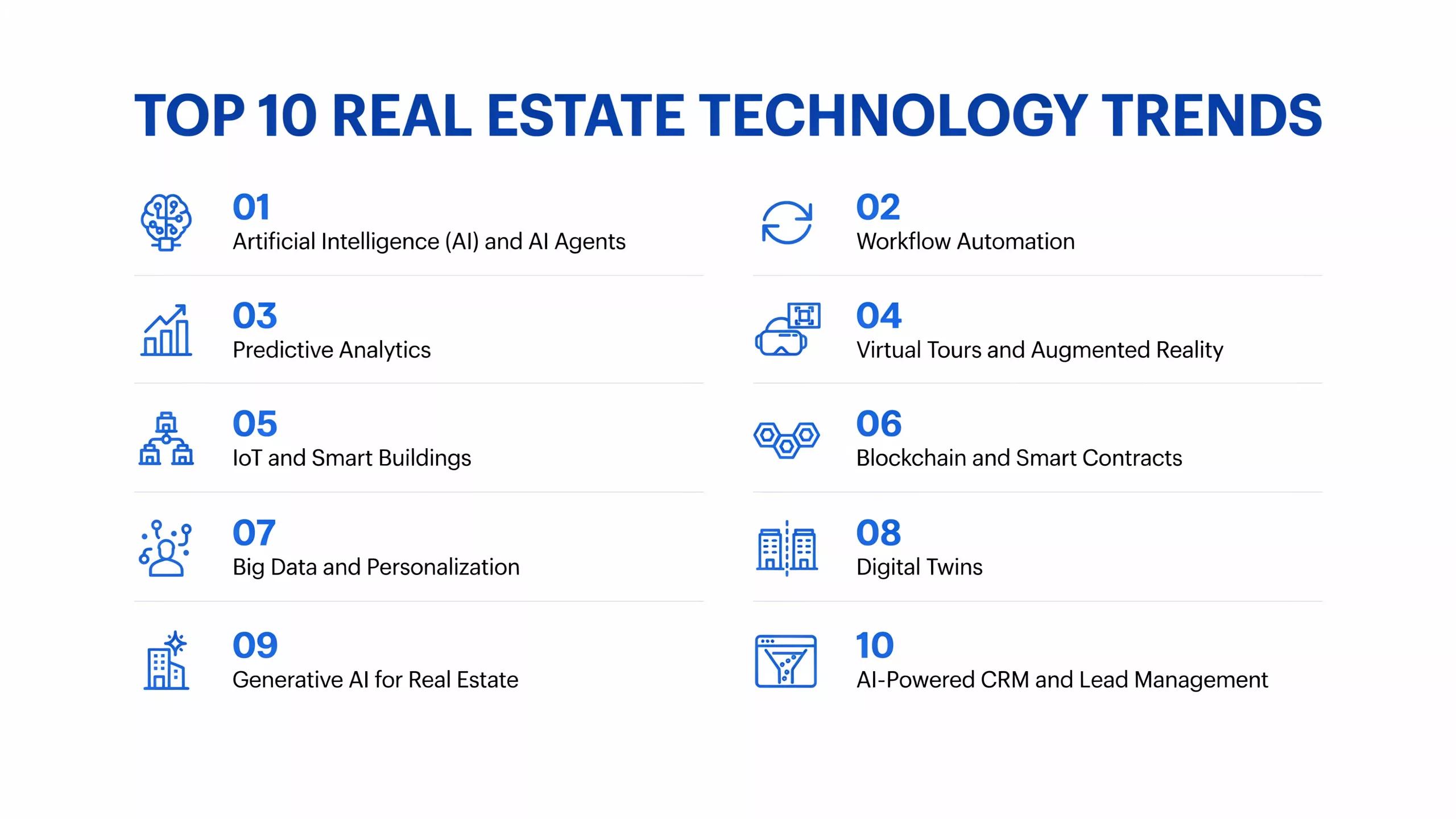
Top 10 Real Estate Technology Trends
The real estate industry is evolving rapidly, with emerging technologies transforming how properties are marketed, sold, managed, and experienced. Here are the ten most significant trends every brokerage should watch in 2026.
1. Artificial Intelligence (AI) and AI Agents
AI is transforming how brokerages generate leads, qualify prospects, and provide customer support. AI Agent Development enables businesses to build intelligent virtual assistants that can answer property inquiries 24/7, schedule viewings, recommend properties, and automate follow-ups without human intervention.
Business Benefits
- Faster lead response
- Higher conversion rates
- Lower operational costs
- Improved customer satisfaction
2. Workflow Automation
Manual processes such as appointment scheduling, document approvals, CRM updates, and lead nurturing consume valuable time. N8N Workflow automation services eliminates repetitive tasks, allowing agents to focus on building relationships and closing deals.
Business Benefits
- Reduced manual work
- Faster operations
- Better team productivity
- Consistent customer experience
3. Predictive Analytics
Predictive analytics uses historical and real-time data to forecast market demand, property prices, and customer behavior. This enables brokerages to make informed investment decisions and identify emerging market opportunities.
Business Benefits
- Better investment decisions
- Improved pricing strategies
- Higher lead quality
- Accurate forecasting
4. Virtual Tours and Augmented Reality
Virtual property tours allow buyers to explore homes remotely using immersive 3D experiences. Augmented Reality helps visualize furniture placement, renovations, and interior designs before purchasing.
Business Benefits
- More qualified buyers
- Reduced physical visits
- Faster decision-making
- Improved customer experience
5. IoT and Smart Buildings
Smart buildings equipped with IoT sensors monitor energy consumption, security systems, lighting, and maintenance requirements in real time.
Property managers can proactively identify maintenance issues while reducing operational costs and improving tenant satisfaction.
Business Benefits
- Energy efficiency
- Preventive maintenance
- Improved tenant experience
- Lower operating costs
6. Blockchain and Smart Contracts
Blockchain technology increases transparency and security during property transactions. Smart contracts automatically execute agreements once predefined conditions are met, reducing paperwork and minimizing fraud.
Business Benefits
- Faster transactions
- Improved security
- Reduced fraud
- Greater transparency
7. Big Data and Personalization
Every customer interaction generates valuable insights. Big data enables brokerages to personalize property recommendations, marketing campaigns, and customer communication based on user behavior and preferences.
Business Benefits
- Personalized experiences
- Better marketing ROI
- Improved customer retention
- Increased sales conversions
8. Digital Twins
Digital twins create virtual replicas of properties and buildings that help developers, investors, and facility managers simulate maintenance, renovations, and operational performance before making physical changes.
Business Benefits
- Better planning
- Reduced project risks
- Lower maintenance costs
- Improved asset management
9. Generative AI for Real Estate
Businesses are increasingly investing in Generative AI Development Services to automate content creation, property recommendations, document generation, customer support, and personalized marketing campaigns.
Instead of spending hours writing content manually, brokerages can generate high-quality drafts within minutes while maintaining consistency and improving productivity.
Business Benefits
- Faster content creation
- Lower marketing costs
- Better customer communication
- Increased productivity
10. AI-Powered CRM and Lead Management
Modern CRMs use AI to score leads, predict buying intent, automate follow-ups, and recommend the next best action for sales teams.
Instead of manually managing thousands of prospects, AI helps agents prioritize high-intent buyers and improve conversion rates.
Business Benefits
- Better lead prioritization
- Faster sales cycles
- Increased conversions
- Improved customer relationships
Related Case Study: AI-Powered Real Estate CRM & Sales Automation
How to Prepare Your Brokerage for These Trends
Adopting every technology at once isn't necessary. Start by identifying your biggest operational challenges and selecting solutions that provide the highest business impact.
A practical roadmap includes:
- Audit your current processes.
- Identify repetitive workflows.
- Prioritize quick-win automation opportunities.
- Implement AI-powered CRM and workflow automation.
- Train employees on new technologies.
- Measure ROI and scale gradually.
Working with an experienced AI and automation partner can help reduce implementation risks while ensuring a faster return on investment.
Technology Adoption Roadmap
| Timeline | Priority |
|---|---|
| Month 1 | CRM Automation |
| Month 2 | Lead Automation |
| Month 3 | AI Chatbot |
| Month 4 | Predictive Analytics |
| Month 5 | AI CRM |
| Month 6 | AI Agents |
Key Takeaways
- AI is becoming the foundation of modern real estate operations.
- Workflow automation reduces repetitive administrative work.
- Predictive analytics improves decision-making and pricing strategies.
- Virtual tours enhance customer experiences and reduce sales cycles.
- Smart buildings improve operational efficiency.
- Blockchain strengthens transaction security.
- Generative AI accelerates marketing and customer communication.
- Businesses that embrace Real Estate Technology Trends today will be better positioned for long-term growth.
How Ciphernutz Can Help Your Brokerage
Adopting new technologies can feel overwhelming, especially when you're balancing customer expectations, legacy systems, and day-to-day operations. At Ciphernutz, we help real estate companies identify high-impact opportunities for AI and automation, then build scalable solutions that solve real business problems.
Whether you're planning to develop a custom PropTech platform, implement AI-powered CRM, automate lead management, or streamline workflows using n8n, our team works closely with you from strategy to deployment.
Our real estate technology services include:
- AI Agent Development
- Workflow Automation with n8n
- AI-Powered CRM Development
- Custom PropTech Software Development
- Real Estate Mobile App Development
- AI Chatbots and Voice Agents
- API Integrations and Automation
Conclusion
Technology is reshaping every stage of the real estate journey, from property discovery and customer engagement to transaction management and post-sale support. Brokerages that embrace AI, automation, and modern PropTech solutions today will be better positioned to improve operational efficiency, deliver exceptional customer experiences, and stay competitive in an increasingly digital market.
Rather than trying to adopt every emerging technology at once, focus on solving your biggest business challenges first. A well-planned technology roadmap and the right implementation partner can help you maximize ROI while preparing your brokerage for long-term growth.
Ready to Modernize Your Real Estate Business?
Whether you're looking to build an AI-powered CRM, automate lead management, or develop a custom PropTech platform, our experts can help you create scalable solutions tailored to your business.
FAQs
What are Real Estate Technology Trends?
They are emerging technologies such as AI, automation, IoT, blockchain, and predictive analytics that improve how properties are bought, sold, rented, and managed.
Which technology trend has the biggest impact on real estate?
Artificial Intelligence and workflow automation currently deliver the highest ROI by improving lead generation, customer service, and operational efficiency.
How can small brokerages adopt these technologies?
Start with AI-powered CRM, workflow automation, and digital marketing tools before investing in more advanced technologies.
Is AI replacing real estate agents?
No. AI automates repetitive tasks and provides insights, allowing agents to spend more time building relationships and closing deals.
How much does PropTech implementation cost?
Costs vary depending on the solution, integrations, and business size. Many brokerages begin with small automation projects before scaling.
What's the future of real estate technology?
The future includes AI agents, autonomous workflows, digital twins, smart buildings, and hyper-personalized customer experiences.