Understanding Reasoning in AI: Models, Frameworks & Use Cases
Vijay Vamja
8-10 mins
AI is everywhere today, but all its iterations lack something critical: reasoning ability. Reasoning in AI combines logical and adaptive decision-making capabilities - a transformative development for the global artificial intelligence landscape.
Can Artificial intelligence reasoning solutions potentially control the narrative of future AI technologies? Yes, potentially. Everything depends on variables like architecture, deep learning methods, and numerous other AI-associated components.
So let's understand how AI reasoning works and the types of AI reasoning models anyone can use to develop custom AI reasoning applications.
What is Reasoning in AI?
Reasoning in AI concerns drawing data-driven conclusions and making logic-based decisions. Such an artificial intelligence (AI) reasoning system can also learn new information based on structured data, rules, or knowledge.
Unlike traditional machine learning, which functions by identifying patterns, AI reasoning imitates aspects of human thought and thinking. Yes, reasoning AI models can today perform cause-and-effect analysis, deduction, and problem-solving, and more.
Why Does AI Reasoning Matter?
Global businesses and industries are already investing in AI reasoning to develop AI technologies that think, infer, solve problems (and automate everything). Once such systems are developed, innovations will follow, and enterprises, namely NVIDIA, AMD, IBM, etc., are currently leading this pursuit.
In this pursuit, whichever AI system has the following fundamental abilities will become the pioneer and the leading AI reasoning giant.
- Perform decision-making beyond training data
- Improve data transparency
- Enable multi-step problem-solving to develop robotics, etc.
- Function as adaptive systems or their component in dynamic environments
There are several other uses where the applied reasoning in AI can effectively solve various industry and business verticals. However, before we explore them in detail, understanding the different models and types of AI reasoning is super essential.
The Importance of Reasoning in AI
The pattern-recognition method of traditional AI-based tools is inefficient for applications that require adaptive thinking. Reasoning AI solves this problem and delivers outputs to user queries based on its following traits:
- Understand context
- Make decisions with limited data
- Logic-based justification of outcomes or results
For instance, a McKinsey report (2023) states that 47% of employees will use AI reasoning capabilities for decision-making. However, it gets interesting because multiple types of reasoning methods exist and can be used across scenarios.
How Does Reasoning Work in AI?
Reasoning in AI works in multiple ways, like humans reason with situations based on circumstantial data, knowledge, and adaptive thinking. However, unlike us, the AI's reasoning abilities can be scaled and enhanced or even fine-tuned to serve a particular industry niche.
Therefore, learning how reasoning is performed by AI agents can help understand the overall scope and realistic uses of reasoning AI systems.
Exploring Modern Reasoning in AI
Modern AI models or large language models (LLMs) can manage inference (response generation) dynamically, wherein they can continue, stop, or restart their reasoning process. Their capability-aware self-evaluation model predicts mid-generation if more responses could improve the answer and thereby optimise computational resources and output quality.
Any user query is typically processed by a Reasoning AI Agent or AI system in the following manner:
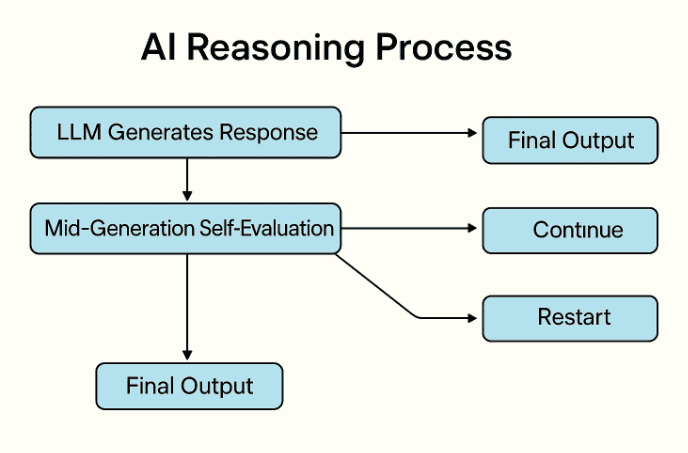
Note: The above depicted step-by-step method of Reasoning in AI is only a basic workflow designed specifically for understanding purposes. The actual workflow could vary based on the designed reasoning AI framework.
Types of AI Reasoning Models:
- Statistical AI Reasoning
- Symbolic AI Reasoning
- Logic-Based AI Reasoning
- Statistical AI Reasoning
When AI relies on probability and data patterns to derive conclusions, it is said to be running on the Statistical AI Reasoning model. Most modern systems already run it based on different techniques, and they are listed below.
Techniques Used in Statistical AI Reasoning
- Statistical Inference
It is a technique that enables drawing conclusions from data samples using probability distributions and hypothesis testing. The Statistical Inference technique also combines Bayesian methods as required to update beliefs or reason with emerging data updates.
- Optimization Algorithms
The gradient descent technique particularly refines model parameters during training to enable efficient learning from large datasets, helping algorithms perform reasonably quickly, pun intended.
- Neural Networks & Deep Learning
Multi-layered architectures help the reasoning model with sensory data processing, like image recognition and natural language processing. Convolutional neural networks (CNNs) are also known to excel in spatial reasoning for offering autonomous navigation capabilities.
- Reinforcement Learning
It follows agents learning optimal behaviors through trial-and-error interactions with environments, and it has major applications for robotics and algorithmic trading.
- Probabilistic Modeling
Uncertainty assessment using Bayesian networks and Markov decision processes improves decision-making accuracy, especially in ambiguous scenarios.
Examples
- Fraud Detection in Finance & Banking
- Predictive Healthcare Diagnostics
- Predicting Customer Behavior in e-Commerce
- Credit Risk Analysis in Lending
- Drug Discovery and Development
- Personalized Marketing Campaigns
- Supply Chain Optimization
- Autonomous Vehicle Navigation
- Legal Contract Analysis
- Customer Service Automation
- Predictive Maintenance in Manufacturing
Strengths
- Pattern Recognition & Predictive Accuracy
- Adaptability & Scalability
- Operational Efficiency and Automation
- Real-time Decision-Making
- Simple Scalability & Cost-Effective
- Symbolic AI Reasoning
Techniques Used in Symbolic AI Reasoning
- Logic Programming
The use of formal logic languages like Prolog enables encoding and interpreting knowledge through facts and rules to help systems perform logical inference and answer non-simple queries.
- Rule-Based System
It is a technique that uses IF-ELSE rules to perform expert knowledge functions and support decision-making. The defined rules can be chained together, allowing the system to reason via multiple logical steps to arrive at accurate conclusions.
- Knowledge Representation
This technique structures the information using symbols, ontologies, semantic networks, and frames to define objects, concepts, and their relationships that mirror the human understanding architecture.
- Ontologies
The ontologies technique for symbolic reasoning offers structured frameworks to map relationships among concepts for supporting complex reasoning and navigation through large knowledge domains.
- Inference Engines
These are like mechanisms that apply logical rules to the knowledge base to acquire new facts, create deductions, and support decision-making automation.
- Automated Theorem Proving
It harnesses logical deduction to prove mathematical theorems and validate logical assertions to support mathematics and formal verification applications.
- Natural Language Processing
It is the core function that analyzes and generates human language using symbolic representations of language, like grammar, syntax, and semantics. Ultimately, it enables rule-based language understanding and output generation.
Examples
- Expert Systems for Medical Diagnosis
- Automated Theorem Validation
- Automation Planning and Scheduling
- Semantic Web Technologies
- Constraint Satisfaction Problems
- Natural Language Processing (GenAI)
- Fraud-Detection Rule-Based Systems
Strengths
- Better Transparency and Interpretations
- Customizable Structured Knowledge Representation
- Rule-Based Decision Making
- Auditability and Accountability
- High Efficiency Despite Limited Data
| Statistical AI Reasoning | Symbolic AI Reasoning | |
|---|---|---|
| Logic Style | Inductive/Abductive | Deductive |
| Techniques | Bayesian networks, Neural networks, Markov models, Probabilistic graphical models | Rule-based systems (e.g., expert systems), Logic programming (e.g., Prolog), Knowledge representation frameworks |
| Strengths | Data-driven, Scalable, Excellent at handling uncertainty | Transparent, Rule-based logic |
| Limitations | Often lacks interpretability (black-box problem), Needs large, high-quality datasets | Difficult to scale for unstructured or noisy data, Needs manual rule creation |
| Use Cases | Fraud detection, NLP, Forecasting | Legal AI, Knowledge graphs |
Understanding Logic-Based Reasoning in AI
AI Reasoning activities that utilize deductive, inductive, and abductive logic can be said to run on a logic-based reasoning model. However, unlike the other two logic types, logic-based reasoning in AI uses the following three techniques to derive the output.
- Deductive Reasoning (Top-down Logic)
This technique draws specific conclusions from general rules to derive accurate outputs. Currently, its uses enable the development of Expert Reasoning Systems, Legal Reasoning, Compliance Regulation Engines.
Example - Identify customers with three or more late payments as high risks >> John Doe has three late payments >> John Doe is a high risk profile.
- Inductive Reasoning (Bottom-up Logic)
This technique infers general rules from specific examples to derive processed outputs using large data. It's popular now for developing recommendation engines, customer analytics tools, etc.
Example - Identify customers who bought product A >> Suggest B to the new A buyers.
- Abductive Reasoning (Best-Guess Logic)
This technique promptly chooses the most likely or accurate explanation based on incomplete data and is widely used in medical diagnostics and AI troubleshooting.
Example - Acknowledge user activity decline + no login for 7 days >> Announce probable reason: Churn Risk.
Introduction to Core AI Reasoning Frameworks
An AI reasoning framework is a structured architecture system that guides how AI models operate for thinking, inference, and execution. Such frameworks combine logic, data, and rules to enable machines to simulate intelligence-driven decision-making.
For any AI reasoning models across any industry, the framework functions as a backbone to offer distinctive AI reasoning applications. The following are a few types of AI reasoning frameworks that are popular worldwide.
Neuro-Symbolic Frameworks
It is a hybrid framework for AI reasoning that combines pattern recognition of neural networks with the logical structure of symbolic reasoning models.
How it Works:
A neural model processes raw data (i.e., image) and the symbolic layer reasons about the output delivered to the user-end.
Example:
IBM developed the Neuro-Symbolic Concept Learner to interpret visual scenes and answer questions with logic-based inferences.
Use Cases:
- Visual Question Answering
- Robotics
- Scientific Reasoning Tasks
Knowledge Graphs
A knowledge graph is a network formed of data about real-world entities and their relationships, primarily used in applied contextual reasoning.
How it Works:
The data is transformed into nodes (entities) and edges (relationships) to form a graph structure that queries AI to infer new connections or to retrieve relevant information based on logical relationships.
Example:
Google uses the knowledge graph AI reasoning framework to link entities like movies, cast, genre, etc., to retrieve precise answers to user search queries.
Use Cases:
- Semantic search
- Chatbots
- Enterprise knowledge management
Bayesian Networks
A Bayesian network depicts probabilistic relationships between variables and also helps AI systems with reasoning despite uncertainty or a contextual lack of data.
How it Works:
Variables in the Bayesian network are modeled as nodes to which probabilities are assigned based on dependencies. In this AI Framework Model, the network updates the beliefs dynamically with any new admission or user input.
Example:
Agentic AI in healthcare and modern medicine uses the Bayesian network framework to support medical diagnosis by evaluating symptoms and test results to predict disease likelihood.
Use Cases:
- Risk Assessment
- Predictive Diagnostics
- Fraud Detection
Rule-based Reasoning Systems
Commonly known as expert systems, the rule-based reasoning systems function on pre-defined rules to make logical decisions and deductions.
How it Works:
The inference engine evaluates the IF-THEN rules against the user input data. Upon the successful match of the conditions, certain conclusions or actions are triggered through forward or backward chaining.
Example:
A compliance engine (expert system) applies policy rules to customer data and flags violations automatically when any are found.
Use Cases:
- Legal tech
- Regulatory compliance
- Industrial automation
Case-Based Reasoning Systems
The CBR (Case-Based Reasoning) system functions to solve problems by referring to similar previously encountered cases.
How it Works:
The AI runs a search inside its case database for scenarios that resemble the current problem and applies the previously known solution as required. Simultaneously, it stores the newer outcomes for future reuse.
Example:
An automated help desk bot recalls similar support tickets and offers the ideally effective resolution based on the cases in the past.
Use Cases:
- Customer support
- Troubleshooting systems
- Incident response
Combined Hybrid Reasoning Systems
A (combined) hybrid reasoning system typically integrates multiple frameworks (i.e., statistical + symbolic) to handle real-world or complex problems with structure and adaptability together.
How it Works:
The respective reasoning engines (neural, rule-based, probabilistic) operate in tandem or in stages to deliver highly refined outputs. In such systems, usually one framework processes the raw input, while another applies probabilistic reasoning or logic.
Example:
An autonomously driven vehicle runs on hybrid reasoning. The neural networks successfully detect objects, Bayesian models perform risk prediction, and the defined rules adhere to traffic law compliance.
Use Cases:
- Autonomous Systems & Digital Twins for Innovations
- AI Copilots (e.g., Agentic AI for Medical/Legal)
- Advanced Virtual Assistant for Staffing or Other Use
AI Reasoning Applications Across Industries
Each industry on the planet may not require an AI agent, but every industry can still benefit from Agentic AI or even basic AI reasoning capabilities.
In 2025, artificial intelligence reasoning enables global industries to access smarter, faster, and adaptive decision-making, and it's only getting better ahead. AI reasoning applications are also further multiplying with each breakthrough in frameworks, models, or the AI reasoning data set.
The following industries are leading by example through various successful everyday uses of reasoning in AI.
Healthcare
Advanced AI reasoning systems today are helping the healthcare industry discover better treatment outcomes while delivering exceptional patient care experiences. The AI-driven telemedicine solutions are a fantastic proof of concept of the virtual healthcare revolution brought on by decisive uses of artificial intelligence.
Likewise, by combining clinical decision-making and treatment autonomously with the help of smart and 'expert systems', the following reasoning frameworks are addressing healthcare's rudimentary challenges.
Multi-Modal Reasoning Empowers Diagnostic Innovations
The applications of hybrid reasoning in AI are bringing the futuristic era in diagnostics closer, with AI systems delivering better detection rates early on.
A mental health assessment platform called Thymia across 300 European clinics analyzes facial expressions and voice patterns. It works by combining statistical and symbolic reasoning models and delivers 92% accuracy in detecting depression indicators.
Similarly, the Med-R1 8B by IQVIA is redefining the next generation of what an agentic reasoning AI doctor can offer. Even at its compact capacity of 8 billion parameters, the medical reasoning AI doctor (Med-R1 8B) achieved a diagnostic concordance rate of 89% with senior physicians.
Note: The Med-R1 8B results are featured in a multi-center trial published in The Lancet Digital Health, March 2025.
Predictive Healthcare and Treatment Personalization
ML (machine learning) algorithms can now successfully forecast potential health issues based on data from wearables and precursory indicative conditions. Thus, probabilistic reasoning techniques are enabling early interventions and improved patient outcomes by anticipating health complications before symptoms fully appear.
Google-made DeepMind implementation for diabetic retinopathy detection is a prime example of convolutional neural networks (CNNs) reasoning with visual data. Rolled out in 2,000 hospitals, it can identify certain anomalies accurately as human specialists.
A peer-reviewed study in JAMA Ophthalmology also confirms DeepMind's early-stage retinopathy detection with a 94% sensitivity rate, similar to the accuracy of board-certified specialists.
The Rise of Agentic Reasoning AI Doctor(s)
The deployment of an agentic reasoning AI doctor in clinical settings is not a surprise, with Microsoft's Azure Health Agent being live and useful in major hospital networks. Agentic AI of this scale is analyzing millions of data points from lab results to longitudinal health records in mere seconds.
A published HIMSS 2025 survey affirms that 67% of hospitals gain a 20% reduction in diagnostic errors using an AI doctor capable of agentic reasoning. Nonetheless, achieving breakthroughs of this extent is attributed to the ability of agentic reasoning AI doctors to break complex medical decisions into logical and evidence-based steps.
Furthermore, the entire process maintains a fully transparent reasoning process, mirroring expert clinicians' approaches to solving difficult patient cases.
Other Agentic Reasoning AI Doctor Implementation & Workflows
Integrated agentic reasoning AI doctors are now a part of modern clinical workflows at the Mayo Clinic and the Cleveland Clinic. These artificial intelligence healthcare units assist with therapy comparisons, interpret clinical trial data, and support diagnostics by working alongside the human workforce.
In drug development scenarios, an agentic reasoning AI doctor using reinforcement learning can identify certain compounds faster than traditional methods. The Pfizer 2025 drug study program saw the deployment of reinforcement learning-driven AI, reducing the time to identify viable compounds by 35%, accelerating lab testing to arrive at clinical trial stages with realistic data-driven strategies.
AlphaFold's protein structure predictions via the agentic reasoning AI doctor system have accelerated research into diseases like Alzheimer's. Hence, it's safe to consider that agentic reasoning AI doctors are not just augmenting healthcare but fundamentally reshaping it for better, faster, and more transparent outcomes.
Finance
Although millions are currently discussing the 'correct' use of AI, especially for its role in global economics, the finance industry is already adopting AI increasingly. The 45% adoption rate in 2022 has skyrocketed to an estimated +80% by 2025.
Workday's AI-powered finance suite uses both statistical and probabilistic reasoning to automate invoice processing, accounts reconciliations, and real-time risk assessment alerts.
JPMorgan Chase uses its Agentic AI platform to analyze millions of daily transactions while flagging anomalies to optimize portfolios. Even NVIDIA's 2024 Financial Services Industry Survey states that operational efficiency with AI improved by 70%, while dropping operational costs by up to 30%.
Education & Training
Adaptive learning platforms have emerged, like Pearson-owned AI-driven MyLab, which personalizes lesson plans and assessments using statistical and probabilistic reasoning methods. Through combined deductive reasoning, MyLab recommended individualized exercises boosted student performance and engagement by 15% in selected U.S. and U.K. schools.
One McKinsey report (2025) also states that 43% of educational institutions using AI have improved student engagement and learning outcomes.
Legal
Contract analysis and case predictions are now handled by AI reasoning systems employed at Luminance. They also utilize rule-based and analogical reasoning to review or edit contracts and identify risks.
The Stanford AI Index 2025 states that 60% of large law firms use AI tools for document review, reducing turnaround times by up to 75% with great error minimization.
Future of AI Reasoning and Immediate Challenges
AI reasoning is driving major gains across industries in 2025, but challenges like data privacy, ethical transparency, and workforce adaptation remain at large. Organizations must invest in responsible, transparent AI solutions to strengthen trust and collaboration between the tech and human workforce.
To conclude, it's safe to expect that newer innovations will hopefully bring positive impacts globally, despite the unfolding challenges. After all, the perfect deployment is only when the full potential is realized efficiently.
Don't want to get left behind? Hire our AI Engineers at Ciphernutz IT Services to develop AI agents and MVP solutions. Explore our AI innovations!
FAQs
Why do we need reasoning in AI?
Reasoning in AI enables systems to apply structured logic, analyze probabilities, and draw informed conclusions from complex data. Applied reasoning in AI consequently helps to solve problems, automate workflows, and enhance predictive accuracy across industries, like healthcare, finance, etc.
What is reasoning in AI?
Reasoning is an activity of using information, logic, and inference to make decisions or solve problems. In both humans and AI, reasoning helps with situation assessment, weighing options, and deducing logical data-driven conclusions to arrive at better outcomes.
Why is AI important in Industries?
The role of AI is to process information, automate tasks, and support or augment human decision-making by analyzing large datasets, recognizing patterns, and generating actionable insights. Advanced AI reasoning models perform it all and optimize operations, improve efficiency, and solve complex challenges across various sectors.
What is an example of AI reasoning?
DeepMind by Google is an AI-powered healthcare diagnostic tool that analyzes patient records, symptoms, and test results using deductive and probabilistic reasoning to recommend possible diagnoses and treatment plans.