How to Choose the Right Voice AI Development Partner in Healthcare
Vijay Vamja
3-4 mins
Evolving with changing times is necessary for every industry, and healthcare cannot keep its primitive systems either. However, in the horde of adopting modern technologies, not all AI solutions are created equally. After the rise of AI voice agents in EHR, triage, and patient care, choosing your AI development partner can affect, build, or setback your success.
Therefore, you will be guided through key traits to explore, questions to ask, and pitfalls to avoid when signing up with a Voice AI development partner.
Why Partnering Right Matters in Voice AI
AI voice agents in healthcare are created with a unique mix of technologies featuring voice recognition, NLP, and machine learning. However, in clinical workflows, having domain fluency and regulatory compliance are vital for the embedded technologies to deliver their impact regularly.
HIMSS study discovered that 83% of AI implementations in healthcare failed due to poor domain alignment instead of tech failure. McKinsey also estimates that the successful deployment of AI voice agents can boost documentation efficiency by 40% while also reducing physician burnout by 35%.
What's at Stake?
- Integration with legacy systems (EHR, EMR)
- HIPAA/GDPR compliance
- Voice UX tailored to patient and clinician needs
- Deployment timelines and training overhead
Traits of A Reliable Voice AI Development Partner
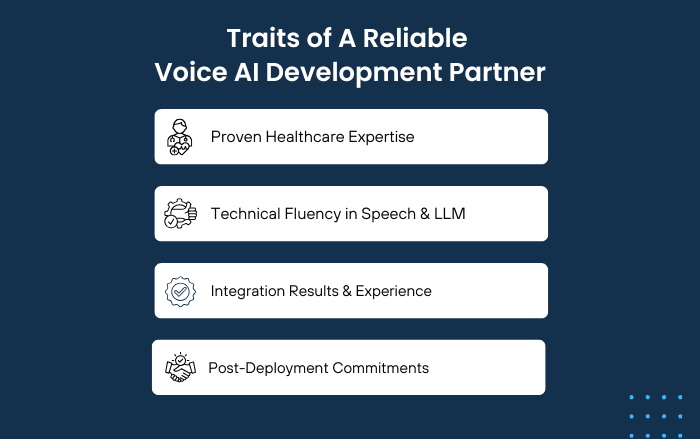
1. Proven Healthcare Expertise
Each of the leading AI voice agent development companies possesses the following:
- Prior successful deployments in healthcare
- Understand terminologies (ICD-10, SNOMED, CPT)
- Be fluent in regulatory requirements
Example: Vendors experienced with Epic and Cerner helped a U.S. clinic improve their intake process speed by 38%.
2. Technical Fluency in Speech & LLM
From integrating Whisper and Deepgram to incorporating custom transformers, your AI development partner should:
- Know which model best suits your use case
- Balance latency and accuracy
- Handle AI training, tuning, and deployment
One of the OpenAI Whisper benchmarks saw medical transcription quality improve by 26% versus the use of traditional dictation tools.
3. Integration Results & Experience
A credible AI partner with ample knowledge about systems and AI integration could offer the following better:
- EHRs using HL7 or FHIR
- Existing IVR, cloud, or contact center stacks
- Secure APIs and real-time data processing
4. Post-Deployment Commitments
The AI partner's work doesn’t end at delivery because the AI system requires additional support indefinitely for the best consistent performance.
- Ask about product support cycles
- Setup phases for model retraining
- Obtain permanent performance monitoring dashboards
Continuous fine-tuning is known to improve voice accuracy 2x in 6 months, based on Healthcare IT News industry data.
Six Must-Ask Questions Before Signing Any Contracts
1. Do you have healthcare-specific case studies?
→ Ask for results, and data studies, not just screenshots.
2. What speech engines and NLP frameworks do you use and avoid?
→ Check for names like Whisper, AWS Transcribe, and clinical NLP add-ons.
3. How do your systems handle clinical terminology and context?
→ Ensure the systems support interpretations and medical coding.
4. What’s your compliance framework for HIPAA/GDPR?
→ Ask for audit log protocols and encryption practice framework.
5. Can you customize integrations for our EHR platform?
→ Only custom plug-ins can support unique hospital workflows.
6. How do you support post-deployment optimization?
→ Real-world tuning in phases is essential to sustain performance.
Pitfalls to Avoid in Choosing Voice AI Agent Vendor
- Generic Solutions: Avoid anyone who repurposes retail or pre-built bots for hospitals.
- Hidden Data Governance: Ask how the AI company stores, trains, and audits models.
- Overpromising: Ask for live demos and case studies before signing up for agreements.
- Inadequate QA Testing: Simulate real-world conditions & traffic to test before going live.
- No Multi-language Support: Over 22% of the US patients speak non-English languages despite understanding it alike.
Accenture states that 60% of healthcare organizations regret their first AI vendor choice due to the vendor's lack of vertical experience in delivering effective healthcare IT solutions. It also highlights that these vendors often underestimated the complexities of integration and compliance specific to the healthcare sector.
Real-World Vendor and Checklist
| Criteria | Must-Have | Why It Matters |
|---|---|---|
| EHR Experience | Yes | Reduces integration delays |
| Custom NLP | Yes | Handles medical terms accurately |
| HIPAA Compliance | Yes | Legal and risk assurance |
| Multilingual Support | Optional but ideal | For diverse populations |
| Proven Use Cases | Yes | Demonstrates real-world ROI |
| Post-Support Model | Yes | Keeps system improving |
Conclusion
Deciding between the right AI voice agent development partner and the best healthcare AI solution to implement should not be two separate things. However, neither is it a given that all bundled custom solutions are perfect. So what can you do? Talk with our AI consultant to shape your vision and scale your ROI.
FAQs
Q. Which technologies are required to power Voice AI in healthcare?
AI, ASR, NLP, ML, and domain-specific technologies and their seamless integration empower AI voice agents. Together, they interpret, understand, and convert speech into structured actions across clinical workflows ethically.
Q. How do you process medical speech data securely?
Through encrypted pipelines, governed models, and HIPAA-compliant cloud technologies, we ensure secure data handling for products that require it in all environments.
Q. How do you ensure your voice AI aligns with healthcare workflows?
Look for vendors who conduct clinician interviews, workflow mapping, and usability testing to ensure AI doesn’t disrupt but enhances care delivery.