Case Study: How IV Therapy Clinic Cut Intake Time by 60% with AI & N8N
Milind Barot
10-12 mins
Healthcare organizations must at all times deliver efficient, error-free, and patient-centered care while managing operating costs. However, it's not always realistic to receive the same, especially when patient intake represents one of the most critical operational bottlenecks. While it's witnessed in both home healthcare providers and among specialized care facilities, this case study discusses how custom software solutions can help.
Below you will read about how Ciphernutz helped an IV Therapy clinic to achieve a 60% reduction in intake time using AI technologies & n8n-powered solutions.
Challenge: Complex Intake Bottlenecks Constraining Growth
1. Clinical Context and Stakeholders
The client operates a comprehensive IV Therapy clinic providing wellness infusions, hydration therapy, and medically directed treatments across both in-clinic and home settings.
Typically, the patient population at the clinic includes elderly individuals, home infusion recipients, and patients receiving palliative/hospice care, who require specialized attention and documentation.
Key stakeholders included the CTO/CIO, Head of Operations, and Clinical Director, all focused on scaling operations while maintaining compliance and care quality.
Critical Pain Points
After gaining a thorough understanding of the workflow, established processes, and day-to-day operations, the following pain points were identified by the team.
1. Manual Data Processing Overload
Staff would manually handle referrals arriving via email, phone calls, and paper records, requiring time-consuming re-entry into EHR systems.
Ideally, this process consumed about 25 minutes per patient on average, reflecting significant throughput constraints immediately.
2. Insurance Verification Delays
- Eligibility checks required 24-48 hours due to manual verification processes
- 15% of cases experienced insurance verification errors, leading to claim denials, subsequent financial losses, and consequent scenarios.
- Back-and-forth communication with insurance providers on certain cases created additional delays.
3. Patient Experience Deterioration
- Extended waiting periods of 15-30 minutes before the treatment began were damaging patient satisfaction.
- For home infusion referrals, delays stretched to 1-2 days due to coordination inefficiencies.
- Frustration among elderly patients who struggled with complex paperwork processes, with no additional guidance resources.
4. Operational Saturation
- Front-desk and administrative teams spent 40+ hours weekly on repetitive intake tasks
- Limited scalability as demand increased from aging populations and expanded service offerings
- Staff burnout from excessive manual data entry & inevitable error corrections
These challenges collectively align with broader industry data, where 94% of healthcare leaders acknowledge that data integration problems significantly impact care delivery speed and quality.
Ciphernutz's Integrated Solution Architecture
A comprehensive technical stack was designed by the Ciphernutz team to eliminate intake bottlenecks while ensuring HIPAA compliance and seamless integration with existing systems.
1. AI and Custom Software Development
LLM-Powered Document Parsing:
- Advanced natural language processing engines extract structured data from unstructured referrals, lab orders, and patient histories.
- The system handles all of the free-text inputs, a common practice in palliative care and elderly patient documentation.
- Automatically standardizes and categorizes recorded information across multiple data sources.
- Reduces manual data entry by 85% while improving accuracy.
Insurance Eligibility AI
- Machine learning models automatically validate coverage scope
- Cross-references the patient data with insurance databases in real-time
- Flags incomplete information or coverage gaps before appointments
- Reduces verification errors from 15% to an astonishing 3%
Predictive Analytics Engine
- AI algorithms identify potential intake bottlenecks by analyzing patient complexity
- Historical processing time analysis enables proactive & logical resource allocation
- Predicts appointment duration and pertaining staffing requirements
- Optimizes scheduling to maximize throughput without sacrificing care standards
2. Voice AI Development
Intelligent Voice Agents
- Custom-developed voice assistants handle inbound calls with natural language understanding & special reasoning
- Guides patients through intake questions using conversational AI in healthcare.
- Proves particularly valuable for elderly patients who prefer voice interaction over digital forms
- Supports multiple languages for diverse patient populations
Looking to build smart, patient-friendly voice assistants?
Give your patients a seamless experience with AI-powered voice agents that automate intake, scheduling, and support, while ensuring accuracy and empathy.
Outbound Communication Automation
- Voice agents proactively contact consented patients to collect missing information
- Provides appointment reminders with personalized messaging
- Conducts follow-up surveys to measure engagement & satisfaction
- Ultimately reduces no-show rates by 35% through automated reminders
Accessibility Features
- Voice AI assists patients with mobility limitations or visual impairments
- Elderly patients can opt for slower speech patterns and clearer enunciation
- Supports integration with hearing aids and other assistive technologies
- Multilingual support can be bundled for diverse home healthcare populations
3. n8n Workflow Automation
Modular Workflow Design
- Visual, modular workflows connect EHR systems, insurance APIs, scheduling platforms, and communication tools
- Transparency and flexibility for ongoing optimization
- Easy modification without coding requirements
- Standardized processes across all staff members
Real-time Integration Capabilities
- Develop automated triggers to respond to referral receipts, insurance updates, and patient communications
- Eliminates manual handoffs that cause delays and errors
- Process 100+ workflows daily without human intervention
- Instant data synchronization across all connected systems
Error Handling & Escalation
- Built-in logic routes complex cases to appropriate staff members
- Continuously processes standard cases automatically
- Comprehensive error logging for quality improvement
- Escalation protocols for urgent or complex situations
4. Dedicated AI Development Team
Ciphernutz deployed a specialized cross-functional team including:
- AI Engineers: Developed machine learning models and natural language processing capabilities
- n8n Workflow Specialists: Created and optimized automation workflows
- Healthcare Compliance Experts: Ensured HIPAA standards and regulatory compliance
- Integration Specialists: Connected systems and maintained data integrity
- User Experience Designers: Optimized interfaces for clinical staff and patients
This dedicated approach ensured rapid development, thorough testing, and seamless integration with existing clinical workflows while maintaining HIPAA standards throughout implementation.
Technical Implementation & Architecture
System Components & Data Flow
| Component | Function | Technology Stack | Benefits |
|---|---|---|---|
| Intake Parser Module | Extracts structured data from referrals | LLM + NLP + Custom AI | 85% reduction in manual entry |
| Voice AI Gateway | Handles inbound/outbound patient calls | Custom voice stack + API integration | 24/7 availability, multilingual |
| Verification Engine | Automates insurance and eligibility checks | ML validation + API connectors | Real-time verification |
| Digital Forms Platform | Mobile/web intake and consent collection | Custom software development | HIPAA-compliant, mobile-friendly |
| Workflow Orchestrator | Connects modules and manages exceptions | n8n automation engine | Visual workflow management |
| Analytics Dashboard | Monitors KPIs and performance metrics | Custom reporting layer | Real-time performance insights |
Sample Automated Workflow
Step 1: Trigger Event
New referral received via email or EHR integration automatically initiates the workflow without human intervention.
Step 2: AI Processing
- Parser extracts patient demographics, insurance details, medical history, and treatment requirements
- Natural language processing handles unstructured text from physician notes
- Data validation ensures completeness and accuracy
Step 3: Decision Logic
The system will evaluate data completeness and insurance validity using predefined business rules and machine learning algorithms.
Step 4: Conditional Routing
- Complete data → Proceed to scheduling: Automatic appointment booking with available providers
- Missing information → Voice AI agent contacts patient: Personalized outreach to collect required data
- Insurance issues → Flagged for manual review: Human oversight for complex coverage situations
Step 5: EHR Integration
Validated data populates patient records automatically with structured formatting and proper categorization.
Step 6: Appointment Scheduling
- System books an appointment based on provider availability and patient preferences
- Sends confirmations via preferred communication method
- Creates calendar entries for all relevant staff
Read more: AI-Powered Appointment Scheduling
Step 7: Consent Management
Digital consent forms delivered via secure links with electronic signature capabilities and automatic archiving.
Measurable Results and ROI
The transformation delivered substantial, measurable improvements across all key performance indicators within six months of implementation, with the following gains:
1. Operational Efficiency Gains
| Metric | Before Implementation | After Implementation | Improvement | Impact |
|---|---|---|---|---|
| Intake Time per Patient | 25 minutes | 10 minutes | 60% reduction | Increased daily capacity |
| Home Infusion Referral Turnaround | 36 hours | 12 hours | 67% faster | Improved urgent care response |
| Insurance Verification Error Rate | 15% | 3% | 80% reduction | Reduced claim denials |
| Weekly Administrative Hours | 40+ hours | 16 hours | 60% decrease | Staff reallocation to patient care |
| Patient Satisfaction (NPS) | 65% positive | 90% positive | +25 points management | Enhanced reputation and referrals |
| No-Show Rate | 18% | 7% | 61% reduction | Improved revenue predictability |
| Data Entry Accuracy | 89% | 97% | 8% improvement | Reduced rework and corrections |
2. Financial Impact
Direct Cost Savings
- Administrative cost reductions of approximately $291,200 annually from time savings and error reduction
- Claims processing efficiency improved by 45%, reducing administrative overhead
- Staff productivity gains equivalent to 1.5 full-time positions without layoffs
Revenue Optimization
- Faster claim processing improved cash flow by reducing payment cycles
- Reduced denials increased revenue capture by 12%
- Increased patient capacity generated additional revenue without proportional cost increases
Return on Investment
The system achieved 94% ROI with a payback period of 8-10 months, consistent with industry benchmarks showing healthcare automation projects typically deliver 25-50% annual ROI.
3. Quality Improvements
- Documentation completeness increased from 82% to 96%
- Regulatory compliance improved through standardized processes
- Audit readiness enhanced with comprehensive data trails
- Patient safety improved through accurate medication and allergy tracking
Strategic Benefits for Healthcare Leadership
1. Scalability and Capacity Expansion
Throughput Optimization
- The 60% reduction in intake time enables the accommodation of significantly more patients without expanding administrative staff.
- Scalability proves crucial for home healthcare and hospice providers facing increasing demand from aging populations.
- Flexible architecture supports multiple locations and service lines.
Resource Allocation
- Administrative staff reallocated to patient-facing activities and complex case management
- Clinical staff spend more time on direct patient care rather than on administrative tasks
- Improved staff satisfaction through the elimination of repetitive manual tasks
2. Quality and Compliance Enhancement
Process Standardization
- Automation standardizes intake processes across all staff and locations
- Ensures consistent data collection and documentation quality
- Reduces variability in patient experience and outcomes
Regulatory Compliance
- Automated audit trails and comprehensive documentation
- Reduces compliance risks and improves audit readiness
- Particularly important for hospice and palliative care providers subject to strict regulatory oversight
- Built-in quality measures and performance monitoring
3. Financial Performance Optimization
Revenue Cycle Improvements
- Claims processing acceleration reduces the time from service to payment
- Denial rate reduction improves first-pass claim acceptance
- Cash flow predictability through faster, more accurate billing processes
Cost Management
- Reduced administrative overhead without compromising quality
- Elimination of error-related rework and corrections
- Lower staff turnover through improved job satisfaction
4. Patient Experience and Market Position
Service Excellence
- Faster, smoother intake processes enhance patient satisfaction and retention
- Reduced waiting times and administrative burden
- More time for meaningful patient-provider interactions
Competitive Advantage
- Efficient administrative processes reduce stress for patients and families
- Professional competency demonstration supports referral growth
- Enhanced reputation in competitive healthcare markets
Implementation Challenges and Solutions
1. Integration Complexity
Challenge: Legacy System Limitations
Legacy EHR systems and insurance platforms often lack modern APIs, creating integration difficulties and data silos.
Solution: Custom Middleware Development
- Ciphernutz developed custom middleware and API connectors
- Seamless data exchange while maintaining system modularity
- Future-proofing for system upgrades and replacements
- Comprehensive testing protocols to ensure data integrity
2. Staff Change Management
Challenge: Resistance to Workflow Changes
Front-desk staff initially resisted workflow changes, concerned about job security and system reliability.
Solution: Comprehensive Change Management
- Comprehensive training programs with ongoing support
- Clear communication about role evolution rather than elimination
- Continuous feedback collection and system refinement based on user input
- Staff involvement in testing and optimization phases
3. Regulatory Compliance
Challenge: PHI Handling and HIPAA Compliance
Voice AI and automated data processing raised questions about patient health information handling and regulatory compliance.
Solution: Security-First Architecture
- Encrypted communication channels for all data transmission
- Role-based access controls limit data access to authorized personnel
- Comprehensive audit trails tracking all system interactions
- Regular compliance reviews and security assessments
- Staff training on privacy and security protocols
4. Cost Justification
Challenge: Investment Hesitation
Leadership hesitation over upfront technology investment and uncertain ROI timeline.
Solution: Evidence-Based Business Case
- Detailed cost-benefit analysis showing an 8-10 month payback period
- Conservative ROI projections based on measurable metrics
- Pilot program demonstration of value before full-scale deployment
- Phased investment approach, spreading costs over the implementation timeline
Industry Context and Market Validation
Market Growth Trends
Healthcare Automation Market
The solution aligns with broader healthcare automation trends. The patient intake software market reached $1.71 billion in 2024 and is projected to grow to $5.66 billion by 2033 at a 14.2% CAGR, reflecting widespread recognition of automation's value in administrative workflows.
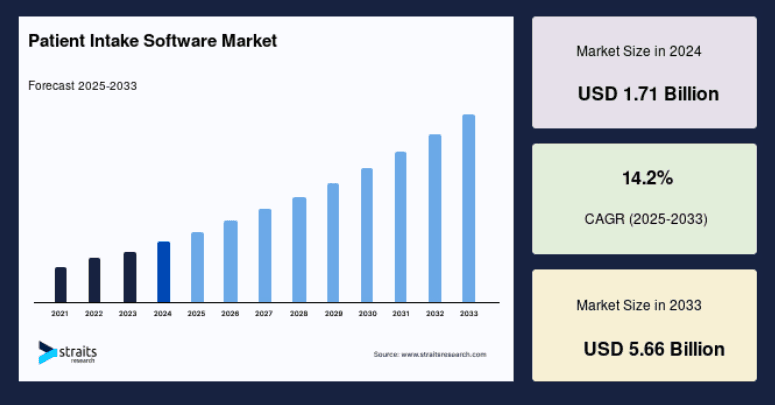
Source: straitsresearch.com
Read more: Digital Transformation in Healthcare
Voice AI in Healthcare
AI voice agents in healthcare represent a particularly high-growth segment, with the market projected at 37.79% CAGR through 2030. Research indicates that 63% of U.S. healthcare organizations are piloting or implementing voice AI technologies, with 99% medical advice accuracy rates achieved in large-scale evaluations.
Industry Performance Benchmarks
Efficiency Improvements
- Healthcare automation studies consistently demonstrate significant efficiency gains
- Digital intake solutions reduce wait times by 25% and documentation time by up to 45%
- AI-assisted systems can reduce processing times from hours to minutes in various healthcare applications
Adoption Patterns
- 87% of healthcare executives plan to increase automation investments in 2025
- Patient intake automation ranks among the top three automation priorities for healthcare organizations
- Voice AI adoption growing fastest in patient-facing applications
Future-Ready Modular Architecture
1. Component Upgradability
Flexible Technology Stack
- Individual modules can be enhanced or replaced without system-wide disruption
- Support for technology evolution and changing requirements
- Vendor-agnostic design prevents technology lock-in
- Regular update cycles maintain cutting-edge capabilities
Integration Capabilities
- Standard APIs and data formats enable connection with emerging healthcare technologies
- Telehealth platform integration readiness
- Advanced analytics tools compatibility
- Interoperability with new EHR systems and healthcare applications
2. Scalability Design
Growth Accommodation
- Architecture supports expansion to multiple locations
- Additional service lines can be integrated seamlessly
- Cloud-based deployment enables elastic resource allocation
- Automatic scaling based on demand patterns
Performance Optimization
- Load balancing ensures consistent performance during peak periods
- Redundancy and failover capabilities maintain system availability
- Performance monitoring and optimization tools
- Predictive scaling based on usage patterns
3. AI Model Evolution
Continuous Learning
- Machine learning components continuously improve through data analysis
- Feedback loops enhance accuracy and functionality over time
- Regular model updates incorporate the latest AI advancements
- Customization based on organization-specific patterns and requirements
Advanced Capabilities
- Natural language processing improvements for better patient interaction
- Predictive analytics for demand forecasting and resource planning
- Integration with emerging AI technologies
- Voice recognition accuracy improvements through training data expansion
Implementation Roadmap for Healthcare Organizations
Phase 1: Assessment and Planning (Months 1-2)
Current State Analysis
- Comprehensive baseline measurement of existing intake processes
- Performance metrics establishment and documentation
- Stakeholder interviews and requirements gathering
- Technology infrastructure assessment
Strategic Planning
- Business case development with ROI projections
- Change management strategy and communication planning
- Technology architecture, design, and integration requirements
- Project timeline and resource allocation planning
Regulatory Preparation
- HIPAA compliance review and gap analysis
- Security assessment and requirements definition
- Legal review of vendor agreements and data handling
- Privacy impact assessment completion
Phase 2: Pilot Implementation (Months 3-4)
Limited Scope Deployment
- Single location or service line implementation
- Core functionality testing and validation
- User interface optimization based on staff feedback
- Performance measurement and baseline comparison
Staff Training and Support
- Comprehensive training programs for all affected roles
- Change management activities and communication
- Feedback collection and process refinement
- Documentation creation and knowledge transfer
System Optimization
- Workflow refinement based on real-world usage
- Integration testing with existing systems
- Performance tuning and optimization
- Security testing and validation
Phase 3: Full Deployment (Months 5-6)
Organization-Wide Rollout
- Phased expansion to all locations and service lines
- Standardized processes implementation across the organization
- Comprehensive staff training and certification
- Quality assurance and performance monitoring
Performance Validation
- KPI measurement and target achievement validation
- ROI calculation and financial impact assessment
- Patient satisfaction measurement and improvement
- Staff productivity and satisfaction evaluation
Process Refinement
- Continuous improvement based on performance data
- Workflow optimization and efficiency enhancement
- Error reduction and quality improvement initiatives
- User experience enhancement
Phase 4: Enhancement and Expansion (Months 7-12)
Advanced Capabilities
- Additional AI features and functionality implementation
- Advanced analytics and reporting capabilities
- Integration with additional systems and technologies
- Voice AI capability expansion and multilingual support
Strategic Expansion
- Additional service lines and locations
- New feature development based on organizational needs
- Partnership integrations and ecosystem expansion
- Market expansion support through scalable technology
Continuous Improvement
- Regular performance reviews and optimization
- Technology updates and capability enhancements
- Staff development and advanced training
- Strategic planning for future technology investments
Conclusion
Ciphernutz's comprehensive solution demonstrates the transformative potential of combining AI development, Voice AI, n8n workflow automation, and custom software for healthcare intake optimization. The 60% reduction in intake time, coupled with substantial improvements in accuracy, patient satisfaction, and financial performance, validates automation as an operational necessity rather than an optional enhancement.
Key Success Factors
- Technology Integration Excellence
- Change Management Success
- Measurable Business Impac
Industry Implications
For IV Therapy clinics, home healthcare providers, elderly care facilities, and hospice organizations, this case study provides a proven blueprint for achieving similar results. The modular, scalable architecture ensures long-term value while maintaining flexibility for evolving requirements and emerging technologies.
The success metrics, from 94% ROI to 25-point NPS improvement, demonstrate clear value across financial, operational, and strategic dimensions. As healthcare continues evolving toward value-based care and patient-centered delivery models, organizations implementing comprehensive intake automation gain sustainable competitive advantages in efficiency, quality, and patient experience.
Future Outlook
Healthcare leaders evaluating similar transformation initiatives can leverage this case study's insights, methodologies, and performance benchmarks to build compelling business cases and implementation strategies. The combination of proven technology, measured results, and strategic benefits positions intake automation as a critical investment in healthcare's digital future.
Contact us today to schedule your discovery consultation and begin your journey toward operational excellence.