Healthcare AI Readiness: What Legacy Systems Reveal About Your Organization's Future
Dharmesh Dave
6-8 minutes
Healthcare organizations are pouring money into artificial intelligence, yet nearly half aren't ready to deploy it successfully. According to Guidehouse's February 2026 Healthcare AI Trends report, 78% of health systems are actively engaged in AI projects, but only 52% feel operationally ready to implement them at scale.
This gap isn't about technology selection or vendor contracts. It's about something deeper: legacy healthcare systems reveal whether your organization possesses the data quality, interoperability, governance, and architectural maturity required for successful AI adoption.
The average ROI on AI in healthcare is $3.20 for every $1 invested, with returns realized within 14 months. But that ROI disappears when AI projects hit data fragmentation, interoperability gaps, or governance failures rooted in outdated infrastructure.
Your legacy systems aren't just outdated technology. They're diagnostic indicators of AI readiness.
Where Healthcare Organizations Are Applying AI Today
Healthcare organizations are investing in AI across clinical, operational, and patient engagement workflows, including:
- Ambient clinical documentation
- Medical coding automation
- Patient triage assistants
- Appointment scheduling and reminder systems
- Predictive readmission analysis
- Revenue cycle optimization
- Prior authorization automation
- Healthcare AI agents for patient support
Before these initiatives can scale successfully, organizations must assess whether their existing systems can support AI-ready data, governance, and interoperability.
The Four Pillars of Healthcare AI Readiness
Successful healthcare AI initiatives depend on four foundational capabilities. Legacy systems often expose weaknesses across these pillars long before AI deployment begins.
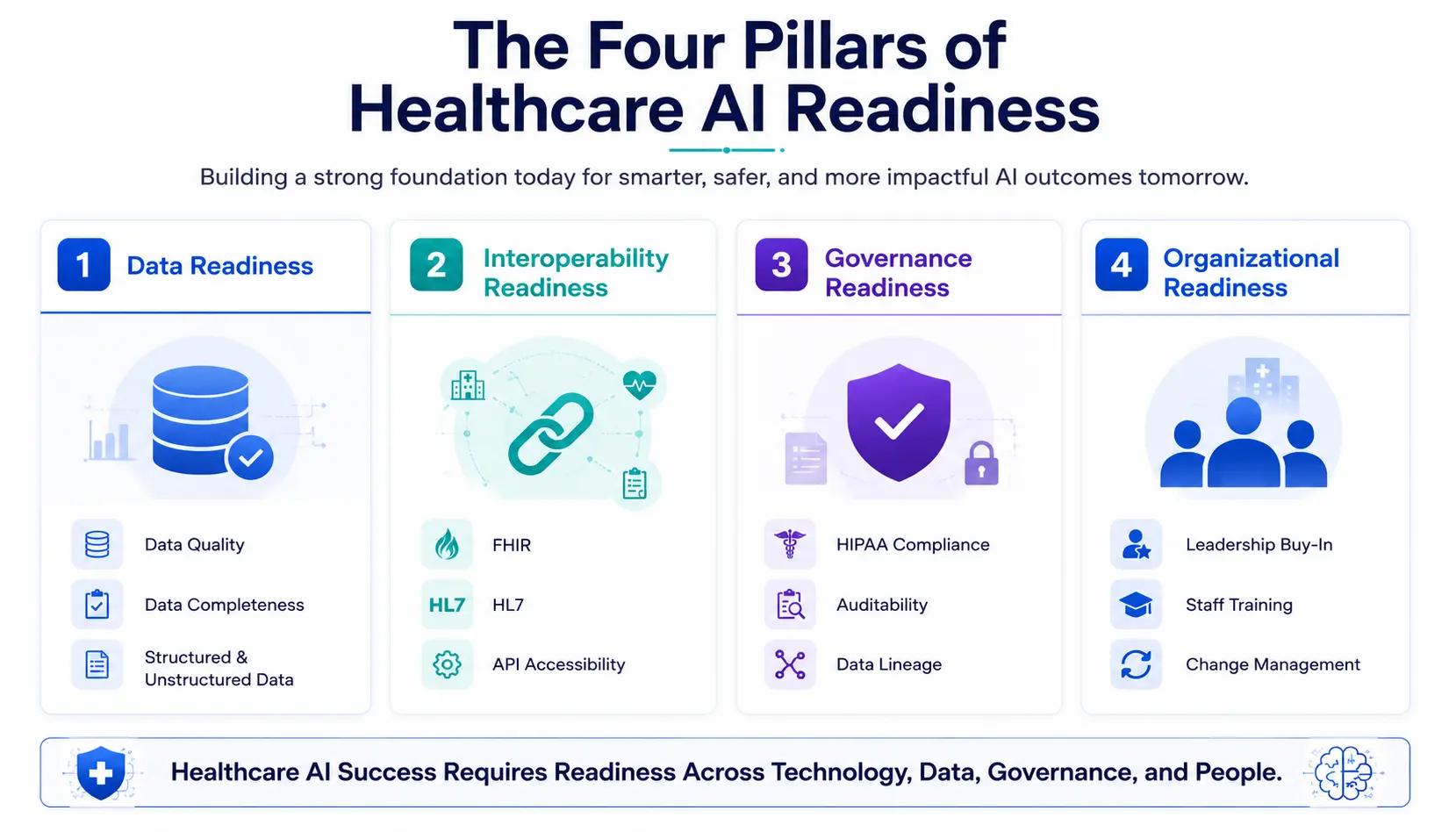
1. Data Readiness
AI depends on accurate, accessible, and trustworthy data.
Evaluate:
- Data quality and accuracy
- Data completeness
- Structured vs. unstructured data
- Duplicate patient records
- Data standardization
If patient information is fragmented across systems, AI models will produce unreliable outcomes.
2. Interoperability Readiness
Healthcare AI requires data movement across systems.
Evaluate:
- FHIR adoption
- HL7 integration capabilities
- API accessibility
- Real-time data exchange
- Cross-system connectivity
Organizations with poor interoperability often struggle to move AI projects beyond pilot stages.
3. Governance Readiness
Healthcare AI must operate within strict regulatory and security requirements.
Evaluate:
- HIPAA compliance controls
- Auditability and logging
- Data lineage tracking
- Access management
- AI governance policies
Weak governance increases both compliance and operational risk.
4. Organizational Readiness
Technology alone does not determine AI success.
Evaluate:
- Executive sponsorship
- AI strategy and roadmap
- Clinical stakeholder buy-in
- Workforce training
- Change management processes
Organizations with strong organizational readiness adopt AI faster and realize value sooner.
The Healthcare AI Readiness Gap: 2026 Statistics That Matter
Execution Paralysis Is Widespread
The numbers tell a stark story about healthcare AI readiness in 2026:
| Readiness Barrier | Percentage of Healthcare Leaders |
|---|---|
| Concerned about cybersecurity and data privacy | 48% |
| Limited budget or competing financial priorities | 48% |
| Worried about data quality, standardization, or governance | 42% |
| Lack internal expertise or strategic vision for AI at scale | 36% |
(Source: guidehouse)
These barriers aren't abstract concerns. They're operational blockers that prevent AI initiatives from moving beyond pilot programs.
Workforce Training Gap Outpaces Adoption
Global AI in Healthcare Report reveals a critical disconnect: while 100% of surveyed healthcare organizations use AI in some form, 85% of healthcare professionals feel they need more training to use AI effectively.
Meanwhile, 57% of clinicians report stronger clinical decision-making with AI, and 43% see early reductions in clinical errors. The technology works. The readiness gap is in the infrastructure and human preparedness surrounding it.
Integration Is the Biggest Hurdle
66% of healthcare IT leaders identify system integration as the biggest AI adoption hurdle. This isn't surprising when you consider that 70% of Fortune 500 companies still operate software over two decades old.
Healthcare is no exception. Legacy electronic health record (EHR) systems, outdated data warehouses, and fragmented interoperability standards create the exact conditions that cause AI projects to underperform or fail entirely.
Why AI Projects Fail in Healthcare: The Legacy System Connection
Data Quality Problems Start at the Source
AI models are only as good as the data they consume. Yet 42% of healthcare leaders worry about data quality, standardization, availability, or governance when implementing AI.
Legacy systems create three specific data quality problems that derail AI initiatives:
1. Data Fragmentation Across Silos
When patient data lives in disconnected systems-old EHRs, separate lab databases, paper-based billing-you can't train AI models on complete clinical pictures. The result? AI tools that make recommendations based on incomplete information.
2. Inconsistent Data Standards
Legacy systems often use proprietary data formats or outdated coding standards. Without consistent FHIR (Fast Healthcare Interoperability Resources) adoption, AI models struggle to normalize inputs across different data sources.
Read more: Interoperability & Standards in the Healthcare Industry
3. Missing Metadata and Lineage
Modern AI requires understanding where data comes from, how it's transformed, and what governance rules apply. Legacy systems rarely track this metadata, making it impossible to establish the data lineage AI governance frameworks require.
Interoperability Gaps Block AI Workflows
Healthcare and lifesciences organizations are modernizing legacy EHR systems specifically to support FHIR data standards, enabling seamless interoperability between hospitals and wearable devices. Why? Because this shift facilitates predictive patient care, where AI models analyze historical data and real-time updates to alert doctors hours before a medical emergency.
Without modernization, you can't achieve this level of AI-enabled care.
Governance Maturity Determines AI Success
48% of healthcare leaders are concerned about cybersecurity and data privacy when deploying AI. These concerns are legitimate. Healthcare data breaches cost $9.77 million on average-the highest of any industry.
Legacy systems make governance harder because:
- They lack modern role-based access control (RBAC)
- They don't support audit trails required by HIPAA and emerging AI regulations
- They can't enforce data encryption at rest and in transit at modern standards
- They don't integrate with identity management systems used by AI platforms
57% of developers rank privacy and security as their top AI concern. You can't address this concern without modernizing the underlying infrastructure.
AI Readiness Assessment Framework: 5 Steps to Evaluate Your Organization
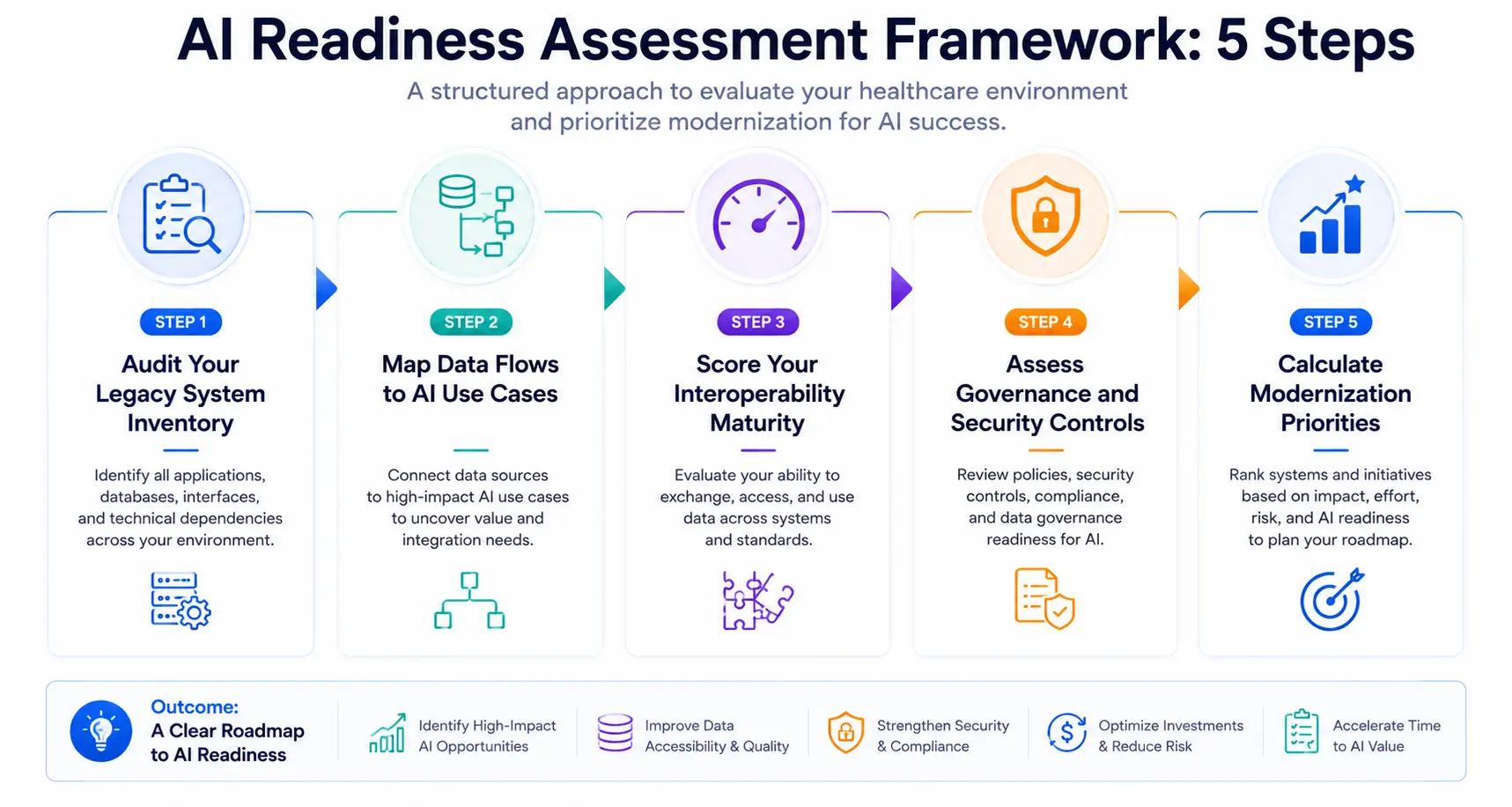
Step 1: Audit Your Legacy System Inventory
Document every system that holds data relevant to AI initiatives. Include:
- System name and vendor
- Year of implementation
- Data types stored
- Integration methods (API, batch, manual)
- Support status (vendor-supported, end-of-life, custom)
70% of Fortune 500 companies have software over two decades old. You likely have similar aging infrastructure.
Step 2: Map Data Flows to AI Use Cases
For each AI use case you're considering (clinical decision support, operational optimization, patient engagement), map:
- What data sources are required?
- How does data move between systems?
- Where are the bottlenecks or manual interventions?
- What governance controls apply at each step?
This mapping reveals whether your infrastructure can support the AI use case or if legacy system modernization becomes a prerequisite rather than a parallel project.
Step 3: Score Your Interoperability Maturity
Use this scoring rubric:
| Score | Interoperability Level | Characteristic |
|---|---|---|
| 1 | Fragmented | Point-to-point integrations, manual exports |
| 2 | Partial | Some APIs, but inconsistent standards |
| 3 | Standardized | FHIR/HL7 adoption, REST APIs available |
| 4 | Integrated | Real-time data feeds, event-driven architecture |
| 5 | AI-Ready | API-first, automated governance, real-time streaming |
Companies with high interoperability grew revenue 2.5x faster than peers with low interoperability. AI readiness correlates directly with interoperability maturity.
Step 4: Assess Governance and Security Controls
Evaluate whether your infrastructure supports:
- Automated audit trails (required for AI governance)
- Field-level access controls (required for PHI protection)
- Data encryption standards (required for compliance)
- Identity integration with modern AI platforms
48% are concerned about cybersecurity and data privacy when deploying AI. Address these concerns through infrastructure modernization, not policy changes alone.
Step 5: Calculate Modernization Priorities
Not all legacy systems need immediate modernization. Prioritize based on:
- AI impact: How critical is this system's data to your AI use cases?
- Risk level: What's the security/compliance risk of keeping it legacy?
- Integration cost: How expensive is maintaining current integrations?
- Vendor support: Is the system still supported by the vendor?
Enterprises that prioritize legacy app modernization report 30-50% faster release cycles and up to 75% reduction in IT infrastructure costs.
Modernization as AI Infrastructure: Strategic Priorities for 2026
Priority 1: API-Led Data Access Layer
Over 75% of organizations are using AI to support modernization. The most effective approach: use API generation platforms to expose legacy data through modern REST APIs without replacing core systems.
Benefits:
- Expose legacy data in minutes without rewriting code
- Support 20+ database types including IBM DB2, Oracle, and SAP HANA
- Enforce enterprise security through built-in RBAC, OAuth 2.0, and LDAP
- Deploy on-premises or in air-gapped environments for compliance
98% of organizations experienced benefits in at least one critical area after modernization, including security, reliability, and scalability.
Priority 2: FHIR-First Interoperability
Healthcare organizations modernizing legacy EHR systems to support FHIR data standards enable seamless interoperability between hospitals and wearable devices. This interoperability is mandatory for AI that analyzes patient data across multiple sources.
Healthcare applications are set to grow at 18.40% CAGR in the modernization market, driven by interoperability mandates and patient data access requirements.
Priority 3: Cloud-Native Architecture with Hybrid Options
Cloud deployments captured 67.78% market share in 2024, but regulated industries still require on-premises or hybrid options for data sovereignty.
Large enterprises retained 65.80% of market share in 2024, often requiring self-hosted solutions for compliance and security.
Your AI infrastructure should support hybrid deployment-cloud for AI compute, on-premises for sensitive data.
Priority 4: AI-Augmented Modernization
75%+ of organizations now use AI for modernization alongside API generation platforms to accelerate transformation.
Use cases include:
- Automated code analysis to identify modernization opportunities
- AI-assisted documentation of legacy system logic
- Machine learning models that predict integration failures
- Natural language interfaces for querying legacy data
This creates a virtuous cycle: you use AI to modernize systems, then use modernized systems to support more advanced AI.
When Modernization Becomes a Prerequisite for AI
Organizations pursuing AI initiatives often discover that legacy system modernization becomes a prerequisite rather than a parallel project. Here's when this happens:
Scenario 1: AI Project Stalls Due to Data Quality
You've selected an AI vendor, defined use cases, and secured a budget. But during implementation, you discover that 42% of your data doesn't meet quality standards for AI training.
Solution: Modernize data access layers first. Use API generation to consolidate and standardize data before feeding it to AI models.
Scenario 2: Integration Costs Exceed AI ROI
Your AI project shows promising pilot results, but system integration costs are 66% of your total AI budget. The economics don't work.
Solution: Modernize integration infrastructure using API-led approaches. Organizations report 288%-362% ROI within 3-5 years from modernization initiatives.
Scenario 3: Governance Requirements Block Deployment
Your legal and compliance teams flag AI deployment because legacy systems lack audit trails and field-level access controls required for HIPAA and emerging AI regulations.
Solution: Implement modernization that adds governance capabilities. 58% have already seen security benefits from modernization.
The Cost of Waiting: Why AI Readiness Can't Wait
Technical Debt Compounds Annually
U.S. accumulated technical debt reached ~$1.52 trillion in 2022 and compounds as legacy systems require increasingly complex workarounds.
Organizations spend 60-80% of IT budgets maintaining legacy infrastructure instead of building AI capabilities.
Talent Gap Widens
The average COBOL programmer is 55 years old, and 10% of the COBOL workforce retires annually. The same talent shortage affects legacy EHR specialists in healthcare.
Security Risk Increases
Vulnerability exploitation as a breach "way-in" almost tripled (180% increase) year over year. Legacy systems are the primary attack vector.
Healthcare data breaches cost $9.77 million on average. AI deployments on insecure infrastructure multiply this risk.
Competitive Disadvantage Mounts
Ambient scribes are healthcare AI's breakout category, generating $600 million in 2025 (+2.4x YoY). Organizations without modernized infrastructure can't compete with AI-enabled providers.
Physician AI usage jumped from 38% in 2023 to 66% in 2024. The adoption curve is steep. Organizations that wait lose ground.
Healthcare AI Readiness Checklist
Before investing heavily in AI initiatives, ensure your organization can answer "yes" to most of the following:
✔ Standardized patient data across systems
✔ FHIR-compliant interoperability
✔ API-based access to critical healthcare data
✔ Modern identity and access management
✔ Data governance policies for AI workloads
✔ Audit trails and compliance controls
✔ Defined AI use cases and success metrics
✔ Executive sponsorship and budget allocation
✔ Staff training and change management plans
✔ Scalable cloud or hybrid infrastructure
Next Steps: Start Your Healthcare AI Readiness Assessment
Your legacy systems are telling you something important about your AI readiness. The question is whether you'll act on that information before AI projects stall or fail.
52% of health systems feel operationally ready to implement AI at scale. That means 48% aren't ready. Don't let your organization be part of that statistic.
Immediate Actions (30 Days)
1. Audit your legacy system inventory using the framework above
2. Map data flows to your top 3 AI use cases
3. Score your interoperability maturity (1-5 scale)
4. Identify the single biggest readiness blocker in your infrastructure
Short-Term Actions (90 Days)
1. Implement API-led data access for your highest-priority legacy systems
2. Pilot FHIR interoperability with one EHR system
3. Establish governance controls for AI data pipelines
4. Calculate modernization ROI for your top 3 legacy systems
Enterprises that prioritize legacy app modernization report 30-50% faster release cycles. That acceleration applies to AI initiatives too.
Ready to Know Exactly Where You Stand?
Ciphernutz's Healthcare AI Readiness Package gives your team a complete picture: legacy system audit, interoperability scoring (1–5), governance gap analysis, and a prioritized modernization roadmap, all mapped to your specific AI use cases.
Frequently Asked Questions
What is healthcare AI readiness?
Healthcare AI readiness is an organization's operational capability to deploy AI at scale, including data quality, interoperability, governance, and architectural maturity. According to Guidehouse's 2026 Healthcare AI Trends report, only 52% of health systems feel operationally ready to implement AI at scale, despite 78% being engaged in AI projects.
How do legacy systems affect AI implementation?
Legacy systems create data fragmentation, interoperability gaps, and governance failures that block AI projects. 66% of healthcare IT leaders identify system integration as the biggest AI adoption hurdle. 42% worry about data quality, standardization, or governance when implementing AI.
What are the signs my organization isn't ready for AI?
Key signs include: inability to query data across systems with a single API, custom point-to-point integrations, missing audit trails, lack of field-level access controls, and dependence on batch processing instead of real-time data. 48% are concerned about cybersecurity and data privacy when deploying AI.
What is the ROI of legacy system modernization for AI?
Organizations report 288%-362% ROI within 3-5 years from modernization initiatives. Enterprises that prioritize legacy app modernization report 30-50% faster release cycles and up to 75% reduction in IT infrastructure costs. The average ROI on AI in healthcare is $3.20 for every $1 invested, with returns typically realized within 14 months.
When should I modernize before implementing AI?
Modernize first when: your AI project stalls due to data quality issues, integration costs exceed 50% of your AI budget, or governance requirements block deployment. Organizations pursuing AI initiatives often discover that legacy system modernization becomes a prerequisite rather than a parallel project.