Interoperability & Standards in the Healthcare Industry: A Study
Vijay Vamja
10-12 mins
Healthcare interoperability means different systems "speaking the same language" while being driven by global standards, and it's an endless pursuit. Making patient data flow seamlessly across hospitals, clinics, labs, and apps must also be driven by global standards (like HL7 and DICOM). Additionally, the interoperability must also be mandated by law (HIPAA in the US, PDPL/NCA in the Middle East, etc.)
From HIPAA-compliant EHR software to telehealth apps, interoperability standards are reshaping how providers exchange, secure, and scale data. Hence, this blog explores the global and regional frameworks driving adoption, the compliance mandates shaping technical decisions, and how digital transformation in healthcare is adopting modern innovations.
Core Global Interoperability Standards in Healthcare
Healthcare standards are the building blocks of interoperability worldwide. Some of their key examples include:
1. HL7 (Health Level Seven)
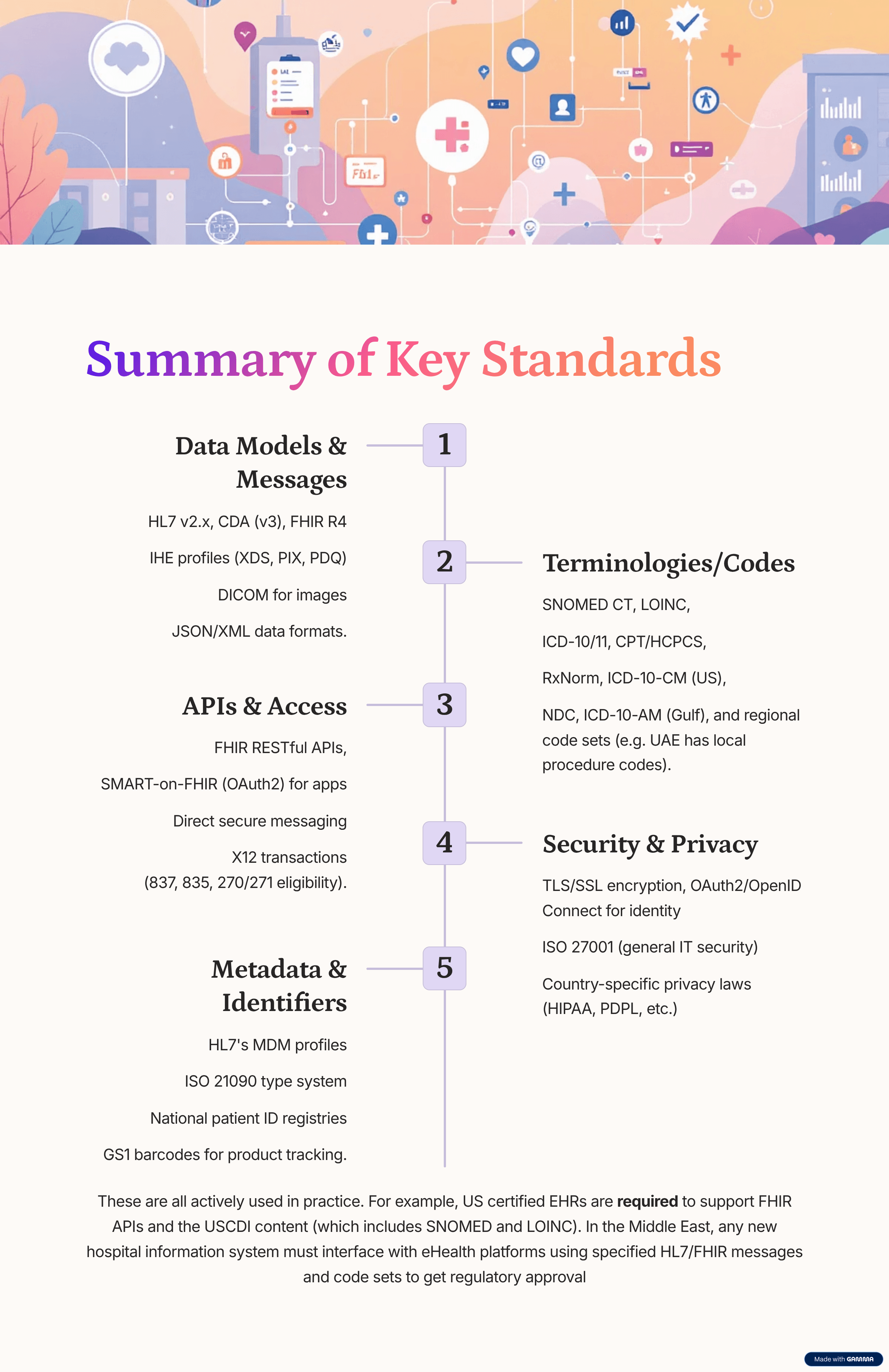
It comprises standards pertaining to messaging and documentation. The HL7 v2 is widely used for real-time messaging (admissions, lab results, orders) in hospitals. Likewise, the HL7 V3/CDA (Clinical Document Architecture) defines structured clinical documents (discharge summaries, referrals).
The FHIR (Fast Healthcare Interoperability Resources) is the newest HL7 standard, using modern web APIs (JSON/XML) for sharing structured clinical data. Many countries (including the US and UAE) now require and utilize FHIR APIs across healthcare IT solutions. Even in the UAE, national HIE platforms Riayati and Malaffi exchange data via HL7 V2 messages and CDA documents, and increasingly via FHIR APIs.
Read more: FHIR for Patient Data Exchange
2. IHE Profiles
Integrating the Healthcare Enterprise (IHE) defines workflows and profiles using HL7/DICOM. For example, there's XDS (Cross-Enterprise Document Sharing) for patient record repositories, PIX/PDQ for patient ID management, MHD/MIC for mobile health exchange, and XCA for cross-community access. These profiles ensure consistent implementation of HL7 standards.
3. DICOM
DICOM: It is the standard for medical images (X-rays, MRIs, CT scans) and related data. PACS (Picture Archiving & Communication Systems) and radiology departments use DICOM to share images across vendors.
4. Clinical Terminologies
Recognizing and using standard vocabularies ensures a uniform meaning of data. The SNOMED CT covers diagnoses, procedures, and observations in a "clinical language" used globally (UAE joined SNOMED International in 2021, with Saudi and other members too).
Parallelly, the LOINC codes lab tests and clinical measurements. ICD-10/11 (ICD-10-CM in the US) is a standard disease classification used for billing and statistics. CPT/HCPCS codes (USA) and NDC (drug codes) are mandated by HIPAA for claims.
5. Pharmacy/EHR Standards
NCPDP SCRIPT and RxNorm are recognized and implemented in the US for e-prescribing medications and drugs. The GS1 applies to barcodes of products/locations, and ISO/IEEE 11073 for device data. Furthermore, the USCDI/CCDA (US Core Data for Interoperability / Consolidated CDA) is utilized to specify core clinical data elements.
All of these standards are required by law or as per healthcare management policy in many regions. For instance, HIPAA's Administrative Simplification rules mandate the use of specific code sets (ICD-10, CPT, NDC, etc.) on all claims and transactions. In the GCC region, governments explicitly require health IT to support HL7 and FHIR, along with data encryption and ISO 27001 security for any software. Compliance programs ensure systems use standardized APIs and code sets.
US Healthcare Interoperability Framework
Hence, when looking for healthcare IT solutions companies, it's worth learning whether they are familiar and adept with the mature, regulated healthcare interoperability ecosystem of the US:
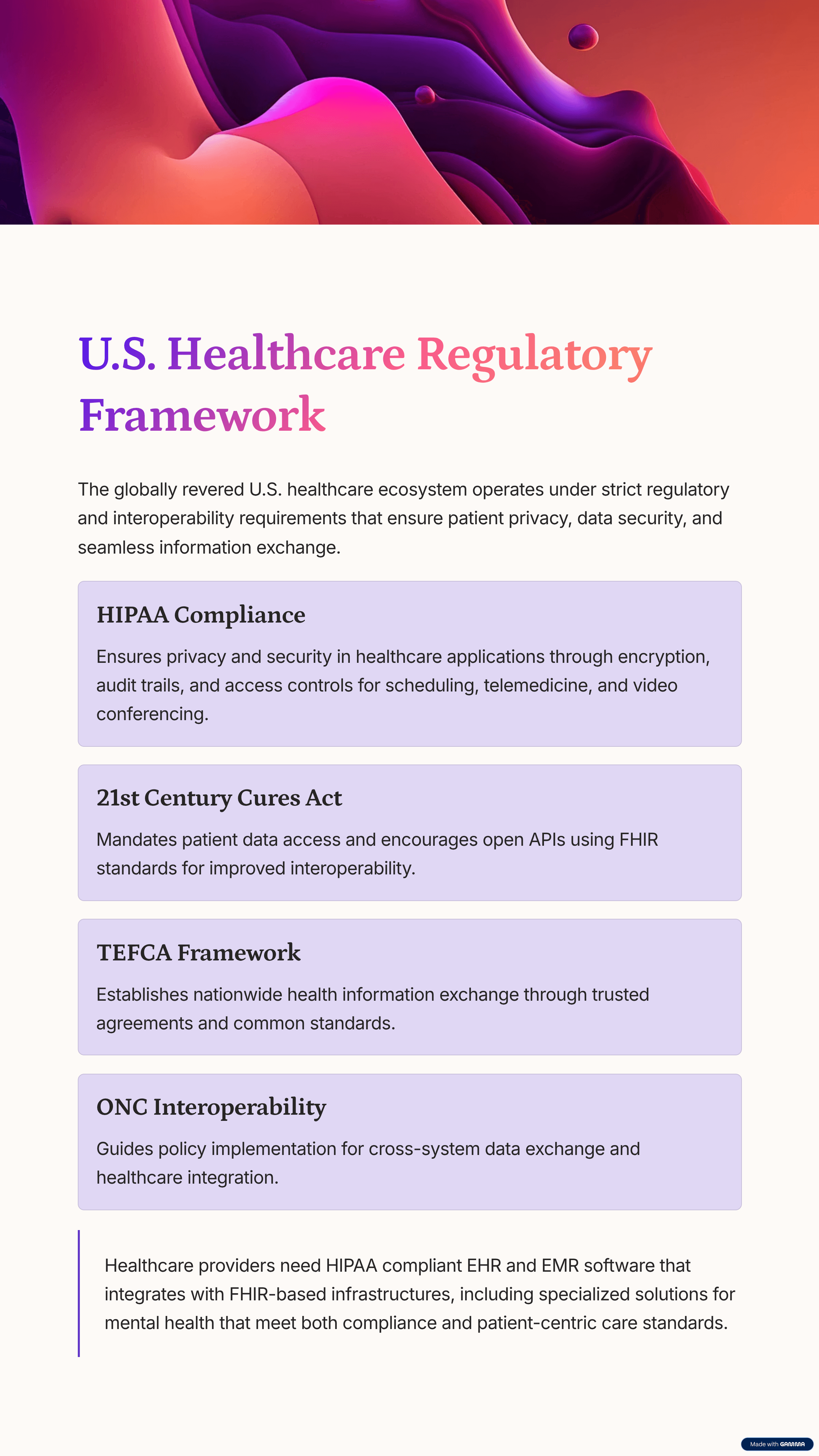
- Legislation & Regulations: The HITECH Act (2009) kick-started EHR adoption ("Meaningful Use"), with interoperability as a goal. The 21st Century Cures Act (2016) and its ONC Final Rule (2020) aggressively push open APIs. Certified EHRs must support FHIR v4 APIs by the end of 2022. Information-blocking rules (also from the Cures Act) forbid unreasonable data access restrictions.
- Certification & Data Sets: The ONC's Certification Program and USCDI (US Core Data for Interoperability) define what data must be exchangeable (demographics, problems, meds, labs, etc.). EHR vendors obtain these certifications. The Common Clinical Data Set (older MU core) and newer USCDI mandates standardized data classes and terminologies (for example, USCDI v5 requires SNOMED-CT for problems and LOINC for labs).
- Networks & Exchanges: The Trusted Exchange Framework (TEFCA) is being built to connect Health Information Exchanges (HIEs) into a national network of networks. States and regions have HIEs and collaborative networks. ONC promotes standards via its Interoperability Standards Advisory listing.
- Data Transactions: The US uses electronic transaction standards (HIPAA X12) for claims (e.g., 837 for claims, 835 remittance). NCPDP standards govern pharmacy claims. The Direct Project and eHealth Exchange enable secure point-to-point messaging. SMART-on-FHIR and OAuth2 provide standardized app access to EHRs.
- Privacy/Security: HIPAA Privacy and Security Rules (with HITECH) set mandatory safeguards for patient data. State laws (e.g., California Cures Act) and new FTC rules on apps also impact data sharing.
Key point: The US paradigm is a combination of top-down mandates and market-driven networks. Agencies like CMS tie reimbursement to "Promoting Interoperability" (formerly MU) usage. The result is nearly all US hospitals having EHRs, and a strong momentum towards FHIR-based data exchange.
Middle East Healthcare Interoperability, Standards and Regulations
The Middle East (GCC and neighboring countries) is rapidly digitizing healthcare. Governments are building national health data networks and setting eHealth standards:
1. GCC-wide Trends:
Gulf countries have aligned on core technologies. Most public hospitals (>75% in the GCC) now use EHR/EMR systems. Governments mandate HL7 v2/v3 (CDA), FHIR, and ISO 27001 security for any health IT solution. Data privacy laws are emerging (UAE's PDPL, Saudi NCA rules, Oman PDPL, Bahrain PIPA) and often modeled on GDPR.
2. United Arab Emirates:
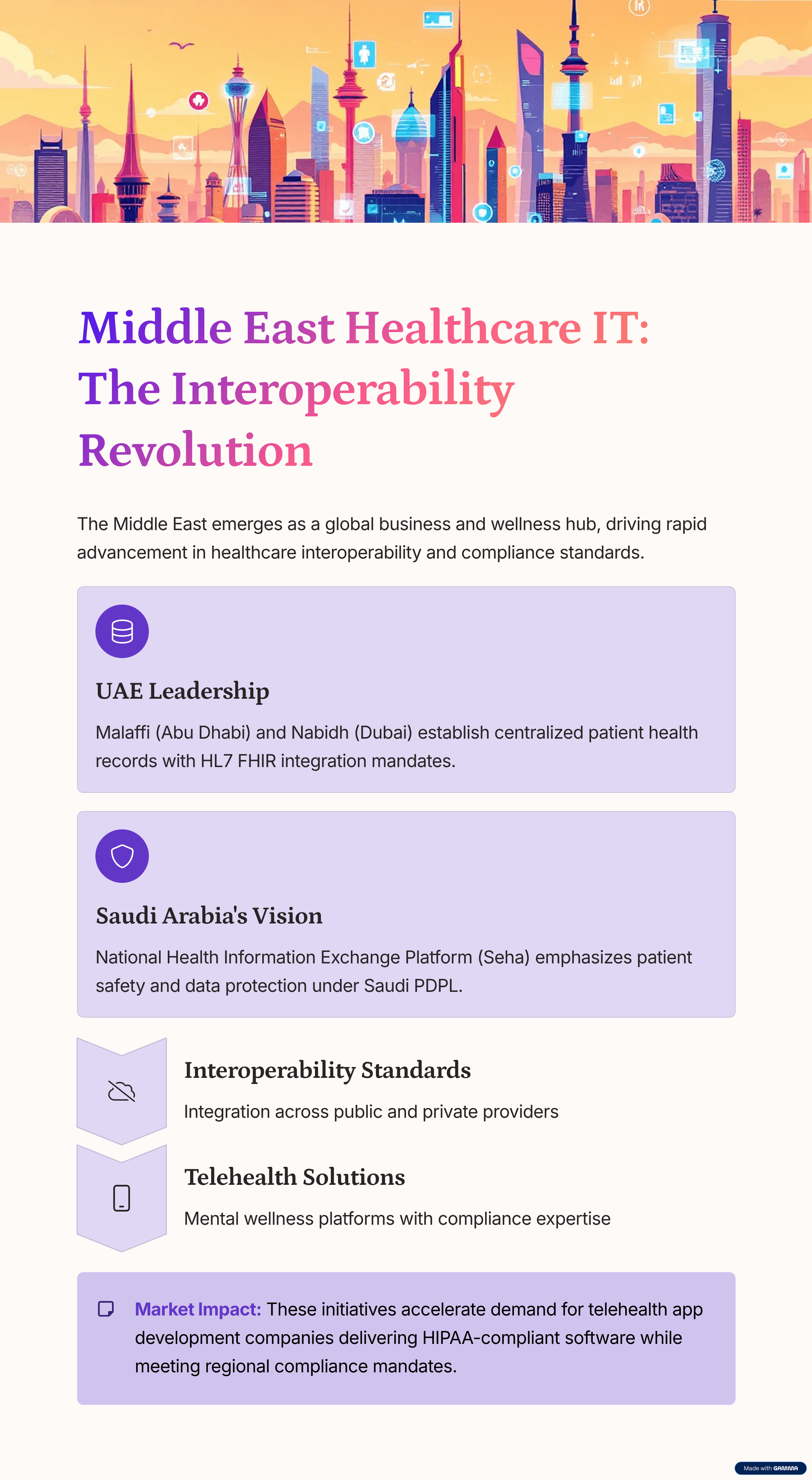
UAE's Malaffi (Abu Dhabi HIE) and Riayati (federal HIE) are national exchanges that link all emirates' providers. Systems must connect using HL7 and CDA messages. Many vendors and hospitals now also support FHIR APIs. In 2021, the UAE joined SNOMED International, giving providers free access to SNOMED CT to code clinical data. UAE participates in WHO/EU initiatives too (e.g., COVID data sharing via WHO's GISRS), and its platforms are designed to align with global standards like HL7 FHIR and SNOMED CT.
3. Saudi Arabia:
The National Platform for Health Information Exchange (NPHIES) / "Seha" project is establishing national registries (patient, provider) and core services (e-prescribing, lab results, referrals). Saudi Arabia has defined detailed interoperability specifications (IS0001…IS0011) for lab, radiology, imaging, referrals, etc. These are built on HL7 FHIR, CDA, DICOM, and content profiles. Saudi Health Informatics Standards (via NHIC) explicitly include HL7 v2, FHIR, CDA, IHE profiles, DICOM, and X12. The country also joined SNOMED CT (with the UAE, Jordan, and Israel) to standardize clinical terms. The Health Ministry requires all systems to support these standards or risk non-compliance with its eHealth regulations.
- Other Gulf States:
- Qatar has a national Hamad EHR (Cerner) and government initiatives for health data exchange.
- Oman launched a national e-health strategy with standards and has a privacy law (PDPL) for data sharing.
- Kuwait, Bahrain, Egypt, Jordan, Lebanon (Eastern), are each modernizing hospitals and often adopt HL7/FHIR in new projects, though their regulatory frameworks vary.
- Integration Trends: The region emphasizes multilingual interfaces (Arabic/English) and mobile-first solutions. Healthcare data Interoperability use-cases include synchronizing patient profiles across emirates, sharing imaging via DICOM between city hospitals, and connecting fitness/wearable data to clinical records. Startups and EMR vendors in the region (like Athir in KSA) now build on standardized data models to serve multiple hospitals.
Bottom line: The US and Middle East both converge on international standards (HL7/FHIR, ICD, SNOMED) but with different rollout paths. The US focus is on APIs and networks (TEFCA, CHIME), while the Middle East is rapidly implementing national HIEs and codified eHealth policies. In both cases, compliance with standards is tied to government mandates (for example, the UAE's MoHAP requires EHRs to use HL7 for Malaffi integration.
Overview of Compliance & Governance
We know medical data interoperability doesn't happen in a vacuum, and it's tied to these regulations in the respective regions:
- US: HIPAA (Health Insurance Portability and Accountability Act) requires the use of standardized code sets (ICD, CPT, HCPCS, NDC, CDT) in electronic transactions. It also enforces privacy/security safeguards. The HITECH Act and Cures Act penalize information blocking. State laws (like California's Shield Act, Virginia's CDPA) add privacy requirements. Federal agencies (ONC, CMS) issue detailed rules. For example, CMS's Interoperability and Patient Access final rule (2020) requires payers to share data via FHIR APIs.
- Middle East: Several countries have enacted data protection laws: the UAE's PDPL (2021), Saudi NCA personal data law, Qatar's data privacy law, etc. Healthcare regulators (e.g., UAE Ministry of Health, Saudi MOH) explicitly tie health software licensing to interoperability and security requirements. Saudi Arabia's MOHAP lists mandatory HL7 support and centralized EHR synchronization as part of 2025 compliance checkpoints. Non-compliance can mean fines or loss of licenses. Countries are also aligning with global privacy frameworks: GCC often references GDPR-like standards and WHO guidelines.
- International: Across borders, legal agreements and standards bind exchanges. The EU's European Health Data Space (EHDS) is establishing common rules (GDPR-based) and standards (HL7 FHIR, SNOMED, ICD-11) for cross-country health data. The US and some Middle Eastern countries participate in international forums (Global Digital Health Partnership, WHO digital health strategy). All these frameworks emphasize consent, encryption, and standard vocabularies to protect privacy while enabling data flows.
Compliance Meets Technology: Driving Standards into Software Development
Medical data Interoperability and compliance are no longer optional, they are baked into modern healthcare software development services:
- EHR and EMR Platforms: Built with FHIR-based APIs to ensure extensibility and secure data exchange.
- Telemedicine Applications: Secure HIPAA-compliant telemedicine software and virtual mental health care platforms for cross-provider collaboration.
- Scheduling & Billing Systems: HIPAA-compliant scheduling software and HIPAA-compliant accounting software integrated with clinical workflows.
- Clinical Research & Trials: Clinical trial management software development companies ensuring alignment with FDA, EMA, and regional regulatory standards.
- Training & Compliance: Compliance & regulatory LMS and healthcare LMS solutions support workforce education on HIPAA and regional mandates.
Emerging Trends in Healthcare Interoperability
- FHIR-based APIs: Standard for cloud-native EHR systems and electronic medical records software for mental health. Read more about FHIR API Integration here.
- Cloud-native Health IT: Scalability for healthcare incident reporting software and remote patient monitoring.
- AI and LLM Compatibility: Integration of generative AI into healthcare for proactive care delivery.
- Mobile-first Interoperability: Driving demand for telehealth app development companies in the USA and GCC.
Cross-Border Healthcare & Medical Data Exchange
With global travel and post-pandemics, cross-border health data sharing is gaining the necessary urgency. Imagine a diabetic traveler in Dubai whose home country EHR can be queried, or a refugee in Jordan whose history from Syria follows them. Secure, standards-based exchange makes this possible.
- Global Initiatives: The WHO's Global Strategy on Digital Health (2020–2025) and G20 health ministries promote standardization (FHIR, SNOMED, ICD) for worldwide interoperability. Initiatives like the WHO Global Influenza Surveillance (GISRS) and OECD Health Data projects rely on shared standards. The UAE, for instance, reports COVID and flu data via WHO networks and contributes to OECD health stats. The US and Canada collaborate on genomic data standards (GA4GH) and surveillance data.
- Regional Frameworks: Regions are creating health "data spaces." The EU's EHDS will allow prescriptions and records to follow citizens across member states. Southeast Asia's AeHIN forum is encouraging HL7-based exchange among member states. In the Middle East, there is interest in GCC-wide eHealth collaboration, though it's still nascent. Pilot efforts (e.g., interoperable immunization records) have been discussed in MENA health forums.
- Challenges and Keys: Differences in law can hinder flow, e.g., privacy rules (HIPAA vs. PDPL vs. GDPR) need harmonization. Technical consistency is key: using FHIR and SNOMED CT as a "common digital language" is widely cited. Shared infrastructure and APIs (like the EU's cross-border health network, or future TEFCA QHIN links) can provide the plumbing. Ultimately, while complex, cross-border exchange can save lives (e.g., timely emergency info) and speed research, Interoperability standards and agreements (federated queries, shared patient identifiers) are the enablers.
Leading to it, Patients expect continuity of care across borders:
- Shared frameworks like HL7 FHIR for patient record exchange.
- Cross-border compliance between HIPAA-compliant EHR/EMR software and GCC health data regulations.
- Secure integration of telehealth software for mental wellness and virtual mental health care platforms to support remote consultations.
For global providers, healthcare IT services and healthcare software solutions that support cross-border exchange deliver both compliance and competitive advantage.
Conclusion
Interoperability in healthcare is both a compliance necessity and a driver of digital transformation. The U.S. enforces HIPAA and TEFCA, while the Middle East accelerates adoption through national health exchanges like Malaffi and Seha. For providers and enterprises, success depends on building HIPAA-compliant software, whether for telemedicine applications, EHR software development, or healthcare LMS solutions.
Organizations seeking to expand must invest in healthcare software development services that embed global standards, regional mandates, and cross-border healthcare interoperability. The future of healthcare belongs to those who can bridge compliance, technology, and patient experience at scale.
Explore the compliant, future-ready healthcare IT solutions developed by Ciphernutz, a leading AI & Healthcare software development company. Connect with expert healthcare app developers for standards-driven innovation.