How to Run n8n Multi-Agent Orchestration: A Step-by-Step Guide
Dharmesh Dave
8-10 mins
Most AI workflows fail because a single LLM is expected to handle research, decision-making, validation, and execution simultaneously.
Multi-agent orchestration solves this problem by decomposing work into specialized AI systems that collaborate through deterministic workflows.
For enterprise architects, deploying n8n multi-agent orchestration is the critical mechanism for building scalable, resilient AI operations. Rather than relying on fragile single-prompt scripts, advanced engineering teams are structuring highly decoupled AI agents that pass structured context, execute discrete API calls, and maintain strict operational governance.
Here is the definitive, highly technical guide to designing, deploying, and maintaining multi-agent systems in n8n.
n8n Multi-Agent Orchestration: Coordinate AI Agents at Scale
The automation landscape is accelerating at a historic pace. Gartner predicts that 40% of enterprise applications will embed task-specific AI agents by the end of 2026, up from less than 5% in 2025.
Furthermore, industry data indicates that 72% of enterprises have at least one AI workload in production as of Q1 2026. However, a structural gap remains between pilot programs and true enterprise scale. McKinsey research shows that while 62% of organizations are experimenting with AI agents, only 23% are scaling them effectively in at least one business function.
To cross this deployment chasm, organizations require multi-tenant, governable infrastructure. Implementing Multi-Agent Orchestration with n8n: Run Multiple AI Agents within a unified environment provides precisely this scalability.
The primary advantage of n8n workflow automation in 2026 is its advanced node architecture - specifically native integrations with LangChain, the Model Context Protocol (MCP), and external vector stores - which seamlessly bridges the probabilistic reasoning of Large Language Models (LLMs) with the deterministic execution of HTTP Request APIs.
What Is Multi-Agent AI & What is API Orchestration?
Before examining specific node topologies, we must define the core methodologies powering this architecture:
- Multi-Agent AI: A distributed intelligence framework where multiple autonomous, specialized LLM models collaborate. Distinct personas (e.g., a "Research Agent" and a "CRM Agent") divide tasks, allowing for isolated tool calling, peer review, and self-correction.
- API Orchestration: The structural coordination of multiple application programming interfaces to execute a unified business workflow.
Combining these concepts means cognitive agents do not just generate conversational text they take secure, verifiable actions across your enterprise tech stack.
Multi-Agent vs Single-Agent Architecture
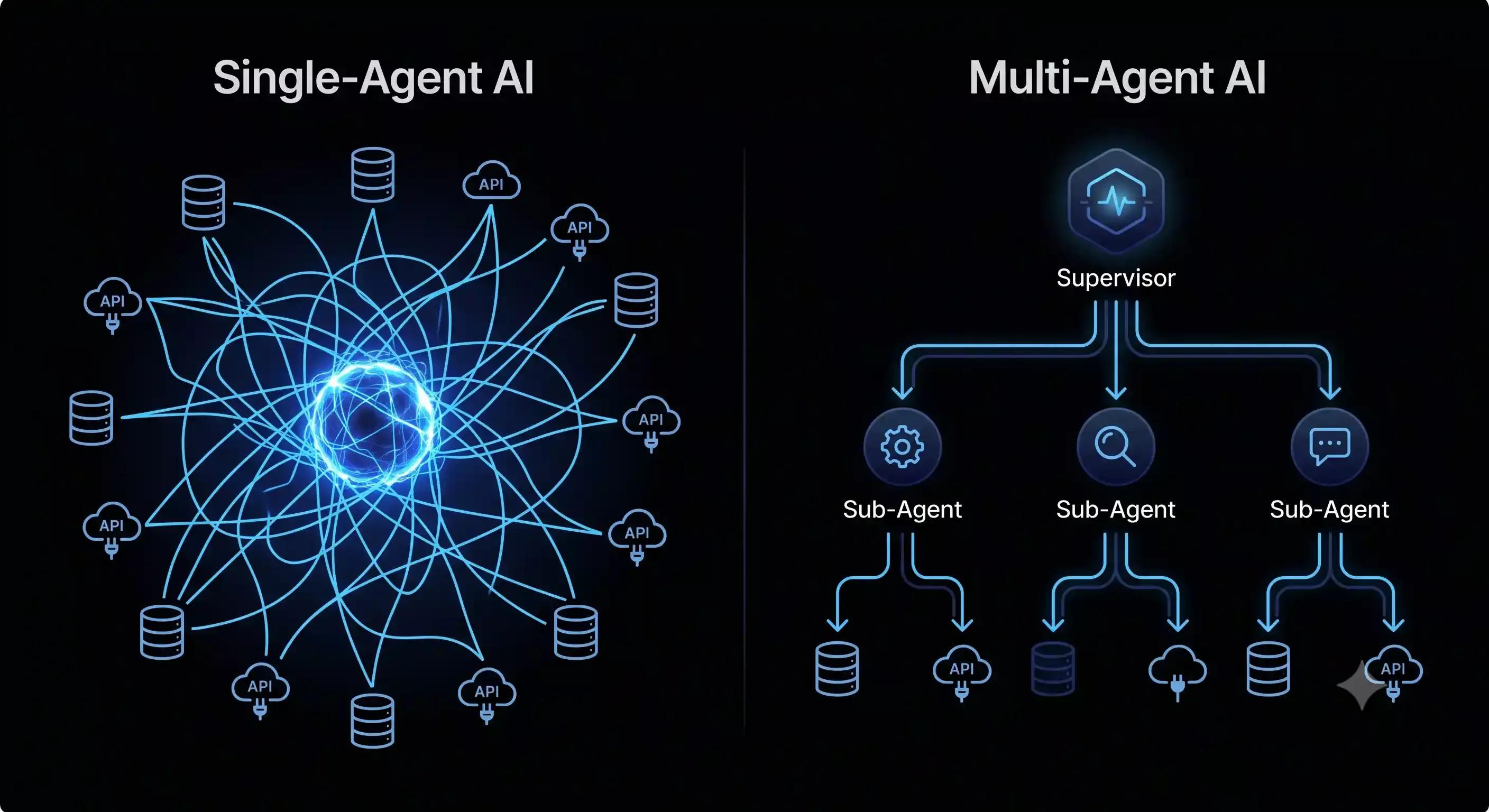
In a Single-Agent architecture, developers feed a massive system prompt to one model (like GPT) and give it access to a dozen different API tools. The model inevitably degrades: it confuses instructions, calls the wrong tool, or hallucinates parameters because its context window is overloaded with competing logic paths.
In a Multi-Agent architecture, you decouple the logic. A Manager Agent evaluates the request and hands it to a specialized Sub-Agent. That Sub-Agent has exactly one job (e.g., "Query the CRM") and access to exactly one custom tool. This reduces hallucination rates, simplifies debugging, and drastically cuts token costs.
Benchmark Data: The performance gap between these architectures is severe at the enterprise level. A recent Cornell University study benchmarking complex planning tasks found that coordinated multi-agent systems achieved a 42.68% success rate, whereas a single-agent GPT-4 setup scored just 2.92% on the exact same benchmark.
n8n vs LangGraph for Multi-Agent Systems
When building these architectures, engineering teams frequently evaluate n8n against code-heavy libraries like LangGraph.
LangGraph is a powerful Python library for building cyclical agent graphs, favored by researchers building highly custom models. However, it struggles in enterprise IT environments because it requires developers to manually code every API authentication flow, rate limit, and retry logic.
n8n provides a visual, node-based abstraction layer over LangChain. While LangGraph requires custom scripts to securely connect to a PostgreSQL database, n8n provides pre-built, authenticated nodes. It allows engineers to focus entirely on agent topologies and prompt engineering rather than reinventing OAuth2 flows for Salesforce or Stripe.
Read more: n8n Native Agents vs. LangChain & LangGraph
n8n vs CrewAI and AutoGen
While code-first frameworks like CrewAI and AutoGen dominate open-source experimentation, they present steep operational hurdles at scale.
CrewAI excels at structuring multi-agent role-playing tasks using pure Python, but lacks a native visual interface for live debugging, visual data mapping, and session state monitoring. AutoGen provides highly flexible conversation patterns but requires managing custom asynchronous code blocks for complex enterprise API integrations.
n8n solves these production issues by functioning as an operational orchestration layer. It allows developers to import custom Python logic when necessary or use native AI Agent nodes, providing built-in visual logs, error-retry policies, and hundreds of pre-built enterprise connectors out of the box.
Multi-Agent AI Orchestration with API Integration: The Complete Framework
Deploying a multi-agent system requires strict adherence to workflow design and state management. Below is the complete framework for structuring your n8n deployments.
4 Multi-Agent Patterns in n8n
Before placing your first webhook, you must select an orchestration logic pattern.
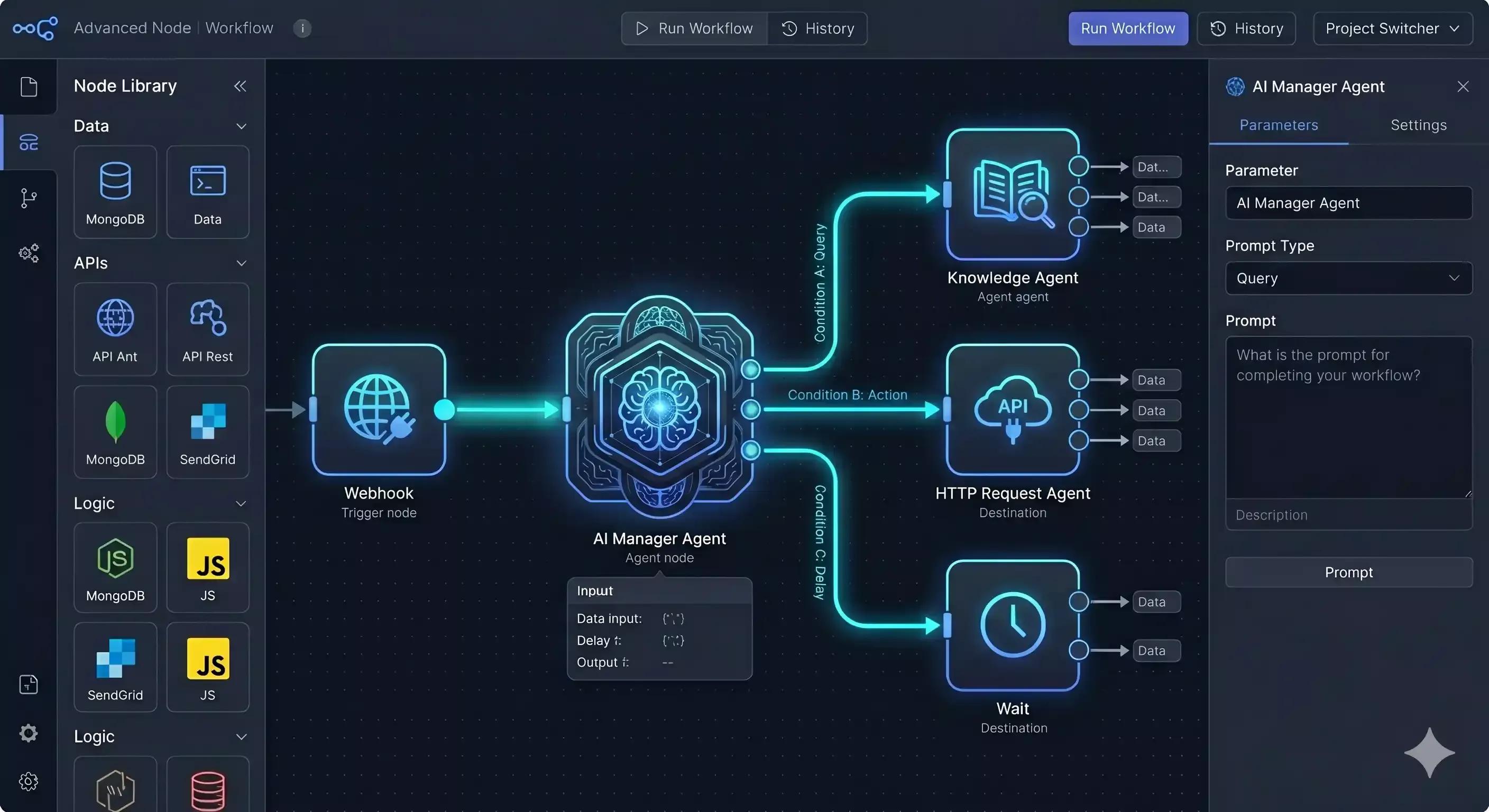
Webhook Trigger (Incoming Request)
      │
      ▼
Manager Agent (AI Agent Node + Switch Node)
      │
      ├────────► Intent: "Information" ──► Knowledge Agent (MCP Client to Vector DB)
      │                                            │
      │                                            ▼
      │                                     Resolution Agent
      │
      ├────────► Intent: "Refund" ───────► Authentication Agent (HTTP Request Node)
      │                                            │
      │                                            ▼
      │                                     CRM Update Agent (Execute Tool)
      │
      └────────► Intent: "Escalate" ─────► Human-in-the-Loop (Wait Node)
Step 1: Webhook Trigger & Initial Context
Start with a Webhook node to ingest the payload (e.g., a JSON payload from your chat widget). Immediately route this into a Code node to parse and structure the payload before passing it to the LLM.
Step 2: The Manager Agent Node
Use the n8n AI Agent node configured strictly as a classifier.
- Prompt Engineering: Instruct this agent to output only a structured JSON string containing the identified intent and extracted entities.
- Memory Management: Attach a PostgreSQL Chat Memory node to ensure the session ID is tracked securely across the multi-tenant architecture.
Step 3: Intent Classification & Routing
Pass the Manager Agent's output into a Switch node. The Switch node evaluates the JSON object and routes the execution to the appropriate sub-workflow using the Execute Workflow node.
Crucial Operational Insight: In production n8n deployments, most orchestration failures occur during context transfer between agents rather than model inference itself. The solution is passing structured JSON objects between worker agents via Code nodes instead of passing raw conversational memory strings.
Example Context Payload (Passed via n8n Code Node):
{
  "session_id": "req-9082",
  "intent": "refund_processing",
  "extracted_entities": {
    "order_id": "ORD-12345",
    "customer_tier": "enterprise"
  },
  "agent_state": "authentication_required"
}
Step 4: Knowledge Retrieval via MCP (n8n MCP Integration Explained)
If the route is informational, the sub-workflow triggers a specialized Knowledge Agent using the MCP Client node.
The Model Context Protocol (MCP) standardizes how AI models securely connect to external data sources. In early multi-agent designs, giving an agent access to internal documentation meant hardcoding API keys directly into custom tools.
With n8n's native MCP integration, your AI agents can dynamically discover and securely utilize internal tools (like querying an internal Confluence wiki) without exposing core system credentials to the LLM's system prompt.
Step 5: Secure Execution via HTTP Requests
If the route is transactional, the payload routes to the CRM Update Agent. Attach an AI Agent Tool node configured as a secure wrapper around an HTTP Request node. This limits the agent's ability to execute only POST requests to the specific /v1/refunds endpoint of your CRM.
Step 6: Human Escalation Route (HITL)
If the CRM Update Agent detects an anomaly, the workflow routes to an n8n Wait node. This pauses execution indefinitely, sending a webhook to Slack with action buttons for a human manager to approve the payload before the workflow resumes.
Common Multi-Agent Orchestration Failures
Before scaling n8n multi-agent orchestration to production, engineers must engineer guardrails against common failure states:
- Context Bloat: Passing the entire conversational history between five different agents causes context limits to max out, leading to API rejection.
- Infinite Debate Loops: In Swarm topologies, Agent A asks Agent B for data, Agent B asks Agent A for clarification, and the loop runs indefinitely until the billing limit is hit.
- Tool Calling Hallucination: An agent decides it needs to format a date string, but instead of using native code, it tries to invent a non-existent API endpoint to do the math.
When Multi-Agent Orchestration Is Overkill
A hallmark of architectural maturity is knowing when not to deploy an agentic framework. Teams often fall into the trap of over-engineering simple problems, where the coordination overhead between agents costs more in latency and token usage than it saves in capability.
You should strictly avoid n8n multi-agent orchestration for:
- Single API Tasks: If the goal is highly deterministic - such as extracting a standardized email attachment and uploading it to an AWS S3 bucket - a standard n8n HTTP Request node is exponentially faster, cheaper, and more reliable than prompting an LLM to execute it.
- Strictly Linear Workflows: If Step B requires the complete, exact output of Step A and involves zero dynamic reasoning or parallel execution, adding multiple agents simply introduces context loss and handoff risk. A single well-prompted model - or traditional rule-based automation - is superior.
- Low-Volume Automation: If a workflow processes three documents a week and takes a human ten minutes, spending forty hours designing, debugging, and hosting a decentralized swarm architecture yields a negative ROI. Multi-agent systems provide business value only at the intersection of high complexity and high volume.
Production Considerations for n8n Deployments
Scaling beyond a proof-of-concept requires addressing enterprise DevOps challenges.
- Token Cost Management: Multi-agent debate loops can spiral costs. Using the standard formula $Cost = \sum (Tokens_{in} \times Rate_{in}) + (Tokens_{out} \times Rate_{out})$, a three-agent swarm can easily triple the cost of a single query. Mitigate this by using smaller, specialized models (e.g., Llama 3 8B) for Worker Agents, reserving expensive models (like GPT-5.5) solely for the Supervisor Agent.
- Context Window Pruning: Attach a Window Buffer Memory node to your agents, configuring it to only retain the last 5 conversational turns, aggressively pruning older data.
- Observability and Logging: Black-box AI operations are unviable in the enterprise. Map the output of every AI Agent node to a parallel logging webhook (e.g., Datadog or LangSmith) to ensure a permanent audit trail of why an agent chose to call a specific tool.
- Rate Limiting: If an agent attempts to rapidly iterate through customer records, it will trigger an HTTP 429 error. Utilize n8n's Split In Batches node before passing large arrays to an agent to throttle execution.
By rigorously applying these architectural patterns, engineering teams can transition their n8n environments from standard integration hubs into resilient, autonomous cognitive engines capable of executing complex enterprise logic at scale.
Organizations often discover that orchestration design, observability, and governance create more complexity than workflow construction itself. Teams requiring production-grade deployment typically begin with a pilot orchestration architecture before expanding to multi-agent operations across departments.
Also Read: AI Workflow Automation Explained: What You Get in 4 Weeks
Build Engineering Cognitive Autonomy The Right Way
Deploying n8n multi-agent orchestration marks the definitive shift from brittle scripts to resilient, autonomous backend operations. Success at this enterprise tier requires designing rigorous, decoupled architectures that securely govern context transfer and API execution.
If your engineering team is navigating the complexities of production-grade deployment and ongoing agent governance, explore how we structure scalable AI infrastructure at Ciphernutz.
Frequently Asked Questions (FAQs)
What is the difference between an AI Agent node and an AI Agent Tool node in n8n?
The AI Agent node is the cognitive core that houses the LLM connection and holds the system prompt. The AI Agent Tool node defines the specific, restricted actions (like a database query or a custom API call) that the Agent node is permitted to execute.
How do I prevent infinite loops in a Swarm architecture?
Prevent infinite loops by injecting a "Max Iterations" variable in an n8n Code node. Increment this variable upon every agent transition; if the counter exceeds a defined threshold (e.g., 5), force the workflow down an error-handling path using an If node.
Why should I use the Model Context Protocol (MCP) in n8n?
MCP standardizes secure connectivity. Using the MCP Client node in n8n allows your agents to dynamically discover and utilize internal tools (like your codebase or private documentation) without requiring you to manually build distinct REST API wrappers for every internal system you want the agent to access.
Can I use local, open-source LLMs for n8n multi-agent orchestration?
Yes. Connect n8n to local execution runtimes like Ollama or Hugging Face to deploy open-source models (e.g., Llama 3) as task-specific worker agents. This topology guarantees absolute data sovereignty - keeping sensitive API payloads and infrastructure data within your private cloud - while eliminating external token costs entirely.
How do AI agents share context and memory during a multi-step workflow?
Isolate operational state using database memory nodes (like PostgreSQL Chat Memory) mapped to distinct session IDs, but block raw conversational history transfer. Instead, insert an n8n Code node to compress and parse upstream agent outputs into tight, structured JSON payloads. Passing only essential key-value pairs downstream stops context inflation, eliminates API timeouts, and maintains deterministic state across sub-workflows.