How to Integrate Generative AI into EHR Systems?
Vijay Vamja
4-5 mins
Introduction
The healthcare industry is at a pivotal moment wherein the Generative AI in EHR (Electronic Health Records) has the power to transform how medical professionals collect, analyze, and use patient data.
Hospitals and clinics are regularly facing increasing pressure to improve patient care while also reducing administrative burdens. But most EHR systems already in use are typical: clunky, time-consuming, and not optimized for modern healthcare needs.
This is exactly where AI in healthcare can play a revolutionary role, particularly with the various uses of generative AI.
Generative AI in Healthcare: Market Outlook
US & UK: Focus on value-based care models that reduce admin overhead..
Saudi Arabia, UAE, Qatar: National AI growth strategies are funding digital health & wellness ecosystems, making EHR-AI integration a fast-growing priority..
The global generative AI healthcare market is projected to exceed $22 billion by 2032, driven by EHR automation and clinical AI adoption.
In this guide, we’ll explore how to integrate Generative AI in EHR systems, its benefits, common challenges, and real-world use cases.
What is Generative AI in EHR?
Generative AI in EHR refers to the use of advanced AI models (like GPT-based systems) to analyze, generate, and summarize health records in real time.
Instead of physicians typing every note, generative AI can:
- Listen to patient consultations (with consent).
- Convert conversations into structured EHR entries.
- Suggest treatment pathways or alerts.
- Translate clinical jargon for patients.
This strategic use of GenAI transforms EHR systems from static data repositories into smart assistants. Now, let's look into some key benefits and impact of GenAI in healthcare before we dive into learning why it really matters to integrate it with EHR.
Key Benefits of Generative AI in Healthcare (EHR Focus)
Generative AI is not just hype, it unlocks tangible, measurable advantages for healthcare providers struggling with EHR inefficiencies.
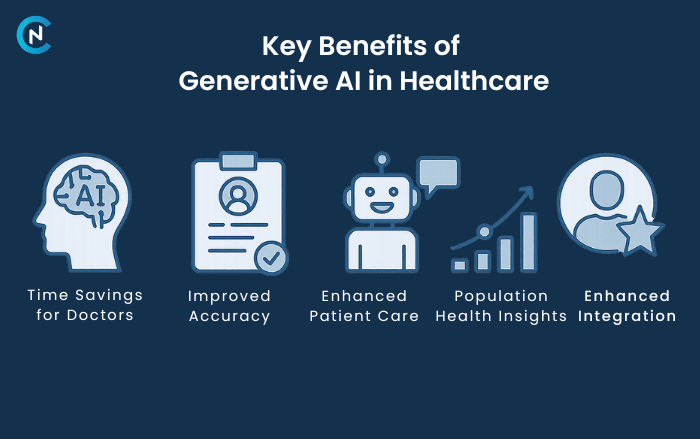
1. Time Savings for Doctors
Physicians often spend more time typing into EHRs than interacting with patients. Generative AI reduces this burden by automatically generating SOAP notes, discharge summaries, and billing codes during or immediately after patient encounters. This means doctors can reclaim valuable hours each week, translating into higher-quality patient interactions and reduced burnout.
2. Improved Accuracy
Manual data entry is prone to errors that can delay care or impact outcomes. Generative AI extracts, validates, and standardizes data automatically, ensuring fewer discrepancies between clinical notes, lab results, and prescriptions. By reducing documentation errors, healthcare organizations see fewer claim rejections and better clinical decision-making.
3. Enhanced Patient Care
Generate real-time, context-aware insights to help clinicians focus better on patient-oriented responsibilities. For example, AI can summarize a patient’s entire medical history in seconds or highlight risk factors during consultations. This allows providers to make faster, more informed decisions and improves the overall quality of care and patient satisfaction.
4. Population Health Insights
When combined with EHR and external datasets, generative AI can predict chronic disease risks and flag early warning signs at scale. This is especially valuable for population health management programs targeting diabetes, cardiovascular disease, or asthma. By uncovering patterns across thousands of records, AI empowers healthcare systems to shift from reactive treatment to proactive prevention.
5. Better Interoperability
Generative AI supports seamless integration across different IT systems by leveraging standards like HL7 and FHIR. This means labs, pharmacies, and hospitals can share and consume patient data in real time, improving collaboration across the care continuum. Interoperability also opens the door for third-party apps, AI-driven agents, and patient engagement tools to connect directly with EHRs. (Read more: FHIR API Integration in Healthcare)
Together, these benefits highlight why generative AI in EHR systems is not just an upgrade but a competitive advantage for hospitals and clinics.
Why Integrating Generative AI into EHR Matters
Let’s talk about Paint Point:
Healthcare organizations across the world face these common challenges:
- Clinicians spend 40–60% of their time documenting instead of treating patients.
- Legacy EHR systems are often slow and complex, often frustrating the staff.
- Growing healthcare data (structured + unstructured) is underutilized, preventing precision care delivery.
Generative AI solves this by:
- Automating clinical documentation in real time.
- Making EHRs interoperable across systems.
- Improving decision support with predictive analytics.
- Enhancing patient engagement with conversational interfaces.
Step-by-Step: How to Integrate Generative AI into EHR Systems
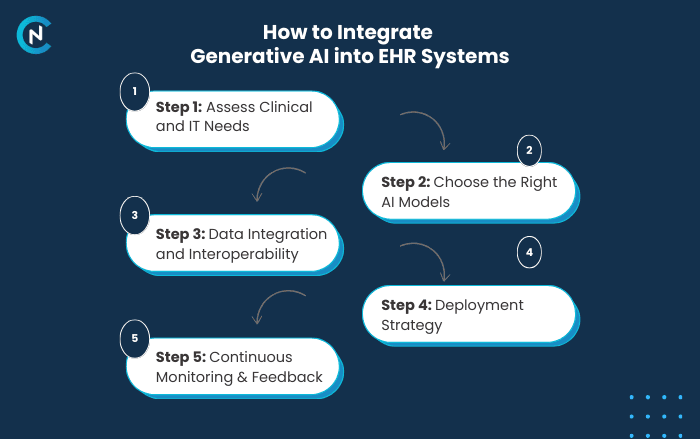
1. Assess Clinical and IT Needs
- Identify workflows and bottlenecks causing burnout (documentation, scheduling, referrals).
- Set clear outcomes: reduce admin time, improve accuracy, or enable predictive insights.
2. Choose the Right AI Models
- Generative AI for health data management → Handles structured + unstructured data.
- LLMs fine-tuned for medical text → Converts speech to structured clinical notes.
- Predictive models → Identify at-risk patients early.
3. Data Integration and Interoperability
- Use FHIR/HL7 APIs to connect EHR with AI engines.
- Ensure compliance with HIPAA, GDPR, and regional health data laws.
- Normalize and develop unstructured data exchange (doctor’s notes, lab reports, imaging files, medication records).
4. Deployment Strategy
- Cloud-based APIs (AWS HealthLake, Azure Health Data Services).
- On-premise AI servers for highly regulated Middle Eastern markets.
- AI Agents → Use orchestration tools like n8n integrated with EHR for automation.
Also, If you are unsure about which deployment strategy will work the best for your business, book a free consultation with our expert AI developer.
5. Continuous Monitoring & Feedback
- Track & maintain accuracy of AI-generated documentation in real-time.
- Set clinician feedback loops and learn from them for ongoing model improvement.
- Ensure readily accessible explainability across the system to build trust with regulators and providers.
Real-World Generative AI Use Cases in Healthcare
Generative AI is moving beyond theory and making a measurable impact in hospitals and clinics. By embedding AI directly into EHR workflows, providers can cut down on administrative friction, reduce errors, and deliver better patient outcomes. Here are some of the most practical use cases:
1. Clinical Documentation
Generative AI can listen to patient-provider conversations in real time and automatically generate structured SOAP (Subjective, Objective, Assessment, Plan) notes. This eliminates the need for clinicians to manually type notes after each visit. AI-driven documentation not only saves time but also ensures consistency across patient records.
2. Medical Imaging Reports
Radiologists often spend significant time dictating or writing reports. Generative AI can analyze imaging results like CT scans, MRIs, or X-rays and generate structured, standardized reports. This accelerates turnaround times, reduces interpretation errors, and creates better-aligned data for treatment planning. Read more: Generative AI in Medical Imaging.
3. Patient Summaries
EHR data is often scattered across different departments and visits. Generative AI agents can summarize a patient’s medical history into a concise, easy-to-read overview, pulling details from labs, prescriptions, and past encounters. This gives providers quick context during appointments and helps avoid missed details in complex cases.
4. Referral & Scheduling Automation
By combining workflow automation tools like n8n with EHR systems, generative AI can automatically generate referral letters, match patients to appropriate specialists, and optimize scheduling. This reduces appointment leakage, streamlines patient flow, and ensures continuity of care across different providers. Learn more about how to integrate n8n with EHR system here.
5. Predictive Analytics
Generative AI models can identify patients at risk of readmission, complications, or adverse drug events by analyzing structured and unstructured EHR data. For example, AI may flag a diabetic patient with rising glucose variability as a readmission risk. This allows providers to intervene earlier with proactive care, improving outcomes while reducing costs.
Challenges to Overcome
While the benefits and use cases are clear, challenges exist:
Data Privacy: Ensuring compliance with HIPAA and GDPR.
Integration Complexity: Legacy EHR systems may resist seamless integration.
Cost of Implementation: Requires investment in technology and training.
Trust Issues: Clinicians need confidence in AI recommendations.
The solution? Work with trusted healthcare IT services providers and AI specialists to minimize risks.
How a Generative AI Development Company Can Help
If you’re a hospital, clinic, or health IT vendor, working with a generative AI development company provides:
- Custom model fine-tuning for your specialty (cardiology, oncology, primary care).
- Seamless integration into Epic, Cerner, Allscripts, or custom EHR platforms.
- End-to-end healthcare IT solutions – from data pipelines to deployment.
- Access to skilled AI engineers – you can even hire generative AI developers for in-house teams.
FAQs
Q1. How is generative AI used in EHR?
Generative AI is used to automate documentation, extract structured data from notes, improve clinical decision-making, and create patient summaries.
Q2. What are the benefits of generative AI in healthcare?
It reduces physician burnout, improves accuracy, supports interoperability, and accelerates patient care.
Q3. Can generative AI ensure HIPAA compliance?
Yes, when deployed with secure data pipelines, encryption, and audit trails, generative AI can meet HIPAA and GDPR standards.
Q4. What challenges do hospitals face when integrating AI into EHR?
Challenges include high costs, legacy system limitations, clinician resistance, and regulatory requirements.
Q5. Should hospitals hire generative AI developers or outsource?
It depends on resources. Large hospitals often build internal AI teams, while smaller networks benefit from outsourcing to an software development company for faster ROI.
Q6. What is the future of generative AI in healthcare?
Expect AI-powered voice-enabled EHRs, predictive patient flow management, and multi-agent systems where AI assistants handle documentation, billing, and scheduling seamlessly.