Why Integrate Voice AI Agent in Manufacturing & ERP Systems?
Vijay Vamja
4-5 mins
If you are still on the ledge about the adoption of AI or voicebot solutions, you must reconsider now. The Voice AI market will expand to $47 billion by 2030 due to global business sectors welcoming custom AI-powered solutions and automation. In this era of innovation, having a Voice AI agent is a must for manufacturing and ERP systems, at the least.
Once either an AI agent or a voicebot solution is integrated into the workforce, it brings several additive benefits that bring compounding results. Therefore, this blog briefly discusses each of the benefits of integrating Voice AI Agent in Manufacturing & ERPs to help you make informed decisions.
What Does A Voice AI Agent Do?
By now, you should ideally be aware of what a voice AI agent does - It interacts with users via voice commands. An AI utilizes the NLP within an LLM to understand, comprehend, and respond to user queries and automate routine tasks.
A GenAI developer can further prepare the Voice AI Agent to assist technicians on the factory floor or to query ERP reports. These AI agents function as smart copilots to enhance operational agility across systems.
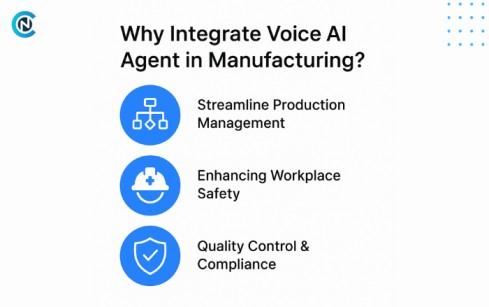
Why Integrate Voice AI Agent in Manufacturing?
The manufacturing sector is instrumental for all types of industries, wherein the adoption of AI systems simplifies process control and management. While theoretically, it may seem ideal to make the entire workflow AI-driven, it's rather better when human intervention guides the AI tools. Such a workflow ensures better risk management and other benefits.
Streamline Production Management
Upon integration of AI agents in manufacturing, owners can gain real-time monitoring control and remote inventory tracking and management. More than 31% of manufacturers already use AI voice agents and custom AI tools to optimize production. Read more: Maximize Efficiency with Smart Manufacturing
Enhancing Workplace Safety
AI in industrial automation via Voice AI Agents instantly delivers safety guidelines and can auto-trigger emergency protocols as required. Parallelly, AI agents can also play a crucial role in delivering interactive training to make industrial environments safer.
Quality Control & Compliance
Voice AI agents can promote guided inspection with real-time data capturing to ensure high compliance standards are maintained. They can also flag inconsistencies early to indicate the need for better decisions or actions at the moment to prevent huge failures or critical flaws.
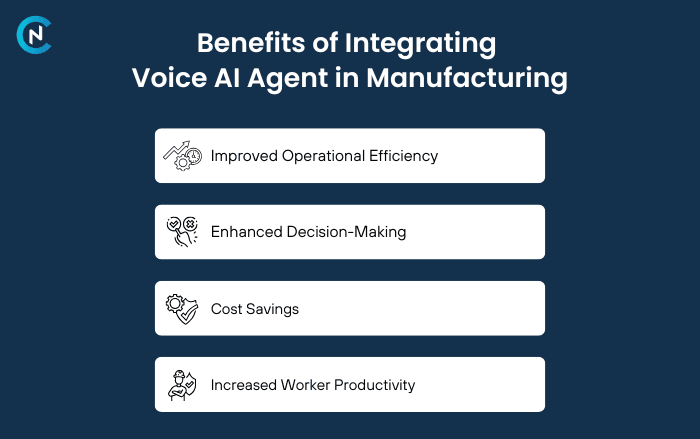
Benefits of Integrating Voice AI Agent in Manufacturing
- Improved Operational Efficiency: Automate inventory & supply chain maintenance, low-stock alerts, and SOPs.
- Enhanced Decision-Making: Analyze plant data on-demand and in the background using natural language voice queries for live insights.
- Cost Savings: Minimize downtime instances and lower labor costs with automated workflows.
- Increased Worker Productivity: Delegating admin tasks to AI enables teams to focus on strategy with extra time and clarity.
What To Do After You Integrate Voice AI Agent in Manufacturing?
Onboarding an AI Voice agent in manufacturing can provide more utility than simply operating as per instructions. It can become the driving force to support modern technologies by auto-guiding them and even assist the workforce with better healthcare management, among other uses.
1. Optimize Predictive Maintenance
Voice-enabled instructions enable on-the-fly diagnostics to predict and detect equipment failures and schedule maintenance based on analytics, strategies, and goals. To learn more about techniques for predictive maintenance, read our blog.
2. Enhance Collaboration
The integration of voice-activated project management tools can facilitate teams by enabling hands-free communication across production lines to establish better work synchronicity.
3. Super Optimize Inventory Management
Voice-based insights delivered to core personnel help to maintain stock levels at ideal equilibrium, assisted by accurate demand forecasting derived from the predictive abilities of Voice AI agents.
4. Implement Advanced Analytics
The integration of the machine learning pipeline allows us to gain a deeper analysis of manufacturing verticals via the voice interface, which can be shared team-wide and accessed on-demand.
Why Integrate Voice AI Agent in ERP Systems?
It is not unusual for manufacturers to use enterprise software to manage their everyday operations and datasets. However, it is equally true that not all manufacturers may require it in similar capacities. Irrespective of these industry-variable differences, ERP systems powered by Voice AI agents can offer organization-wide enhancements, especially when optimized by generative AI engineers.
1. Streamline Data Accessibility
ERP voice assistant driven by AI integration lets users pull reports, KPIs, trends, and insights data with a simple voice command. Other custom voice commands can also be developed to produce answers with nested responses and results after processing specific calculations.
2. Routine Task Automation
It may seem insignificant to set up task automation cycles, but it pays big time over a defined period in terms of saved hours and manual labor. Similarly, order processing, inventory updates, and scheduling can be assigned to voicebot AI solutions within the ERP ecosystem to boost efficiency.
3. User Experience Improvement
Voice AI Agent integration with ERP makes navigation intuitive and convenient with smart voice prompts and contextual insights delivered to align with employee and employer needs. Also, You can hire an experienced prompt engineer to develop voice AI agents or to build their add-on functions.
Benefits of Integrating Voice AI Agent in Manufacturing
1. Systemic Data Analysis
The Voice AI agents will utilize the historical ERP data to provide actionable insights to drive better decision-making.
2. Streamline Operations
Performing automation of scheduling, inventory management, and reporting tasks ensures smoother workflows within ERP systems.
3. Improved Scalability
The AI-ready ERP systems are pivotal when scaling operations efficiently, as they can be expanded upon with modern integrations, including cloud-based systems.
4. Continuous Improvement
Integrated feedback loops between manufacturing outcomes and ERP systems enable ongoing optimization of processes like MRP planning.
What To Do After You Integrate Voice AI Agent in Manufacturing?
Enable Proactive Decision-Making
Voice-driven analytics can anticipate market trends and allow business strategies to adjust accordingly.
Enhance Customer Interactions
Analyzing customer interactions and generated summaries by voice agents helps refine service delivery and product offering experience. If you want to know how AI will enhance customer experience, read our blog.
Automate Compliance Reporting
Utilize voice-enabled documentation tools and vendor data with inventory figures to streamline regulatory compliance processes.
Expand Integration Scope
Integrate voice AI with other enterprise systems like CRM or SCM for a unified operational approach and centralized management.
Final Words
The integration of Voice AI agents in manufacturing and ERP systems is greater than a technological upgrade; it's a strategic development towards innovation. The enhanced operational efficiency and cost savings will also help the industry push the global market for exponential growth as businesses adopt these solutions early on.
Are you ready to automate your everyday manufacturing processes?
Contact us to build your AI-ERP solution - Hire our generative AI developers for a demo!