FHIR for Patient Data Exchange: Solving Digital Interoperability
Vijay Vamja
3-4 mins
Modern healthcare cannot exist without accessing accurate patient information across systems. What's also not optional is enabling clinicians, administrators, and patients to rely on seamless data flow to reduce errors and improve care coordination. However, despite these essentials, interoperability challenges do persist that affect both sides on a global scale.
The Fast Healthcare Interoperability Resources (FHIR) standard plays a crucial role in the digital transformation in healthcare by solving such challenges, and as a working framework, it bridges these gaps, making patient data exchange secure in reality.
What is FHIR in Healthcare?
FHIR is a standardized framework developed by HL7 for healthcare data exchange. It defines how electronic health records (EHRs), mobile applications, and medical systems can share information.
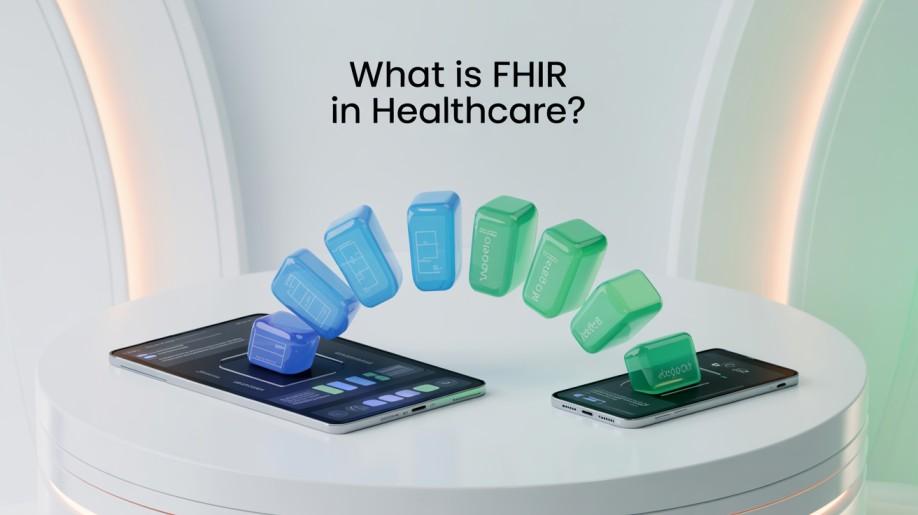
Unlike earlier standards that were rigid and difficult to implement, FHIR focuses on simplicity, modularity, and flexibility, powered by modern web technologies like RESTful APIs and JSON.
Thus, data such as lab results, medication lists, allergies, or discharge summaries can be transmitted between providers, health apps, or even insurers without requiring complex system reconfiguration.
Why is FHIR Essential In Healthcare Management?
Healthcare delivery today demands running multiple touchpoints, i.e., primary care, specialists, labs, pharmacies, and telehealth. Otherwise, without interoperable data standards, each might operate as an isolated island, leading to duplicated tests, missed information, and slower clinical decisions.
FHIR connects this landscape by supporting better care continuity for patients, while for providers, it reduces the friction of fragmented medical data. Upon enabling consistent and secure data sharing, it also opens doors to Clinical workflow automation with FHIR, streamlining routine processes and improving overall efficiency.
FHIR supports:
- Care coordination where patient information is available to every treating physician in real time.
- Population health management by allowing researchers and administrators to aggregate anonymized patient data for insights.
- Patient empowerment allows individuals to access and share their medical history through FHIR-enabled apps.
In practice, hospitals adopting FHIR see measurable improvements in reducing duplicate testing and enabling faster decision-making at the point of care.
Interoperability in Healthcare: What You Should Know
The ability of different health IT systems to communicate, exchange, and interpret shared data is called interoperability in healthcare. It is foundational for digital health initiatives, like value-based care, and for integrated delivery networks.
FHIR addresses interoperability by defining "resources," i.e., modular data elements like patient, observation, or medication that can be consistently shared across systems.
The resource-based approach ensures structured, context-rich data management and accessibility instead of ambiguous data silos or incomplete information.
For example, a patient's blood glucose level transmitted as a FHIR Observation carries not just the numeric result but also details as follows for accurate clinician interpretation.
- Testing Method
- Units
- Time Data
- And more
Challenges with FHIR
Although FHIR adoption is expanding, healthcare organizations must recognize these existing challenges:
- Implementation Variability: Some vendors may interpret FHIR specifications differently, leading to partial interoperability rather than complete alignment.
- Legacy Systems: Older EHRs often lack native FHIR support, requiring middleware or costly upgrades.
- Data Governance: Sharing information across systems raises concerns about security, HIPAA compliance, and patient consent management.
- Evolving Security Standards: As FHIR continues to develop, keeping systems updated requires ongoing technical investment.
These hurdles do not diminish the concept of FHIR, but rather, they highlight the need for careful planning, vendor collaboration, and strong compliance frameworks supported by reliable healthcare IT services.
How to Connect FHIR APIs to EHR Systems?
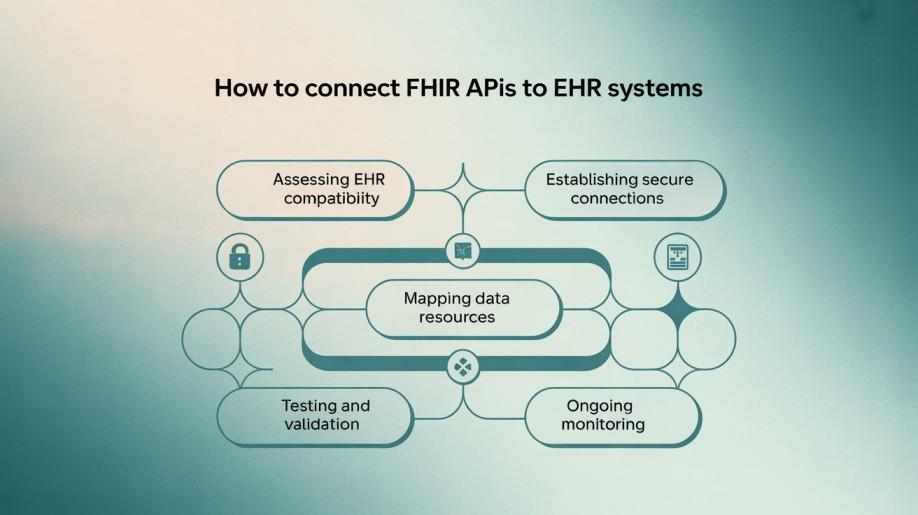
Integrating FHIR APIs with EHR systems is an achievable process that transforms how providers access and exchange data.
The steps typically involve:
1. Assessing EHR Compatibility
Evaluate whether your EHR vendor supports FHIR APIs natively. Most major vendors, including Epic and Cerner, now offer standardized FHIR endpoints, but some systems may require additional modules or updates.
2. Establishing Secure Connections
FHIR relies on OAuth 2.0 for authentication and authorization. Configuring secure tokens ensures that only authorized users or applications can access sensitive data.
3. Mapping Data Resources
Identify which FHIR resources, such as Patient, Encounter, or Medication, are relevant for your workflows. Care teams can prioritize which clinical data needs to be exchanged first.
4. Testing and Validation
Before deploying live, organizations should use test environments or "sandboxes" to validate API requests, ensure accurate mapping, and confirm compliance with regulations.
5. Ongoing Monitoring
Continuous monitoring of API performance, security logs, and data exchange metrics is essential for maintaining reliability and compliance.
When done correctly, connecting FHIR APIs to EHRs not only enables internal interoperability but also opens doors for third-party innovations like remote patient monitoring platforms, clinical decision support apps, and mobile health tools. To dive deeper into practical implementation, check out our blog on FHIR API Integration using n8n.
Conclusion: FHIR Builds a Connected Future for Patient Care
FHIR is not just a technical standard but a critical enabler of patient-centered care. By standardizing how information flows across EHRs, apps, and clinical systems, FHIR reduces silos, enhances safety, and empowers both providers and patients. The journey involves addressing challenges with legacy systems, governance, and evolving specifications, but the benefits, like better coordination, faster decisions, and improved outcomes, are pretty clear.
Healthcare organizations that adopt FHIR with strategic planning and technical diligence position themselves to lead in the next era of digital care. Ready to be the one?
Build Smarter Healthcare Systems with FHIR
A connected healthcare ecosystem starts with better data flow. With the right approach, you can simplify integrations, reduce inefficiencies, and give both patients and providers a smoother experience. Our team helps you take the complexity out of the process so you can focus on delivering quality care.
Frequently Asked Questions (FAQs)
Q. How much does it cost to implement FHIR in a hospital system?
Implementation costs vary depending on EHR vendor support, legacy system complexity, and integration needs. Some organizations require middleware or third-party platforms, while others can leverage native FHIR endpoints at lower cost.
Q. Is FHIR compliant with HIPAA and other healthcare regulations?
Yes. FHIR itself is not a compliance framework but supports secure, standards-based exchange. By using OAuth 2.0, TLS, and role-based access, FHIR APIs can meet HIPAA and regional privacy requirements.
Q. Can FHIR be adopted in stages rather than all at once?
Absolutely. FHIR is modular, meaning hospitals can start with high-priority resources such as Patient or Medication before expanding to full-scale interoperability. This staged approach reduces disruption and accelerates adoption.
Q. What role do vendors play in FHIR adoption?
Vendors are central. Leading EHR providers offer FHIR endpoints, but adoption quality varies. Hospitals must engage vendors closely to ensure implementation consistency, data mapping accuracy, and alignment with evolving FHIR versions.