N8N in HIPAA Compliance and Audit-Ready Processes
Milind Barot
6-8 mins
Introduction: The New Face of Healthcare Automation
In the healthcare industry, compliance is non-negotiable. Every workflow, whether it is patient admission, telehealth data transfer, or medical billing, is governed by strict laws like HIPAA.
Yet, compliance is not the singular cause of worry. Healthcare leaders also face rising costs, staffing shortages, and the pressure to modernize systems. That’s where automation platforms like n8n play a crucial role. By connecting multiple systems into intelligent workflows, n8n enables healthcare providers to automate routine tasks, integrate AI, and still stay compliant.
But one big question drives most conversations:
- Is n8n HIPAA compliant?
- Can it help organizations build audit-ready processes without compromising security
- And even more importantly: Should you hire n8n experts, or partner with an n8n development company to ensure everything runs securely and efficiently?
This article explores these questions, diving deep into n8n HIPAA compliance, AI workflow automation, and how healthcare organizations can use n8n to innovate responsibly.
Why HIPAA Compliance Is the Core of Healthcare Automation
The U.S. healthcare system handles an enormous amount of Protected Health Information (PHI) daily. HIPAA sets strict rules to protect this data, covering:
- Confidentiality: Ensuring PHI is accessible only to authorized users.
- Integrity: Protecting PHI from tampering or corruption.
- Availability: Making sure PHI is accessible when needed.
Failing HIPAA compliance can lead to:
- Fines of up to $1.5M per year per violation category.
- Lawsuits and reputational damage.
- Loss of partnerships with payers and providers.
2026 update: Following the January 28, 2026 inflation adjustment, HIPAA Journal reports Tier 4 penalties (willful neglect, uncorrected) now reach $2,190,294 per violation category, per year. Tiers 1 through 3 carry lower annual caps under OCR's current enforcement discretion policy, ranging from roughly $36,505 to $365,052. These figures replace the pre-2019 $1.5M blanket cap referenced above, which OCR revised for all but the most severe violation tier.
Automation platforms, when not configured properly, can be compliance risks. That’s why any discussions around n8n HIPAA workflows must focus not just on convenience but on governance, logging, and data security.
Is n8n HIPAA Compliant?
n8n itself is not “HIPAA certified.”No automation tool comes pre-certified. Instead, compliance depends on how you deploy and configure it.
Here are the factors that determine n8n HIPAA compliance:
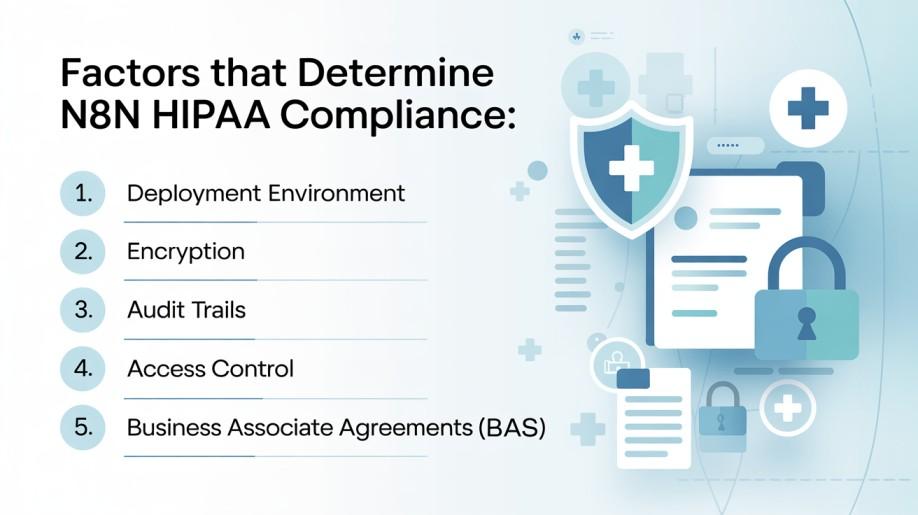
1. Deployment Environment
- Self-hosting: For sensitive healthcare workflows, most organizations self-host n8n in a private cloud or on-prem servers. This ensures PHI does not pass through third-party infrastructure.
- n8n Cloud: Easier to set up but not always HIPAA-aligned unless specific safeguards (like BAAs) are in place.
2. Encryption
HIPAA requires encryption in transit (TLS/SSL) and at rest. With n8n, this means setting up SSL certificates, securing databases, and encrypting backups.
3. Audit Trails
HIPAA demands audit readiness. n8n logs workflow executions, which can be stored securely for audit purposes. You can extend this with log forwarding to SIEM tools like Splunk or ELK.
4. Access Control
Role-based access and user authentication ensure that only the right people can edit or run workflows.
5. Business Associate Agreements (BAAs)
When relying on external services alongside n8n, ensure vendors sign BAAs to meet HIPAA’s legal requirements. Thus, n8n can support HIPAA compliance, but it’s not automatic. Proper deployment and governance are essential.
n8n Cloud vs. Self-Hosted: Which Is Actually HIPAA-Ready?
n8n itself is not a HIPAA covered entity, and it does not sign a Business Associate Agreement the way a dedicated healthcare SaaS vendor might. That single fact drives most of the confusion around n8n HIPAA compliance, and it is worth separating clearly from the deployment question.
Self-hosted n8n runs inside infrastructure your organization controls, typically AWS, Google Cloud, or Azure, each of which signs a BAA and offers HIPAA-eligible services. In this model, PHI never leaves an environment you govern, and your BAA sits with the cloud provider and any downstream vendor, not with n8n as a company.
n8n Cloud is a managed SaaS offering. Unless n8n's commercial team confirms a signed BAA for your specific plan, most healthcare organizations treat n8n Cloud as unsuitable for PHI-bearing workflows and default to self-hosting instead.
For teams weighing this decision, the practical rule is simple. If a workflow touches PHI, self-host on a HIPAA-eligible cloud, sign BAAs with every downstream vendor in the chain, and treat n8n HIPAA compliance as an infrastructure and governance outcome, not a checkbox n8n ticks on your behalf.
Already decided to self-host?
Our step-by-step guide, How to Build a HIPAA-Compliant Workflow in n8n, walks through the technical architecture, minimum-necessary data design, and a full appointment-reminder workflow example.
Building Audit-Ready Processes with n8n
HIPAA compliance is just one piece of the puzzle. Healthcare organizations also need to prove compliance with:
- SOC 2 Type II (data security audits)
- HITRUST CSF (common security framework)
- GDPR (if handling EU data)
n8n helps with audit readiness by:
- Centralizing Logs: Every workflow run, error, and change can be tracked.
- Custom Alerts: n8n can trigger alerts for suspicious behavior (e.g., unusual login activity).
- Automated Reporting: Generate compliance reports automatically from workflow data.
With these practices, organizations not only comply with HIPAA but also stay prepared for multi-standard audits.
The 2026 HIPAA Security Rule Update: What It Means for n8n Workflows
HHS OCR proposed the most significant overhaul of the HIPAA Security Rule since the 2013 HITECH update. The Notice of Proposed Rulemaking was published in the Federal Register on January 6, 2025, and the public comment period closed on March 7, 2025, according to the HIPAA Journal (2026).
As of mid-2026, the rule remains proposed rather than final. HHS and the Office of Management and Budget pushed the target for final action to July 2027, and more than 100 hospital and provider groups, including several major health systems and the American Medical Association, have formally asked HHS to withdraw or scale back the proposal, per HIPAA Journal reporting from July 2026.
The current Security Rule, unchanged since 2013, remains fully in effect while the proposal sits in review.
What the Proposed Rule Would Change
If finalized as written, the update would remove the long-standing "addressable" designation and make several safeguards mandatory rather than optional, including:
- Encryption of ePHI both in transit and at rest, with no addressable exception.
- Multi-factor authentication for all systems that access ePHI.
- Incident reporting within 72 hours of discovery for certain security events.
- Annual penetration testing and more frequent vulnerability scanning.
- Stronger, documented oversight of business associates and subcontractors.
None of these are enforceable yet, and the timeline could still shift again. Organizations should treat this as a strong signal of where enforcement is heading, not as a current legal requirement.
What This Means for n8n HIPAA Compliance Today
OCR's enforcement priorities already lean toward the controls in the proposed rule, so building n8n workflows to this standard now reduces both regulatory risk and rework later. For n8n specifically, that means enforcing TLS across every webhook and API connection today, adding MFA to n8n instance access through your identity provider, documenting a credential rotation schedule, and building an incident response runbook that could support a 72-hour reporting window if it becomes mandatory. Teams that align n8n HIPAA compliance practices with the proposed rule now will have far less to change if and when OCR finalizes it.
n8n HIPAA Compliance Checklist for 2026
Use this n8n HIPAA compliance checklist as a working audit tool for any deployment that touches PHI. It reflects both the current HIPAA Security Rule and the direction OCR has signaled through its 2025 proposal, so treat it as a living document rather than a one-time review.
Administrative Safeguards
- Conduct and document an annual HIPAA risk analysis covering every n8n workflow that touches PHI.
- Assign a designated privacy or security officer accountable for n8n governance.
- Train every team member who builds or edits workflows on minimum-necessary data handling.
- Maintain a current inventory of all workflows, credentials, and third-party nodes connected to PHI.
- Review and re-approve workflow access at least quarterly.
Technical Safeguards for n8n Deployments
- Self-host n8n inside a HIPAA-eligible cloud environment (private VPC, restricted network policies).
- Enforce TLS/SSL on every webhook, API call, and database connection.
- Enable n8n's built-in credential vault rather than storing secrets in plain workflow parameters.
- Turn on Execution Data Pruning or otherwise limit how long execution logs retain PHI payloads.
- Apply role-based access control (RBAC) so editors, viewers, and admins have distinct, minimum-necessary permissions.
- Require single sign-on (SSO) and multi-factor authentication (MFA) for every n8n login.
- Forward logs to a SIEM tool for centralized, tamper-evident audit trails.
Physical Safeguards
- Confirm your hosting provider's data centers meet HIPAA physical safeguard requirements (access control, surveillance, environmental protections).
- Restrict physical and remote access to any on-prem servers running n8n.
- Enforce workstation security policies for staff who access n8n from local devices.
Vendor and BAA Governance
- Sign a BAA with your cloud infrastructure provider before processing any PHI.
- Sign a BAA with every AI model provider (OpenAI, Anthropic, Google, or others) connected through n8n nodes.
- Sign a BAA with any logging, SIEM, or monitoring vendor that receives workflow data.
- Maintain a documented subprocessor list and review it annually.
- Confirm BAA coverage before adding any new third-party node or integration to a PHI-bearing workflow.
Working through this list is the fastest way to move from "probably fine" to a defensible n8n HIPAA compliance posture you can walk an auditor through.
Ready to put this into practice? Hire n8n experts at Ciphernutz to design, deploy, and audit-proof HIPAA-compliant n8n workflows.
n8n AI Workflow Automation in Healthcare
Compliance is the foundation, but innovation is the next frontier. That’s where n8n AI workflow automation shines.
By integrating Large Language Models (LLMs) like ChatGPT, Gemini, and Perplexity, n8n transforms from a rule-based automation tool into an intelligent process manager.
Read more: LLM Models in Healthcare
Examples of n8n AI Workflow Automation:
- Clinical Documentation: Automating medical note transcription into structured EHR entries.
- Patient Communication: Using AI chatbots to answer patient FAQs securely.
- Claims Processing: AI models verifying claims before submission.
- Compliance Checks: AI agents scanning workflows for possible HIPAA violations.
By embedding AI into workflows, n8n doesn’t just automate, it augments decision-making.
n8n AI Agent Integration: The Future of Compliance
AI agents are the next step. With n8n AI agent integration, healthcare organizations can create automation that “thinks” and adapts.
Some emerging use cases:
- AI Compliance Agents: Continuously scanning PHI flows for risks.
- Triage Assistants: Prioritizing patient cases based on urgency.
- Fraud Detection: Spotting anomalies in billing and claims.
- Proactive Auditing: Preparing compliance reports before auditors even ask.
By combining n8n HIPAA compliance with AI agent integration, healthcare providers achieve the best of both worlds: security and intelligence.
Real-World Use Cases
To deliver value more clearly & realistically, here’s how an n8n workflow automation development company like Ciphernutz applies these practices:
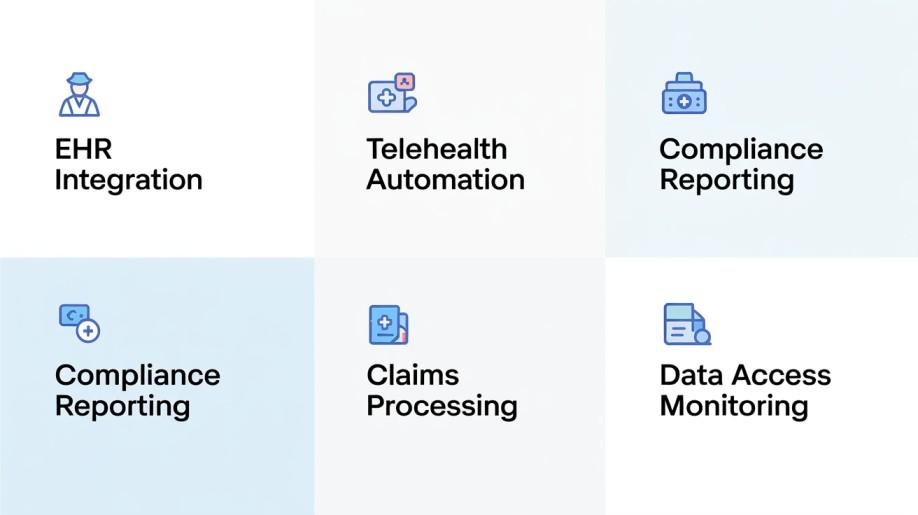
1. EHR Integration
Syncing patient data between Epic, Cerner, and billing platforms while ensuring HIPAA encryption. Learn How to Integrate N8N with EHR System.
2. Telehealth Automation
- Automating scheduling, reminders, and secure video call links.
3. Compliance Reporting
- Generating automated HIPAA and SOC 2 reports every quarter.
4. Claims Processing
- AI-assisted claims checking before submission, reducing denial rates.
5. Data Access Monitoring
- Automatically flagging unusual access to PHI and alerting compliance teams.
Each of these use cases saves time while keeping compliance intact. Read Top n8n Workflow Automation Use Cases for Enterprises & Businesses here.
n8n vs. Dedicated HIPAA Compliance Platforms: Where n8n Fits
Purpose-built healthcare compliance platforms market themselves as pre-configured and BAA-ready from day one, which appeals to small teams without dedicated DevOps resources. n8n takes a different approach. It is a general-purpose automation engine that becomes HIPAA-aligned when self-hosted and governed correctly, trading a steeper initial setup for far greater flexibility across EHRs, billing systems, AI models, and communication tools in a single platform.
When n8n Makes Sense
n8n HIPAA compliance tends to be the right fit when:
- Your team has existing DevOps or IT capacity to manage self-hosted infrastructure.
- Workflows span multiple systems (EHR, billing, telehealth, AI models) that a single-purpose tool cannot connect.
- You need custom AI agent workflows built around clinical or administrative processes.
- Cost efficiency at scale matters more than an out-of-the-box compliance badge.
When a Dedicated Platform Makes Sense
- You have no internal engineering resources to manage self-hosting.
- You need a signed BAA and compliance documentation immediately, with no configuration work.
- Your automation needs are narrow and well served by a single pre-built integration.
Choosing between the two is not about which platform is inherently more compliant. It is about which one matches your team's technical capacity and the complexity of the workflows you need to automate. Either path can satisfy n8n HIPAA compliance requirements when it is configured and governed correctly.
Why Hire n8n Experts?
Here’s the truth: While n8n is powerful, HIPAA compliance is a high-stakes game. Misconfiguration can mean violations, penalties, and ultimately loss of trust.
That’s why healthcare organizations often hire n8n experts or work with a trusted n8n development company.
Benefits include:
- Compliance-First Design: Workflows built with encryption, logging, and role-based access in mind.
- AI Integration Expertise: Connecting ChatGPT, Gemini, Perplexity, and other AI models securely.
- Scalability: Workflows that grow with your organization’s needs.
- Audit-Readiness: Every process is designed to pass compliance audits smoothly.
At Ciphernutz, we’ve helped multiple healthcare innovators implement n8n HIPAA compliance workflows and scale them with AI workflow automation. Our team specializes in secure deployments, intelligent agent integration, and compliance documentation support.
Future of HIPAA-Compliant Automation with n8n
The future of healthcare automation will combine AI agents + compliance automation. Imagine:
- Audit copilots powered by LLMs running 24/7.
- Self-healing workflows that adapt when compliance rules and administration tasks change.
- Global compliance orchestration (HIPAA, GDPR, HITRUST) in one platform.
Healthcare teams that start early with n8n HIPAA compliance + AI workflow automation will have a competitive advantage.
Conclusion
So, is n8n HIPAA compliant? Not out of the box. But when configured with self-hosting, encryption, access control, and audit logging, n8n can form the backbone of a HIPAA-aligned automation strategy.
Combine that with AI workflow automation and AI agent integration, and n8n becomes more than just an automation tool; it's a compliance-ready, intelligence-driven engine for healthcare transformation.
Looking to build HIPAA-compliant, AI-powered workflows with n8n? Contact us to hire n8n experts, and let’s make your automation both powerful and compliant.
Frequently Asked Questions: n8n HIPAA Compliance
These are the questions we hear most often from healthcare teams evaluating n8n HIPAA compliance before a deployment.
Is n8n Cloud HIPAA compliant?
Not by default. n8n Cloud is a managed SaaS product, and most healthcare organizations cannot confirm a signed BAA covering it. Self-hosting on a HIPAA-eligible cloud is the standard approach to n8n HIPAA compliance for PHI-bearing workflows.
Does n8n sign a Business Associate Agreement?
n8n as a company does not broadly offer BAAs the way healthcare-specific SaaS vendors do. When you self-host, your BAA relationship is with your cloud infrastructure provider and any connected third-party services, not with n8n itself.
Is the free, open-source version of n8n HIPAA compliant?
The software license does not determine compliance either way. Community Edition n8n can support HIPAA-aligned workflows when self-hosted with encryption, access control, audit logging, and signed BAAs with your infrastructure and integration vendors.
What is Execution Data Pruning, and why does it matter for HIPAA?
Execution Data Pruning is an n8n setting that automatically deletes stored workflow execution data after a defined period. For HIPAA-bearing workflows, it limits how long PHI payloads persist in logs, reducing exposure if a breach occurs.
Do I need a HIPAA-compliant n8n setup if I only process de-identified data?
If data is properly de-identified under the HIPAA Safe Harbor or Expert Determination method, HIPAA's PHI safeguards do not apply. Many teams still apply the same access controls as a precaution, since de-identification errors are a common audit finding.
How do I keep AI models in my n8n workflows HIPAA compliant?
Route PHI only to AI providers that will sign a BAA, disable data retention or training on your inputs where the provider allows it, and log every AI node's inputs and outputs for the same audit trail you apply to the rest of the workflow. This is quickly becoming one of the most common gaps we find when auditing n8n HIPAA compliance for teams that added AI agents after their initial deployment.