How to Build a HIPAA-Compliant Workflow in n8n?
Vijay Vamja
5-6 mins
The current healthcare risk landscape has both regulatory mandates and operational inefficiencies. Back in 2024, breaches of 276 million patient records exposed the urgency to unify automation and compliance. The raw workflow automation, as with n8n, is potent - but without HIPAA design guidelines, the liabilities will remain. Hence, organizations are now seeking unified and audit-ready HIPAA-compliant automations, all built on a self-hosted n8n foundation.
This blog post will, therefore, instruct you on the correct approach and steps to build a HIPAA-compliant workflow in n8n.
Is n8n HIPAA Compliant?
n8n itself is not “HIPAA certified.”No automation tool comes pre-certified. Instead, compliance depends on how you deploy and configure it.
Here are the factors that determine n8n HIPAA compliance:
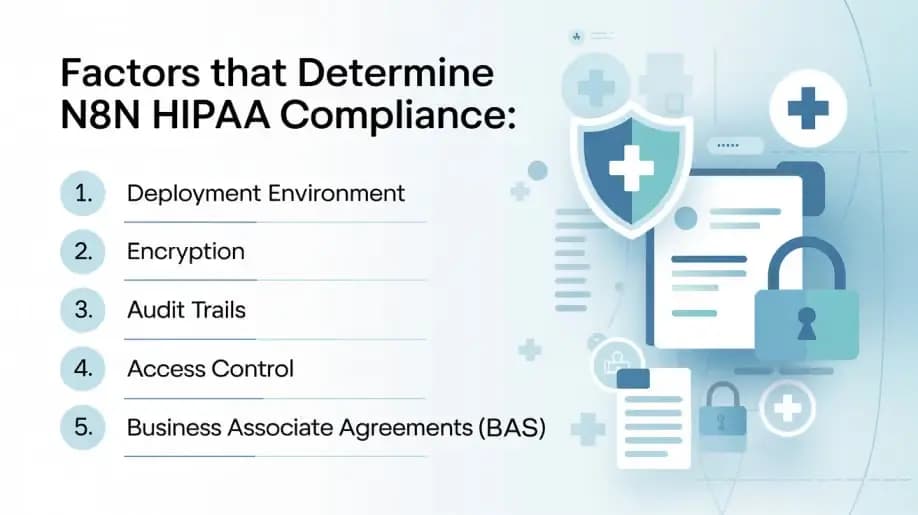
1. Deployment Environment
- Self-hosting: For sensitive healthcare workflows, most organizations self-host n8n in a private cloud or on-prem servers. This ensures PHI does not pass through third-party infrastructure.
- n8n Cloud: Easier to set up but not always HIPAA-aligned unless specific safeguards (like BAAs) are in place.
2. Encryption
HIPAA requires encryption in transit (TLS/SSL) and at rest. With n8n, this means setting up SSL certificates, securing databases, and encrypting backups.
3. Audit Trails
HIPAA demands audit readiness. n8n logs workflow executions, which can be stored securely for audit purposes. You can extend this with log forwarding to SIEM tools like Splunk or ELK.
4. Access Control
Role-based access and user authentication ensure that only the right people can edit or run workflows.
5. Business Associate Agreements (BAAs)
When relying on external services alongside n8n, ensure vendors sign BAAs to meet HIPAA’s legal requirements. Thus, n8n can support HIPAA compliance, but it’s not automatic. Proper deployment and governance are essential.
Understanding HIPAA Framework & Three Pillars of Compliance
The first fundamental step towards building HIPAA-compliant workflows in n8n is understanding three interconnected layers of the regulatory framework, the technical architecture, and the operational governance.
Let's understand the three layers first, before we observe a practical and working example of HIPAA-Compliant workflow with n8n.
1. Administrative Safeguards: Policies, Training, and Accountability
The administrative layer forms the first governance layer, defining who has access to what, under what circumstances, and with what documentation. This is where Business Associate Agreements (BAAs) live.
A written BAA is legally mandated, regardless of whether n8n is cloud-hosted or self-hosted. The BAA also specifies that the vendor must implement administrative, physical, and technical safeguards to protect PHI. Additionally, they must also report breaches within 60 days and ensure any subcontractors (such as cloud infrastructure providers) also comply.
In self-hosted n8n deployments, the compliance responsibility becomes the organization's, while you are responsible for managing the administrative framework. You must document everything from authorization levels to Role-Based-Access-Controls (RBAC) that restrict workflow editors and admins based on job function.
2. Technical Safeguards: Encryption, Authentication, and Audit Trails
It is applicable at the infrastructure layer, where HIPAA mandates covered entities and business entities to implement hardware, software, and procedural mechanisms to:
- Encrypt PHI in transit using Transport Layer Security (TLS) 1.2 or higher, with AES-256 encryption for added robustness
- Encrypt PHI at rest using strong algorithms (typically AES-256) with secure key management
- Enforce access controls via multi-factor authentication (MFA), Single Sign-On (SSO), and role-based permissions
- Generate audit logs that record every access to PHI, including user identity, timestamp, action performed, and outcome.
While the audit trail is particularly critical, organizations must implement Audit Controls or mechanisms that record and examine activity in information systems containing ePHI (electronic PHI).
3. Physical Safeguards: Infrastructure and Data Residency
Physical safeguards address the location and protection of infrastructure. For cloud-hosted systems, this includes data center security standards. For self-hosted n8n, this means network isolation, firewalls, VPN access, and controlled deployment environments.
Consider that when you self-host n8n on your own infrastructure or a private cloud (such as a VPC on AWS), you retain complete data sovereignty. Hence, the patient data never leaves your controlled environment unless explicitly configured in a workflow. This simplifies compliance documentation and eliminates the jurisdictional complexity of cross-border data transfers.
Building Secure n8n Workflows: The Technical Architecture
1. Choose Deployment Model: Self-Hosted vs Cloud
Self-hosted n8n is the gold standard for HIPAA compliance in healthcare since it allows retaining complete control over your workflow data, credentials, and data processing. The n8n community has already documented successful HIPAA deployments on AWS EKS, on-premises Kubernetes clusters, and private Docker environments.
On the trade-off part, self-hosting must handle and manage infrastructure hardening, patch management, SSL/TLS certificate rotation, and database encryption. However, this trade-off becomes advantageous for compliance as it makes auditing easy when PHI processing occurs exclusively within your controlled infrastructure.
For instance, the n8n cloud (the SaaS offering) encrypts credentials at rest using Azure server-side encryption (AES-256, FIPS-140-2 compliant) and transmits data over TLS. While n8n Cloud does employ equally robust security, HIPAA typically requires data residency and self-hosted deployment.
2. Implement Technical Safeguards
After finalizing your deployment model, the three technical controls you must manage include the following:
- Multi-Factor Authentication (MFA) and Identity Management
All of the admins and editors accessing n8n must use MFA. For self-hosted deployments, integrate n8n with your enterprise identity provider via OIDC or SAML (e.g., Okta, Azure AD, Keycloak).
These measures not only centralize password policies and session management but also allow for immediate deprovisioning when staff members leave the organization. Moreover, the MFA should be enforced at n8n login, reverse proxy, and at the API gateway level for better security.
- Credential and Secret Management
n8n workflows need credentials to access EHR systems, patient databases, billing platforms, and other downstream services. Thus, never hardcode these credentials into workflows.
Instead, you can structure the following:
- Store all credentials in AWS Secrets Manager, HashiCorp Vault, or Azure Key Vault.
- Configure n8n to retrieve credentials at runtime, not at deployment time.
- Implement credential rotation policies (typically every 90 days for high-risk credentials).
- Restrict access to secrets to only those workflows that need them, as n8n's permission model allows you to scope credentials per node or workflow.
Such an architectural pattern ensures that even after a workflow is exported or inspected, PHI-accessing credentials remain protected.
- Encryption at Rest and in Transit
All instances of self-hosted n8n workflows for healthcare must enforce these security practices:
- Database encryption: The n8n database (PostgreSQL or MySQL) should use transparent data encryption (TDE) or full-disk encryption
- Encryption in transit: All communication between n8n, your EHR, patient databases, and messaging systems must use TLS 1.2+
- Workflow data: Configure n8n to prune execution data after a set retention period. This prevents sensitive PHI (even if encrypted) from accumulating in n8n's execution history
The environment variables allow you to further disable telemetry, including disabling unnecessary API exposure, and configure data retention policies.
3. Audit Logging & Monitoring
HIPAA requires continuous monitoring of PHI access. Therefore, the n8n's audit logs should capture:
- User authentication: Every login, including failed attempts, source IP, and timestamp
- Workflow actions: Every execution that processes PHI, including who triggered it, what data it touched, and the outcome
- Configuration changes: Any modifications to workflows, node permissions, or credential assignments
- Access events: Who accessed which workflows, and when (timeline/timestamp)
You can export and use these logs with the Security Information and Event Management (SIEM) platform or a centralized log repository (such as AWS CloudWatch or ELK Stack) to monitor for anomalies. Setting up alerts is also possible for suspicious patterns, failed login attempts, unusual workflow hours, and unauthorized access attempts.
The Minimum Necessary Standard: Designing Workflows for Privacy
HIPAA's Minimum Necessary Rule is deceptively simple yet profoundly important, as it requires limiting PHI to only what is essential to complete the intended purpose.
In simpler terms, it practically means:
- A patient appointment reminder workflow should only access the patient's name, phone number, appointment time, and clinic location, and not their full medical history.
- A billing workflow should access diagnosis codes and procedure codes, not psychiatric notes or medication history.
- A lab result notification should include the result and reference range, not unrelated prior test results.
Likewise, each node in a workflow can be configured to pass only the minimum fields downstream. You should also use transform nodes to extract specific fields from your EHR query and conditional logic to branch workflows based on data classification. Read more: How to Integrate N8N with EHR System
This practice reduces security exposure (fewer systems see sensitive data) and demonstrates to auditors that your organization takes data minimization seriously.
Practical Workflow Example: HIPAA-Compliant Appointment Reminders
The aforementioned principles are utilized in this concrete use case of the most common hospital workflows, i.e., automated appointment reminders.
Workflow Requirements
- Query your EHR or scheduling system for all appointments scheduled for the next day
- Retrieve patient contact information
- Send a reminder via email or SMS
- Log the reminder delivery and patient response
HIPAA-compliant Implementation
1. Trigger: Set a scheduled trigger to run daily at 7 AM, before business hours.
2. Access control: Only authorized operations staff can edit or view this workflow. Credentials for EHR access are stored in AWS Secrets Manager, not in the workflow file.
3. Query: Use an API call to retrieve appointments for tomorrow. The query should request only: patient name, email address, appointment date/time, and appointment type (in-person vs. telehealth).
4. Transform: Extract the minimum fields needed for the reminder email. Filter out diagnoses, medications, and other PHI not necessary for the reminder
5. Send: Use n8n's Gmail or email node to transmit the reminder. The email should be encrypted end-to-end if the email provider supports it
6. Log: Record the action in your audit trail: timestamp, workflow ID, patient identifier (not full name), and delivery outcome
7. Compliance: All communication occurs over HTTPS/TLS. Patient identifiers in logs are pseudonymized where possible
Result: The workflow runs automatically, reminder no-shows drop by 15-20% (a typical industry benchmark), and you have a complete audit trail demonstrating HIPAA compliance.
Business Associate Agreements and Vendor Governance
The areas where many organizations falter are in forgetting that every integration partner also needs a BAA whenever deploying n8n and building compliant workflows.
Your n8n instance may be secure, but if it integrates with an unsecured EHR vendor, billing system, or patient communication platform, you're only as compliant as your weakest link. The Business Associate Agreement is your contractual safeguard.
How to identify when you need a Business Associate Agreements (BAA)?
Any vendor with persistent access to PHI - encrypted or otherwise - requires a BAA. This includes:
- Your EHR or EMR system
- Your patient scheduling software
- Your billing and coding system
- Your patient communication platform (SMS, email, patient portal)
- Your cloud infrastructure provider (if self-hosting n8n)
- n8n itself, if using the cloud version
What should the BAA cover?
- A commitment to report breaches within 60 days of discovery
- Permission for audits and inspections of the vendor's security controls
- Liability for unauthorized disclosure of PHI
- Provisions requiring subcontractors to also comply with HIPAA
Note: Foreign vendors also require BAAs. The challenge is that HIPAA enforcement is primarily domestic, but the contractual obligation remains. U.S. covered entities bear the compliance responsibility, even if the vendor is outside the U.S. jurisdiction.
Real-World Impact: The ROI of HIPAA-Compliant Automation
The average healthcare data breach costs $4.45 million, including legal fees ($150,000-$500,000), notification costs ($5-$15 per affected patient), credit monitoring services, and business interruption. OCR fines, too, range from $100 to $50,000 per violation, with penalties reaching six figures for egregious cases.
Conversely, organizations with proactive compliance programs report 60% fewer security incidents compared to peers. When computed over a five-year horizon, the ROI of compliance automation is typically 3:1 to 6:1 - every dollar spent on compliance controls saves $3-6 in avoided breach costs.
Hence, beyond risk mitigation, adopting workflow automation also drives operational efficiency. Automated appointment reminders have also been observed to reduce no-shows by 15-20%, directly improving provider utilization and revenue.
Build Your HIPAA-Compliant Automation Future
The healthcare industry is at an inflection point. Organizations that master HIPAA-compliant automation will outpace competitors in both efficiency and trust. Organizations that delay will face rising compliance costs, security incidents, and operational bottlenecks.
Ciphernutz specializes in healthcare automation architecture, helping enterprises design, deploy, and govern HIPAA-compliant n8n workflows at scale. If you're evaluating workflow automation for your healthcare organization, our team of healthcare IT specialists can guide you through the architectural, regulatory, and operational complexity.
The path forward is clear. The question is:
are you ready to automate healthcare workflows with compliance as your competitive edge?
Contact Ciphernutz today to discuss your healthcare automation roadmap and build workflows that are secure, efficient, and auditable.
Does n8n Sign a BAA? Clearing Up the Compliance Confusion
If you search for "is n8n HIPAA compliant," you'll find conflicting answers, and most of them skip an important legal distinction.
The short answer to the n8n BAA question is: not directly with n8n, but yes, through the infrastructure you run it on. n8n is open-source workflow software, not a covered entity or a business associate in the legal sense.
That means there is no separate contract to sign "with n8n" the way you would with a cloud EHR vendor. HIPAA obligations attach to entities that create, receive, maintain, or transmit PHI on your behalf, not to the software itself.
Here's where organizations get tripped up:
- n8n Cloud does not currently offer a signed Business Associate Agreement on any plan. Without a BAA, n8n Cloud is not a suitable home for workflows that touch PHI, regardless of how strong its encryption or access controls are.
- Self-hosted n8n shifts the compliance boundary to your own infrastructure. When you run n8n inside your own AWS or Azure environment, your BAA is with AWS or Azure (the subcontracted business associate managing the servers, storage, and network), not with n8n as a product.
- Every downstream service your workflow touches, EHR, billing platform, SMS or email gateway, storage bucket, needs its own BAA if PHI passes through it. A single unsecured node in the chain breaks the entire compliance boundary for the whole healthcare data pipeline.
This is the core reason a self-hosted n8n HIPAA deployment remains the recommended path for any HIPAA compliant n8n workflow that processes real patient data: it puts the BAA relationship where it legally belongs, with the infrastructure and software vendors that actually qualify as business associates. For teams building PHI automation into patient-facing systems, that distinction has real legal weight, not just a technical formality.
n8n Cloud vs. Self-Hosted: Which Meets HIPAA Requirements in 2026?
Choosing a deployment model is the first architectural decision in any n8n HIPAA compliance guide, and it determines almost everything downstream.
n8n Cloud is fast to set up and requires no server management, but it currently cannot support PHI workflows because no BAA is available. It's a reasonable choice for internal operations, marketing automation, or non-PHI administrative workflows, but not for anything touching patient data.
Self-hosted n8n (on AWS, Azure, GCP, or a private data center) is the practical standard for a HIPAA-safe workflow in n8n. Running your own instance inside a VPC lets you:
- Sign a direct BAA with your cloud provider covering the compute, storage, and networking layer
- Enforce network isolation, private subnets, and firewall rules around the instance
- Control data residency, keeping PHI inside a defined jurisdiction
- Configure execution data retention and pruning so PHI doesn't accumulate in logs indefinitely
The trade-off is operational: your team owns patching, backups, certificate rotation, and uptime. For most healthcare organizations, that trade-off is worth it, since it's the only path that supports a fully encrypted n8n workflow with a legally sound BAA chain. Furthermore, it is ultimately the only way to run a defensible HIPAA compliant n8n workflow in production.
Some teams can offset the operational load by partnering with an n8n automation partner for ongoing maintenance rather than hiring in-house DevOps solely for this purpose.
The 2026 HIPAA Compliance Checklist for n8n Workflows
Two things are true for 2026 at once: the enforceable HIPAA Security Rule is still the version finalized under the 2013 HITECH Omnibus Rule, and a major overhaul has been proposed but not finalized.
HHS published the Notice of Proposed Rulemaking for a Security Rule update in the Federal Register on January 6, 2025, and OCR has since pushed final action back to July 2027.
It was after a coalition of more than 100 hospital and provider groups, including CHIME, asked the agency to withdraw or scale back the proposal.
Nothing in the proposal is legally binding yet, but OCR's current enforcement priorities already lean toward the controls it describes, so building to that standard now is a reasonable hedge, not a requirement. Use the two tiers below as the working definition of a HIPAA compliant n8n workflow for 2026.
A. Baseline safeguards required today (current Security Rule)
- Signed BAAs with every vendor and subcontractor that touches PHI, including your cloud host
- TLS 1.2+ for all data in transit between n8n, your EHR, and any messaging or storage service
- AES-256 encryption at rest for the n8n database and any file storage
- MFA enforced for every admin and editor with n8n access
- Role-based access control scoping who can view, edit, or execute PHI-touching workflows
- Audit logs capturing logins, workflow executions, configuration changes, and credential updates
- Documented data retention and execution-pruning policy for workflow history
- Annual HIPAA risk assessment covering the n8n environment specifically, not just the EHR
Together, these controls are what auditors mean by HIPAA audit trail automation: not one log file, but a continuously enforced chain of evidence across access, execution, and configuration changes.
B. Get-ahead items tied to the proposed 2025 Security Rule overhaul (not yet final; targeted for 2027)
- Remove the "addressable" designation internally, treat encryption at rest and in transit as mandatory rather than optional
- MFA on every system that can access ePHI, not only privileged accounts
- Incident response runbook that can meet a 72-hour internal reporting window if the rule is finalized as proposed
- Annual penetration testing scheduled for the self-hosted n8n environment and its supporting infrastructure
- Formal, written oversight process for every business associate and subcontractor, with periodic re-verification of BAAs
Treat section A as the pass/fail bar for any HIPAA compliant n8n workflow you deploy this year. Treat section B as the roadmap for staying ahead of enforcement rather than reacting to it once a final rule lands.
Common Compliance Pitfalls and How to Avoid Them
| Pitfall | Risk | Mitigation |
|---|---|---|
| Webhook Misconfiguration | Exposes PHI publicly | Use authenticated webhooks & IP whitelisting |
| Unencrypted Credentials | API key leakage | Use environment variables or KMS |
| Third-party Plugins | Data leaves your control | Audit all integrations before use |
| Lack of BAA | Non-compliance penalties | Ensure BAAs with hosting providers |
| Improper Access Logs | No traceability | Enable detailed audit logging |
Regular security reviews and periodic compliance audits are essential for maintaining trust and meeting HIPAA obligations.
Extending Compliance to AI Agents Inside n8n
A growing share of n8n healthcare deployments now route data through an LLM node, for triage summarization, clinical note drafting, or intake classification, and this changes the compliance boundary. A public, consumer-facing AI endpoint is not a business associate and will not sign a BAA, so pointing an n8n agent at a general-purpose chatbot API is one of the fastest ways to create a HIPAA exposure inside an otherwise well-architected pipeline.
The safer pattern for a HIPAA compliant n8n workflow that includes AI steps:
- Call enterprise-tier model endpoints that offer a BAA, such as Azure OpenAI Service, AWS Bedrock, or Google Cloud's Vertex AI, rather than public consumer APIs
- Confirm the provider contractually excludes your prompts and outputs from model training
- Apply the same minimum-necessary rule to the AI step that you'd apply to any other node, strip identifiers before the prompt where the use case allows it
- Log every AI call the same way you log any other PHI-touching action: who triggered it, what data was sent, and what came back
This is an increasingly common gap in HIPAA automation tools guidance written before agentic workflows became standard, and it's worth auditing every HIPAA compliant n8n workflow for this gap, even if AI wasn't part of the original design.
Is Your Healthcare Workflow Ready for AI?
Before adding AI to your healthcare workflows, assess your data, infrastructure, security, compliance, and automation readiness to identify what should be improved first.
n8n AI Agent Integration: The Future of Compliance
AI agents are the next step. With n8n AI agent integration, healthcare organizations can create automation that “thinks” and adapts.
Some emerging use cases:
- AI Compliance Agents: Continuously scanning PHI flows for risks.
- Triage Assistants: Prioritizing patient cases based on urgency.
- Fraud Detection: Spotting anomalies in billing and claims.
- Proactive Auditing: Preparing compliance reports before auditors even ask.
By combining n8n HIPAA compliance with AI agent integration, healthcare providers achieve the best of both worlds: security and intelligence.
Frequently Asked Questions
Is n8n HIPAA compliant out of the box?
No software is "HIPAA compliant" by default, including n8n. Compliance comes from how you deploy and govern it: self-hosting inside a BAA-covered environment, encrypting data in transit and at rest, enforcing MFA and RBAC, and maintaining audit trails. Used this way, n8n can support a genuinely HIPAA compliant n8n workflow.
Does n8n Cloud work for healthcare automation?
Not for anything involving PHI. n8n Cloud does not currently sign BAAs, so it's suitable for non-PHI workflows only. Healthcare teams building a HIPAA-safe workflow in n8n should self-host.
Who do I need a BAA with if I self-host n8n?
Your cloud infrastructure provider (AWS, Azure, GCP), and any downstream service, EHR, billing system, SMS/email provider, or AI endpoint, that creates, receives, or transmits PHI through your workflow. You don't sign a separate BAA with n8n itself, since it's software you control rather than a service provider.
What's the biggest mistake healthcare teams make with n8n and HIPAA?
Connecting a workflow to a consumer-grade service, a personal email account, a public chatbot API, or an unmanaged spreadsheet tool, that never signs BAAs. One unsecured node breaks the entire compliance boundary, even in an otherwise well-architected HIPAA compliant n8n workflow, so every node deserves the same scrutiny as the ones that obviously touch PHI.
Is the 2026 HIPAA Security Rule update already in effect?
No. As of mid-2026, it remains a proposed rule. OCR's target for final action has moved to July 2027, and the proposal could still be revised, narrowed, or withdrawn. The current, already-enforceable Security Rule is what governs your compliance obligations today.