Understanding AI: Traditional AI vs. Generative AI vs. Vertical AI
Vijay Vamja
3-4 minutes
In the beginning, GOFAI - Good Old-Fashioned Artificial Intelligence (GOFAI) introduced the world to symbolic AI in 1950. Seventy-three years later, today, we have AI technologies like Generative AI and Vertical AI that can create various forms of media and perform autonomously, respectively.
This blog will henceforth accurately understand the purpose, potential, and differences between Traditional AI, Generative AI, and Vertical AI. Additionally, emerging AI technologies like agentic AI will also be discussed to learn how it fits within the AI landscape.
Overview of Types of AI Technologies At A Glance

Traditional AI
The earliest model of AI, i.e., traditional AI, relies on symbolic reasoning and rule-based systems to perform tasks. It requires basic (pre-defined) boundaries when using explicit programming and logical constructs to perform decision-making and problem-solving.
Key-Features
- Rule-Based System: Knowledge is encoded through "if-then" statements to enable and empower deterministic decision-making.
- Search Algorithms: It relies on techniques like breadth-first and depth-first search types to solve optimization problems systematically.
- Logical Programming: Prolog empowers its problem-solving framework performance by using facts and rules.
Applications
- Healthcare: Identifying diseases via Medical Image Analysis and offering predictive capabilities in Diagnostic Support Systems.
- Finance: Real-time transaction monitoring for Fraud Detection and Analyzing market trends for Algorithmic Trading.
- Manufacturing: Monitoring equipment performance for Predictive Maintenance and Automated visual inspection of products for Quality Control.
Limitations
Despite offering high usefulness, traditional AI primarily struggles with ambiguity and variability in real-world data. In turn, this compromises or limits itself in terms of adaptability in comparison to modern machine learning techniques.
Generative AI
Despite offering high usefulness, traditional AI struggles primarily with ambiguity and variability in real-world data. In turn, this compromises or limits itself in terms of adaptability in comparison to modern machine learning techniques.
Key-Features
- Content Creation: Generate original outputs like text narratives, artistic designs, or synthetic data based on prompt engineering.
- Deep Learning Models: Neural networks identify patterns and relationships between tokens within vast datasets to produce coherent results.
- Personalization: Responds to user experiences & tailors them in real-time by analyzing preferences and generating relevant content.
Applications
- Content Marketing: Text generation enables crafting marketing content, copywriting, creative writing, etc.
- Entertainment: Generating animated content, background scenes, developing storyboard concepts, etc.
- Research & Development: Developing computational models and exploring complex scientific scenarios like DNA studies, etc.
Challenges
Generative AI is often misunderstood to be a 'black box' with its less transparent processing. Ethical concerns also surround its outputs as they are likely trained using biased datasets while it is also capable of making deepfakes and synthetic media manipulation.

Vertical AI
Vertical AI is created to solve and address niche challenges of a specific industry with precision and automation capabilities. It requires deep integration into workflows unlike horizontal platforms serving broad applications.
Key-Features
- Specialized Knowledge: It is built on domain-specific expertise, so it can solve nearly all the workflow challenges within the niche or sector.
- Workflow Automation: Integration with existing systems is seamless, where its automation helps to handle and monitor business management for regularly enhanced productivity.
- Collaborative Abilities: Multiple Vertical AI agents can be assigned to a niche per individual responsibilities to collectively accomplish a task - similar to human workforce abilities.
Applications
- Retail: Optimize supply chains and logistics as per customer preferences & behavior to deliver personalized customer experiences.
- Finance: Assist legal investigations using predictive models tuned for fraud detection.
- Legal: Ensure legal compliance(s) and perform contract analysis, legal research, due diligence, etc., as assigned.
Limitations
Vertical AI is developed using immense specialization knowledge, making it dependent on a niche expert and an AI Developer, at the least.
Which AI Technology is the Best For Your Business?
Based on your TLDR or AI summary, you should already possess some understanding of the variable dimensional uses and limitations of each AI tool in this list.
Hence, there is no clear winner for every practical industry or scenario - until some context is stated or presented.
For example, traditional AI can be calibrated to perform with precision in assessment scenarios, even if not with the same extensibility as vertical AI. Likewise, vertical AI may also require incorporating generative abilities to better supply its uses in a marketing organization.
So, what can you do to determine which AI technology will suit your business or goals the best?
Connect with an AI Development Company Consultant before you hire a Generative AI Developer.
After you do connect with a consultant, you will likely also learn about an emerging AI tech known as Agentic AI.
Below is a brief overview of it for your understanding purpose.
Agentic AI
Presently, Agentic AI is only a few steps into being a conceptualized model where systems will possess a certain degree of autonomy to perform decision-making. Unlike other AI models that demand pre-defined rules or user input, an Agentic AI can function near-fully-autonomously.
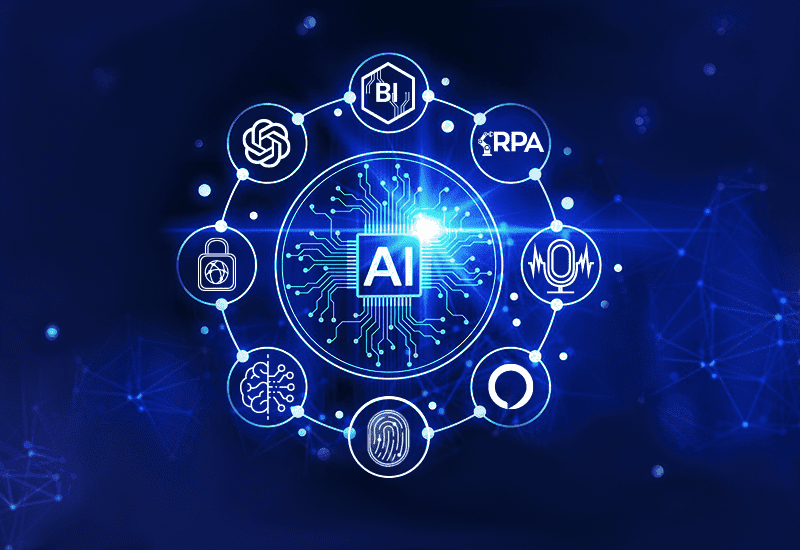
An Agentic AI would independently assess situations, set goals and long-term plans, and execute the action(s) accordingly. Therefore, while it can be considered the perfect AI technology for your business, plenty of development is yet required to make it completely market-ready for global consumers.
Final Words
Each AI technology serves a distinctive purpose, whether through pre-defined means or autonomously. Traditional AI will generally excel in deterministic tasks, whereas Generative AI fosters creativity through generative responses. Similarly, Vertical AI is best for optimizing industry-specific workflows until the autonomous intelligence of Agentic AI solves all of the above.
Until then, the landscape of artificial intelligence is all about matching the diverse applications we may assign to them. Expecting anything different and sooner is just a matter of a waiting game and an exciting one, too, because more AI technologies are arriving that will further innovate human achievements!