Generative AI Introduction & Practical Use Cases in App Development
Vijay Vamja
5-6 mins
It's next to impossible to avoid using AI tools in 2025, especially when mobiles today come with in-baked AI features. But Generative AI is a whole other threshold - the one that you must explore as a working professional.
Our global culture currently labels all types of Artificial Intelligence-driven technologies as AI, which is just human error. Truthfully, Generative AI differs significantly from narrow AI (we've already used it for years). Generative AI is vast, carrying a scope of possibilities that are greater than what we have pushed so far.
So, this blog post will discuss the practical uses of Generative AI in Mobile Application Development and briefly explore the AI types for their correct identification.
What is Generative AI?
Generative AI (GenAI) is a type of artificial intelligence developed specifically to produce content of various types. The GenAI available for consumer use can generate text, images, audio, and synthetic data.
Generative models exist to create things. Similarly, tools that rely on AI to generate outputs can be considered generative AI tools. Learn more about the distinctions between different generative AI model types ahead.
Origin of Generative AI
However, the origin of GenAI dates back to the 1960s, in the form of chatbots. Only in 2014 did the generative adversarial networks or GANs teach the GenAI to create images, videos, and audio of real people.
How Does Generative AI Work?
The GenAI functions by supplying content data in response to a prompt. A prompt can contain text, image, video, design, musical notes, or any input an AI system can process. The returned content can then either be a solution to a problem, an essay, or whatever the prompt directs it to generate.
Earlier versions of GenAI demanded data to be submitted in the form of API or a lengthy process requiring Python expertise. But today, all of it is now cut down and reshaped into an intuitive user experience to be sold as generative AI interfaces
Some popular examples of GenAI interfaces include ChatGPT, Dall-E, Gemini, DeepSeek, etc.
Common Use Cases of Generative AI
- Developing and integrating customer service & technical support chatbots.
- Creating and converting educational content into different languages.
- Writing or generating email responses, resumes, term papers, etc.
- Theme or Story ideation for self-work or organizational goals.
- Generating photorealistic art in defined renaissance or contemporary styles.
- Optimizing architecture of systems, networks, etc.
- Training and developing content models for personal or work use.
- And many more.
How is Generative AI different from other types of AI?
It is vital to first learn about the types of AI technologies available in the market to realize how GenAI differs from others.
There are numerous types of AI models available on the planet, of which only a handful are ready for consumer use. Among them all, AI technologies can be categorized into the following types based on their function.
- Reactive
- Limited memory machines
- Theory of mind
- Self-aware
Despite these variable types of AI models, reactive AI is the only one widely distributed globally and is also the core of generative AI.
Note: The former two types of AIs are classified as narrow AI or weak AI, whereas the latter two kinds are known as strong AI.
Lesser Known AI Models Classifications
Other classifications of AI models also exist, i.e., Narrow AI, Artificial General Intelligence (AGI), and Artificial Superintelligence (ASI). The reason they are largely unknown to mainstream media is that the latter types are still in development or aren't available for public use.
Moreover, generative AI has two additional AI counterparts, namely, Predictive AI and Conversational AI.
The predictive AI uses defined patterns in historical data to predict outcomes, classify events, and get actionable insights.
Conversational AI is developed to empower virtual assistants, chatbots, and customer service apps to interact and engage with humans through human-like text or speech responses. Read more about the trends in AI chatbots.
By now, the AI landscape should've been well understood.
Let's finally explore the practical uses of GenAI!
Practical Uses of Generative AI in App Development
GenAI is said to add up to $15 trillion to the global economy by the end of this decade through its practical uses across worldwide industries.
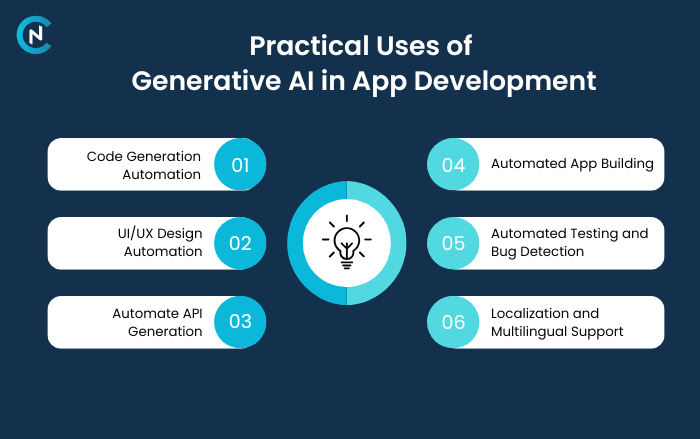
Within the collective practical uses, generative AI for app development can offer the following possible solutions:
1. Code Generation Automatio
Practicality: Immensely Practical - Requires minor human intervention.
Use Cases: GenAI tools can access platforms like GitHub and others to identify code and automate code generation by using a suggestion-based approach. The tool can suggest functions, snippets, and modules based on natural language prompts or help to translate machine code between languages.
Such use will quicken the development cycles and reduce code-line errors, allowing developers to focus on logic and next feature additions.
Read more: AI Tools for Developers
Concerns:
- Generated code may likely require human-led review and optimizations.
- The GenAI code results may not align squarely with specific project requirements.
- Conversion or translation of machine language to code or vice versa may be lossy.
2. UI/UX Design Automation
Practicality: Limited Practicality - Requires significant human intervention.
Use Cases: Figma, Adobe Firefly, and AI plugin third-party tools can be integrated with a GenAI- SaaS solution to create UI layouts, color schemes, and design elements. The user input and design trends toggle will dictate the end result, reducing the hours needed to complete the task.
Moreover, AI can also integrate analyzed user behavior regarding UX improvements. If you want to learn more about UX/UI trends, read our blog.
Concerns:
- AI-assisted design generation can lack dimensions and human creativity.
- Understanding human needs is where GenAI has plenty to learn, making designs less user-centric.
- Improving generation capabilities would require training AI models with multiple Big Data libraries.
3. Automate API Generation
Practicality: Practical for closed-loop use cases.
Use Cases: GenAI can be trusted to build RESTful APIs and GraphQL schemas and run database queries based on natural language descriptions and data models. Next, OpenAI's API or Postman's AI can assist in streamlining the whole process of obtaining absolute APIs with perfect fetch and supply functions.
Concerns:
- Generated APIs would require customizations to meet specific security requirements.
- The performance of GenAI-based APIs can be subjected to AI hallucinations.
- Auto-generated APIs may lack specific business logic connected to the goal or end result.
4. Automated App Building
Practicality: Emerging. Promising IF logically developed.
Use Cases: Developers can use platforms like Bubble, Adalo, ChatGPT, and other AI or non-AI tools for auto-creating basic apps, PWAs, and SPA scripts. The GenAI would also be responsible for generating the code and UI and performing backend logic as per the user instructions.
The particular area where such app-automations are useful is during the prototyping stage or when building simple apps with modular functionalities.
Concerns:
- Applications that feature complex logic or need unique features cannot be made with simple inputs, or they become extensively time-consuming to generate.
- The generated apps might lack scalability and may require manual development efforts.
5. Automated Testing and Bug Detection
Practicality: Positive inclusion but costly or hectic to regularly update.
Use Cases: Users can program the GenAI technology to automate test case creation and user interaction simulation for the identification of potential bugs and vulnerabilities. Tools like Applitools, Testim, or AI-driven third-party frameworks can be integrated to analyze code and generate test scripts to reduce effort and time in manual testing.
Concerns:
- Apps may require undergoing multiple testing phases, reducing the promise of the solution.
- Updating & implementing modern testing practices can require full-time human effort.
- Testing may become inadequate due to bugs or security vulnerabilities.
6. Localization and Multilingual Support
Practicality: Promising. But it carries an adoption curve and a definite training timeline.
Use Cases: The app content localization can be translated into multiple languages on a need-basis using GenAI solutions. Making the app accessible to a global audience would improve both adoption and offer training data to evolve the GenAI-based app itself.
Furthermore, it can harness tools like Google Translate API, DeepL, or custom AI models to process text and audio into cultural adaptations.
Concerns:
- Translations may lack cultural and regional nuances or context, requiring human review until perfected.
- Updating the technology within every few months would be imminent as cultural developments occur regularly - making the project bigger than the solution.
Final Words
Using GenAI productively for App Development should streamline app development, improve efficiency, and enhance user experiences - if nothing else. These three areas are critical to ensure smooth development and to observe whether the apps or solutions are received well by the audiences and communities.
Ready to develop your GenAI solution? Hire Generative AI Developers or Get in touch with the Ciphernutz team!