Vertical AI in SaaS: The BIGGEST Innovation In Software Automation
Vijay Vamja
5-6 mins
Automation is today an essential commodity for several industries thanks to artificial intelligence agents and Generative AI tools. While businesses and enterprises still need cloud-based data solutions, they also need more expansion, and vertical artificial intelligence delivers it. So, if you are not yet aware of vertical AI in SaaS solutions, you've found the right blog!
What is Vertical AI in SaaS?
The simplest definition states that Vertical AI in SaaS (context) is any artificial intelligence system(s) specifically designed to address the unique needs and challenges of particular industries.
For example, Zebra Medical Vision has reduced radiology errors by 40% for quicker disease detection and better, personalized care.
Similarly, many other Vertical artificial intelligence applications exist across industries beyond fitness, retail, finance, real estate, logistics, manufacturing, etc.
Understanding the Vertical AI and Vertical SaaS Relationship
All vertical SaaS solutions are fundamentally cloud-based software solutions tailored for specific industries, and here is exactly where AI automation shines, metaphorically.
Embedding AI automation into cloud-based software solutions enables businesses to automate workflows, optimize resource allocation, and improve decision-making processes.
However, the benefits of vertical AI in SaaS do not stop at achieving operational efficiency. A holistic integration between Vertical AI and any SaaS platform also makes SaaS resources more efficient. To achieve it, the correct implementation of the Vertical AI Agent during the development phase is mandatory.
| Note: A generative AI development company can help you build any Vertical AI integrations for your SaaS businesses or can build you a Custom AI solution for your SaaS system. |
|---|
What is the role of Vertical AI Agent for Integrations in SaaS?
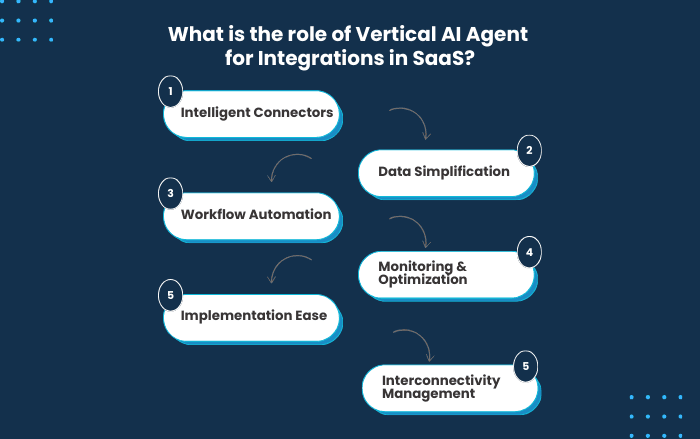
Vertical AI Agents are essential for creating a cohesive and efficient SaaS environment as they supply the following possibilities for developing prized automation:
- Intelligent Connectors: Vertical AI agents act as connectors between systems within the SaaS ecosystem to facilitate smooth data exchange and seamless communication.
- Data Simplification: Intricate data specific to industry applications is transformed into cohesive form to make information flow smoothly between disparate systems and sources.
- Workflow Automation: AI agents automate integration workflows by leveraging deep domain knowledge, reducing manual interventions for streamlined processing.
- Monitoring & Optimization: On a system level, continuous data monitoring by AI agents between components helps optimize performance to ensure resource allocation efficiency.
- Implementation Ease: AI agents can be used as-is from pre-built industry-specific integration templates or can be diversified further to reduce implementation time and complexity.
- Interconnectivity Management: The (vertical) AI agents make the entire ecosystem more intelligent and interconnected to enhance the overall functionalities of the SaaS platform.
Exploring the Holistic Implementation(s) of Vertical AI in SaaS
Using Vertical AI (agents) in SaaS holistically is possible in numerous ways, but they must ultimately fulfill the automation & synergy requirements.
The aim is to integrate specialized AI solutions across workflows, systems, and operations using definitive strategies- to create scalable, efficient, and industry-specific platforms.
You can try these six strategies listed below or refer to them for better understanding and comprehension.
1. Build Domain-Specific AI Models
- Develop AI solutions tailored to the unique workflows and challenges of specific industries (e.g., healthcare diagnostics, legal contract management).
- Leverage proprietary data and domain expertise to ensure high accuracy and relevance.
2. Leverage Vertical AI Agents
- Deploy specialized agents to automate complex tasks, such as cybersecurity incident response and logistics optimization.
- Enable these agents to connect disparate systems, transforming data flows and workflows into cohesive operations.
3. Integrate Feedback Loops
- Implement systems that allow AI models to continuously learn from usage patterns across the SaaS platform.
- Use real-time insights to refine algorithms and enhance functionality over time.
4. Prioritize Data Privacy and Security
- Embed privacy-by-design principles into AI systems to ensure compliance with industry regulations (e.g., HIPAA for healthcare, GDPR for finance).
- Utilize federated learning and encryption technologies to protect sensitive data.
5. Automate Regulatory Compliance
- Incorporate built-in compliance frameworks that automatically update with regulatory changes.
- Utilize audit trails and proactive monitoring tools to streamline adherence to industry standards.
6. Optimize User Interfaces
- Build transition from static interfaces to adaptive, conversational designs that enhance user engagement and simplify complex tasks.
- Ensure accessibility for non-technical users through intuitive dashboards.
Challenges of Vertical AI Implementation(s) in SaaS
Among all the existing AI SaaS solutions, the initial implementation or core setup can bring numerous kinds of challenges relative to data management and ethical concerns. Fortunately, you can use this roadmap listed below to mitigate such challenges.
Lowering Critical Barriers to Adopt Vertical AI in SaaS Systems
- Leverage Pre-Built Solutions and Open-Source Tools
- Adopt Modular Design Principles
- Form Strategic Partnerships (Connect Now!)
- Optimize Data Acquisition and Management
- Simplify Integration with Legacy Systems
- Mitigate Talent Shortages (Hire AI Developers!)
- Address Cost Challenges (Book a Consultation Today)
- Focus on Compliance and Security Early On
Mitigating AI Hallucinations of Vertical AI in the SaaS Ecosystem
- Enhance Training Data Quality
- Implementation of Retrieval-Augmented Generation (RAG)
- Leverage Trusted, Vertical-Tuned LLMs
- Refine Prompt Engineering to Industry-specific Verticals
- Establishing Human-in-the-Loop Systems
- Continuous Monitoring and Optimization
- Establishing Regulatory and Ethical Safeguards
How to Address Ethical Concerns of Vertical AI in SaaS Ecosystems?
- Sorting Biases into Fairness in Domain-Specific Data
- Creating Data Transparency and Explainability
- Establishing Data Privacy and Security Protocols
- Persistent Human Oversight and Accountability
- Adhering to Regulatory Compliance(s)
- Tuning the Societal and Environmental Impact
- Setting Up Ethical AI Governance Frameworks
- Ensure Sustainability for Custom AI Solutions in SaaS
Apart from these challenges, many others may also be present and invariably between different systems. Thus, it is recommended that you work with a trustworthy generative AI development company, as they can provide businesses with the best Vertical AI tools for SaaS implementations.
The Takeaway
The world is only learning the varied uses of vertical AI agents across industries, so everything may seem overwhelming or incredibly challenging. Regardless of either, what's essential right now is to recognize the benefits of Vertical AI agents in SaaS ecosystems and obtain its holistic implementation for your business or enterprise.
Automate your business intelligently before you lose the opportunity to scale with the biggest innovation in business software.
Ready to develop a custom implementation of Vertical AI in SaaS for your business? Let's Connect!
FAQs
Q. What are the key characteristics of Vertical AI?
The following are some key characteristics of vertical AI so you can recognize it among the horde of AI tools available online.
- Industry-Specific Design: Vertical AI allows precise problem-solving that aligns with the unique workflows and requirements of particular industries.
- Custom Data Utilization: Domain-specific data is utilized for custom-training the algorithms to ensure the generated insights are relevant yet actionable.
- Enhanced Predictive Analytics: Vertical AI (SaaS) solutions integrate predictive analysis functionality to help organizations forecast trends and make informed decisions based on data to gain competitive advantages.
Q. Can all businesses benefit from Vertical SaaS AI Integrations?
Yes. When a Vertical SaaS AI solution is created solely to satisfy specific business requirements, it will adequately help the particular business with its automation and predictive abilities.
Q. What are some examples of Vertical SaaS AI?
Zenoti, Innovacer, Whatfix, nCino, Guidewire, Procore, JusticeText, etc., are some of the well-known Vertical SaaS AI applications that lead and empower the IT industry.
Q. What are vertical AI agents?
Vertical AI agents are custom-made and specialized AI-driven systems that automate business processes within specific industries. Unlike generative AI models (not to be confused with GenAI), these agents leverage industry expertise to deliver domain-specific automation across workflows.
Q. What is a generative AI development company?
A Generative AI development company fundamentally specializes in creating artificial intelligence systems to build tailored AI solutions for its clients. They may use advanced algorithms, machine learning techniques, LLMs, etc., as required to deliver enhanced automation capabilities and more.