Voice AI vs AI Voice Agents vs Conversational AI: Difference Explained
Vijay Vamja
3-4 mins
It is too easy to use these terms interchangeably ('Voice AI,' 'AI Voice Agents,' and 'Conversational AI') or misinterpret them. In fact, many people are still not familiar with their respective differences, which are truthfully quite distinctive.
See, when you are looking to invest in AI or purchase AI solutions, confusing these terms simply means wasting resources and time. In today's age, wasting resources is worse than deciding not to scale at all. Not to forget the catastrophe that can occur when healthcare tech or any enterprise-grade system adopts these AI technologies under the wrong pretenses.
Hence, this guide breaks down each Voice-related AI technology to its concept & purpose to offer clarity on where they overlap or differentiate. Also, do let us know afterward (if you may) how this guide helped you choose which option is better suited for your digital roadmap ahead!
The 2026 Market Surge: Numbers That Define the Future
The rise of voice AI 2026 is undeniable. The global market size for AI voice agents leaped to $3.5 billion in 2026, projected to grow at a staggering 39.0% CAGR through 2033. Driving this is the massive shift from generic text bots to dynamic conversational voice AI agents. According to Gartner projections for 2026, conversational voice AI agents and related automated technologies are on track to reduce contact center labor costs by $80 billion globally. This scale proves that voice agent technology growth is moving from experimental pilots to core enterprise infrastructure.
Voice AI: Interpreting Sound For Response
Voice AI technologies are driven by a language or context engine that enables the machines to process, understand, and respond to human speech.
How It Works
- Records sound signals to convert the audio input into text using speech recognition (ASR)
- Process the converted transcription using Natural Language Understanding (NLU)
- Respond to user queries via an AI-generated output or pre-defined logic.
Key Data
- 77% of consumers use voice assistants on mobile devices.
- Voice-enabled AI healthcare solutions are expected to achieve a $5B valuation by 2028.
- The global voice recognition tech market will expand to a $50B valuation by 2029.
Use Cases in Healthcare
- Transcribing Doctor-Patient interactions.
- Voice-driven data entry for EMRs
- Initiate hands-dree commands in surgical or sterile environments
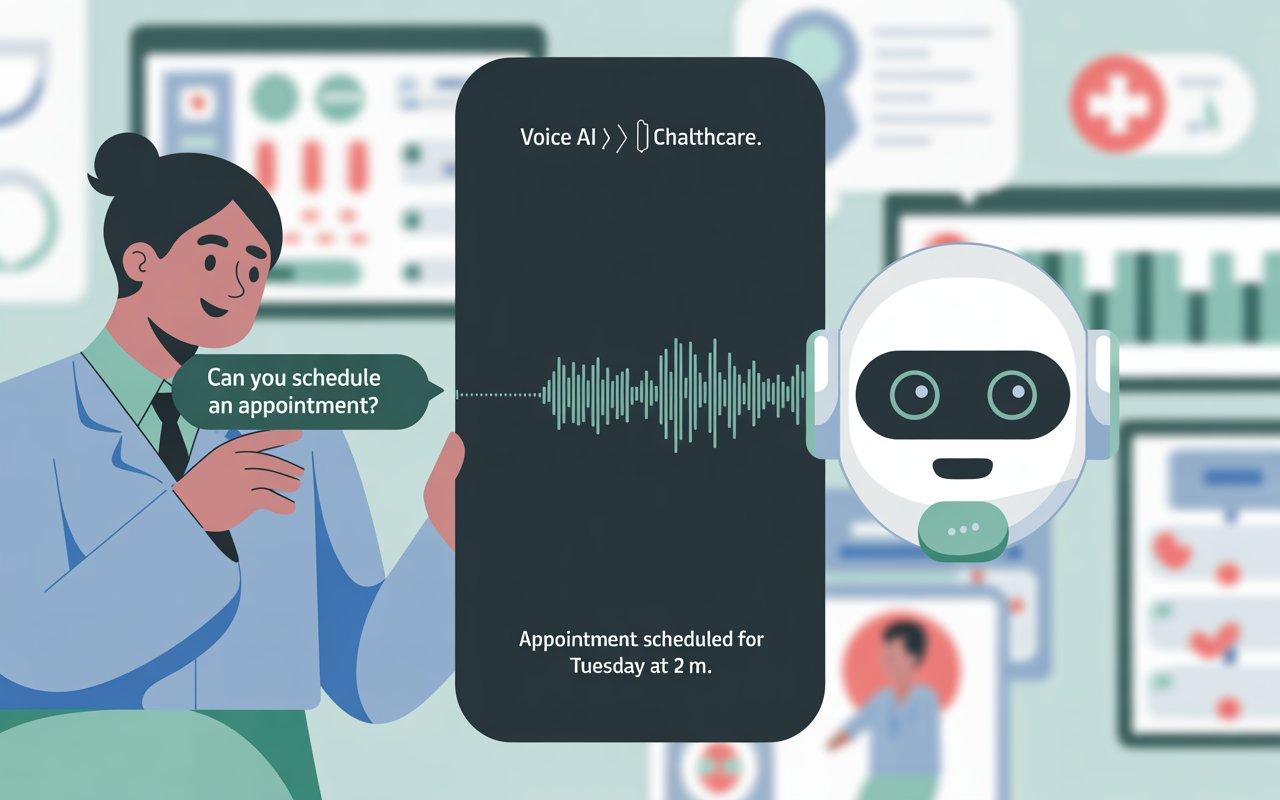
Voice AI technology can supply several other use cases additionally. However, the stated uses are enough to showcase its core potential uses in healthcare.
Read more: Use Cases of Voice AI in Healthcare
AI Voice Agents: Decision-Makers With A Voice
An AI Voice Agent is an autonomous, task-driven system that leverages Voice AI tech to interact with users while performing multi-step actions. Their scope of operation encompasses not just understanding human speech but also acting on it without requiring additional human oversight.
How They Work
- Uses Voice AI tech to capture and understand speech
- Applies Agentic AI Architecture logic to process data and make decision
- Connect with APIs, databases, or apps to complete data tasks or assigned responsibilities
Key Data
- Voice AI agents could likely replace 40% of customer service roles by 2030.
- Using Voice AI agents in every cycle can reduce average handle time (AHT) by 50-70% in contact centers.
Use Cases in Healthcare
- Automate Patient Booking
- Prescription Refill Handling & Logging
- Symptom Triage & Post-Discharge follow-ups.
- And so on.
One thing to particularly note about Voice AI agents is that they can exhibit autonomy, context awareness, and contextual memory across their sessions. These AI voice agents don't just answer questions - they solve problems and challenges.
Conversational AI: The Brain of the Dialogues
Conversational AI is the technology that enables machines to understand human language and respond in equivalent human dialects via text or voice. The IT solutions mainly powered by Conversational AI are chatbots, voicebots, AI assistants, and AI agents.
Tech Components
- Natural Language Understanding (NLU)
- Natural Language Processing (NLP)
- Natural Language Generation (NLG)
- Dialogue management systems
Key Data
- The conversational AI market will grow to an estimated $47B valuation by 2033.
- Over 70% of mobile users prefer messaging over direct calls when reaching out to service providers.
Healthcare Use Cases
- Chatbots in Patient Care portals.
- Intelligent Auto-form filling.
- Email triage assistants
Conclusively, conversational AI can be considered a cognitive layer that enables Voice AI and AI voice agents to have fluid, goal-oriented conversations via text and voice.
Comparing Voice AI, AI Voice Agents & Conversational AI
| Feature/Aspect | Voice AI | AI Voice Agents | Conversational AI |
|---|---|---|---|
| Input Mode | Speech | Speech | Speech + Text |
| Autonomy | Low | High | Varies |
| Intelligence Level | Recognition + Understanding | Decision-making + Task Completion | Dialogue Reasoning |
| Output Type | Text/Speech | Task execution + responses | Text/Speech |
| Primary Use | Transcription, Interface | Automation, Operations | Conversations, Experience |
Which is the best solution for your organization?
When you need -
- Only transcription and voice commands - Get Voice AI
- End-to-end automation driven by voice - Get AI Voice Agents
- To deliver voice-driven experiences across channels - Get Conversational AI
All three voice technologies can be devised together to work on a need basis. Still, it's the AI Voice Agents that encompass all three, i.e., listening (Voice AI), understanding and conversing (Conversational AI), and acting logically on decisions (Agentic AI).
Conclusion
Implementing the right voice-driven solution isn't limited to adopting its daily use directly, as we often do when upgrading our tech. No, choosing to incorporate Voice AI agents is a strategic decision where knowing which voice solution to adopt can save you major troubles. To save yourself from overspending, misalignment, and under-whelming patient & staff care expectations, connect with a trusted Voice AI Agent development company.
Want help identifying or building the right voice-based solution for your healthcare and business workflow?
Ciphernutz IT Services builds Agentic & HIPAA-compliant custom Voice AI systems that get the work done with a modular voice agent architecture.
FAQs
Q. How is Voice AI different from a chatbot?
Voice AI transforms spoken input into machine-readable data using natural language understanding and speech recognition. Alternatively, chatbots work with typed input, as it lacks the engine behind voice dictation and speech-to-text capabilities that Voice AI uses for spoken communication. A chatbot won't necessarily hold a conversation or take action, which is where AI voice agents and conversational AI are the better picks.
Q. Can Voice AI systems work without Conversational AI?
Yes. However, the voice AI systems will be limited to speech recognition and basic response delivery without conversational AI. In such a scenario, the AI system won't perform dialogues nor understand complex contexts. For example, transcribing a sentence would be possible but it won't possess the depth to answer follow-up questions with logic.
Q. What makes an AI Voice Agent different from a Virtual Assistant?
Mainstream popular voice assistants like Siri or Alexa function on complex yet rule-based or stateless architecture, whereas the AI voice agents are built on agentic architecture. The latter can remember, reason, and autonomously complete tasks, further capable of simulating goal-directing behavior, and multi-step workflows. In conclusion, assistants mostly answer whereas agents also take action.
Q. How does modular architecture improve Voice Tech scalability?
Different components like speech recognition, language understanding, dialogue handling, and task execution can be integrated together to be updated or scaled independently in modular architecture. Such systems become more resilient, customizable, and HIPAA-compliant, too, for empowering enterprise-grade healthcare applications.
Q. How do tokens, temperature, and other LLM parameters affect AI Voice Agents output?
Tokens decide the response length, with Temperature controls determining response randomness (0 = deterministic; 1 = creative) and Top-p (nucleus sampling) influencing the diversification of the content.
Q. Can we deploy Voice AI without building an Agent?
Yes, but if you require voice dictation, medical note transcription, or voice-command-trigger responses, Voice AI is the better pick. Simultaneously, to develop patient-side automation systems, utilizing and combining Voice AI + Conversational AI and AI agents are necessary to control logic.
Q. Are AI Voice agents always HIPAA compliant?
No. Compliance measures depend on how the system is built, deployed, and monitored. Key areas to make a system compliant also include data encryption, role-based access, audit logging, and use of HIPAA-covered services. Ciphernutz designs AI voice agents with HIPAA-compliance infrastructure that encapsulates proper prompt designs, cloud hosting, and memory boundaries.