Voice AI Use Cases in Healthcare: 10 Use Cases & ROI Benchmarks
Milind Barot
3-5 mins
Introduction
AI voice agents are becoming foundational infrastructure within modern digital healthcare systems. What once began as simple speech-to-text tools has evolved into intelligent systems capable of documentation, triage, monitoring, and patient engagement. Today, voice AI healthcare solutions are not operational add-ons but the strategic catalysts enabling scalable and patient-centered care.
While conversational AI in healthcare continues to mature, providers are already leveraging AI-driven voice systems to reduce administrative burden, improve data accuracy, and enhance patient satisfaction while maintaining strict compliance standards.
According to Gartner, by 2026, 75% of healthcare organizations will have invested in AI-powered digital agents for front-line operational tasks, including scheduling, triage, and patient engagement.
This guide explores the highest-impact use cases for AI voice agents and conversational AI in healthcare. Additionally, it describes how these systems enhance the patient experience and solve their pain points while making clinical workflows efficient.
What Are AI Voice Agents in Healthcare?
The AI voice agents are autonomous intelligent systems using voice as the medium to interpret human intent to complete clinical and operational tasks. They do not require constant human oversight, and their upkeep is relatively cost-efficient once they are integrated into everyday workflows.
Every AI voice agent possesses the following capabilities:
- Real-time speech-to-text and text-to-speech
- LLMs trained in healthcare-specific language
- EHR integrations and workflow triggers
- Decision frameworks with fall-back logic and escalation protocols
It must be noted that these agents don't just record, transfer, and maintain information but also participate in multistep, context-aware conversations.
Often, the conversations they carry out can circle around:
- Appointment booking
- Handling insurance queries
- Summarizing patient histories
- Documenting SOAP notes
- Escalating abnormal triage findings
While typical conversational AI in healthcare may respond in chat or assist with limited use cases, AI voice agents are full-stack performers. They are built to encompass voice-based understanding, reasoning, and system execution authority.
Strategic Impact and Measurable Outcomes of AI Voice Agents
For healthcare CIOs and operations leaders, the value of AI voice agents must be measured beyond automation narratives. Mature deployments of conversational AI in healthcare are reporting measurable improvements across documentation time reduction, patient response latency, and administrative cost optimization.
In clinical documentation use cases, AI voice agents development can reduce physician charting time by 30-50%. Appointment automation systems frequently demonstrate no-show reductions in the 15-25% range.
However, achieving these benchmarks depends entirely on an organization's position within the Ciphernutz 4-Stage Voice Automation Maturity Model:
- Stage 1 (Legacy): Basic button-prompt IVR systems and passive dictation.
- Stage 2 (Transitional): Text-to-speech chatbots with siloed database lookups.
- Stage 3 (Integrated): Conversational AI with bi-directional EHR read/write capabilities.
- Stage 4 (Agentic): Multi-agent ecosystems capable of autonomous clinical routing and complex reasoning.
When providers reach Stage 4, the operational metrics transform.
Note: The following indicators reflect aggregate industry benchmarks (such as AMA and Deloitte reports) paired with proprietary deployment data:
| Workflow Category | Primary Operational Metric | Benchmark / Impact Indicator |
|---|---|---|
| Scheduling | Appointment handling time | Reduced by 50-60%; near-elimination of peak-hour call abandonment |
| Triage | Voice triage accuracy SLAs | 95%+ intent classification precision; zero-second wait time for immediate routing |
| Discharge | Readmission reduction | 15-20% decrease in 30-day readmissions through early risk flagging |
| Adherence | Staff utilization improvements | Automated check-ins save up to 12 hours of nursing outreach per week |
| Billing | Claim denial rate | Level 1 billing queries resolved autonomously; denial backlogs reduced by 20-35% |
| Language Access | Patient engagement rate | Multilingual NLU models expand addressable patient populations without added staffing cost |
| Mental Health | Intake-to-care latency | Structured voice screening reduces time-to-first-appointment by 30-40% for behavioral health |
These outcomes require shifting away from isolated metrics to view your automation as a holistic financial and clinical engine. To explore the exact cost-savings models behind these figures, review our deep dive into Voice AI healthcare automation ROI and implementation case studies.
Looking to Build a HIPAA-Compliant Voice AI Agent?
Ciphernutz helps healthcare providers design, develop, and deploy custom Voice AI agents for intake, triage, documentation, and post-care engagement.
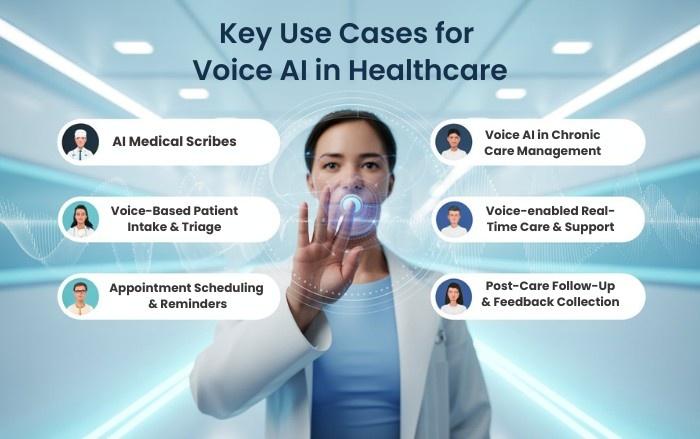
Key Use Cases for Voice AI in Healthcare
1. AI Medical Scribes
- Pain Points: Time-consuming manual documentation, physician burnout, and delayed EHR entries.
- The Solution: AI medical scribes transition manual documentation into automated, real-time data management. Moving beyond traditional dictation tools, these AI voice agents actively listen during patient encounters, transcribe the conversation securely, and generate structured medical notes (such as SOAP notes).
- The Benefit: Built specifically to understand clinical context and terminology, these agents deliver higher accuracy and save physicians hours per shift.
Examples: Suki, Nabla, or custom agents trained on specialized medical NLP models.
2. Voice-Based Patient Intake and Triage
- Pain Points: Front-desk congestion, manual communication, and inefficient care coordination.
- The Solution: Voice AI systems handle initial patient intake through kiosk-based conversations or intelligent phone calls. By programming the agent with symptom-based logic and FAQs, patients can securely provide critical information before their appointment. Advanced systems apply triage logic to classify urgency levels and route patients to the right care provider.
- The Benefit: Reduces wait times, improves intake data accuracy, and requires robust custom healthcare software development to ensure data flows securely into existing EHRs like Epic or Cerner.
Examples: Infermedica and EasyClinic.
Related: AI Patient Intake & Triage Automation Systems: Cost, Benefits and ROI
3. Appointment Scheduling and Reminders
- Pain Points: High resource allocation for outbound calls, schedule management, and high no-show rates.
- The Solution: Patients can book, reschedule, or confirm appointments through conversational AI agents available 24/7. To operate effectively, these systems must integrate directly with EMRs using HL7 and FHIR standards to avoid double bookings.
- The Benefit: Automating outbound scheduling and forwarding timely reminders drastically reduces no-show rates and frees up staff for critical clinical tasks.
Case Study: WhatsApp Appointment Booking Automation for Clinic
4. Voice AI in Chronic Care Management
- Pain Points: Lack of expert on-demand support between visits, low patient adherence.
- The Solution: Patients managing chronic conditions (like diabetes or hypertension) require regular engagement. Voice AI systems create a virtual support layer between appointments, acting as an intelligent monitor.
- The Benefit: Care teams can monitor patient adherence proactively. The AI agent can deliver daily medication reminders, conduct voice check-ins on symptoms, and alert a nurse or physician if conditions escalate.
5. Voice-enabled Real-Time Care & Support
- Pain Points: Handling bulk repetitive queries, inconsistent touchpoints, and call center fatigue.
- The Solution: Dealing with repetitive queries in high volume can be exhausting for administrative teams. Call centers and frontline care teams can utilize AI voice agents as intelligent copilots to ensure shared patient information is accurate and consistent.
- The Benefit: These agents actively listen during calls to suggest relevant information on the screen, fetch patient histories, and securely log call outcomes directly into EHR systems.
6. Post-Care Follow-Up & Feedback Collection
- Pain Points: Manual data input, delayed detection of post-discharge complications.
- The Solution: Modern healthcare voice agents are highly capable of understanding context and recognizing patient sentiment. AI voice agents can call patients post-discharge, ask tailored follow-up questions, and evaluate responses.
- The Benefit: This establishes an automated feedback loop that helps hospitals perform early detection of adverse reactions, clarify care instructions, refine operations, and maintain compliance standards.
7. Care Assistants for the Elderly & Home-Care
- Pain Points: Costly day-care assistance, low technology adoption among elderly patients.
- The Solution: Empathy is critical when communicating with elderly patients. While human care providers are essential, they are resource-intensive, and standard mobile apps often create a cognitive burden for elderly users.
- The Benefit: Voice AI agents solve this by providing accessible, conversational engagement. They deliver medication alerts, schedule physician home visits, and monitor spoken responses for cognitive or physical changes, accommodating patients with limited mobility seamlessly.
Read more: AI in Home Health Care
8. Billing & Insurance Verification
- Pain Points: Lengthy insurance verification processes, claim denials, billing errors, and administrative overload.
- The Solution: Voice AI agents can automate insurance eligibility checks, benefits verification, prior authorization requests, and billing inquiries through natural conversations with patients and payers. These agents can collect insurance details, validate coverage in real time, and answer common billing questions without human intervention.
- The Benefit: Reduces administrative workload, accelerates reimbursement cycles, minimizes claim errors, and improves patient satisfaction by providing instant answers regarding coverage and payment responsibilities.
Examples: Custom AI voice agents integrated with insurance APIs, revenue cycle management platforms, and payer systems.
9. Multi-Lingual Patient Navigation & Accessibility
- Pain Points: Language barriers, communication gaps, limited interpreter availability, and poor patient experience for diverse populations.
- The Solution: AI voice agents equipped with multilingual capabilities can guide patients through appointment booking, registration, intake, medication instructions, and discharge processes in their preferred language. These systems can provide real-time translations and culturally relevant communication.
- The Benefit: Improves healthcare accessibility, enhances patient engagement, reduces misunderstandings, and helps healthcare organizations deliver equitable care across diverse patient populations.
Examples: Voice AI solutions supporting English, Spanish, Hindi, Mandarin, Arabic, and other regional languages integrated into patient engagement platforms.
10. Mental Health & Behavioral Health Support
- Pain Points: Limited access to mental health professionals, long wait times, patient stigma, and lack of continuous support between therapy sessions.
- The Solution: Voice AI agents can provide conversational support, wellness check-ins, mood tracking, cognitive behavioral therapy (CBT)-based exercises, and crisis risk screening. These agents can engage patients through empathetic conversations and escalate cases to licensed professionals when intervention is needed.
- The Benefit: Expands access to mental health support, improves patient adherence to treatment plans, enables early identification of behavioral health risks, and provides 24/7 assistance outside clinical hours.
Examples: AI-powered behavioral health assistants, CBT-based conversational agents, and mental wellness voice companions integrated with healthcare systems.
Where do AI Voice Agents Fit in the Healthcare Workflow?
AI voice agents in healthcare can operate in a flexible capacity, serving across front-office and back-office and sorting clinical functions simultaneously or in a turn-based model.
| Use Case | Agent's Role |
|---|---|
| Scheduling and Reminders | Automatically manage appointments and send confirmations |
| Patient Intake and Triage | Capture symptoms, pre-fill charts, and assess urgency |
| Billing and Coverage Inquiries | Handle insurance verification and explain costs |
| Chronic Care Monitoring | Remind patients about meds, flag nonadherence, notify teams Screen for mood trends, offer resources, escalate crises |
| Mental Health Support | Screen for mood trends, offer resources, escalate crises |
Real-World Example of AI Voice Agents Use Case
When a patient says: "Can I move my MRI to next week? And is it covered?"
The AI voice agent would execute the following actions:
- Verifies patient ID via phone match
- Checks open slots in radiology
- Reviews payer eligibility via API
- Reschedules and sends an SMS confirmation
- Updates the EHR in seconds
In this manner, without human intervention or hold times, healthcare providers can incorporate intelligent end-to-end automation into their workflows to solve multiple bottlenecks.
Cost of Implementing Voice AI in Healthcare
For technology leaders evaluating these systems, understanding the financial investment requires structured evaluation across architecture, compliance, and long-term scalability. The cost varies significantly based on the complexity, integration requirements, and security frameworks needed.
1. Performance Benchmarks and ROI Considerations
Beyond implementation costs, executives must evaluate ROI across three dimensions:
- Operational Efficiency Gains: Reduction in documentation time, call handling time, and intake processing duration.
- Revenue Protection: Lower no-show rates, improved billing accuracy from structured documentation, and reduced claim denials due to incomplete records.
- Risk Mitigation: Early detection of post-discharge complications and escalation triggers that prevent readmissions.
When properly deployed through a custom healthcare software development company, AI voice agents can generate ROI within 6-12 months, depending on use-case scope and patient volume.
Note: Organizations evaluating whether to hire AI agent developers internally or partner with an AI voice agent development company must weigh long-term scalability and governance capabilities.
2. Evaluation Criteria To Remember
Partnering with a specialized custom healthcare software development company or an AI agent development company must begin with an evaluation of the following cost factors:
- Setup and Integration: Building secure API connections to legacy EHR/EMR systems (Epic, Cerner) using FHIR/HL7 standards.
- Compliance and Security: Ensuring the architecture is fully HIPAA-compliant, which requires encrypted data pipelines, audit logging, and secure cloud infrastructure.
- Customization vs. SaaS: Licensing a pre-built SaaS tool might have lower upfront costs but higher recurring licensing fees. Conversely, partnering with an AI agent development company to build a proprietary system may require initial investment, but it eliminates per-user licensing fees and offers total data ownership.
Governance, Bias Mitigation, and Model Oversight
Enterprise-grade AI voice agents must operate within strict governance frameworks. Model governance ensures that conversational AI in healthcare adheres to clinical safety standards, regulatory compliance, and ethical AI deployment protocols.
Key considerations include:
- Bias Mitigation Controls: Continuous monitoring to detect demographic or linguistic bias in speech recognition and triage classification.
- Human-in-the-Loop Oversight: Escalation pathways allowing clinicians to review, override, or audit AI-generated outputs.
- Model Versioning and Auditability: Transparent tracking of model updates, retraining cycles, and dataset lineage.
- Accuracy Monitoring: Ongoing benchmarking of speech recognition accuracy across accents, dialects, and medical specialties.
An experienced AI agent development company should provide structured governance documentation, audit logs, and compliance mapping aligned with HIPAA, SOC 2, and HITRUST standards.
Executive Decision Framework for AI Voice Agent Adoption
For healthcare executives evaluating AI voice agents, decision-making should follow a structured framework:
1. Clinical Impact Assessment
Identify high-friction workflows where automation can reduce cognitive or administrative load without compromising care quality.
2. Integration Readiness Evaluation
Assess EHR interoperability maturity, API accessibility, and internal IT bandwidth to support deployment.
3. Compliance and Risk Modeling
Evaluate data residency, encryption architecture, model governance protocols, and bias mitigation safeguards.
4. Build vs. Buy Analysis
Determine whether to license a SaaS product or partner with an AI voice agent development company for custom healthcare software development aligned with long-term strategic control.
5. Scalability Forecasting
Ensure the architecture can scale across departments, specialties, and patient populations without reengineering core infrastructure.
A disciplined evaluation process ensures AI voice agents transition from experimental tools to mission-critical healthcare infrastructure.
The Takeaway
To drive measurable improvements in patient outcomes and operational efficiency, AI voice agents must be implemented as secure, scalable infrastructure - not experimental tools. Long-term success depends on rigorous governance, seamless EHR integration, and architecture designed for clinical workflow alignment.
Whether organizations build internal capabilities or partner with an experienced AI voice agent development company specializing in voice AI healthcare solutions, the decision should be grounded in compliance readiness, interoperability maturity, and total cost of ownership.
FAQs
Q. What is Voice AI in healthcare?
Voice AI in healthcare refers to artificial intelligence-powered systems that use speech recognition and natural language processing to automate tasks like documentation, appointment scheduling, patient triage, and follow-ups, improving efficiency and patient care.
Q. Can Voice AI agents handle patient intake and triage?
Yes, Voice AI agents can conduct patient intake through voice-based questionnaires, assess symptom severity, and perform triage by routing patients based on urgency, reducing front-desk workload and wait times.
Q. How does Voice AI improve appointment scheduling in healthcare?
Voice AI agents automate appointment booking, rescheduling, and reminders. They work 24/7, reduce no-show rates, and integrate with EMRs to avoid double bookings and missed updates.
Q. Are Voice AI systems HIPAA-compliant?
Yes. A Voice AI designed with proper encryption, audit logging, and model governance can obtain HIPAA-compliant status. Partner with Ciphernutz, a HIPAA-compliant Generative AI development company, to ensure proper alignment with privacy laws and secure patient data handling.
Q. What are the benefits of using Voice AI in healthcare customer service?
Voice AI reduces human error, handles repetitive queries efficiently, provides consistent responses, and integrates with EHRs to log interactions, improving both patient satisfaction and operational workflows.
Q. Will the AI voice agent integrate directly with our existing EHR?
Yes. A professionally developed AI voice agent can be integrated seamlessly with major EMR/EHR systems (like Epic, Cerner, or Athenahealth) using custom APIs and interoperability standards like HL7 and FHIR, ensuring a single source of truth for patient records.
Q. Can Voice AI handle billing and insurance verification calls?
Yes. Voice AI agents can authenticate callers, query insurance clearinghouses or payer portals in real time, and resolve Level 1 billing inquiries - such as copay verification, balance inquiries, and pre-authorization status - fully autonomously, escalating complex disputes to a human billing specialist with a prepopulated call summary.
Q. Is Voice AI appropriate for mental health and behavioral health use cases?
Yes, with careful design. Voice AI agents can administer validated screening instruments (PHQ-9, GAD-7, PC-PTSD-5) in a conversational format, score results, route high-acuity patients to immediate human support, and conduct between-session check-ins. Clinical voice implementations in this space require co-design with licensed behavioral health clinicians and robust safety escalation logic for acute risk disclosures.