Why Hire AI Agent Developers? Process, Skills & Cost Breakdown
Yuti Agarwal
8-10 mins
The global AI agent development market is already past $7.5 billion in 2025, with several talented high-positing entities receiving six to eight figures packages from Meta in USD. The growth from $5.4 billion in 2024 is not comparatively about twice the market before, at a 45.8% CAGR. This growth is indicative of businesses' strategic pivot towards adopting or implementing autonomous intelligent systems to empower measurable outcomes.
With over 80% of enterprises already having deployed AI agents in 2025, the compelling ROI potential of the 62% organizations are noted to gain over 100% results within 12 months.
To achieve these figures or build your AI agent, you'll require resources and a lot many other team-connected variables. With AI agents representing the new frontline to compete globally, organizations are pushing for about 40% cost reduction while increasing productivity by 50%.
It is all through AI agent implementations and intelligent automation - led by vision-based actions and decision-making. Hence, this comprehensive guide addresses critical aspects of hiring AI agent developers: specialized skill requirements, proven recruitment methodologies, and implementation frameworks that maximize AI investment returns.
Understanding AI Agent Development
What Are AI Agent Developers?
AI agent developers architect autonomous artificial intelligence systems capable of independent reasoning, planning, and execution. The AI agent developers are specialists who create proactive agents that perceive environments, make decisions, and take actions with minimal human oversight.
AI agent development services focus on creating intelligent systems that exhibit autonomous goal-directed behavior, learning from interactions while continuously improving decision-making capabilities. Obtaining this specialization requires a deep understanding of agent communication protocols, task distribution mechanisms, and conflict resolution strategies
The following key distinctions separate traditional AI/ML developers from AI agent developers:
- Agentic Architecture Design - Creating systems with agency, autonomy, and goal-directed behavior
- Multi-agent Orchestration - Coordinating multiple specialized agents working collaboratively
- Tool Integration Mastery - Enabling agents to interact with diverse software ecosystems
- Context-aware Decision-making - Building systems that adapt to dynamic environments
Why AI Agent Developers Are Critical for Modern Business
AI agents for enterprises enable sophisticated process optimization that adapts to changing conditions while maintaining operational consistency. Research also demonstrates gaining 13.8% higher productivity per hour in customer service operations, with generative AI technologies automating 60-70% of employee time.
The collective business impact delivered by AI agent developers include:
- 31.5% improvement in customer satisfaction scores
- 24.8% increase in customer retention rates
- 54% average ROI in marketing applications
- 70% reduction in research time for complex processes
After they are onboard, their strategic value emerges through AI agents' ability to scale institutional knowledge and decision-making processes. Organizations code expert reasoning patterns into agent behaviors, ensuring consistent high-quality outcomes are obtained regardless of human resource availability.
Read more: What Are AI Agents & Why Build AI Agents for Business
Essential Skills and Qualifications for AI Agent Developers
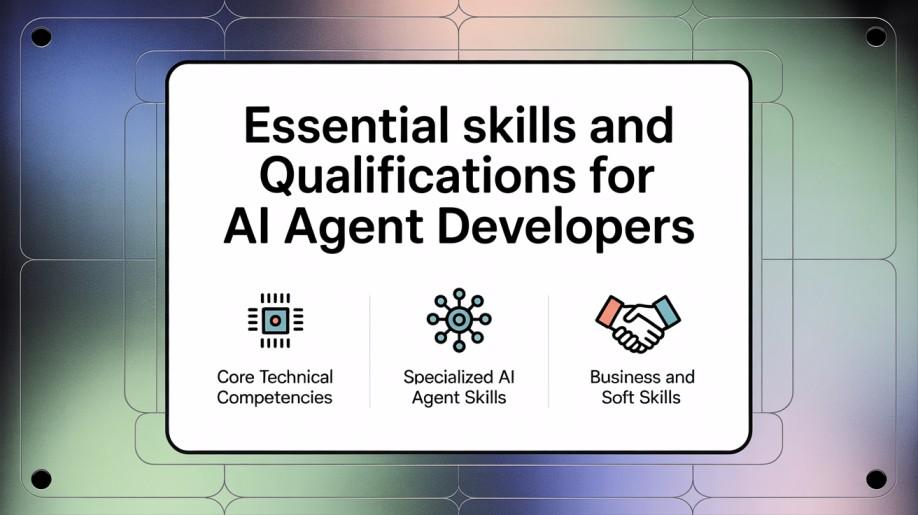
1. Core Technical Competencies
Programming language mastery for AI agent development centers on Python proficiency with comprehensive libraries including TensorFlow, PyTorch, and LangChain. While learning these are vital, they are not the standalone measures of technical capabilities for rapid prototyping and deployment.
Advanced practitioners have also demonstrated expertise in Java and C++ for performance-critical applications requiring optimized execution speed. Likewise, their essential skills include the following:
- Machine learning frameworks - Neural network architectures, training methodologies, optimization techniques
- Microservices architecture - Containerization with Docker, orchestration with Kubernetes
- API integration - Secure communication protocols, authentication management, data exchange formats
- Database management - Both SQL and NoSQL systems for agent data storage and retrieval
Note: Agent architecture expertise is inclusive of understanding autonomous system design, reinforcement learning algorithms, and multi-agent coordination mechanisms.
2. Specialized AI Agent Skills
Designing multi-agent systems requires mastery over agent communication protocols, distributed problem-solving strategies, and coordination mechanisms ensuring optimal collective outcomes. Some of the optimal specializations may involve learning the following.
- Natural language processing - Quicker Intent recognition, entity extraction, conversation management, context preservation.
- Planning and reasoning algorithms - Complex objective decomposition, execution strategy development, adaptive planning
- Memory management systems - Reflective, project-based, and episodic memory implementation
- Tool integration frameworks - Establish seamless interaction with external systems, databases, third-party services
3. Business and Soft Skills
Problem-solving capabilities integrated into AI agent solutions enable translation of complex business requirements into technical specifications guiding agent development. This also involves understanding business processes, identifying automation opportunities, and designing solutions aligned with organizational objectives.
Essential soft skills:
- Stakeholder communication - Articulating technical concepts clearly across multidisciplinary teams
- Industry domain knowledge - Understanding specific challenges, regulatory requirements, operational constraints
- Project management - Agile methodologies, collaborative tools, iterative development processes
- Cross-functional collaboration - Working effectively with business analysts, domain experts, end-users.
When and Why to Hire AI Agent Developers?
You want to adopt the latest AI tech into your workflow but your MERN/MEAN stack developers lack the expertise to build AI solutions that function as automated intelligence business tools.
If this requirement isn't true for you, there can be other similar scenarios with other variables, that each have something in common - your team isn't AI-Ready or AI-smart.
Business Scenarios Requiring AI Agent Expertise
Process automation and workflow optimization scenarios deliver immediate value, where the AI agents handle complex, multi-step processes involving decision trees, data validation, and conditional routing.
Manufacturing companies report 70% reduction in research time while discovering previously unknown market segments.
Signs Your Business Needs AI Agent Development
Here are the assessment framework indicators that help organizations identify optimal timing for AI agent initiatives:
- Repetitive manual processes consuming significant employee time
- Inconsistent decision-making across similar scenarios requiring standardization
- Scalability challenges where systems cannot handle increasing volumes
- Information coordination difficulties across multiple departments or systems
Types of AI Agent Developers and Hiring Models
If you believe that hiring one AI agent developer will sort things out for you, it's still a gamble. AI tech is evolving quicker than you can google about it in-depth. In this situation, your AI agent developer should possess 'implementation & deployment' knowledge on multi-architecture capabilities and a whole other essentials stated below.
1. Development Specialization Areas
AI specialists who develop conversational AI, focus on natural language understanding, dialogue management, and human-computer interaction optimization. These developers create sophisticated conversation systems with context retention and appropriate escalation capabilities.
Note: Market data shows conversational agents dominating with 44% market share.
Similarly, there are AI agent specialization categories:
- Process automation agents - Workflow orchestration, business rule implementation, cross-system integration
- Analytics agents - Data processing, pattern recognition, strategic recommendation generation
- Multi-modal agents - Processing text, voice, images, sensor data across platforms and devices
Thus, dedicated AI agent developers also increasingly specialize in specific frameworks like LangChain, CrewAI, and AutoGen. Their choices in tools and platforms mirror global market demands of expertise in next-generation agent development platforms.
2. Hiring Model Options
There are two primary AI agent developer hiring models, i.e., In-house vs. outsourcing, with their distinct advantages:
In-house benefits:
- Complete IP control and direct business alignment
- Seamless integration with existing teams
- Full-time dedication to organizational objectives
Outsourcing advantages:
- 20-90% cost reductions compared to US rates
- Access to specialized expertise and proven methodologies
- Reduced recruitment overhead and time-to-market
Alternatively, the hiring model is often also segregated based on geographic cost variations:
- US markets: $115,000-$153,000 annually for senior developers
- Eastern Europe: $45,300-$65,700 with high-quality deliverables
- India: $18,600-$54,000 for experienced professionals
- Latin America: $22,200-$30,000 competitive alternative
Looking up AI agent developers near me can reflect ideal preferences for local talent. Yet parallelly, remote collaboration has also proven effective for complex agent development projects requiring specialized expertise.
Where to Find and Source AI Agent Developers
1. Traditional Recruitment Channels
Professional developer recruitment networks including LinkedIn, Stack Overflow, and GitHub. They all provide access to extensive developer communities with verifiable portfolios demonstrating real-world AI agent implementation capabilities.
Effective sourcing channels:
- Technical communities - Reddit's r/MachineLearning, specialized AI Discord servers, Hacker News.
- University partnerships - Computer science departments, AI research labs, specialized programs.
- Industry conferences - NeurIPS, ICML, local AI meetups for direct practitioner interactions.
Note: Checking GitHub contributions to AI agent frameworks like LangChain, AutoGen, and CrewAI demonstrate practical expertise and collaborative skills essential for complex enterprise implementations.
2. Specialized Platforms and Networks
AI-focused platforms including AI Jobs, Toptal, and Hired provide pre-screened candidates with verified expertise and specialization filters to streamlining identification processes.
- Freelance marketplaces - Upwork, Freelancer, Kaggle Competitions with global talent pools
- Development consultancies - Comprehensive team solutions with project management and QA
- Open-source communities - Active contributors demonstrating framework expertise and implementation experience
AI agent development companies can also maintain talent pools having individuals with complementary skills and proven delivery methodologies, offering alternatives to individual hiring challenges.
Step-by-Step Hiring Process for AI Agent Developers
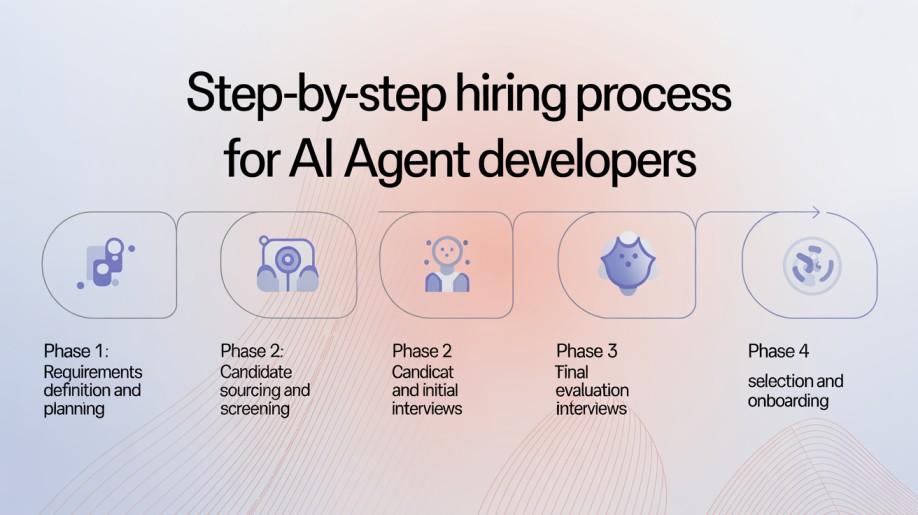
Phase 1: Requirements Definition and Planning
Attaining clarification on business objectives is paramount to establish foundation for successful initiatives through interviews, process mapping and automation opportunity identification. Simultaneously, the results must align with strategic goals, otherwise they aren't actionable in ROI.
Planning components:
- Technical specification development - Framework preferences, integration constraints, performance expectations
- Budget establishment - Development costs, infrastructure, ongoing maintenance ($99,578-$172,468 US salary ranges)
- Team integration planning - Collaboration protocols, reporting structures, knowledge transfer processes
Phase 2: Candidate Sourcing and Initial Screening
Multi-channel sourcing strategy maximizes your candidate pool quality through diverse recruitment channels. A few examples of the latter can include job boards, specialized platforms, professional networks, and referral programs.
Evaluation criteria:
- Portfolio assessment - Practical experience with agent frameworks, successful project deliveries
- Technical screening - Coding challenges, framework knowledge, problem-solving scenarios
- Cultural fit evaluation - Communication skills, collaborative approaches, adaptability
Phase 3: Technical Evaluation and Interviews
Performing hands-on assessments provide direct evaluation of programming proficiency, framework knowledge, and problem-solving approaches through realistic agent design scenarios.
Assessment components:
- System design discussions - Scalable architecture evaluation, distributed systems understanding
- Scenario evaluations - Real-world challenges including edge cases, error handling, optimization
- Reference validation - Technical verification, performance quality, professional relationships
Phase 4: Final Selection and Onboarding
Competitive offers should be extended after understanding global and regional market compensation trends, total packages, and positioning including base salary, equity, professional development, flexible arrangements.
Integration elements:
- Contract considerations - IP rights, confidentiality, employment terms
- Structured onboarding - Technical documentation, system access, mentor assignment
- Success metrics - Performance expectations, delivery timelines, evaluation criteria
Cost Considerations and Budget Planning
1. Salary Ranges and Market Rates
Geographic variations significantly impact budget planning, with US premium markets versus cost-effective international alternatives maintaining quality standards:
US salary ranges by experience:
- Entry-level: $99,438-$103,140
- Mid-level: $121,641-$138,301 (15-30% increases)
- Senior positions: $155,132-$172,468
- Top performers: Exceeding $300,000 in major tech hubs
International cost advantages:
- India: ₹18.6-54 lakhs ($18,600-$54,000)
- Eastern Europe: $45,300-$65,700
- Latin America: $22,200-$30,000
Specialization premiums reward high-demand expertise:
- Solution architects: ₹45.0 lakhs
- Data scientists: ₹36.0 lakhs
- Senior AI engineers: ₹35.0 lakhs (30-50% premiums over general roles)
2. Hidden Costs and Additional Expenses
Infrastructure requirements for AI agent development will fundamentally include cloud computing resources, specialized software licenses, development tools for AI agent projects with substantial ongoing operational costs.
Additional budget considerations:
- Training investments - 10-15% of salary costs for continuous learning, certifications, conferences
- Project oversight - 25-40% additional costs for management, technical leads, QA resources
- Integration expenses - System integration, testing, security audits, production deployment
3. ROI Calculation and Budget Justification
Market-validated returns on hiring AI developer demonstrates compelling investment rationales:
- Average ROI: 171% with 62% of organizations exceeding 100% returns
- Recovery timeline: Most investments recovered within 12 months
- Sustained benefits: Multi-year value accumulation through operational improvements
Common Mistakes and Red Flags to Avoid

1. Hiring Pitfalls
Over-promising capabilities represent frequent challenges where unrealistic deliverable commitments ignore AI agent development uncertainties, iterative refinement requirements, and complex integration challenges.
Critical pitfall avoidance strategies:
- Realistic timeline expectations - Account for development uncertainties and scope evolution
- Adequate technical vetting - Hands-on assessments, portfolio verification, practical demonstrations
- Requirement alignment - Shared understanding between business stakeholders and technical teams
- Structured project management - Clear deliverables, progress monitoring, stakeholder coordination
2. Warning Signs in Candidates
Experience validation indicators:
- Lack of practical agent system experience - Only theoretical knowledge without implementation examples
- Poor communication skills - Inability to explain complex concepts to non-technical stakeholders
- Inadequate portfolios - Limited project examples, outdated skills, incomplete solutions
- Collaboration challenges - Unprofessional interactions, delayed responses, rigid communication styles
Best Practices for Successful AI Agent Developer Integration
Onboarding and Team Integration
Comprehensive knowledge transfer accelerates productivity through technical architecture reviews, codebase walkthroughs, internal documentation access, and mentoring programs pairing new hires with experienced team members.
Integration best practices:
- Collaboration tools - Version control systems, CI pipelines, development environments
- Support systems - Structured mentoring, guidance availability, team culture integration
- Performance monitoring - Clear metrics, regular feedback, continuous improvement processes
Project Management and Delivery
Agile methodologies enable responsive development cycles accommodating changing requirements, stakeholder feedback, and technical discoveries through iterative approaches.
Delivery excellence components:
- Communication protocols - Regular updates, milestone reviews, transparent reporting
- Quality assurance - Comprehensive testing including unit, integration, user acceptance
- Production readiness - Infrastructure setup, monitoring, maintenance procedures, rollback strategies
Future Trends in AI Agent Development
Emerging Technologies and Capabilities
Advanced frameworks continue evolving toward sophisticated autonomous capabilities with market growth from $7.92 billion in 2025 to $52.62 billion by 2030, driven by foundation models enabling complex multi-step autonomous task execution.
Technology evolution trends:
- Multi-modal capabilities - Processing text, voice, images, sensor data across platforms
- LLM integration - Advanced language model combinations with computer vision, IoT systems
- Enterprise frameworks - LangGraph, CrewAI, AutoGen supporting human-in-the-loop workflows
Market Evolution and Skill Requirements
Emerging skill demands reflect increasing emphasis on agentic frameworks, multi-agent orchestration, and enterprise integration capabilities requiring deeper understanding of distributed coordination and security frameworks.
Career development paths:
- Technical leadership - Agent architecture specialization, solution design
- Product management - AI solution strategy, enterprise transformation consulting
- Specialized training - Coursera's AI Agent Developer Specialization, hands-on learning resources
Conclusion and Next Steps
Successfully hiring AI agent developers requires strategic alignment of business objectives, technical requirements, and market realities within rapidly evolving technological landscapes.
Organizations must approach hiring with clear understanding of specific needs, realistic implementation timelines, and commitment to ongoing technology and talent investment.
Implementation roadmap:
- Start with pilot projects demonstrating value while building internal expertise
- Establish success metrics aligning with business objectives
- Create comprehensive onboarding accelerating time-to-productivity
- Develop competitive packages attracting top talent in constrained markets
- Invest in continuous learning maintaining expertise as technologies evolve
Build AI agents represent the next competitive frontier where strategic hiring decisions determine long-term market positioning and operational excellence.
FAQs
Q. How long does hiring qualified AI agent developers typically take?
The complete hiring process requires 8-12 weeks for senior positions: 2-3 weeks requirements definition, 3-4 weeks sourcing/screening, 2-3 weeks technical evaluation, 1-2 weeks final selection. Complex specializations may extend timelines further.
Q. What salary ranges should organizations expect?
US markets range $99,578-$172,468 annually depending on experience level. International markets offer 20-90% cost savings: India ($18,600-$54,000), Eastern Europe ($45,300-$65,700), with premium rates for specialized expertise.
Q. In-house vs. outsourcing for AI agent development?
Decision depends on strategic objectives and budget constraints. In-house provides control and alignment but requires higher investment. Outsourcing offers cost advantages and specialized expertise but requires careful management. Hybrid approaches often provide optimal balance.
Q. Most critical technical skills for AI agent developers?
Essential skills include Python/AI frameworks (TensorFlow, PyTorch, LangChain), multi-agent systems design, NLP capabilities, enterprise integration patterns. Specialized reinforcement learning, distributed systems, and industry domain expertise command premium compensation.
Q. How to evaluate practical AI agent experience?
Combine portfolio reviews, hands-on coding assessments, system design discussions, reference checks. Look for demonstrated framework experience, successful deliveries, clear technical communication. Open-source contributions and published work provide additional validation.