AI for Startups: Use Cases, Benefits, and How to Build It
Dharmesh Dave
4-6 minutes
Startup budgets are tighter than ever while competitors keep moving fast. Today, AI has become one of the few tools that lets a five-person team do the work of twenty. Global venture funding hit $510 billion in the first half of 2026, and AI companies took the largest share of it. As bystanders or industry players, founders face a real question: where does AI actually earn its cost? If you're unsure where to begin, an AI Readiness Audit can help identify the highest-impact use cases before investing in development.
This guide skips the sales pitch. It covers where AI for startups works today, what it costs to build, and where it still falls short.
What AI for Startups Actually Looks Like in 2026?
Ask five founders what AI for startups means, and you'll get five different answers. For one, it's a support chatbot bolted onto a help inbox. For another, it's a model fine-tuned on years of proprietary data. Both count. Both share one trait: a small team producing the output of a much bigger one.
In our experience building AI products for startups, fewer than 10% of early-stage companies need custom model training. Most achieve faster results by integrating foundation models such as OpenAI, Anthropic, or Gemini APIs and focusing engineering effort on product workflows rather than model development.
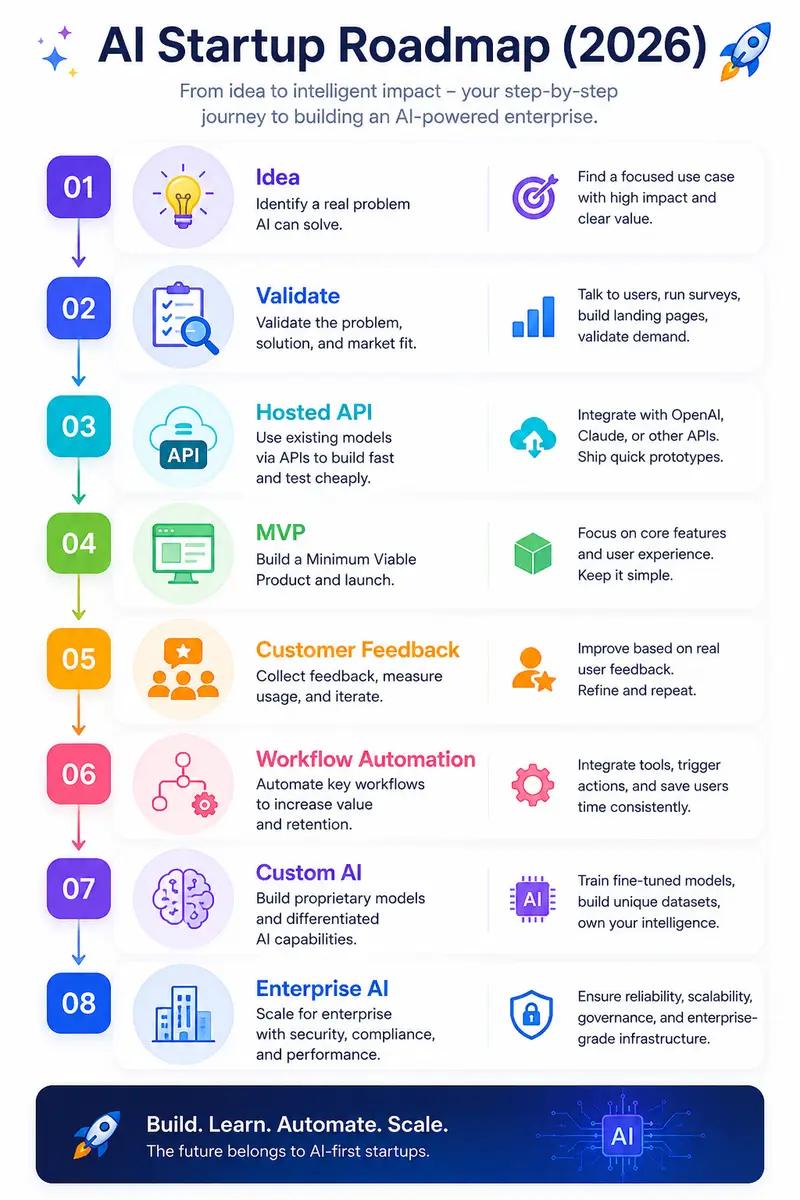
AI Startup Roadmap (2026)
Idea
↓
Validate
↓
Hosted API
↓
MVP
↓
Customer Feedback
↓
Workflow Automation
↓
Custom AI
↓
Enterprise AI
Why Founders Are Turning to AI Right Now?
The numbers explain the shift.
- 91% of businesses now use AI in at least one part of their operations, up from 78% two years earlier. That's per research combined by Azumo and McKinsey.
- Among small businesses already using AI, about 71% use it for writing and content. Another 38% use it for customer service or chat, and 29% for scheduling and admin work. That's per a 2026 analysis by AI consultant Lilach Bullock.
- AI startups captured close to 80% of all global venture funding in the first quarter of 2026. That's up from roughly 55% a year earlier, per Crunchbase-sourced data.
- 65% of startup founders raised their AI spending in the past year alone, according to a GTM benchmark report cited by HubSpot.
None of this guarantees results, but investors and customers now expect AI somewhere in the product.
| Metric | Value |
|---|---|
| AI Adoption | 91% |
| Venture Funding | 80% |
| SMB AI Usage | 71% |
| AI Coding | 46% |
Where AI Creates Value for Startups
Product and Engineering
AI coding tools now write a real share of shipped code. GitHub measured 46% of code on its platform touched by Copilot back in 2023, and usage has only grown since. A focused AI MVP with one core feature typically ships in two to three weeks on a hosted model. That's the 2026 build benchmark from SpeedMVPs.
Marketing and Growth
Data-enrichment startup Clay built its go-to-market product around OpenAI's models and grew usage tenfold. That's according to HubSpot's 2026 GTM report. Workforce platform Rippling used Clay's AI enrichment tools to double its year-over-year cold email reply rate, per the same report.
Sales and Customer Relationships
Commercial real estate marketplace Crexi cut manual lead tracking and freed up about 5 hours a day per rep. That's per Salesforce's small-business research. Lead-scoring models rank prospects by close likelihood. A two-person sales team can then spend its time on the 20 leads worth a call out of 200.
Customer Support
Chatbots now handle routine tickets around the clock, freeing small support teams for the harder cases. 90% of small and medium businesses already use AI to automate some customer interactions, per Salesforce's 2026 SMB Trends Report.
Related Blog: AI Customer Support Automation Using n8n
Operations and Finance
Forecasting models flag cash-flow gaps weeks before they hit, not at month-end close. Expense tools sort spend into categories automatically, cutting the manual bookkeeping load for a two-person finance team.
Hiring and People
Resume-screening tools cut the time to a shortlist without a dedicated recruiter on staff. Small HR teams use AI to draft job posts, sort applications, and flag likely fits early in the process.
The Real Benefits of AI For Startups, with Proven Numbers
Skip the generic list. Here's what the data actually shows about how AI has been backing startups worldwide.
Lower Build Cost
A no-code AI MVP development typically costs $1,000 to $8,000 and ships in one to eight weeks. That's per 2026 cost data from AngelHack DevLabs and CreWork Labs.
Faster Iteration.
Teams using no-code AI tools build and test working software about 56% faster than teams doing a full custom build from day one. That's per BuildMVPFast's 2026 platform review.
Smaller Teams, More Output.
A solo founder can review code and copy drafted by AI without hiring a full team before the idea is proven.
Stronger Fundraising Position
Investors increasingly want a working demo before they commit capital. A slide deck alone often isn't enough anymore, per 2026 fundraising analysis from SortResume.
Should You Build AI Features or Buy them?
Most startups face three real paths, not two.
| Path | Best for | Typical cost | Typical timeline |
|---|---|---|---|
| Hosted API (OpenAI, Anthropic, Google) | Testing a first idea, no training data needed | Usage-based, often under $500/month early on | Days to a few weeks |
| No-code or low-code platform | Internal tools, simple customer-facing forms | $1,000–$8,000 | 1–8 weeks |
| Custom-built AI product | Proprietary data, regulated industries, enterprise buyers | $50,000–$300,000+ | 3–9 months |
A hosted API fits most startups testing a first idea. It needs no training data of your own and can ship within days.
No-code platforms fit internal tools and simple customer-facing forms well. Complex products built for enterprise buyers often outgrow no-code platforms within 6 to 12 months. That's the pattern AngelHack DevLabs found in its 2026 cost comparison.
Custom development pays off once you have real proprietary data and a problem that off-the-shelf models can't solve. Moving off a no-code platform later often costs $10,000 to $40,000 on top of what you already spent. That's per CreWork Labs' 2026 analysis.
Decision rule: Start with a hosted API or no-code platform to validate your idea quickly. Once you've achieved product-market fit or secured funding, transition to a custom AI solution for greater flexibility and scalability. Book a free AI consultation to discuss the right development approach for your startup and avoid costly technical mistakes.
The AI Stack Global Startups are Actually Using
A few categories cover most of what founders touch in 2026.
- LLM APIs: OpenAI, Anthropic, and Google supply the underlying models behind most startup AI products. Most startups call these through an API. Few train models in-house.
- AI app builders: Tools like Bubble, Lovable, and Bolt turn a plain-language prompt into a working app with a database and user accounts already built in.
- Workflow automation: Make.com and Zapier connect an AI model to the rest of a stack, like a CRM or email tool. No custom backend code needed.
- Coding assistants: GitHub Copilot and similar tools draft code inside an editor, cutting first-draft time for a small engineering team.
- Vertical AI tools: Data-enrichment and GTM tools like Clay apply AI to one specific job, such as research or lead scoring. They skip general-purpose chat entirely.
Data and Compliance Basics
Regulated sectors change the calculus. A fintech startup handling payment data usually needs a custom build. No-code platforms rarely meet its security and compliance needs, per Multisyn Tech's 2026 comparison.
Founders outside regulated industries still owe users clarity on what data trains a model and where it's stored. Startups should treat compliance as a build requirement, not an afterthought. This applies most to health, finance, and biometric data, where rules like the EU AI Act already apply.
Risks Worth Planning for As A Startup Using AI
Balanced founders plan for the downside too.
MIT researchers found that 95% of generative AI deployments produced no measurable financial return in 2025. RAND puts the overall AI project failure rate above 80%, most often tracing back to weak data and poor integration.
Trust in code written by AI is falling, not rising. Only 29% of developers trust the accuracy of AI coding output in 2026, down from 40% in 2024, per Uvik Software's research. Gartner expects more than 40% of agentic AI projects to be cancelled by the end of 2027.
Data quality remains the top blocker. 52% of businesses name it as their biggest barrier to real AI adoption, per Process Excellence Network research.
Review beats avoidance here. Every line of code drafted by AI, and every customer message it writes, needs a human check before shipping.
A simple rollout plan
- Pick one workflow that wastes real hours each week. Skip the flashy feature(s) nobody asked for.
- Test it with a hosted AI model or a no-code tool before writing custom code.
- Set one metric to judge success, such as reply time or hours saved per week.
- Run it with real users for two to four weeks before expanding its scope.
- Move to custom development only once demand and data justify the cost.
- Review AI output on a schedule. Treat it like a new hire, not an autopilot.
How We Help Startups Build AI
Over the last few years, our team has worked with startups across healthcare, logistics, SaaS, real estate, and manufacturing to design and launch AI-powered products.
Some common projects include:
- AI customer support agents
- AI document processing
- AI voice assistants
- AI workflow automation
- AI-powered CRMs
- AI MVP development
Instead of recommending AI everywhere, we help founders determine whether a hosted LLM, no-code automation, or custom AI development is the right investment for their stage.
Not Sure Where to Start?
Our AI architects can review your startup idea, identify the highest-value AI opportunities, estimate development costs, and recommend whether a hosted API, no-code platform, or custom AI solution is the right fit.
FAQ
What is AI for startups?
It's the use of AI tools, bought or built, to automate tasks, support decisions, and serve customers on a small team and budget. Most startups start with a hosted model. Few train one from scratch.
Do startups need AI to compete in 2026?
Not on day one. But AI captured close to 80% of venture funding in early 2026. Investors increasingly want a working AI demo before they commit capital.
Should a startup build AI features or buy them?
Start by buying access through a hosted API or a no-code tool. Move to a custom build only once you have paying users, real data, and a problem generic models can't handle.
How much does adding AI to a startup product cost?
A simple no-code AI MVP runs about $1,000 to $8,000 and ships in one to three weeks. A custom build with its own data pipeline runs $50,000 or more over several months.
What's the biggest risk of using AI in a startup?
Trusting the output without review. Most AI projects still fail to show a financial return, and developer trust in code written by AI keeps falling. Human review still matters.