Building a Voice Agent That Qualifies Real Estate Leads 24/7 with n8n + Sarvam AI
Dharmesh Dave
6-8 mins
The real estate market operates under strict time constraints. When an inbound property inquiry arrives, the probability of converting that prospect decreases rapidly if they are forced to leave a voicemail or wait for a callback. Yet, brokerages consistently struggle with delayed responses, missed after-hours calls, and subjective lead qualification.
Today, inbound real estate call automation requires more than static IVR (Interactive Voice Response) routing trees. A production-grade AI voice agent real estate system combines a real-time audio transport layer with specialized speech-to-text models, LLMs, and backend workflow orchestrators to evaluate buyer intent, ask qualification questions, and route prospects directly into a CRM-operating continuously.
Every missed property inquiry is a missed revenue opportunity. In this guide, you'll learn how to build a production-ready AI voice agent using n8n, Sarvam AI, and LiveKit that answers calls 24/7, qualifies real estate leads, and automatically syncs high-intent prospects to your CRM.
Why Transition to Automated Lead Qualification?
High-value real estate conversations-where budgets and timelines dictate the viability of a deal-typically occur over the phone. Transitioning to an automated voice architecture fundamentally changes how a brokerage captures this top-of-funnel data.
Replacing the Traditional Call Center Model
When comparing an AI voice agent vs traditional call center, the operational differences are measurable. Traditional call centers experience high agent turnover, ongoing training requirements, and inconsistent adherence to qualification scripts.
Automated lead qualification removes these bottlenecks. An AI lead qualifier real estate bot answers the phone instantly, strictly follows your established framework, and executes AI lead scoring for property buyers based on parameters like budget, timeline, and location preferences without human bias. By standardizing this initial contact phase, human agents receive a filtered pipeline of high-intent buyers, drastically improving their closing efficiency.
The Reality of Real-Time Voice Architecture
A common architectural mistake is attempting to build the entire live conversational loop inside a standard asynchronous workflow orchestrator like n8n or Make.
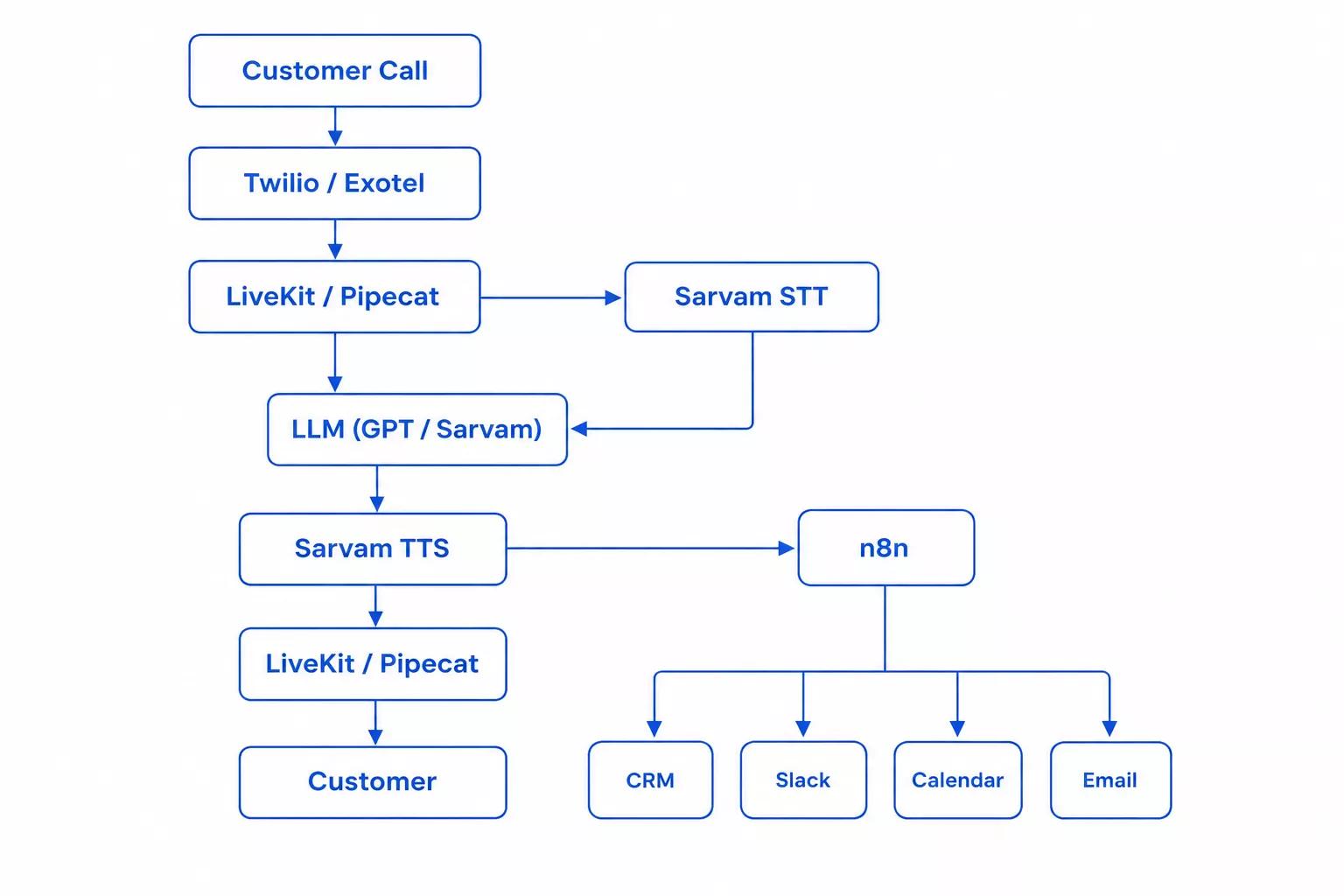
If you attempt to route a live SIP phone call through an n8n webhook, passing it into a standard HTTP Request node pointing at Sarvam’s REST endpoint, your system will fail in production. Sarvam’s standard real-time REST endpoint for speech-to-text caps audio processing at 30 seconds per request.
More importantly, n8n’s node-by-node execution model introduces severe latency. A natural voice agent requires rapid turn-taking, interruption handling (barge-in), and continuous audio chunking-tasks that REST APIs and asynchronous orchestrators are not built to handle.
To achieve natural conversational latency, the architecture must be split into two distinct layers:
The Real-Time Transport Layer (Live Loop)
This layer sits at the edge. Frameworks like LiveKit or Pipecat handle the live WebRTC/SIP audio stream. This layer maintains a persistent WebSocket connection to Sarvam AI for continuous, bidirectional streaming of speech to text for Indian real estate calls, completely bypassing the 30-second REST limit. This ensures the audio flows continuously in chunks rather than waiting for large file uploads.
The Orchestration Layer (Business Logic)
n8n sits safely behind the transport layer. It handles the heavy backend lifting before, during, and after the call. Instead of processing the raw audio, n8n acts as the logic controller-managing state, checking database inventory via webhooks, scoring the lead, and logging the n8n CRM integration for real estate leads.
Related Case Study: AI-Powered Real Estate CRM & Sales Automation
Step-by-Step Architecture: Building the Pipeline
Below is a structured guide to build AI voice agents with n8n, progressing from conceptual design to live CRM integration.
Step 1: Real Estate AI Call Flow Design & System Prompts
A call flow must function as a dynamic decision tree rather than a static script. Your initial voice agent script for property buyers identifies the caller, asks specific questions, and handles unrecognized inputs.
- The Greeting: "Hello, this is the automated assistant for [Brokerage Name]. Are you looking to buy or rent a property today?"
- Data Collection: Capturing specific parameters such as budget limits, preferred zip codes, and move-in timelines.
- System Prompting: The LLM powering the conversation needs strict instructions. To prevent hallucinating property prices or guaranteeing availability, the prompt must constrain the LLM to only offer details retrieved directly from your inventory database.
Step 2: The Real-Time Audio Loop and VAD
To establish the live conversation, connect your SIP provider (such as Twilio, Exotel, or Airtel IQ) to a real-time media server.
- WebSocket Streaming: Use a framework like Pipecat or LiveKit to bridge the SIP audio. Establish a WebSocket connection to the Sarvam STT streaming endpoint. This allows you to stream 8kHz audio chunks continuously and receive rolling transcriptions.
- Turn-Taking and VAD: The transport layer uses Voice Activity Detection (VAD) to identify when the user stops speaking. It passes the final transcript chunk to a fast conversational model (like Sarvam-30B or GPT-4o-mini), and streams the LLM's text output back to Sarvam's Bulbul v3 TTS engine.
- Latency Breakdown: A properly configured LiveKit pipeline achieves total turn-around latency between 1.1 to 1.4 seconds. This breaks down roughly as: SIP network transit (~50ms) + Sarvam STT (~300ms) + LLM Time-To-First-Token (~400ms) + Sarvam TTS Time-To-First-Byte (~300ms).
Step 3: Solving Mid-Call Tool Calling and Filler Audio
The most difficult engineering challenge in inbound real estate call automation occurs when the LLM determines it needs to check a live database mid-call (e.g., a user asks, "Do you have any 3BHKs in Navrangpura under 2 Crores?").
Reconciling a low-latency voice loop with a comparatively slow backend webhook is a major synchronization problem. If Pipecat fires a webhook to n8n to query your CRM, that database lookup might take 800 to 1,200 milliseconds. If the voice agent remains silent during this time, the caller will assume the line dropped and hang up.
To solve this, you must implement "tooling hygiene". When the LLM triggers the check_inventory tool, the Pipecat server must immediately play a localized filler audio file (e.g., "Let me pull up those listings for you...") while it waits for the n8n webhook response. Once n8n returns the JSON inventory data, Pipecat injects it back into the LLM context, and the agent continues speaking seamlessly.
Step 4: Post-Call LLM Enforcement and CRM Routing
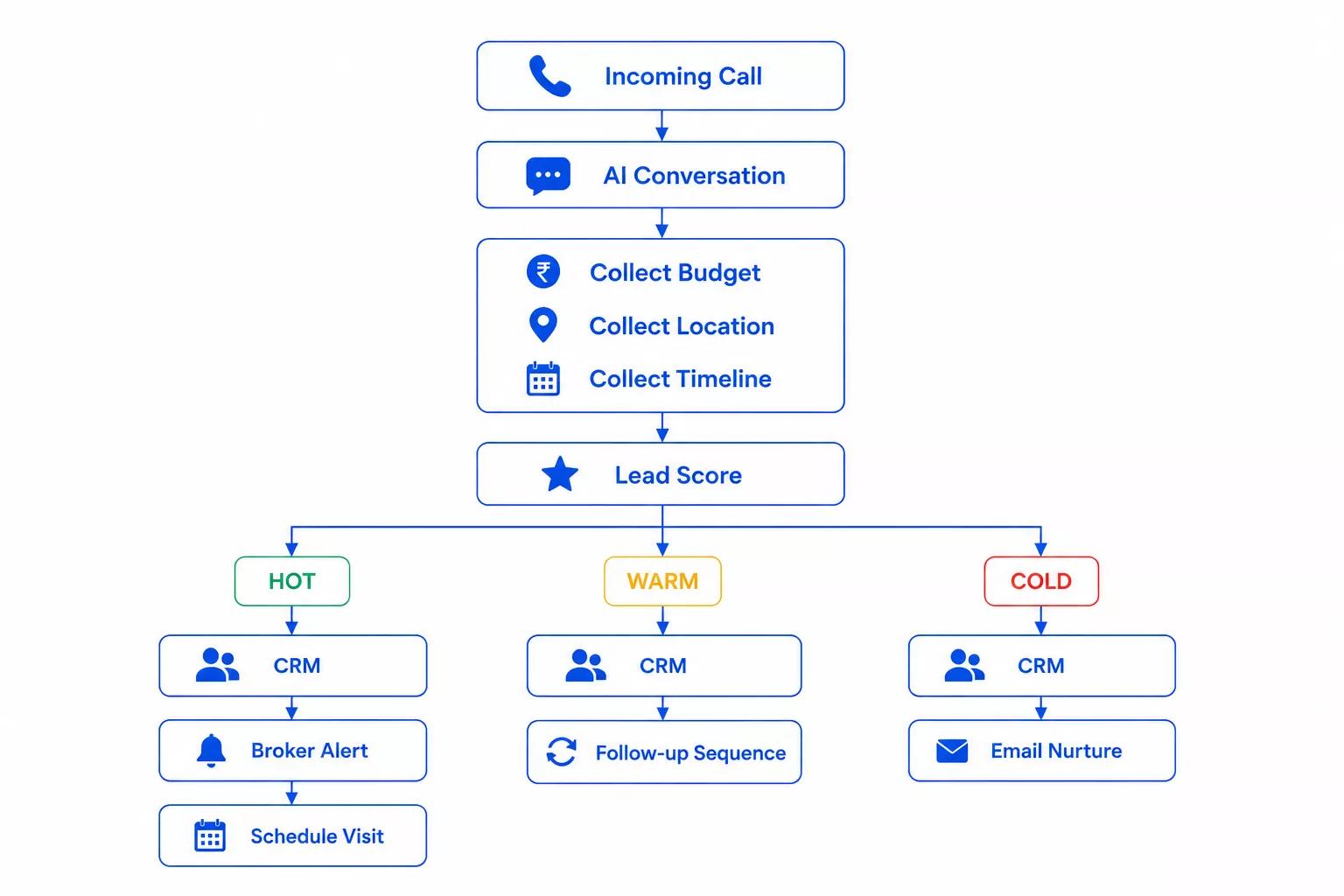
When the call ends, your Pipecat/LiveKit server sends the final, complete transcript payload to an n8n webhook. Now, n8n handles the post-call intelligence.
If you need help building and deploying this type of workflow, you can hire n8n experts to design, implement, and optimize your n8n automation.
Pass the transcript to an LLM node within n8n. To make this pipeline plug-and-play for your database architects, you must enforce a strict JSON schema. Use a system prompt that instructs the LLM to respond strictly in this JSON format, without conversational filler or markdown tags.
Looking to Build an AI Voice Agent for Your Brokerage?
Instead of building everything from scratch, our team can design, develop, and deploy a production-ready AI voice agent tailored to your CRM, telephony provider, and business workflows
Comparative Stack Analysis: Finding the Right Tools
When architecting a real estate automation stack, selecting the correct foundational tools dictates long-term scalability and maintenance costs.
Workflow Orchestration: n8n vs Zapier vs Make
A frequent question from technical teams is n8n vs Zapier for AI voice agents. While Zapier is excellent for linear tasks, voice agent infrastructure requires complex data transformations.
| Platform | Technical Strengths | Operational Limitations | Voice Agent Suitability |
|---|---|---|---|
| Zapier | Requires zero coding; massive app directory | High cost at scale; cannot natively handle complex nested JSON parsing efficiently | Low. Too rigid and expensive for high-volume conversational logs. |
| Make | Advanced visual interface; handles complex routing | Debugging complex API logic loops can be difficult in the visual UI | Medium. Capable, but execution pricing scales linearly with high volume. |
| n8n | Self-hosting options; custom JavaScript control; extensive error handling | Requires more technical expertise to configure | High. Functions as the industry standard for custom AI backend orchestration. |
To learn more about these platforms, read our blog: n8n vs Zapier vs Make: A Breakdown for Businesses
Evaluating Voice Stacks: Retell AI vs Vapi vs Sarvam
When analyzing Retell AI vs Vapi vs Sarvam for voice automation, the primary distinction is the target demographic.
| Feature / Platform | Retell AI & Vapi | Sarvam AI (via custom LiveKit/n8n orchestration) |
|---|---|---|
| Best For | US English markets; rapid deployment | Indian/South Asian markets; deep localization |
| Strengths | Extremely low latency; automated interruption handling built natively | Native support for 22 Indian languages; excels at regional accents and code-mixing |
| Limitations | Lower accuracy with heavy regional accents outside core Western languages | Requires deploying custom transport orchestration (LiveKit) for full conversational logic |
| Real Estate Fit | Appropriate for US, UK, and Australian property brokerages | Essential for Indian brokerages dealing in regional dialects |
Precise Cost Analysis: Total Cost of Ownership (TCO)
A true "build vs buy" analysis requires looking at the per-minute unit economics of a deployed AI voice agent compared to a human sales development representative.
Based on published API pricing from Sarvam, standard Indian telecom providers, and estimates for cloud infrastructure provisioning, the variable costs for a custom-built stack handling Indian real estate inquiries break down as follows:
- Speech-to-Text (Sarvam Saaras): ₹30 per hour of audio, which equates to exactly ₹0.50 per minute.
- Text-to-Speech (Sarvam Bulbul v3): ₹30 per 10,000 characters. Assuming a dense conversational output of ~800 characters per minute, this costs roughly ₹2.40 per minute.
- LLM Tokens (Sarvam-30B): Priced at ₹2.5 / ₹1.5 / ₹10 per 1M tokens (input/cached/output). Assuming standard real estate conversational contexts and output generation, token usage averages roughly ₹0.03 per minute.
- Telephony (Inbound SIP Trunk): Standard Indian inbound SIP trunks (like Exotel or Tata) for fielding inquiries run approximately ₹0.40 to ₹0.90 per minute.
- Infrastructure Estimate (LiveKit + n8n hosting): A dedicated server cluster capable of handling roughly 10,000 active minutes a month typically requires ₹4,000 to ₹6,000 monthly in cloud compute, adding an estimated ~₹0.50 per minute in fixed overhead distribution.
Total Variable Cost: Roughly ₹3.83 to ₹4.33 per minute (approx. $0.04 to $0.05 USD) of active conversation.
A standard 5-minute qualification call costs approximately ₹19 to ₹22 in raw compute and API fees. When compared to the fully loaded cost of a 24/7 human call center agent (including management overhead, software licenses, and attrition), the AI unit economics become highly favorable at scale.
Illustrative ROI: Modeling a Voice Agent Deployment
To understand the business impact of this technology, consider an illustrative operational model based on standard real estate telecom patterns.
If a mid-sized brokerage is experiencing a typical 30% to 40% missed-call rate for inquiries arriving after-hours or during peak weekend rushes, implementing this stack changes the operational math:
- Missed Calls: Drops to near-zero. The WebSocket infrastructure dynamically provisions concurrent agent instances to handle simultaneous queries, meaning no caller hears a busy signal.
- Lead Conversion Impact: The probability of qualifying a lead decreases sharply with time. By ensuring every prospect is instantly pre-qualified and handed off to human closers the next morning with a clear CRM summary, brokerages eliminate the "speed-to-lead" decay. Organizations utilizing automated top-of-funnel filtering routinely see structurally higher volumes of booked site visits simply because no high-intent inquiry is allowed to go cold.
Again, suppose, If your brokerage receives
- 400 calls/month
- misses 28%
Then, this equates to roughly 112 lost leads.
Now, If only 5% convert, despite the lost ones, that's still around 5–6 additional deals per month, and recovered with a 24/7 AI voice agent.
Strategic Implementation Paths: Build vs. Buy
After establishing the technical architecture, leadership teams face the build vs buy AI voice agent decision.
Option 1: In-House Custom Engineering
Building an inbound real estate call automation system internally provides complete control over data residency. However, your engineering team assumes responsibility for managing WebRTC server latency, handling VAD synchronization, resolving API rate limit errors, and continuously adjusting system prompts to prevent hallucinated property listings. Audio latency is the primary cause of user abandonment; if you cannot maintain the 1.5-second threshold, callers will disconnect.
Option 2: Partnering with an Implementation Agency
For most real estate firms, time-to-market and reliability are priorities. Engaging an established engineering firm removes the technical learning curve. A specialized n8n implementation partner already possesses the boilerplate for Pipecat/LiveKit integrations and backend orchestration, allowing brokerages to bypass the trial-and-error phase of audio transport engineering and secure Sarvam AI integration services reliably.
Option 3: Deploying Turnkey Solutions
If your organization requires the benefits of AI without managing architecture, securing a done-for-you real estate voice bot is the most direct commercial route. Procuring a real estate AI voice agent service means acquiring a product that has already undergone extensive field testing. These deployed solutions include pre-built call scripts and immediate CRM-integrated call logging, requiring virtually no technical oversight from the brokerage.
Ensuring Trust, Transparency, and Compliance in Lead Operations
Deploying an AI voice agent requires establishing strict data governance. A sustainable lead operations stack balances automated data capture with legal compliance.
For teams looking to build and scale similar AI-powered workflows, you can hire AI automation developers to handle the architecture, integrations, and production deployment.
Transparent Lead Scoring & Explainable AI
One of the main objections to automated qualification from human sales personnel is the lack of system visibility. To build trust, your workflow must maintain transparent lead scoring criteria.
Every prospect profile pushed to the CRM must include a brief, AI-generated summary explaining exactly why they received a specific score. This explainable AI lead qualification ensures that your human agents understand the factual context (e.g., "Assigned HOT status because the buyer verified a pre-approved mortgage and a 30-day timeline") before they contact the prospect for a follow-up discussion.
GDPR-Compliant Call Recording & SLA Enforcement
Handling personal financial budgets and direct contact information requires strict adherence to telecom and data privacy regulations. Your technical architecture must enforce GDPR-compliant call recording protocols. Furthermore, by integrating the AI workflow directly into your CRM operations, you ensure a SLA-based follow-up. If a lead is designated as 'Hot', the system automatically alerts the team to guarantee a human representative initiates contact, drastically increasing the closing probability.
If your team needs help architecting a resilient, low-latency AI communication stack, the engineering team at Ciphernutz IT Services specializes in custom n8n deployments, real-time voice integrations, and enterprise-grade PropTech automation consulting.
Why Trust Ciphernutz?
- Built & shipped compliance-ready AI automation solutions across industries (Real Estate, Healthcare, and Logistics)
- Experience integrating n8n, LiveKit, OpenAI, Sarvam AI and custom CRMs
- Expertise in developing and orchestrating multilingual AI automation (with AI Managed Pod)
- Production-grade deployment experience
Frequently Asked Questions (FAQs)
1. Why can't I just use n8n directly for the live voice agent conversation?
Standard HTTP webhooks and asynchronous orchestrators like n8n introduce too much latency for live audio. Sarvam's REST APIs also cap audio processing at 30 seconds. You need a WebRTC layer (like LiveKit or Pipecat) to handle the live WebSocket audio stream, while n8n handles the asynchronous CRM routing after the call ends.
2. How do you handle audio latency when checking a database mid-call?
Database queries via n8n webhooks take time. To prevent the caller from hanging up during the silence, the transport layer must be programmed to inject filler audio (e.g., "Let me pull up that inventory for you...") the moment the tool is called, masking the lookup latency until the LLM receives the data.
3. What makes Sarvam AI better for Indian real estate than US models?
Real estate in India involves heavy code-mixing (blending English with regional languages) and specific numerical scales like lakhs and crores. Sarvam's acoustic models (Saaras v3) are explicitly trained on Indian telecom audio, resulting in superior accuracy over standard Western models that fail on regional accents.
4. How much does it cost to run a Sarvam AI voice agent per minute?
Based on current API pricing, Sarvam's Speech-to-Text costs ₹0.50/min, and TTS costs roughly ₹2.40/min depending on character density. Factoring in LLM token usage, inbound SIP trunk telephony costs, and compute infrastructure, a custom voice agent runs roughly ₹3.83 to ₹4.33 ($0.04 - $0.05 USD) per active minute.
5. How do we prevent the voice agent from making up property prices?
You must enforce strict boundaries in the system prompt powering the LLM. The prompt must explicitly forbid quoting prices or guaranteeing availability unless that data is dynamically retrieved and injected into the context window via an active database lookup during the call.
6. What is the typical JSON data payload sent to the CRM after a call?
A typical payload extracted by the LLM contains the caller's phone number, core intent (buy/rent), requested property type (e.g., 3BHK), budget ceiling, location preference, timeline, and an algorithmic lead score (Hot/Warm/Cold) used by n8n to trigger automated calendar invites.