Role of AI in Emergency Department Triage Systems
Vijay Vamja
4-5 mins
Imagine walking into a crowded emergency room (ER). You notice patients with chest pain, injuries, or fever, waiting anxiously. The nurses are overwhelmed, while the doctors are rushing between cases, and every minute matters.
Now, What if an AI triage agent system could instantly guide patients to the right care path, analyze symptoms, and predict severity for better care delivery?
Instead of relying solely on manual intake, AI-powered triage agents analyze symptoms, vital signs, and patient data in real-time. It will prioritize whoever needs immediate care versus whose symptoms allow waiting safely.
This is not science fiction.
It’s the growing reality with the use of AI in emergency medicine, where AI-powered triage tools are transforming the way healthcare providers handle critical cases.
In simple terms: AI in emergency medicine acts like a digital triage nurse, helping hospitals and their teams reduce overcrowding and save lives, everyday.
Why Emergency Departments Struggle with Triage Process
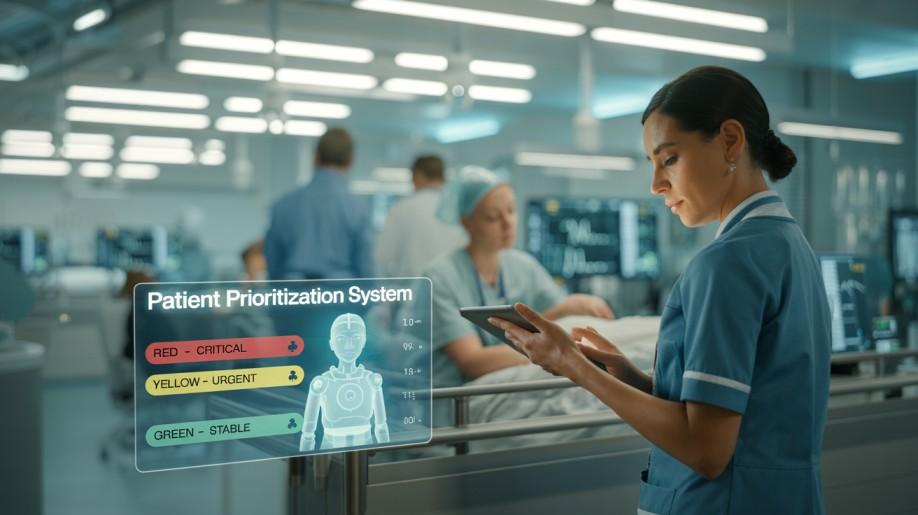
The emergency department is naturally overloaded with high patient inflow. They must often wait hours before being seen, and staff shortages further make this problem worse. Manual triage can be, therefore, called inconsistent depending on staff availability, experience levels, and mistakes carry high risk.
The pain points is clear:
- Overcrowding: High patient volume stretches resources.
- Delayed assessments: Manual triage often takes too long.
- Risk of error: Human fatigue and bias may affect accuracy.
- Limited staff: Nurse-to-patient ratios are challenging.
This is where triage AI agents step in, to perform by automation.
What is a Triage AI Agent System?
In hospitals, the triage AI agent is a digital assistant that uses machine learning, natural language processing, and predictive analytics to handle various healthcare processes.
You can integrate triage AI agent(s) to manage the following autonomously:
- Collect patient symptoms via text, voice, or digital kiosks
- Compare symptoms against millions of historical cases
- Predict urgency levels (critical, urgent, non-urgent)
- Recommend the next step: immediate physician attention, tests, or safe discharge
In more advanced setups, hospitals also deploy multi-agent systems (MAS) in healthcare workflows, where several AI agents collaborate.
For example:
- AI triage nurse agent for initial screening
- AI diagnostic agent for test prioritization
- AI workflow agent for resource allocation
This collaborative multi-agent system (MAS) in daily operation reduces and prevents bottlenecks, making the ER smarter and more efficient.
Benefits of AI in Emergency Medicine
| Benefit | Impact in the ER |
|---|---|
| Faster Triage | Cuts patient waiting times significantly. |
| Consistency | Reduces human error, especially in high-pressure situations. |
| Better Patient Flow | Routes low-acuity cases to urgent care or telehealth. |
| Staff Efficiency | Frees nurses and doctors from repetitive intake. |
| Patient Safety | Ensures high-risk patients are identified instantly. |
| Cost Savings | Decreases unnecessary ER usage and resource waste. |
How AI Improves Emergency Triage Systems
AI triage systems receive patient data, collect & analyze it, and assign priority scores based on severity.
Here’s how it works:
1. Patient Input
Symptoms are shared via kiosks, mobile apps, or chatbots.
2. AI Analysis
A triage AI tool uses NLP + predictive models to interpret symptoms.
3. Risk Scoring
AI assigns urgency levels: immediate, urgent, routine, or self-care.
4. Alerts & Routing
Critical cases are flagged to clinicians, while low-risk patients are routed elsewhere.
5. EHR Integration
Notes are synced into the hospital’s electronic health records (EHR).
Direct Value: Patients get seen faster, clinicians focus on true emergencies, and hospitals optimize staff resources.
AI Triage Nurse: The Digital First Responder
Think of the AI triage nurse as an intelligent front desk assistant:
- Always available, 24/7.
- Able to ask consistent intake questions.
- Provides structured, actionable information to the medical team.
In practice, an AI triage tool can act as the first layer of emergency care, screening and routing patients before they even meet a clinician.
Multi-Agent Systems (MAS) in Healthcare Triage
The future of emergency medicine isn’t just about one AI tool, it’s about multi-agent systems (MAS).
- A triage AI agent handles intake and urgency.
- A documentation agent creates initial SOAP notes.
- A scheduling agent fills slots and manages waitlists.
- A discharge agent generates instructions and follow-ups.
Together, these agents build a smarter emergency department ecosystem where care is faster, safer, and more scalable.
Real-World Example
A patient enters the ER with: "I’ve had chest pain for two hours and difficulty breathing."
- The AI triage system flags a potential heart attack.
- The case is marked high priority and escalated to a physician immediately.
- Structured intake notes appear in the EHR, saving clinicians 10+ minutes of documentation.
- Meanwhile, patients with minor injuries are safely routed to urgent care.
Result: life-threatening cases get immediate attention while overall ER flow improves.
Implementing AI in Emergency Triage
Hospitals usually partner with an AI agent development company or hire AI agent developers to customize these systems.
Key steps include:
- Workflow mapping: Define intake, routing, and escalation paths.
- Compliance: Ensure HIPAA, consent, and audit trail safeguards.
- Integration: Sync with existing healthcare IT solutions like EHRs, LIS, and telehealth solutions.
- Monitoring: Establish and use clinician feedback loops to improve accuracy.
The right healthcare IT consulting company can help you design, build, and deploy AI triage systems safely.
How to Get Started with AI Triage Agents
If you’re considering building or integrating a triage AI agent system, here’s the roadmap:
1. Identify Pain Points:
Patient flow bottlenecks, triage delays, or misclassification.
2. Consult Experts:
Work with healthcare IT consulting companies to assess IT solution feasibility & potentially supportive innovations.
3. Hire AI Agent Developers:
Build custom MAS systems tailored to your hospital workflows & data management needs.
4. Integration with EHR/EMR:
Ensure seamless data flow across systems.
5. Continuous Training:
Keep models updated with real-time medical data.
That’s exactly what we help with at Ciphernutz IT Services. We deliver scalable healthcare solutions that improve triage accuracy, speed, and patient safety.
Future Outlook: AI + Predictive Emergency Medicine
The next evolution of emergency triage is predictive and proactive care.
- AI + Wearables: Real-time monitoring of vitals for early warnings.
- Smart Hospitals: AI agents connected to IoT devices for instant alerts.
- Predictive Analytics: Forecasting patient surges to optimize staff allocation.
- Personalized Triage: Using patient history + AI to tailor recommendations.
The future emergency triage system won’t just treat patients faster, it will predict and prevent crises before they happen.
Conclusion
AI is reshaping emergency department triage from reactive intake to proactive, predictive care. By reducing wait times, improving patient flow, and supporting staff, AI triage tools are fast becoming a must-have in modern hospitals.
For providers, the opportunity is clear: partnering with the right AI agent development company is the fastest way to move from today’s overcrowded ERs to the smart, efficient emergency department of tomorrow.
FAQs
1. What is the role of AI in emergency department triage?
AI helps assess patient symptoms, assign urgency, and guide them to the right care pathway, reducing delays and errors.
2. Can AI replace triage nurses in the ER?
No. AI supports nurses by automating intake and prioritization, but human clinicians still make the final decisions.
3. How accurate are AI triage tools?
Studies show that AI triage systems can match or exceed human triage accuracy, especially for high-volume, routine cases.
4. What are examples of AI in emergency medicine?
AI triage nurses, symptom checkers, and predictive analytics tools for ER capacity management.
5. How can a hospital implement an AI triage system?
Work with an AI agent development company or healthcare IT services provider to design, integrate, and deploy a compliant solution.