What is a Triage AI Agent & How Do They Work?
Milind Barot
4-6 mins
What is a Triage AI Agent?
A triage AI agent is an artificial intelligence system that helps healthcare providers quickly assess, categorize, and prioritize patients based on the urgency of their medical needs. It uses natural language processing (NLP), medical knowledge bases, and predictive algorithms to support clinical decision-making, reduce waiting times, and ensure that critical patients get immediate attention.
In simple terms: A triage AI agent acts like a digital nurse assistant that listens to symptoms, analyzes them, and routes patients to the right care, faster.
Why Hospitals Need Triage AI Agents
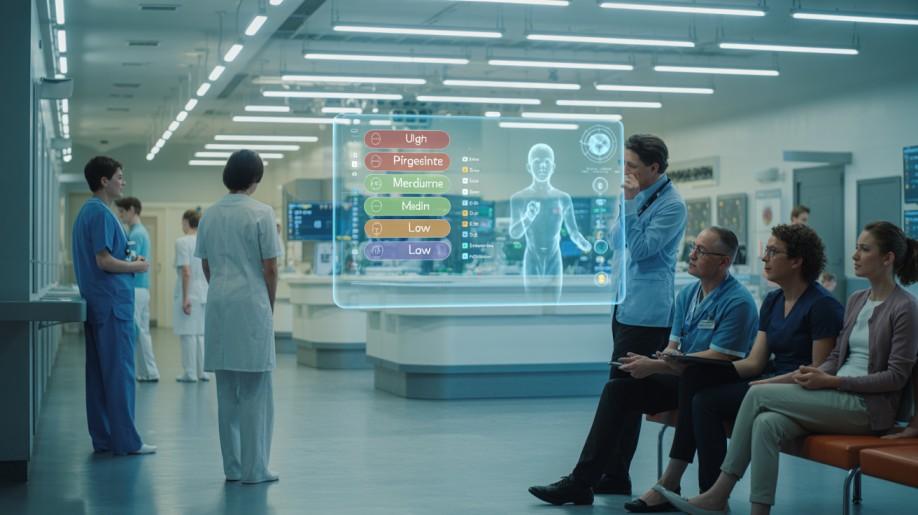
Traditional triage is time-consuming and depends heavily on human staff who may already be overwhelmed. Emergency departments regularly face:
- Long patient queues.
- Clinician burnout.
- Risk of mis-prioritization.
This ensures hospitals can:
- Treat emergencies first.
- Reduce average waiting time.
- Improve patient satisfaction.
Considering a triage AI agent for your hospital, clinic, or care network?
Ciphernutz builds HIPAA-compliant triage and patient-intake automation that integrates with your existing EHR.
Role of Triage AI Agents in Healthcare
Triage AI in healthcare addresses one of the biggest pain points: overwhelmed staff and delayed care.
- Patient side: No more waiting for weeks for an appointment only to be told it wasn’t urgent.
- Clinician side: Physicians spend less time on repetitive intake questions and more time on diagnosis.
- Hospital side: Hospitals use triage AI to reduce ER overload and optimize scheduling.
In fact, many hospitals and telehealth platforms now see triage AI agents as essentials for digital front door strategies, helping patients get the right care, faster.
How Do Triage AI Agents Work? (Step by Step)
Triage AI agents work by collecting patient information, analyzing symptoms, assigning urgency scores, and routing the patient to the appropriate care path.
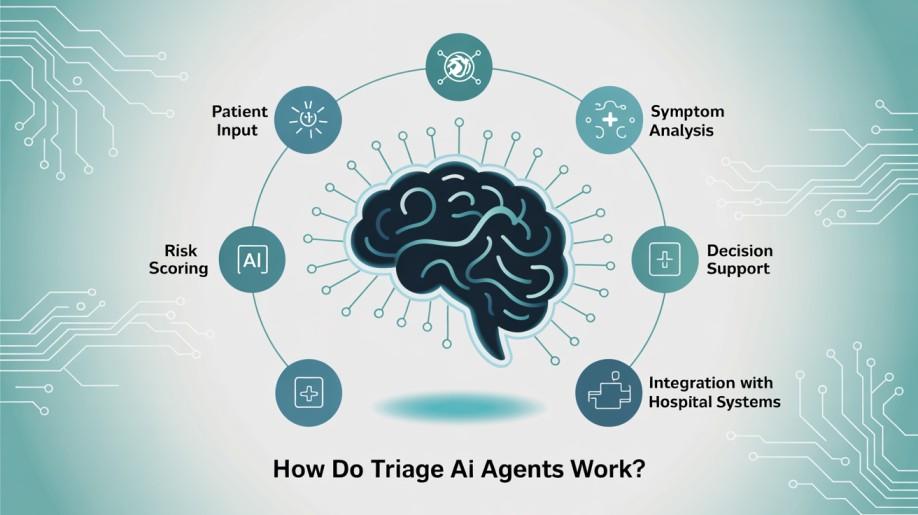
Here’s the workflow:
1. Patient Input
Patients share symptoms via chatbot, voice assistant, or kiosk.
2. Symptom Analysis
The AI uses NLP to interpret the patient’s language and match symptoms with medical databases.
3. Risk Scoring
The agent applies triage protocols (like ESI or CTAS) + machine learning models to classify the severity (e.g., critical, urgent, non-urgent).
4. Decision Support
Suggests next steps: emergency care, specialist consultation, or self-care instructions.
5. Integration with Hospital Systems
- Syncs with EHR/EMR for seamless handoff to doctors.
- Updates patient queue and scheduling systems.
In real-world hospitals, triage AI doesn’t replace doctors, it augments clinicians by handling repetitive intake work, so they can focus on care.
See how triage agents work in hospitals, Real deployment patterns, integrations and pitfalls.
How Triage AI Agents Work vs. Traditional Intake
| Step | Traditional Intake | Triage AI Agent System |
|---|---|---|
| Symptom Collection | Manual forms, front-desk questions, or nurse calls | Automated form-filling via chat/voice, 24/7 availability for correspondence |
| Understanding Context | Relies on human interpretation | AI uses NLP + medical rules to interpret symptoms |
| Urgency Prioritization | Nurse/doctor judgment, often delayed | Real-time risk scoring (emergency, urgent, routine, self-care) |
| Routing Patients | Manual scheduling, long wait times | Smart routing to telehealth, ER, or self-care instantly |
| Integration with EHR | Notes added later, risk of data gaps | Auto-generated intake notes sent directly to EHR |
| Efficiency | Time-consuming, staff heavy | Reduces workload, improves patient flow |
Key Benefits of Triage AI Agents
- Faster patient flow → Reduce bottlenecks in emergency departments.
- Reduced staff burnout → Automates repetitive intake questions.
- Improved accuracy → Consistent triage decisions using data-driven models.
- 24/7 availability → Patients can access care anytime through virtual assistants.
- Better patient experience → Shorter wait times and smoother handoffs.
Real-World Example
A busy urban hospital adopted an AI triage chatbot in its ER (Emergency Room). Within three months:
- Waiting times for non-urgent patients dropped by 27%.
- Clinicians saved 2-3 minutes per patient intake.
- Patient satisfaction scores improved significantly.
Let’s understand this with example:
Imagine a patient opens their provider’s app and types:"I have chest pain when climbing stairs, and it started yesterday."
The triage AI agent immediately:
- Flags potential cardiac risk.
- Suggests urgent care/ER visit.
- Notifies a nurse or physician dashboard.
- Stores a structured report in the EHR.
This shows how triage AI directly impacts both efficiency and patient outcomes.
Real-World Use Cases of Triage AI Agents
1. Emergency Department Triage
Hospitals use a Triage AI system to instantly classify ED arrivals, with included follow-up about recommendations, and predictive insights on optimal treatments with individualistic success rates. For example:
- Chest pain patients → Immediate cardiology consult, with the data and recommendations delivered to the specialist. The first visit with a specialist is complete with them informed about the patient history, current symptoms, and possible treatment plans.
- Minor injuries → Scheduled for standard treatment later, but not without the recommended care applied or passed on to the patient for better accessibility and care experience.
Read more: AI in Emergency Department Triage
2. Virtual Triage for Telehealth
AI agents integrated into patient portals or telehealth apps can pre-screen symptoms before virtual visits, helping doctors prepare and plan ahead.
3. Smart Scheduling
AI-driven triage can route non-urgent cases to next-day outpatient clinics, reducing ED congestion and prioritizing continuity of care in all scenarios.
4. Chronic Disease Monitoring
For repeat patients (e.g., diabetes, heart disease), AI triage agents analyze ongoing health data to flag deteriorations early. Concurrently, the triage agents also perform predictive analysis to warn patients and the healthcare specialist days before critical needs.
Case Study: How Hospitals Are Using Triage AI Today
Example 1: Mayo Clinic Platform's Perspective on AI-Assisted Sepsis Detection
Context: Rather than a single quantified pilot, Mayo Clinic Platform - Mayo Clinic's digital and AI division - has been publicly evaluating where AI adds the most value in ED triage.
What the evidence shows: Published research comparing AI-driven sepsis-detection models against standard Emergency Severity Index (ESI) screening found the AI models identified high-risk sepsis patients faster and more reliably than ESI alone. Mayo Clinic Platform's own emergency medicine leadership has said AI can meaningfully supplement, not replace, triage and clinical decision-making in the ED.
Example 2: NHS App's 2026 AI Triage Rollout (UK)
Challenge: The NHS needed a way to cut the 8 a.m. rush of patients calling GP practices for same-day appointments, and to route people to the right level of care faster.
Solution: NHS England is rolling out an AI-powered triage tool inside the NHS App, following a trial at Wealden Ridge Medical Partnership in Sussex, a practice serving 23,000 patients.
Result: The Sussex trial cut the number of patients waiting in telephone queues by 29%, with no drop in patient satisfaction. The tool is expanding to more than 200,000 patients within a year, with full national rollout targeted for April 2028, as part of a £10 billion NHS technology investment.
Example 3: Mount Sinai Health System's Admission-Prediction Study
Challenge: Across its seven New York hospitals, Mount Sinai needed a faster way to know which arriving ED patients would ultimately need an inpatient bed.
Solution: Researchers compared a machine learning model - trained on more than 1 million past ED visits - against real-time assessments from more than 500 emergency nurses, across nearly 50,000 patient visits over two months.
Result: The model matched or outperformed nurse-based predictions and flagged likely admissions hours earlier than standard workflows allow, giving staff more lead time to arrange beds and specialists. Mount Sinai is now testing the model in live workflows to measure its effect on boarding and throughput.
Example 4: Peer-Reviewed Evidence Across Three Emergency Departments
Challenge: Most triage AI claims come from vendor case studies or single-hospital pilots, which makes it hard for hospital leadership to separate marketing from clinical evidence.
Solution: A multisite quality improvement study published in NEJM AI evaluated an AI-informed triage clinical decision support tool across three emergency departments, comparing 83,404 patient visits before the tool went live with 91,244 visits after it did - 174,648 visits in total.
Result: Correct identification of patients needing critical care (ESI level 1 or 2) rose from 78.8% to 83.1%, and median time from arrival to an initial care area dropped 33%, from 12 minutes to 8. Rates of hospitalization, ICU admission, and in-hospital death held steady — evidence, the study's authors note, that the tool re-sorted patients into more accurate acuity levels without changing who actually needed intensive care.
Lessons Learned from These Hospitals
- Integration is key: Hospitals succeeded when AI was embedded into existing EHR workflows, not added as a standalone tool.
- Transparency builds trust: Clinicians were more likely to adopt AI when its risk-ranking logic was clear and explainable.
- Patient satisfaction rises: Digital check-ins gave patients confidence that their cases were being assessed quickly and fairly.
How to Build or Implement a Triage AI Agent
Healthcare providers usually partner with an AI agent development company or hire AI agent developers to build and integrate these systems.
Key steps include:
- Define workflows: Emergency, outpatient, telehealth, follow-up.
- Integrate with EHR: Epic, Cerner, MEDITECH, or athena.
- Compliance guardrails: HIPAA, consent logs, audit trails.
- Deploy and monitor: Continuous tuning with clinician feedback.
If you’re evaluating healthcare IT services, look for vendors who specialize in healthcare software development services with strong experience in AI triage.
Automating Triage with Medical Chatbots and n8n
Building a chatbot is only half the battle if it does not auto-receive its commands or next instructions. To unlock full value, it must connect with EHRs, CRMs, appointment systems, and secure databases. This is where n8n comes in to create a unified experience.
n8n is a workflow automation platform that enables no-code/low-code integrations between AI agents, CRMs, and healthcare systems.
N8N AI Integration
n8n AI integration allows chatbots to automatically:
- Send triage results into the EHR
- Trigger appointment scheduling in real-time
- Update CRM records with patient interactions.
N8N HIPAA Compliance
For healthcare, compliance is non-negotiable. n8n enables workflows that respect HIPAA compliance by:
- Ensuring data encryption
- Restricting access with role-based permissions
- Maintaining auditable logs
N8N AI Agent Workflows & Use Cases
AI chatbots become even more powerful when paired with n8n AI agent workflows.
Example Workflow:
- Patient enters their chest pain symptoms in the chatbot.
- An AI triage agent understands the urgency and flags it for immediate assessment.
- n8n workflow instantly:
- Notifies ER staff
- Updates patient EHR record
- Sends SMS or alerts to the patient with hospital directions
Other n8n AI agent use cases include:
- Prescription refill requests
- Lab result notifications
- Chronic disease management reminders
Triage AI Agents Beyond Healthcare: IT, Customer Service, and Cybersecurity
The same core logic behind healthcare triage AI agents - assess, score, route - applies well outside the hospital. In IT service management, a triage AI agent reads an incoming ticket, classifies its urgency and category, and routes it to the right queue instead of a human agent sorting through a backlog.
In customer support, it separates a billing question from a service outage report and escalates accordingly, cutting first-response time. In cybersecurity operations centers, a SOC triage agent filters, enriches, and prioritizes security alerts so analysts focus on the incidents most likely to be real threats, rather than chasing every automated alert individually.
The underlying architecture - intake, natural language understanding, risk or priority scoring, and routing - stays consistent across every use case. What changes is the knowledge base the agent draws on: medical protocols for healthcare, ticketing taxonomies for IT, or threat intelligence feeds for security.
Organizations building a triage AI agent for any of these functions face the same core decision hospitals do: how much autonomy to give the agent, and where a human needs to stay in the loop.
The Future of Triage: AI, Predictive Analytics & Smart Hospitals
The future of triage is not just about symptom checkers, it’s about predictive, personalized, and proactive care.
1. Predictive Analytics
Triage AI agents will soon analyze not only symptoms but also wearable data, medical history, and population health trends to forecast risks before they escalate. Imagine an AI alerting both patient and provider days before a potential cardiac episode.
2. Integration with Smart Hospitals
As healthcare IT solutions evolve, triage agents will become the entry point to “smart hospitals,” automatically syncing with IoT devices, remote monitoring systems, and digital twins of patients.
3. Multi-Agent Collaboration
In the near future, triage AI agents won’t work alone. They will hand off seamlessly to AI documentation agents, scheduling agents, and discharge agents, building a full AI-powered care continuum.
4. Patient-Centric Experience
Tomorrow’s digital front door won’t just route patients; it will personalize every interaction, from triage to follow-up, making care faster, safer, and more empathetic.
The future of triage AI is about shifting from reactive care to anticipatory healthcare, powered by predictive analytics and intelligent healthcare IT systems. Hospitals that invest today in triage AI agents will be tomorrow’s leaders in efficiency, patient trust, and innovation.
How to Choose the Right Triage AI Agent Development Partner
Choosing a triage AI agent vendor is not the same decision as choosing an EHR add-on. The system will make real-time judgments about patient urgency, so the evaluation bar should be higher.
Key Evaluation Criteria for Hospitals and Clinics
Before signing with a vendor, hospitals should ask for evidence, not marketing claims, in these areas:
- Clinical validation data specific to a supervised deployment, not a general-purpose chatbot benchmark
- Native support for ESI, CTAS, or Manchester Triage System protocols, whichever your facility already uses
- FHIR-compliant integration with your existing EHR (Epic, Cerner, MEDITECH, or athenahealth)
- HIPAA safeguards by design: encryption, audit trails, role-based access, and a signed BAA
- A clear escalation path where clinicians can override or review every AI recommendation
- Published or third-party bias testing across age, sex, and ethnic groups
Exploring a triage agent for your practice?
We build AI agents that connect to your existing systems - scoped around one clear outcome.
What Ciphernutz Delivers for Healthcare Triage Automation
Ciphernutz builds HIPAA-compliant clinical workflow automation, including patient intake, appointment scheduling, and triage-adjacent systems. All of them are possible to integrate directly with existing EHR platforms through FHIR R4 APIs.
Our [WhatsApp AI appointment agent for clinics] shows this approach in production: an AI agent handling patient-facing scheduling and intake with measurable reductions in no-shows and front-desk workload - the same intake layer a triage AI agent depends on.
For hospitals evaluating agentic AI development for clinical use cases, our agentic AI development team can scope a pilot around your existing EHR and compliance requirements, often using n8n-based workflow automation to connect the triage layer to scheduling, EHR, and alerting systems without replacing your core platform.
Final Thoughts
Triage AI agents are not futuristic, they’re a real-world technology already transforming hospitals today. By automating intake and prioritization, they free up clinicians, reduce wait times, and improve patient outcomes.
For hospitals, adopting triage AI isn’t just about saving time, it’s about delivering faster, safer, and smarter care to every patient.
If you’re exploring triage AI agent systems, the next step could be to partner with a trusted AI agent development company to build and deploy a solution that fits your specific operations.
FAQs
Q. What is a triage AI agent?
A triage AI agent is a digital healthcare assistant that evaluates patient symptoms, prioritizes urgency, and guides them to the right care pathway.
Q. How do triage AI agents work in hospitals?
They collect patient input (chat/voice), analyze symptoms with AI models, assign urgency scores, and recommend next steps while syncing with EHR systems.
Q. Can triage AI replace human doctors?
No. Triage AI supports, but does not replace, clinicians. It automates intake and prioritization so doctors can focus on diagnosis and treatment.
Q. How accurate are triage AI systems?
Modern AI agents trained on medical datasets and validated triage protocols can achieve 80-90% accuracy, though they must always be supervised by clinicians.
Q. Is patient data safe with triage AI?
Yes, if deployed correctly. Triage AI must comply with HIPAA, GDPR, and healthcare data security standards to protect sensitive patient information.
Q. How do patients interact with triage AI?
Patients typically interact through chatbots, mobile apps, hospital websites, or smart kiosks in emergency rooms.
Q. How accurate is a triage AI agent compared to human triage nurses?
Published 2025 research shows agreement rates of roughly 85% between AI triage tools and physician assessments, with the most rigorous studies showing measurable improvements in identifying patients who need critical care. Accuracy varies significantly by system design, and results from consumer chatbots should not be assumed to apply to clinically validated, protocol-based tools.
Q. What triage protocols do triage AI agents follow?
Most clinically deployed systems are built around an established scale such as the Emergency Severity Index, the Canadian Triage and Acuity Scale, or the Manchester Triage System, layering machine learning on top of the same five-level urgency framework clinicians already use.
Q. Can a triage AI agent be used outside of healthcare?
Yes. The same access-score-route logic powers triage AI agents in IT service management, customer support ticketing, and cybersecurity alert triage, though each domain uses a different knowledge base and risk model.