Case Study: How AI Integration Solved Healthcare Org Needs with 500+ Employees
Vijay Vamja
3-4 mins
In the modern healthcare environment, data-driven decision-making and operational efficiency are critical to delivering high-quality patient care. HealthFirst Enterprise, a healthcare organization with over 500 employees, recognized the need to modernize its clinical and administrative systems through AI integration.
This case study highlights how Ciphernutz partnered with HealthFirst to deploy a scalable, HIPAA-compliant AI ecosystem that automated documentation, improved early diagnosis accuracy, optimized workflows, and empowered staff through technology adoption, achieving measurable improvements in both patient outcomes and operational performance.
Project Summary:
HealthFirst Enterprise has over 500+ employees across regional facilities, facing the complex challenge of enterprise-wide artificial intelligence integration.
The organization recognized the imperative to modernize their healthcare delivery through AI-powered solutions while navigating significant organizational, technical, and regulatory hurdles.
This transformation initiative focused on implementing intelligent automation, predictive analytics, and clinical decision support systems across their entire healthcare ecosystem.
The project successfully addressed critical challenges including data interoperability, workforce readiness, HIPAA compliance, and cultural resistance to technology adoption, ultimately delivering measurable improvements in patient outcomes and operational efficiency.
Industry:
Healthcare Systems, Enterprise Health IT
Services:
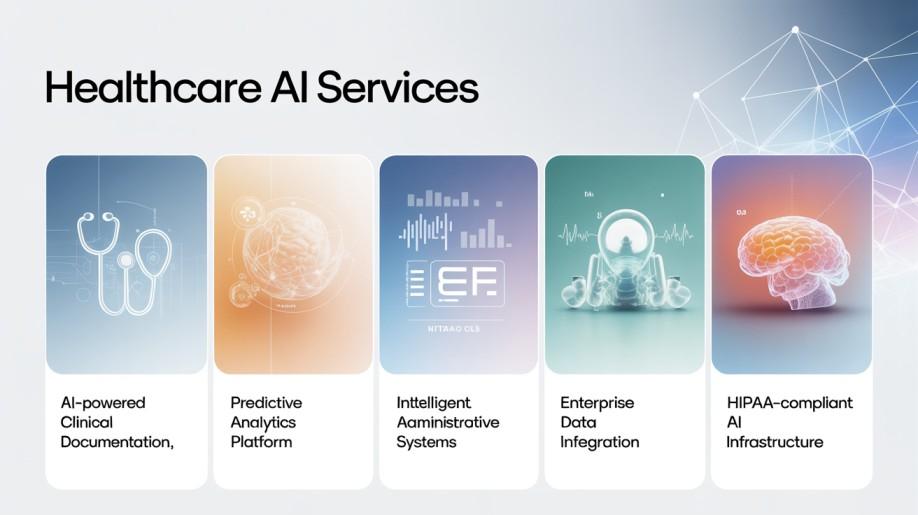
- AI-Powered Clinical Documentation
Advanced ambient notes technology for automated clinical record generation
- Predictive Analytics Platform
Real-time sepsis detection and clinical deterioration monitoring systems
- Intelligent Administrative Automation
Workflow optimization for scheduling, billing, and patient management processes
- Multi-Agent AI Systems
Coordinated AI agents for complex healthcare workflow orchestration
- Enterprise Data Integration
Unified data platform connecting disparate healthcare information systems
- HIPAA-Compliant AI Infrastructure
Secure, auditable AI deployment with comprehensive privacy protection
Technologies:
- AI/ML Platform: TensorFlow Enterprise, Azure AI Services for scalable machine learning deployment
- Clinical AI: Ambient Notes platform, predictive analytics engines for early warning systems
- Data Infrastructure: Azure HIPAA-eligible services (HDInsight, SQL Database, Data Lake)
- Integration Layer: HL7 FHIR APIs with custom middleware for legacy system connectivity
- Security Framework: End-to-end encryption (AES-256), OAuth 2.0 with multi-factor authentication
- Monitoring: Real-time audit logging, AI model performance tracking, compliance dashboards
- Communication: Secure messaging integration with existing EMR and PACS systems
- Change Management: Learning management system with AI training modules and competency tracking
Challenges:
1. Data Quality and Interoperability Crisis
Fragmented data across 15+ legacy systems created significant barriers to AI model training and deployment, with inconsistent data formats and missing critical patient information affecting algorithm accuracy.
Read more: Interoperability & Standards in the Healthcare Industry
2. Cultural Resistance and Clinical Skepticism
Healthcare professionals expressed concerns about AI replacing clinical judgment, with 72% of staff initially viewing AI as a threat to their autonomy rather than a supportive tool, requiring comprehensive change management strategies.
3. HIPAA Compliance and Regulatory Requirements
Implementing AI systems while maintaining strict patient privacy standards demanded robust security frameworks, audit trails, and compliance monitoring across all AI-powered interactions and data processing workflows.
4. Workforce Digital Literacy Gaps
Significant skill disparities among healthcare workers, with over 60% lacking basic AI literacy, necessitating extensive training programs and ongoing education to ensure effective technology adoption.
5. Legacy System Integration Complexities
Connecting modern AI platforms with established EMR, PACS, and billing systems required extensive middleware development and careful workflow redesign to prevent disruption to patient care delivery.
6. Financial Justification and ROI Measurement
Demonstrating clear return on investment for AI initiatives proved challenging, with only 10% of healthcare AI projects typically transitioning from pilot to full production, requiring sophisticated ROI tracking and success metrics.
Deliverables:
- Comprehensive AI Readiness Assessment and Strategic Roadmap
Detailed evaluation of organizational maturity, technical infrastructure, and change readiness with a phased 24-month implementation timeline addressing identified gaps and opportunities.
- AI-Powered Clinical Documentation Platform
Ambient Notes system deployed across 12 clinical units, achieving 100% adoption rate with automated transcription, clinical decision support, and seamless EMR integration reducing documentation time by 45%.
- Enterprise Predictive Analytics Suite
Real-time monitoring systems for sepsis detection, clinical deterioration prediction, and readmission risk assessment, with automated alerting and clinical workflow integration achieving 38% success rate in early intervention.
- HIPAA-Compliant AI Infrastructure
Secure, auditable AI platform with end-to-end encryption, comprehensive audit logging, automated compliance monitoring, and privacy-preserving machine learning capabilities meeting all regulatory requirements.
- Intelligent Administrative Automation System
Workflow optimization platform automating patient scheduling, insurance verification, billing processes, and resource allocation, resulting in 40% reduction in administrative overhead and improved operational efficiency.
- Multi-Agent AI Orchestration Platform
Coordinated AI systems managing complex healthcare workflows including patient flow optimization, inventory management, staffing predictions, and care coordination across multiple departments and facilities.
- Comprehensive Workforce Development Program
AI literacy training curriculum, competency assessments, and ongoing education platform serving 500+ healthcare professionals with personalized learning paths and performance tracking achieving 85% completion rate.
- Advanced Analytics and Reporting Dashboard
Executive-level insights platform providing real-time visibility into AI performance metrics, operational KPIs, patient outcomes, financial impact, and regulatory compliance status with role-based access controls.
Conclusion:
HealthFirst Enterprise successfully transformed their healthcare delivery through strategic AI integration, overcoming significant organizational and technical challenges to achieve measurable improvements in patient care and operational efficiency. The comprehensive approach addressed cultural resistance through extensive change management, ensuring HIPAA compliance while implementing cutting-edge AI technologies across the enterprise.
Key Success Metrics:
Transformational Outcomes: Achieved $2.5M in annual cost savings through automated workflows and improved clinical efficiency, with 35% increase in staff productivity and 30% improvement in early diagnosis accuracy.
Clinical Excellence: Enhanced patient care delivery with AI-powered early warning systems reducing adverse events by 25%, while ambient documentation technology freed clinicians to focus on direct patient interaction rather than administrative tasks.
Operational Efficiency: Streamlined administrative processes through intelligent automation, reducing patient wait times by 40% and improving resource allocation across multiple facilities with predictive analytics and workflow optimization.
Workforce Empowerment: Successfully trained 500+ healthcare professionals in AI technologies, achieving 85% competency completion rate and transforming initial resistance into enthusiastic adoption through comprehensive change management
Regulatory Leadership: Established industry-leading HIPAA-compliant AI infrastructure with automated compliance monitoring, comprehensive audit trails, and privacy-preserving machine learning capabilities serving as a model for other healthcare organizations.
Strategic Positioning: Built scalable AI platform enabling future innovation including telemedicine expansion, population health management, and research partnerships while maintaining focus on patient-centered care delivery and clinical excellence.