How to Automate Hiring with an AI Recruiter?
Vijay Vamja
4-5 mins
Imagine you hire your next star employee by an AI recruiter working tirelessly behind the scenes while you finish your morning coffee. Today, it's not a dream but a reality that's reshaping talent acquisition. Nearly every hiring manager uses AI to unlock higher efficiency, making recruitment automation no longer a futuristic perk but a competitive necessity.
Modern AI recruiters aren't here to replace human intuition but to amplify it. Through automated talent sourcing and screening, HR recruitment automation solutions are helping HR teams focus on nurturing culture, crafting strategy, and human connection.
To unlock the full potential of AI-driven hiring, it's fundamental to understand the practical applications and the must-know details down to the fine print.
Understanding Hiring Automation and AI Recruiter
What is an AI Recruiter?
The AI recruiter is a digital assistant powered by artificial intelligence to streamline and optimize the entire hiring process. Unlike traditional methods, modern recruitment automation software is a sophisticated system capable of understanding context and intent and even predicting candidate success.
By leveraging data-driven algorithms and machine learning, the AI recruiter can automate candidate sourcing, screening, and engagement. Moreover, similar AI recruiting tools can craft personalized outreach messages and job descriptions, transforming candidate engagement into a tailored experience.
Key Features of Recruitment Automation Software
Modern recruitment automation software consists of several features that collectively enhance the talent acquisition experience. While it's further possible to use integrations to expand the set of features, the AI recruitment automation software is usually available as an all-in-one solution.
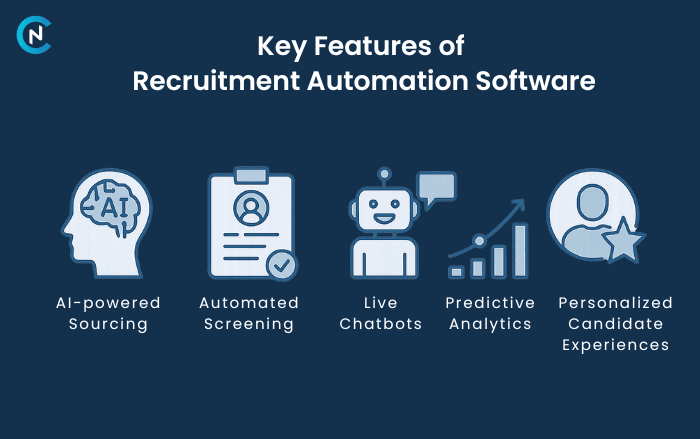
- AI-powered Sourcing: Identify and rank top candidates automatically from multiple channels, with all the data backed up on the cloud for real-time access.
- Automated Screening: Assigning predefined criteria to shortlist candidates reduces manual effort and bias without overlooking top picks.
- Live Chatbots: Engage with candidates 24x7 and answer FAQs or schedule interviews and conduct pre-screening assessments automatically without additional human effort.
- Predictive Analytics: Forecast hiring success and identify potential talent gaps to build efficient teams and achieve strategic success.
- Personalized Candidate Experiences: Deliver customized job recommendations and communications based on individual profiles.
If you can think of several additional ways to accelerate the hiring process, it's worth building it. Connect with Gen AI and Agentic AI developers at Ciphernutz to build your next hiring recruitment solution.
Benefits of AI Recruitment Tools
Ensuring a consistent and engaging experience for all candidates is a must across the recruitment lifecycle. Fortunately, AI recruiter delivers it all, with the following tangible benefits.
- Reduced time-to-hire: Automation of sourcing and screening lets recruiters fill positions faster without sacrificing quality prospects.
- Improved Quality of Hire: Data-driven insights assist with identifying candidates who are both qualified and a strong cultural fit.
- Lower Operational Costs: Planned automation of manual tasks reduces the need for additional HR staff, thereby minimizing hiring errors that can prove costly.
- Enhance Inclusion: Adopting AI can help mitigate conscious bias by placing focus on skills and experience rather than demographic factors.
- Better Candidate Experiences: Delivering instant responses, personalized communication, and streamlined processes attracts top talent and creates a positive impression.
Implement Hiring Automation with an AI Recruiter
Formulating a strategic implementation of hiring automation solutions is crucial to drive long-term results and all of the benefits it adds. Therefore, you can either follow the steps below to set up AI-powered recruiting or contact us.
Steps to Integrate AI in Recruitment
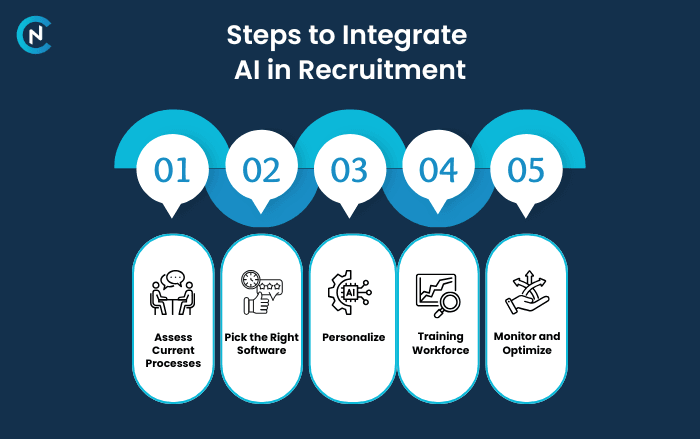
- Assess Current Processes: Beginning with mapping out the current recruitment workflows to identify bottlenecks is mandatory to recognize areas that can benefit from automation.
- Pick the Right Recruitment Automation Software: Evaluate the recruitment solution based on features, scalability, integration capabilities, and user experience.
- Customization: Manually adjusting the platform to your organization's unique requirements is beneficial to ensure seamless integration with existing HR systems.
- Training Workforce: Equip recruiters and hiring managers with the knowledge base to leverage AI-powered features extensively. From interpreting analytics to managing AI-driven candidate communications, the workforce must be familiar with every component and its scale of performance.
- Monitor and Optimize: Continuously tracking key metrics like time-to-her, quality of hire, and candidate satisfaction using AI-driven insights helps refine processes and maximize ROI.
Note: Platforms like iCIMS Talent Cloud, and Phenom offer resolute AI recruiting features that include sourcing, screening, scheduling, and analytics.
Essential Areas to Focus on Using AI Recruitment Tools
Automation and efficiency mean nothing when the recruitment tools don't function as per their purpose. Thus, look out for the following qualities in any recruitment automation software you may pick and implement.
- Prioritizing Data Quality: AI is as effective as the data it uses to learn. Ensure candidate data and its sources are maintained to accuracy.
- Balancing Automation: AI recruiters can handle repetitive tasks, but human oversight in final decisions and relationship-building can create definitive moments for candidates.
- Candidate Experiences: Chatbots and personalized messaging can aid candidate engagement while keeping them informed throughout the process.
- Smart Inclusion: Auditing the AI systems regularly to eliminate any signs of biases and updating algorithms to support fair hiring practices helps promote diversity.
- Predictive Analytics: Forecasting outcomes, identifying high-potential candidates, and guiding workforce planning are ever-ongoing pursuits in leveraging predictive analytics. Make sure they are derived regularly.
Real-World Impact of AI in Recruitment: Become Future-Ready
Organizations that leverage AI recruiting tools have witnessed dramatically positive hiring outcomes. Alight is one such high-volume employer that has automated recruitment processes to obtain over 1,000 hires in a mere six weeks.
Likewise, expecting faster time-to-hire and better efficiency in cost per hire is pretty realistic. Higher candidate satisfaction scores via AI-driven communication have also been noticed to ensure timely feedback and transparency throughout the hiring journey.
The Core Architecture of an Enterprise AI Hiring System
Off-the-shelf tools package these capabilities as black boxes. For teams who need auditability, customization, and data sovereignty, understanding the underlying stack is essential.
Partnering with a specialized development team like Ciphernutz ensures your orchestration, reasoning, and data layers are built for enterprise compliance.
1. The Orchestration Layer
Platforms like n8n serve as the central nervous system to route data between systems, handling API authentication, managing error states, and sequencing multi-step workflows. Unlike iPaaS tools designed for simple linear automations, n8n supports conditional branching, sub-workflows, and self-hosted deployment, which is critical for enterprise compliance requirements.
Resource: Build Recruitment AI Agent Using n8n
2. The Reasoning Layer
Large Language Models (OpenAI , Anthropic Claude, or fine-tuned open-source models via Ollama) are integrated via n8n's AI nodes or direct API calls. This layer handles tasks requiring language understanding, like evaluating whether a candidate's experience matches a role's requirements, generating personalized outreach, and flagging potential red flags.
3. The Memory Layer (RAG)
Without memory, every LLM call starts from zero context. Retrieval-Augmented Generation (RAG) solves this by connecting vector databases (Pinecone, Qdrant, or Weaviate) to the reasoning layer. This retrieves your company's specific hiring rubrics, culture fit criteria, and role-specific evaluation frameworks at query time.
4. The Data Layer
Structured candidate data lives in managed relational databases (PostgreSQL, Supabase) or is pushed directly into existing ATS platforms (Greenhouse, Workday, Lever) via REST API. The architecture wraps around your ATS, adding intelligence where native tooling falls short.
High-Impact Use Cases: Automating the Recruitment Lifecycle
1. Intelligent Resume Parsing and Contextual Scoring
When an application arrives, it triggers an extraction pipeline. The AI parses the resume and evaluates the candidate's experience contextually against the job description. It understands semantic equivalence, like 'managed a cross-functional product roadmap' which scores similarly to 'product management'. This is because the agent evaluates what the candidate did, not the exact words used.
2. Dynamic Pre-Screening and Autonomous Outreach
Rather than sending every applicant the same five-question form, an n8n recruitment workflow generates a tailored pre-screening questionnaire based on each candidate's specific background. Engagement rates for personalized outreach consistently outperform batch-generic messaging. A benchmark firmly established by Mailchimp's 2023 foundational email marketing studies show a 6.6% average CTR for segmented versus 3.2% for non-segmented campaigns.
3. Bias Auditing and Structured Evaluation
Human interviewers score candidates differently depending on interview order, time of day, and implicit pattern-matching. An AI agent applies the exact same evaluation rubric to every candidate. Combined with blind resume screening, this creates a measurable reduction in demographic disparity at the shortlisting stage. Notably, this trajectory was also first proven in MIT's 2023 audit of AI hiring tools at Fortune 500 firms.
4. Interview Logistics and IT Provisioning
Post-screening, the agent handles coordination by syncing calendars, distributing video links, and collecting structured post-interview feedback. Upon a hire decision, it triggers IT provisioning scripts (Slack, Google Workspace, Jira). While SHRM's 2024 baselines placed average time-to-hire at 44 days, organizations running end-to-end workflow automation today report reductions to 12–18 days by eliminating this administrative waste.
5. Cross-Platform Candidate Intelligence
An agentic system can retrieve a software engineer's public GitHub commit history, evaluate code quality against technical requirements, and cross-reference findings with their ATS profile. It surfaces a consolidated briefing to the hiring manager on Slack before a human has even opened the application file.
FAQs
Q. What is an AI recruiter?
An AI recruiter is a software that uses artificial intelligence to automate and optimize parts of the hiring process, like sourcing, screening, and scheduling interviews.
Q. Can AI recruiters reduce bias in hiring?
Yes, AI recruiters can apply standardized criteria while masking sensitive data to reduce unconscious bias by up to 35%, leading to better fairness in hiring.
Q. Which hiring tasks can be automated with an AI recruiter?
AI recruiters can automate tasks like resume screening, job-candidate matching, interview scheduling, feedback collection, analytics reporting, and much more.
Q. Are AI hiring software suitable for small businesses?
Yes. AI recruiting tools feature scalable utilities that businesses of all sizes can use as per their requirements to match enterprise-level efficiency and precision.
Q. What are the benefits of AI-powered resume screening?
AI can analyze thousands of resumes and rank the best-fit candidates based on skills, experience, and job-matching criteria after individual identification of each profile.
Q. How can I get started with an AI recruiter?
Audit your current hiring process, then select a trusted AI recruitment software to integrate with your ATS, and lastly, train your team for the best results. It is best to work with AI developers at a trusted firm if you want to custom-build your own AI recruitment software.
Q. Will AI replace human recruiters?
No, AI enhances the efforts of human recruiters. It handles and automates repetitive tasks so humans can focus on relationship-building and strategic decisions.