AI Sprint vs Traditional Software Development: A Founder's Guide
Milind Barot
6-8 mins
You Had a Great Idea. Then Development Killed It.
You know the story, and it always returns the same disappointing result.
In the beginning, you hire a dev team or an agency, and you're spending weeks writing specs. A few months into the build cycles and you burned $80K, $150K, maybe more. Then, right when the product was finally shipped, the market had moved. The assumptions were not wrong, only the feedback loop was broken from day one.
This is not a talent problem. It's a methodology problem.
Founders, SMB owners, CTOs, and operations leaders can use this guide when development gets tiring - slow timelines, scope creep, and results that drain the runway without delivering value.
We'll break down exactly how AI Sprints work, why they're replacing traditional development for AI-powered products, and when each approach actually makes sense to adopt.
"The best founders I know don't ask 'how do we build this?' They ask 'how do we prove this works - fast?'"
What Is Traditional Software Development?
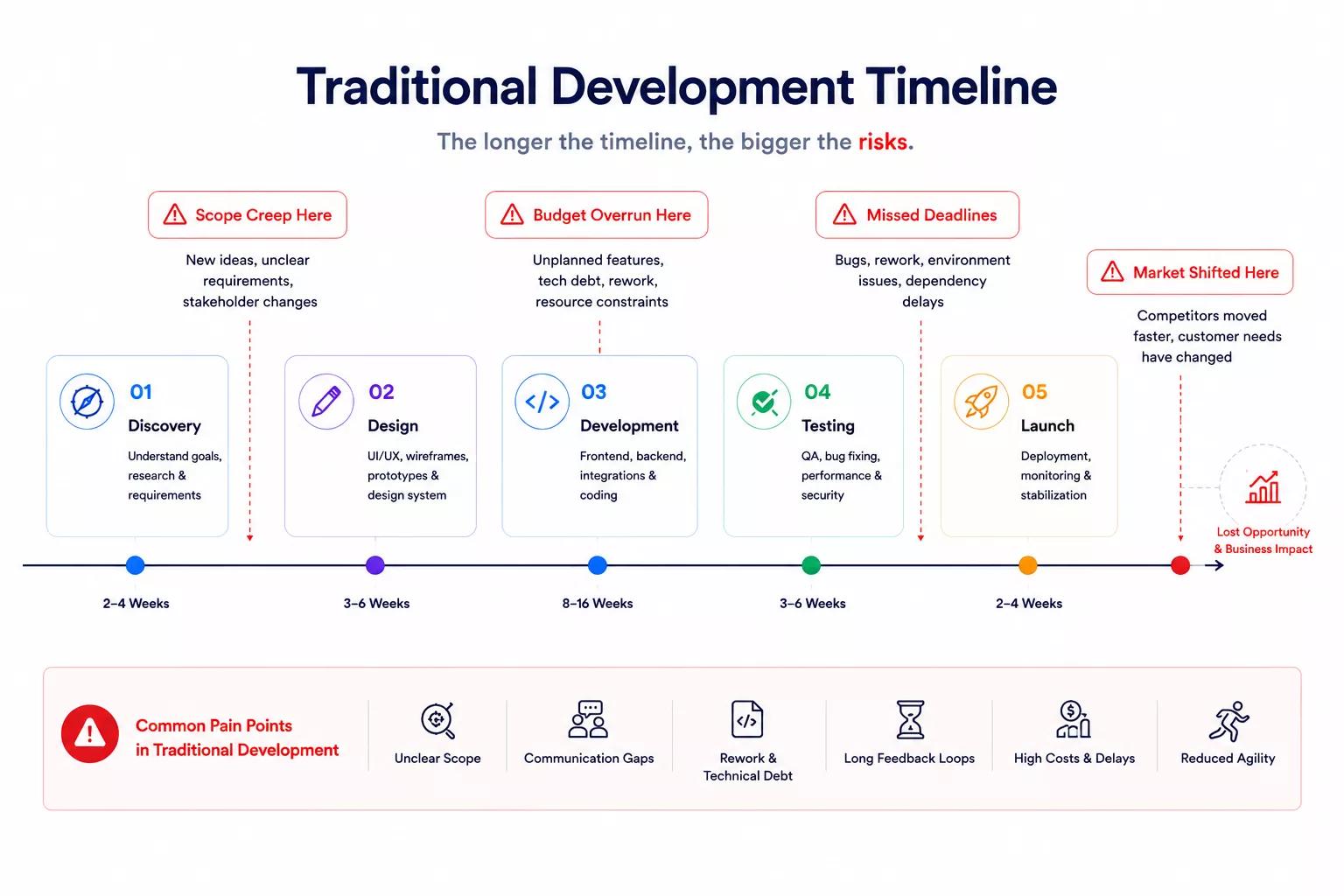
Traditional software development follows a structured, phase-based approach. Whether it's Waterfall, a bloated Agile process, or a hybrid of both - the pattern is familiar.
Typical phases include:
- Discovery & Requirements (2-4 weeks)
- Architecture & Design (3-6 weeks)
- Development (3-9 months)
- QA & Testing (4-8 weeks)
- Deployment & Launch (2-4 weeks)
- Post-launch iterations (on the fly)
Total time to market: 6-18 months on average.
For established enterprises building complex, compliance-heavy systems - this process holds its place. But, for founders testing a new idea, automating a workflow, or building an AI-powered MVP? It's a trap.
The Real Problems With Traditional Development
1. Long timelines kill strategic momentum
By the time you ship, your assumptions are stale. What users wanted in the 1st month is rarely what they need in month 9.
2. Scope creep is almost unavoidable
Requirements change. Stakeholders add features. Timelines stretch. Budgets blow past estimates. A study by McKinsey found that large IT projects run 45% over budget and 7% over time - while delivering 56% less value than predicted.
3. High burn rate with delayed ROI
You're paying for months of development before a single user touches your product. No feedback. No validation. Just spend till whenever the completion arrives.
4. Feedback loops are broken
Real learning only happens when real users interact with real software. Traditional dev cycles delay that essential feedback by months.
5. AI capabilities are bolted on, not built in
Most traditional dev teams design the product first, then figure out where AI "fits." This produces clunky integrations that can break with feature updates, and missed opportunities for automation.
What Is an AI Sprint?
An AI Sprint is a fixed-scope, time-boxed delivery model built specifically for AI-powered products and automation projects.
Instead of spending months on planning and building, an AI Sprint compresses the entire cycle - discovery, design, development, and deployment - into 3 to 6 weeks.
The key principles:
- Fixed scope, not open-ended.
The sprint defines in-length exactly what gets built. No scope creep, No "just one more feature," none of that. A planned outcome is agreed before day one and obtained by the end, period.
- Rapid prototyping and validation.
Working software is developed in front of stakeholders within days - not months. The essential feedback, too, is continuous, not a thing to tick-off post-launch.
- AI-native from the start.
Workflows, automations, agents, and integrations are designed around AI capabilities - not added as an afterthought inclusion.
- Production-ready output.
AI Sprints don't deliver "proof of concepts that need rebuilding." The deliverable is deployable, tested, real-world-ready software.
Understanding the AI Architecture Layers
Traditional software treats AI as an afterthought. A true AI sprint builds from the data layer up. To understand how a 4-week timeline produces stable software, leaders must look at the structural layers we configure:
- Business Problem: Defining the exact manual bottleneck or user friction point.
- Workflow & Logic: Mapping the step-by-step routing of data and decisions.
- System Components: Selecting the right foundation models, vector databases, and automation frameworks.
- Integrations: Connecting the AI output directly to your CRM, ERP, or communication channels.
- Governance & Measurement: Establishing human-in-the-loop safeguards and performance tracking metrics.
By isolating these layers early, the sprint team avoids reinventing basic infrastructure and focuses entirely on custom logic and validation.
The Three Types of AI Sprints
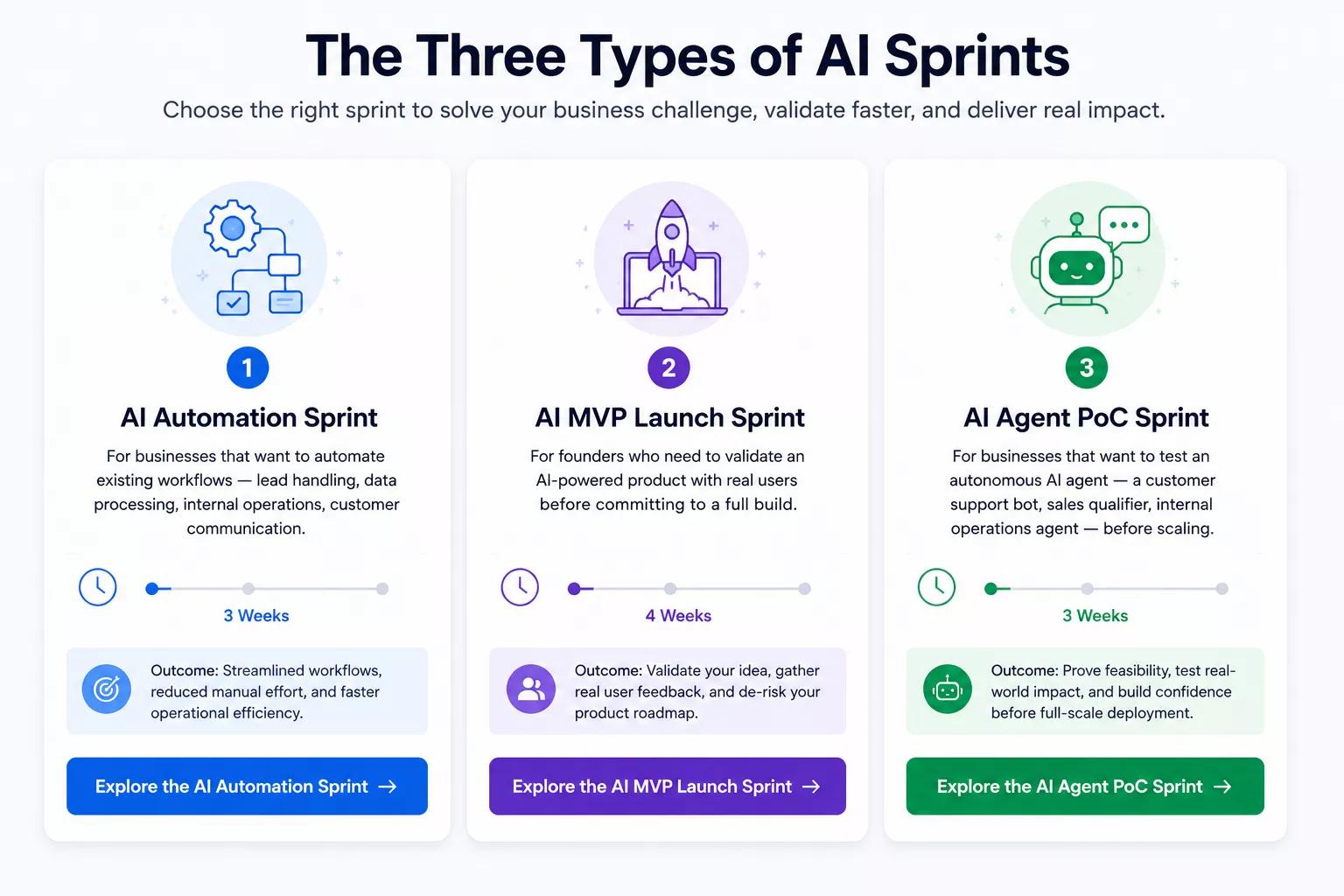
1. AI Automation Sprint
For businesses that want to automate existing workflows, like lead handling, data processing, internal operations, customer communication. → Explore the AI Automation Sprint
2. AI MVP Launch Sprint
For founders who need to validate an AI-powered product with real users before committing to a full build. → Explore the AI MVP Launch Sprint
3. AI Agent PoC Sprint
For businesses that want to test an autonomous AI agent - a customer support bot, sales qualifier, internal operations agent - before scaling. → Explore the AI Agent PoC Sprint
AI Sprint vs Traditional Software Development: The Full Comparison
| Factor | Traditional Development | AI Sprint |
|---|---|---|
| Timeline | 6-18 months | 3-6 weeks |
| Cost | $50K-$500K+ | Fixed, scoped budget |
| Risk | High - long commitment before validation | Low - validate before scaling |
| Flexibility | Low - changes are expensive mid-build | High - scope is tight but pivots are fast |
| Time to Market | Slow | Fast |
| Feedback Loop | Post-launch only | Continuous during sprint |
| ROI | Delayed by months | Measurable within weeks |
| Team Size | Large cross-functional team | Lean, senior-only sprint team |
| AI Readiness | AI is an add-on | AI-native by design |
| Scope Management | Prone to creep | Fixed and protected |
| Validation | Assumption-based | User-tested and data-driven |
| Scalability | Built for scale from day 1 (expensive) | Validate first, scale after (smart) |
The bottom line: Traditional development is optimized for certainty. AI Sprints are optimized for learning fast and delivering value early. For most AI-powered products and automation projects in 2026 and ahead, the sprint model wins.
The Founder’s Evaluation Framework
Choosing between an AI sprint vs traditional development requires a clear assessment of your current business maturity. Use this checklist to dictate your approach:
Score 1 point for every "Yes" statement below:
- Our core assumptions about user behavior still need real-world validation.
- The project involves automating an existing manual workflow.
- We have less than six months of runway to prove measurable ROI.
- The requirements are likely to evolve once users interact with the system.
- We prefer a fixed budget over open-ended hourly billing.
Decision Rule: If you scored 3 or higher, an AI sprint is the mathematically safer investment. If you scored 0 to 2, you are likely building a highly regulated, rigid enterprise system where traditional software development is required.
The Risks and Limitations of AI Sprints
Transparency is critical. While AI sprints reduce financial risk, they are not a magical cure for bad planning. Projects can still fail if founders ignore foundational constraints.
- Poor Data Quality: AI relies entirely on structured, clean data. If your internal documentation is a mess, the sprint will require a data-cleaning phase before automation can begin.
- Unrealistic Scope: A sprint is highly protected. Trying to force enterprise-grade, multi-tenant SaaS features into a 3-week window will break the model. You must commit to a true Minimum Viable Product.
- Lack of Internal Ownership: The sprint delivers working software, but your team must actually use it. Failing to designate an internal champion leads to low adoption rates.
Compliance Note: The information provided in this article regarding data routing and automation is for educational and informational purposes only and does not constitute legal or compliance advice. Always verify data privacy standards within your specific jurisdiction.
Why Founders Are Choosing AI Sprints in 2026
The shift toward sprint-based AI development is a structural change in how smart companies build.
Here's what's driving it:
1. Faster MVP Validation
The lean startup principle has always been "validate before you scale." AI Sprints apply that principle in execution. Yes, you can put a working AI-powered MVP in front of real users in under a month.
2. Reduced Burn Rate
Founders are actively overseeing the development timelines more carefully than ever. A 4-week sprint at a fixed price is easily beating a 9-month engagement with an open-ended invoice. By choosing AI Sprints, you know exactly what you're spending and exactly what you're getting, at the same time.
3. The AI Adoption Window Is Open - But Not Forever
Businesses that automate workflows and launch AI-powered products now are building competitive moats. Those that wait for "the right time" are handing market share to faster-moving competitors.
4. Lean Team Alignment
AI Sprints are designed for lean teams, so you don't need a 20-person engineering department. A sprint team of 3-5 senior specialists - working in a focused, time-boxed model can outdeliver a traditional team twice the size.
5. Faster Experimentation Cycles
Failed experiment in a sprint? You've lost 3 weeks and a fixed budget. Failed experiment in a traditional build? You've lost 9 months and $200K. The asymmetry is stark.
6. AI Makes Rapid Development Genuinely Possible
Modern AI tooling - LLMs, automation platforms like N8N, agent frameworks, pre-built integrations - means one absolute truth. What used to take months to build through typical cycles can now be assembled, configured, and deployed in weeks by the right team.
The 5-Step AI Implementation Process
A successful AI sprint requires ruthless efficiency. When you partner with Ciphernutz, the weeks are structured precisely:
- Audit and Blueprint (Days 1-5): We map the exact workflow, identify data sources, and define the single metric for success.
- Architecture Design (Days 6-10): We select the appropriate Large Language Models, automation nodes, and database structures.
- Build and Integrate (Days 11-20): Our senior engineers construct the logic, train the agents on your specific context, and connect APIs.
- Testing and Safeguards (Days 21-25): We run edge-case scenarios, implement human fallback loops, and ensure accurate outputs.
- Deployment and Handoff (Days 26-30): The system goes live. We document the architecture and train your team on managing the new workflows.
Ready to validate your AI idea in 3-6 weeks?
We'll scope your sprint, map your outcomes, and show you exactly what 3-6 weeks of focused AI development can deliver.
Real-World AI Sprint Use Cases
These aren't theoretical, they're the kinds of projects Ciphernutz delivers in sprint format - every week.
1. Real Estate Workflow Automation
Problem: A real estate agency was manually handling lead intake, follow-up scheduling, and document collection. 4 staff members spent 60% of their time on repetitive admin.
AI Sprint Solution: Automated lead capture, AI-powered follow-up sequences via WhatsApp and email, and intelligent document request workflows - built on N8N and integrated with their CRM.
Timeline: 3 weeks
Outcome: 70% reduction in manual admin. Staff redirected to client-facing work. Resultantly, the lead response time dropped from 4 hours to under 3 minutes.
ROI: Operational cost savings equivalent to 1.5 FTE within the first 60 days.
2. AI Customer Support Assistant
Problem: A SaaS company was handling 300+ repetitive support tickets per week. Their support team was overwhelmed and the response times were hurting NPS scores.
AI Sprint Solution: An AI agent trained on product documentation, FAQs, and historical tickets that is integrated with their helpdesk. It also handles Tier 1 queries autonomously, and escalates complex cases to humans with full context.
Timeline: 4 weeks
Outcome: 65% of support tickets get resolved without human intervention. Average response time is reduced from 6 hours to under 2 minutes. The NPS also improved by 18 points within 90 days.
ROI: Support team headcount requirement reduced by 2 full-time agents.
Case Study: AI-Powered Customer Support Automation
3. AI Lead Qualification System
Problem: A B2B services company was spending 12+ hours per week manually qualifying inbound leads from their website and LinkedIn outreach. The sales team was wasting time on unqualified conversations.
AI Sprint Solution: AI-powered lead qualification agent that scores inbound leads based on ICP criteria, asks qualifying questions via chat, and routes hot leads directly to the sales calendar - with a full context summary for the rep.
Timeline: 3 weeks
Outcome: Time spent by the sales team on lead qualification reduced by 80%. Qualified meeting rate increased by 40%. Zero unqualified demos in the first month post-launch.
ROI: 3x more productive sales conversations from the same pipeline volume.
Case Study: Voice AI Lead Qualification
4. AI Sales Workflow Automation
Problem: An e-commerce brand was manually sending follow-up sequences after abandoned carts, post-purchase upsells, and re-engagement campaigns. Inconsistent execution. Missed revenue.
AI Sprint Solution: End-to-end AI sales workflow automating abandoned cart recovery, personalized upsell recommendations, and win-back sequences. Each is triggered by behavioral data and powered by AI-generated messaging.
Timeline: 4 weeks
Outcome: Abandoned cart recovery rate improved by 28%. Post-purchase upsell conversion increased by 19%. Campaign execution time reduced from 8 hours/week to near zero.
ROI: Estimated $40K+ in recovered revenue within the first quarter.
5. AI Internal Operations Assistant
Problem: A logistics company's operations team was constantly interrupting each other to answer internal process questions - routing decisions, exception handling procedures, compliance checklists.
AI Sprint Solution: An internal AI assistant trained on their SOPs, playbooks, and operations documentation that is also accessible via Slack to process questions and answer readily. It additionally surfaces the right SOP for the situation, and escalates edge cases to the right person.
Timeline: 3 weeks
Outcome: Estimated 2 hours per day reclaimed per operations staff member. New hire onboarding time reduced by 40%. Zero "where's the SOP for X?" Slack messages.
ROI: Productivity gains equivalent to 0.5 FTE per team member within 30 days.
6. AI Document Processing Automation
Problem: A financial services firm was manually reviewing, extracting, and routing data from hundreds of client-submitted documents per week - contracts, KYC forms, financial statements.
AI Sprint Solution: AI document processing pipeline that extracts key data fields, validates completeness, flags anomalies, and routes documents to the correct workflow - with human review triggered only for exceptions.
Timeline: 5 weeks
Outcome: Document processing time reduced by 85%. Error rate on data extraction dropped to under 2%. Compliance team freed from routine document review.
ROI: Processing capacity tripled without additional headcount.
Conclusion: Validate Fast, Scale Smart
The founders winning in 2026 aren't the ones with the biggest budgets or the most developers. They're the ones who validate their ideas the fastest, automate the right things early, and scale only what's proven to work.
Traditional development asks you to bet big before you know if you're right.
AI Sprints let you find out if you're right - before you bet big.
Hence, when you're automating a workflow that's slowing your team down or launching an AI-powered MVP to test with your first 100 users - take the AI sprint path.
Even when deploying an AI agent to responsibly handle a repeatable business function - the AI sprint model gets you there in weeks, at a fraction of the cost and risk.
The question isn't whether AI Sprints work. The question is: how much runway are you willing to spend finding out the slow way?
Frequently Asked Questions
What exactly is an AI Sprint?
An AI Sprint is a fixed-scope, time-boxed development engagement - typically 3 to 6 weeks focused on delivering a specific AI-powered outcome. Unlike traditional development, sprints are designed to validate ideas fast, automate workflows rapidly, and deliver working software to production without months of planning and build cycles.
How long does an AI Sprint take?
Most Ciphernutz sprints complete in 3-6 weeks depending on scope. The AI Automation Sprint and AI Agent PoC Sprint typically take 3-4 weeks. The AI MVP Launch Sprint, which involves a full product build, runs 4-6 weeks.
How much does an AI Sprint cost compared to traditional development?
Traditional development engagements for AI-powered products typically range from $50,000 to $300,000+ with timelines of 6-18 months. AI Sprints are fixed-scope and fixed-price - making budgeting predictable and removing the risk of cost overruns. Contact Ciphernutz for sprint-specific pricing based on your use case.
What's the difference between an AI MVP and a full product build?
An AI MVP (Minimum Viable Product) is a production-ready but scope-limited version of your product - built to validate your core assumptions with real users before a full investment. An AI MVP Launch Sprint delivers a deployable MVP in 4-6 weeks. A full product build expands from there once you have validation data.
What kinds of businesses benefit most from AI Sprints?
Startups validating new AI product ideas, SMBs automating repetitive internal workflows, SaaS companies building AI-powered features, operations teams reducing manual workload, and any business that needs to test an AI agent or automation before committing to large-scale deployment.
Can an AI Sprint integrate with my existing tools and systems?
Yes. Ciphernutz AI Sprints are designed to integrate with your existing stack - CRMs, helpdesks, communication tools (Slack, WhatsApp, email), databases, and APIs. Integration scope is defined as part of sprint planning.
What happens after the sprint is complete?
You receive production-ready software, documentation, and a handover. Ciphernutz also provides a scaling roadmap based on sprint performance data. Many clients continue with follow-on sprints to expand and iterate - or transition to a retainer engagement for ongoing development.
Is an AI Sprint suitable for non-technical founders?
Absolutely. AI Sprints are specifically designed for decision-makers who understand the business problem but don't have a technical background. Ciphernutz handles all technical scoping, architecture, and delivery. Your role is to define the outcome - we figure out how to build it.