Top n8n Automation Workflows Every Hospital Should Have
Yuti Agarwal
4-5 mins
Introduction
Hospitals are complex ecosystems where inefficiencies directly impact patient outcomes. Manual processes in scheduling, documentation, billing, and triage increase workloads and create bottlenecks. That’s where n8n AI workflow automation comes in to improve upon the traditional outcomes.
Why Does AI Automation for Hospitals Define Operational Scale?
The modern care environments generate multi-variate data across EHRs, labs, imaging, scheduling, pharmacy, and revenue systems. Understanding each type of data at hand often causes context switching among clinicians, resulting in excessive time spent in reconciling records and re-entering information across systems.
AI automation for hospitals and clinics solves this by acting as an intelligent orchestration layer. It reasons over both structured and unstructured data while executing actions through secure APIs. Instead of linear rules or manual workarounds, workflows are allowed to evolve based on outcomes, making operations more adaptive over time.
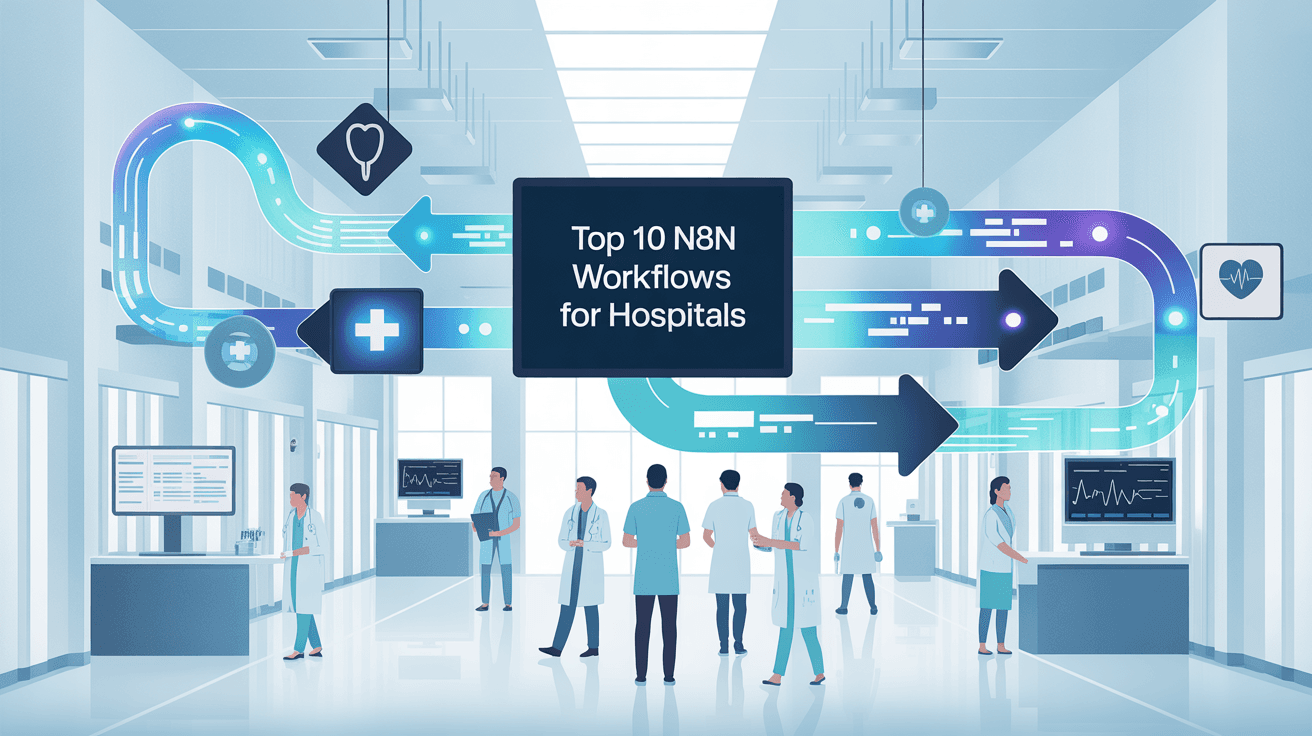
This article explores the top 10 n8n workflows every hospital should automate.
1. Patient Appointment Scheduling
Missed appointments waste clinical time and delay critical care. Automating scheduling with n8n eliminates the dependency on manual coordination.
Implementation Steps:
- Integrate hospital scheduling systems with Google Calendar or Outlook.
- Set up SMS/email reminders via Twilio, SendGrid, or WhatsApp Business API.
- Sync data automatically with EHR platforms to keep patient records updated.
Automation of patient appointment scheduling with AI reduces no-shows, ensures efficient slot utilization, and saves administrative staff hours weekly. Hospitals looking to scale this setup often hire n8n experts for EHR-API customizations.
2. Digital Patient Intake Forms
Paper-based intake slows down onboarding and introduces errors, while digital onboarding without guided automation can be clunky. However, automating intake forms with n8n speeds up the process and secures records, while reducing errors with built-in validation systems.
Implementation Steps:
- Collect patient details through online forms (Typeform, Jotform, or custom web apps).
- Push data directly into EHR systems through FHIR or HL7 interfaces.
- Validate entries against existing patient databases to prevent duplication.
Digitalization of patient intake with n8n reduces wait times during admission and ensures patient histories are available to doctors instantly. Hospitals engaging in digitization projects often collaborate with n8n developers for reliable integration.
3. AI-Powered Triage Chatbots
Triage AI Agents accelerate care delivery speed with minimal or negligible errors. By connecting AI chatbots with triage workflows, hospitals can quickly assess patient needs and prioritize them as appropriate for specialized care.
Implementation Steps:
- Deploy AI triage bots trained with symptom databases.
- Use n8n to integrate chatbot responses with triage dashboards or nurse call systems.
- Automate escalation by routing critical cases directly to emergency staff via SMS or Slack.
The AI Triage system has already demonstrated reduced patient backlog and faster allocation of resources. With an n8n AI agent integration, hospitals can replicate first-line triage functions while keeping clinicians in control.
4. Lab Results Notifications
Patients and doctors often face delays in receiving lab reports due to manual follow-ups that are bottlenecked due to burnout or systemic delays. n8n can automate these notification deliveries to the connected departments.
Implementation Steps:
- Monitor LIS (Laboratory Information Systems) for completed reports.
- Trigger n8n workflows to send secure email or SMS notifications to patients and providers.
- Automatically upload reports to patient portals and EHRs.
Auto-delivery of lab results eliminates delays and ensures clinicians can make timely and informed decisions. Partnering with an n8n development company ensures these sensitive notifications remain HIPAA-compliant.
Read more: n8n for Medical Lab Automation
5. Medical Billing & Claims Processing
Billing and claims involve multiple stakeholders: patients, insurers, and hospital finance teams. Delays or inconsistencies further hold the possibility of incurring losses among the connected stakeholders. In contrast, automation reduces such costly errors by auto-validating claims based on defined criteria and compliance.
Implementation Steps:
- Connect hospital billing systems with insurance provider APIs.
- Automate claims submission with real-time status tracking.
- Trigger alerts for incomplete or denied claims for faster resolution.
By reducing manual intervention and onboarding n8n-powered billing & claims processing automation, hospitals can accelerate reimbursements and improve cash flow. Hospitals in competitive markets increasingly seek n8n development services in India for cost-effective billing automation.
See a real healthcare automation project
How we streamlined patient communication for a healthcare client.
6. HIPAA-Compliant Document Management
Managing patient records securely is one of the biggest challenges for healthcare IT teams, who are already overworked or overwhelmed. n8n can create secure document routing systems to ensure patient data security is maintained without sacrificing timely accessibility.
Implementation Steps:
- Automate record transfers between EHRs, CRMs, and secure storage solutions.
- Use encryption and access control steps within workflows to maintain compliance.
- Apply audit logging within n8n for every transfer.
Implementing solutions that align with HIPAA compliance removes the risks of manual document handling and ensures regulatory compliance. Working with n8n experts helps hospitals set up compliant pipelines without disrupting workflows.
7. Doctor On-Call Alerts
Emergency responsiveness entirely depends on how quickly on-call doctors are notified and can become available for care coordination. n8n can automate real-time paging to help doctors and patients arrive at positive outcomes.
Implementation Steps:
- Integrate staff scheduling systems with n8n.
- Trigger SMS, email, or Slack/Teams alerts when emergency calls are logged.
- Use fallback logic to escalate to the next available doctor if there’s no response.
Automated alerts ensure hospitals never face gaps in emergency care coverage. n8n developers often configure these workflows with multi-channel communication for redundancy.
8. Inventory & Pharmacy Management
Inventory shortages can interrupt patient care and even become a liability for efficient healthcare providers. n8n helps hospitals maintain proactive stock control and provides them with predictive auto-restocking tools to maintain optimal resource levels.
Implementation Steps:
- Connect pharmacy inventory systems with procurement platforms.
- Set up workflows to monitor thresholds for medicines and equipment.
- Trigger automatic reorder requests when the minimum stock is reached.
Automating supply chains prevents shortages and reduces resource wastage. Hospitals and healthcare providers partnering with an n8n development company can gain customized dashboards for better and extensive pharmacy oversight.
9. Patient Feedback Collection
Post-discharge feedback provides valuable insights but is often overlooked due to human reasons. Automating this workflow ensures hospitals continuously improve in areas where the patient pain points demand immediate attention.
Implementation Steps:
- Trigger patient surveys via email or SMS after discharge.
- Integrate responses with hospital CRMs for analytics.
- Use AI sentiment analysis to categorize feedback for quality teams.
Collecting patient feedback automatically post-treatment helps hospitals measure satisfaction trends and address issues proactively. n8n AI workflow automation can also tag urgent complaints for immediate follow-up or develop a custom workflow to align with guidelines and care policies.
10. Emergency Department Workflow Automation
Emergency departments face unpredictable surges, with unprecedented anomalies surrounding the healthcare staff every day. n8n helps streamline the chain from intake to escalation in a structured and compliant manner to ensure timely care delivery.
Implementation Steps:
- Connect intake kiosks, triage systems, and diagnostic labs with n8n.
- Automate real-time updates to on-call doctors via Teams or Slack.
- Link diagnostic results directly into EHRs for faster decisions.
By linking intake, triage, and escalation into a unified flow, hospitals will reduce delays and chaos in high-pressure environments. With n8n AI agent integration, ED teams can handle emergency department patient surges more effectively. Read more: AI in Emergency Department.
Act Now To Accelerate Coordinated Healthcare Experiences
Healthcare automation is no longer optional. By automating repetitive workflows, hospitals can reduce errors, extend patient care availability, and optimize resource allocation. While some workflows are simple enough for internal IT teams, scaling to enterprise-grade systems requires expertise and specialized knowledge. That’s why many hospitals choose to hire n8n experts or partner with a n8n development company offering long-term support.
Whether you start with appointment scheduling or tackle full emergency department automation, n8n offers a modular path forward. If your hospital is considering this transition, partnering with n8n experts or a trusted n8n development company is the most reliable way to scale securely.
Outsourcing to n8n development services is also gaining traction, as hospitals gain access to skilled developers at competitive costs without compromising quality. Whether you’re starting with patient scheduling or full ED automation, n8n provides a modular, future-proof platform.
Want these workflows running in your hospital?
Fixed-scope n8n automation - we build, test and hand over.
FAQs
Q. Why should hospitals choose n8n over other workflow automation tools?
A. n8n is open-source, highly customizable, and integrates easily with EHRs, CRMs, and AI agents. Its flexibility makes it ideal for healthcare automation.
Q. How does n8n AI agent integration improve hospital triage?
A. AI agents connected through n8n can assess symptoms, prioritize urgency, and notify staff in real time, reducing triage delays and improving outcomes.
Q. Is n8n HIPAA-compliant?
A. n8n can be configured for HIPAA compliance by implementing encryption, access controls, and audit logging within workflows. Compliance depends on setup, which is why working with an n8n development company is recommended.
Q. Should hospitals hire in-house n8n developers or outsource?
A. Small to mid-sized hospitals often hire n8n developers or outsource to a vendor for faster deployment. Larger hospitals may build internal expertise for long-term scalability.
Q. Can n8n development services in India handle complex hospital automation?
Yes. Many providers offer advanced n8n development services in India, delivering cost-effective automation across EHR integration, AI-powered triage, and HIPAA-compliant workflows.