AI in IV Therapy: Improving Patient Safety & Nurse Workflow Efficiency
Vijay Vamja
7-8 mins
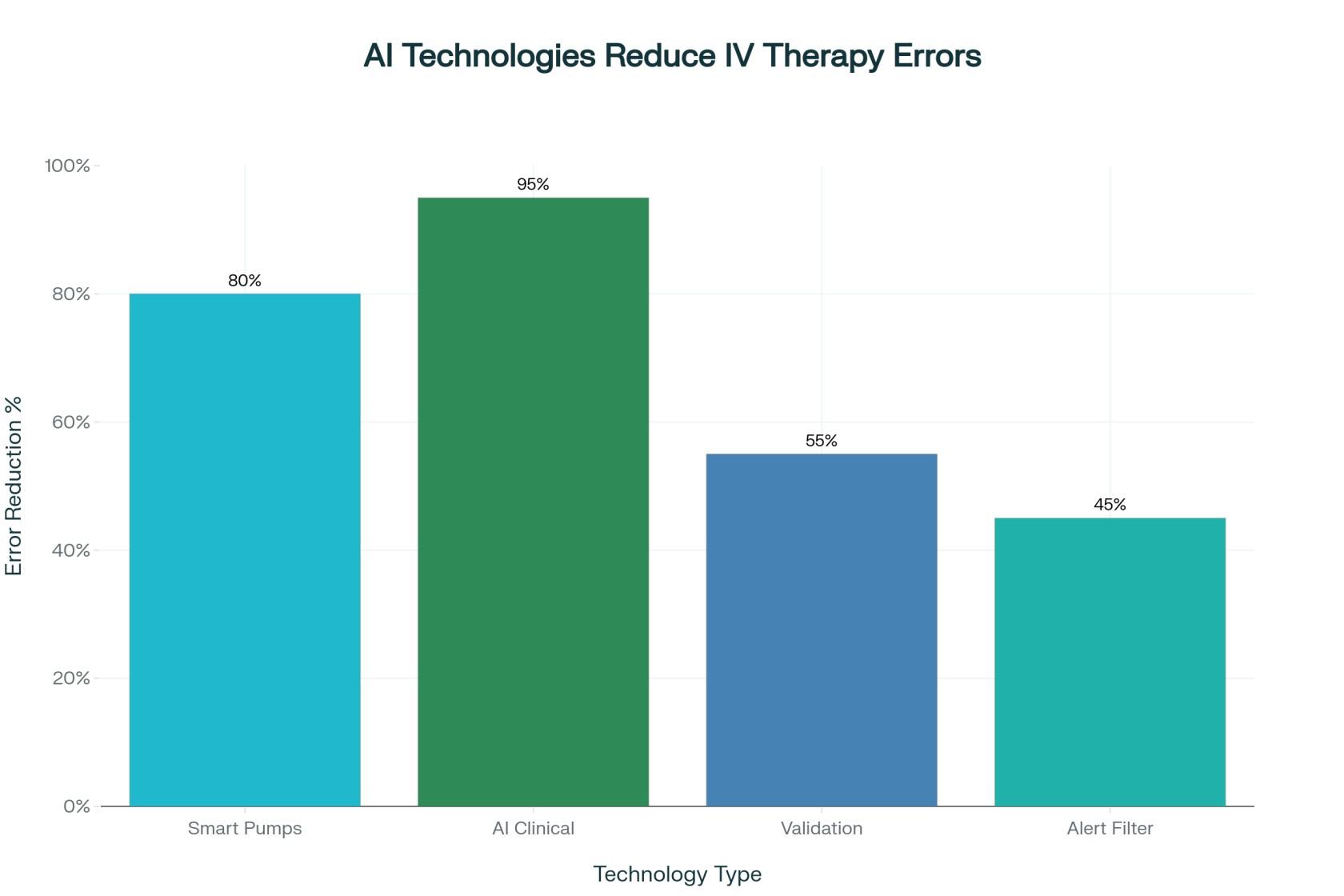
Artificial Intelligence is adding several improvements into intravenous therapy delivery, including exceeding patient safety while dramatically enhancing nursing efficiency. The global IV therapy market is projected to reach $47.3 billion by 2032 and AI-powered solutions are already reducing medication errors by up to 95
Why Does IV Therapy Need AI?
Healthcare organizations are near-constantly under pressure to deliver safer, more efficient patient care amidst various challenges. One in five patients admitted to hospitals receiving IV fluid therapy are known to suffer due to inappropriate administration. Since the traditional IV therapy workflows rely heavily on manual processes, AI helps avoid the human errors - from dose calculation to monitoring & documentation.
Key Operational Challenges in IV Therapy Clinics
1. Staffing Shortages & Nurse Burnout
The Challenge: Qualified nurses and healthcare staff are in short supply. Clinics often struggle with overworked teams, long hours, and high turnover. This directly impacts patient experience and safety.
How AI Helps:
- AI-driven scheduling optimizes staff shifts.
- Predictive analytics helps prevent burnout by balancing workload.
- Virtual assistants automate admin tasks, freeing nurses for patient care.
Result: Clinics improve nurse efficiency and reduce burnout.
2. Scheduling Inefficiencies
The Challenge: Manual scheduling often leads to double bookings, long wait times, and underutilized staff. This hurts patient satisfaction and clinic revenue.
How AI Helps:
- Smart scheduling tools automatically match patients with the right staff.
- AI predicts peak hours and adjusts availability.
- Appointment reminders reduce no-shows.
Result: Streamlined patient flow and better clinic productivity.
3. Patient Safety Risks
The Challenge: Errors in IV dosage, infusion monitoring, or medication tracking can put patient safety at risk. Human oversight alone isn’t enough.
How AI Helps:
- AI-powered infusion monitoring reduces dosage errors.
- Smart alerts notify staff of abnormalities in real time.
- Machine learning analyzes patient vitals for early risk detection.
Result: Fewer medical errors and improved patient safety.
4. EHR Integration & Manual Data Entry
The Challenge: Managing patient data across electronic health records (EHR) is often messy. Manual entry leads to errors, wasted time, and compliance issues.
How AI Helps:
- Automated data entry reduces human error.
- Natural Language Processing (NLP) extracts insights from records quickly.
- AI ensures smoother integration between EHR and clinic systems.
Result: Better data accuracy and faster access to patient history.
5. Inventory & Supply Chain Management
The Challenge: Running out of IV fluids, medical supplies, or infusion kits disrupts patient care. Over-ordering leads to waste and higher costs.
How AI Helps:
- Predictive inventory management forecasts demand.
- AI tracks expiration dates and usage patterns.
- Smart dashboards give real-time supply chain visibility.
Result: Reduced waste, lower costs, and uninterrupted patient care.
6. Rising Operational Costs
The Challenge: From staffing to equipment, IV therapy clinics face rising expenses. Without efficiency, profit margins shrink.
How AI Helps:
- Workflow automation reduces labor costs.
- Predictive analytics optimizes resource allocation.
- AI-driven insights help cut unnecessary expenses.
Result: Clinics operate efficiently while maintaining high-quality care
How AI Boosts IV Therapy Safety
1. Smart Infusion Pump Therapy
Intelligent systems incorporate Dose Error Reduction Software (DERS) that prevents programming errors and provides real-time safety alerts.
The smart infusion pump market is growing from $6.1 billion in 2024 to a projected $11.5 billion by 2033 at a 7.3% CAGR. Such growth represents the frontline of AI-driven patient safety improvements.

Key Safety Features:
- Automated dose calculations with built-in safety limits
- Real-time monitoring of infusion parameters
- Wireless connectivity for remote oversight
- Drug library integration with customizable safety protocols
2. Clinical Decision Support Systems
AI-powered Clinical Decision Support Systems (CDSS) showcased remarkable efficacy in reducing medication errors. Studies show these systems achieved up to 95% reduction in operating room errors while providing real-time guidance to healthcare providers.
Advanced Capabilities of AI-Enabled CDSS:
- Pattern recognition for identifying potential complications
- Predictive analytics for anticipating patient needs
- Integration with Electronic Health Records for comprehensive patient data analysis
- Natural language processing for interpreting clinical notes and orders
3. Adverse Event Prediction & Early Warning
AI models use real-time infusion data + patient vitals to detect early signs of sepsis, fluid overload, or drug incompatibility.
Why It’s Powerful:
- Prevents harm before it happens
- Gives nurses a chance to intervene proactively
- Reduces ICU transfers and improves patient outcomes
4. Closed-Loop Medication Verification
AI verifies the “5 Rights” of medication administration (right patient, drug, dose, route, time) by cross-checking EHR orders, barcodes, and infusion pump settings.
Why It’s Powerful:
- Minimizes human error during high-risk IV therapy
- Provides real-time visual and audio alerts for mismatches
- Improves compliance with hospital safety protocols
5. Remote Monitoring & Tele-IV Support
AI dashboards track multiple patients’ infusion parameters from a central location.
Why It’s Powerful:
- Enables faster response to pump alarms
- Supports home infusion therapy with real-time oversight
- Improves nurse-to-patient ratio efficiency without sacrificing safety
How is Nurse Efficiency Enhanced Through AI Integration
1. Automated Documentation & Workflow Optimization
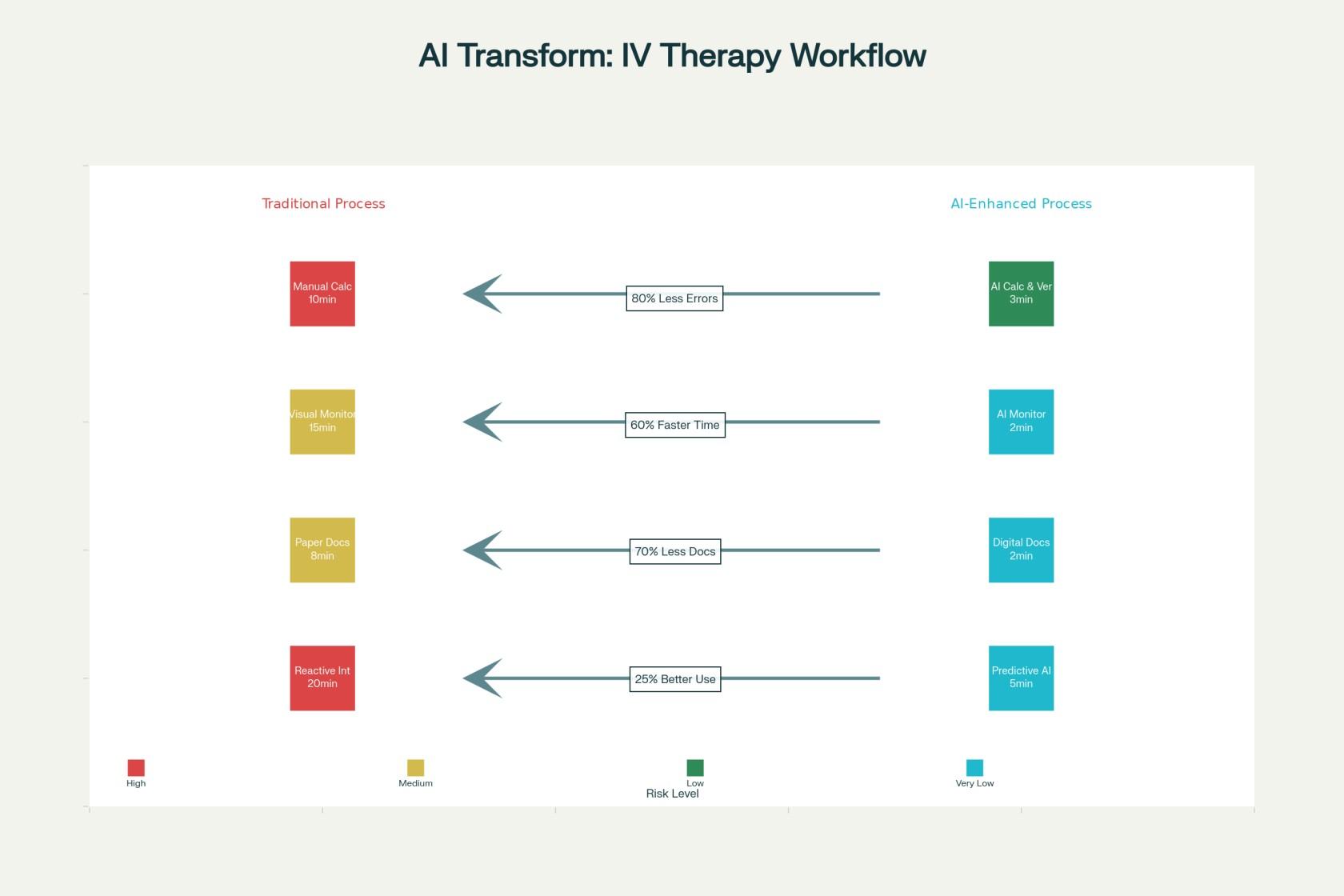
AI-powered documentation systems reduce clinical documentation time by 70%, allowing nurses to prioritize direct patient care over wasting hours in administrative tasks. Example: At Pinnacle Home Care, AI implementation reduced start-of-care time from 119 minutes to 87.3 minutes, significantly improving clinical efficiency.
2. Predictive Patient Monitoring
Advanced AI algorithms analyze the patient data to predict health deterioration with 78% accuracy, enabling proactive interventions that prevent complications and reduce emergency responses. This predictive capability allows nursing staff to prioritize care delivery and allocate resources more effectively.
3. Intelligent Alert Management
AI-driven alert filtering systems reduce non-actionable alerts by 45%. Effectively, it addresses alert fatigue while ensuring critical notifications receive appropriate attention. This intelligent filtering helps nurses focus on genuinely urgent situations requiring immediate intervention.
Market Opportunities and Growth Drivers of AI in IV Therapy
1. AI-Powered Mobile IV Therapy Revolution
The US mobile IV therapy market has expanded from $568.25 million in 2024 to a projected $1.56 billion by 2034, reflecting growing demand for convenient, at-home healthcare delivery. This 10.6% CAGR growth is driven by:
- Consumer preference for home-based care delivery
- Integration with digital booking platforms for seamless service access
- Professional oversight through licensed healthcare providers
- Personalized treatment protocols tailored to individual patient needs
2. Home Healthcare Technology Adoption
Home infusion therapy represents the fastest-growing segment, with the market expanding from $39.84 billion in 2024 to $92.23 billion by 2032 at an 11.1% CAGR. Key drivers include:
- Cost-effectiveness compared to hospital-based care
- Patient preference for familiar environments during treatment
- Aging population requiring chronic disease management
- Healthcare system optimization focused on reducing hospital readmissions
Read more: Home Healthcare Industry Trends
Implementation Success Stories and ROI
Healthcare System Transformations
- Primary Care Excellence
A five-physician clinic implementing AI documentation technology achieved a 94.13% ROI with a payback period of just 6.1 months. The system saved 7 minutes per patient visit, translating to $291,200 in annual savings.
- Hospital System Efficiency
A mid-sized hospital's automated billing and claims processing implementation reduced claim denials by 25% and achieved 12% improvement in collections, with the system paying for itself within 8 months.
- Emergency Department Innovation
An ED implementing ambient AI scribes regained 20 minutes per shift for clinicians, increasing patient throughput by 10% and boosting patient satisfaction scores by 8%.
Technology Integration & Infrastructure of IV Therapy Systems
1. Enterprise-Ready Deployment
89.5% of US hospitals have implemented smart pump technology, with full implementation standard in hospitals with 600+ beds. This widespread adoption demonstrates the maturity and reliability of AI-powered IV therapy solutions.
2. Compliance and Security
AI systems in healthcare must meet stringent regulatory requirements including HIPAA compliance, FDA approval for medical devices, and cybersecurity standards to protect patient data. Modern solutions incorporate:
- End-to-end encryption for data transmission
- Role-based access controls for system security
- Audit logging for compliance tracking
- Integration capabilities with existing EHR systems
How Does Ciphernutz Empower Healthcare Innovation?
1. Custom AI Development for Healthcare
Ciphernutz specializes in developing HIPAA-compliant AI solutions that enhance patient care while maintaining regulatory compliance. Our AI agent development services create intelligent systems that adapt to healthcare workflows and improve operational efficiency.
Core Capabilities:
- Custom AI agent development for healthcare automation
- EHR integration with major systems including Epic, Cerner, and Athena
- Voice AI solutions for clinical documentation and patient interaction
- Workflow automation using advanced platforms including n8n
2. Healthcare-Focused Development Services
Our custom healthcare software development team understands the unique challenges facing medical organizations and develops solutions that prioritize patient safety, regulatory compliance, and operational efficiency.
Specialized Services:
- Telemedicine platform development with AI-powered triage
- Remote patient monitoring systems with predictive analytics
- Clinical decision support tools integrated with existing workflows
- Mobile health applications for patient engagement and care delivery
3. AI Developer Expertise
Organizations seeking to implement AI-powered IV therapy solutions can hire dedicated generative AI developers from Ciphernutz with specialized healthcare experience. Our team combines deep technical expertise with healthcare domain knowledge to deliver solutions that meet clinical and regulatory requirements.
4. N8N Workflow Automation
For healthcare organizations requiring flexible workflow automation, our n8n development services enable seamless integration between disparate systems, automated patient communications, and intelligent care coordination workflows that enhance both patient outcomes and operational efficiency.
Future Trends and Emerging Technologies
1. Advanced AI Capabilities
The future of AI in IV therapy includes multi-agent systems that coordinate complex care delivery, augmented reality interfaces for enhanced clinical decision-making, and predictive wellness models that focus on prevention rather than treatment.
2. Integration with Emerging Technologies
IoT connectivity, 5G networks, and edge computing will enable real-time patient monitoring with minimal latency, while blockchain technology will ensure secure, transparent patient data management across care settings.
3. Personalized Medicine Applications
AI systems will increasingly incorporate genomic data, biomarker analysis, and individual patient response patterns to create truly personalized IV therapy protocols that optimize efficacy while minimizing adverse reactions.
Comprehensive Market Data
IV Therapy Market Statistics
| Market Segment | Market Value (USD) | CAGR (%) | Key Growth Driver |
|---|---|---|---|
| Global IV Therapy Market 2024 | $28.7 billion | 5.1% | Aging population, chronic diseases |
| Global IV Therapy Market 2032 (Projected) | $47.3 billion | 5.1% | Technology integration, home care shift |
| Smart Infusion Pump Market 2024 | $6.1 billion | 7.3% | Patient safety features, automation |
| Smart Infusion Pump Market 2033 (Projected) | $11.5 billion | 7.3% | Smart integration, dose error reduction |
| Mobile IV Therapy (US) 2024 | $568.25 million | 10.6% | Convenience-based wellness demand |
| Mobile IV Therapy (US) 2034 (Projected) | $1.56 billion | 10.6% | Mobile health services, at-home care |
| Home Infusion Therapy 2024 | $39.84 billion | 11.1% | Cost-effective care, patient preference |
| Home Infusion Therapy 2032 (Projected) | $92.23 billion | 11.1% | Chronic disease management, aging population |
| IV Hydration Therapy 2024 | $2.64 billion | 8.9% | Wellness trend, preventive care |
| IV Hydration Therapy 2033 (Projected) | $5.66 billion | 8.9% | Mobile services, digital health adoption |
ROI of Healthcare Automations
| Healthcare Setting | AI Solution Implemented | ROI (%) | Payback Period | Key Benefit |
|---|---|---|---|---|
| Primary Care Practice(3 doctors) | AI Documentation/Scribes | 94.13% | 6.1 months | 7 minutes saved per visit |
| Mid-sized Hospital | Automated Billing/Claims Processing | 12% improvement in collections | 8 months | 25% reduction in claim denials |
| Emergency Department | Ambient AI Scribes | 10% increase in patient throughput | Immediate impact | 20 minutes saved per shift |
| Specialty Practice (Dermatology) | Automated Scheduling | 30% fewer no-shows | Annual savings of $45,000 | Reduced lost revenue from no-shows |
| Large Health System (500 beds) | AI Documentation System | 300% return on investment | Annual savings of $600,000 | System-wide efficiency gains |
| Home Healthcare Agency | Remote Patient Monitoring | 20-40% improvement in efficiency | 1-3 months | Improved patient outcomes |
| Mobile IV Therapy Service | Smart IV Pump Technology | 15-35% reduction in operational overhead | 1-3 months | Enhanced patient safety |
Learn more about IV Therapy and its ROI by reading our case study on the IV Therapy Digital Platform.
Impact of AI Integration in IV Therapy
| AI Technology | Error Reduction (%) | Efficiency Improvement | Implementation Rate |
|---|---|---|---|
| Smart Infusion Pumps | 80% | Reduced programming errors, automated alerts | 89.5% of US hospitals |
| AI Clinical Decision Support Systems | 95% | Real-time error detection in OR | 15% globally (higher in academic centers) |
| Prescription Validation Tools | 55% | Reduced prescribing errors | 25-30% US hospitals |
| AI-driven Alert Filtering | 45% | Decreased alert fatigue | Growing adoption |
| Automated Documentation | 70% | Faster clinical documentation | Increasing in pilot programs |
| Predictive Analytics | 78% accuracy in health deterioration prediction | Early intervention capability | Early adoption phase |
| AI Voice Assistants | 30% reduction in emergency calls | 24/7 patient support | Rapid growth phase |
| Remote Patient Monitoring | 70% reduction in hospital readmissions | Continuous health monitoring | Widespread adoption |
Read more: AI in Home Healthcare
Conclusion
Taking healthcare's evolution toward safer, more efficient, and more compassionate patient care is advantageous and real in 2025. Achieving 95% error reduction in critical care settings and 25% operational efficiency improvements, with AI-powered IV therapy solutions is plenty remarkable to begin delivering healthier patient outcomes and healthcare sustainability.
Partnering with experienced development teams like Ciphernutz can accelerate their AI implementation journey while ensuring regulatory compliance and clinical excellence. Our comprehensive approach to custom software development, AI agent creation, and workflow automation provides the foundation for transformative healthcare delivery that enhances both patient safety and nursing efficiency.
Book your free consultation with Ciphernutz today to explore how AI in IV Therapy can revolutionize your healthcare practice.