Home Healthcare Industry Trends: Evolving Patient Care
Milind Barot
10-12 mins
The global home healthcare market has several modern technologies serving as a primary catalyst for welcoming a newer era of patient care. Navigating through 2025, we have artificial intelligence, telemedicine software, and healthcare automation software bringing about changes that seemed impossible earlier. However, not taking the time to understand these technological shifts can be detrimental. Can't avoid or adapt to what you don’t know, right?
Numbers tell a compelling story of the global healthcare market, from a valuation of ~$390.2 billion in 2024, the industry is projected to reach $666.9 billion by 2031, growing at a CAGR of 7.96%. Now, although this growth isn't uniform across regions, it's not without unique opportunities that will shape the demographic shifts of the future and technology adoption rates.
The Technology Revolution in Patient Care Management
| The $148 Billion AI Transformation
The shift from reactive to predictive healthcare isn't gradual; it's already exponential. Based on numerous studies and research, and respective outcomes, these metrics reflect the real-time function and purpose of modern technologies.
- 85% accuracy in predicting health deteriorations before symptoms appear
- 40% reduction in emergency response times through automated triage
- $148.4 billion projected AI healthcare market by 2030 (from $20.9B in 2024)
- 12-hour advantage in detecting cardiac events through continuous monitoring
Five Pillars of Modern Patient Care Management
Behind these growth and market numbers are families given extra years together, elders living independently, and frontline workers empowered by smart technology. Every region, whether in the U.S., India, the UK, or Saudi Arabia, faces unique challenges and opportunities that will shape the patient experience with innovation and empathy.
As the home healthcare industry is being rebuilt around five foundational pillars, each supercharged by technology, each pillar is only amplifying the human touch rather than replacing it.
Pillar 1: Skilled Nursing Services
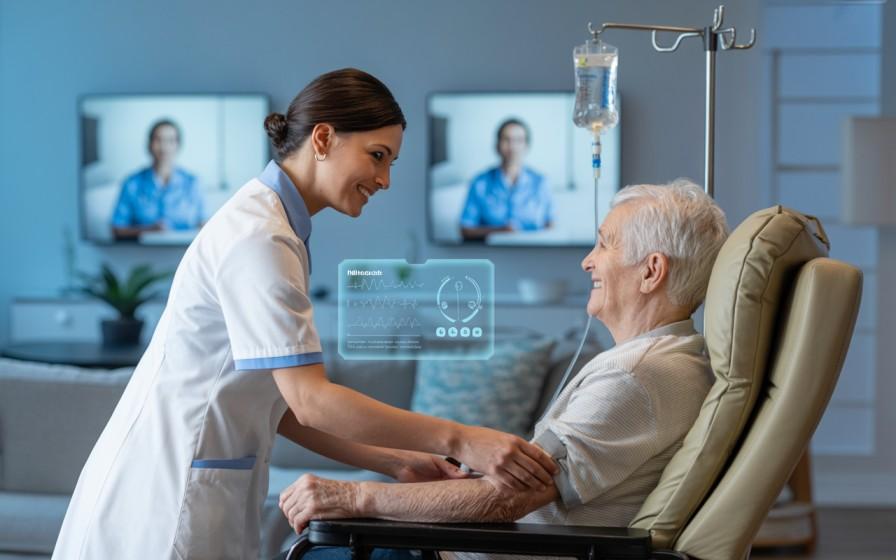
Skilled nursing represents the clinical heart of home healthcare, delivering hospital-level care in living rooms and bedrooms across the globe. This isn't basic caregiving; it's a complex medical intervention that requires advanced technology support.
Core Components:
- Wound care management with AI-powered healing prediction (87% accuracy)
- IV therapy administration using smart pump technology
- Post-surgical monitoring through connected devices
- Medication management via automated dispensing systems
Technology Impact Metrics
| Service Area | Traditional Approach | Tech-Enhanced Approach | Improvement |
|---|---|---|---|
| Wound Assessment | Visual inspection only | AI imaging analysis | 73% better outcome prediction |
| IV Administration | Manual monitoring | Smart booking automation | 94% reduction in lost cases |
| Vital Sign Tracking | 4x daily checks | Continuous monitoring | 12-hour earlier crisis detection |
| Documentation | 2 hours daily | AI Automation & 45 minutes daily | 63% time savings |
Pillar 2: Therapy Services
Patients typically require intermittent skilled nursing care, physical therapy, speech-language pathology services, or continued occupational services, making therapy services essential for recovery and independence.
Revolutionary Tech Applications:
- Virtual Reality Rehabilitation: 67% faster motor skill recovery
- AI Movement Analysis: Real-time form correction with 91% accuracy
- Gamified Therapy Apps: 3.2x higher patient engagement
- Telerehabilitation Platforms: Serving 2.8 million rural patients previously without access
Measurable Outcomes:
- Patient compliance: 71% → 94% with tech-enabled programs
- Recovery timelines: 34% reduction on average
- Therapist productivity: 2.3x more patients served
- Cost per treatment course: 41% decrease
Pillar 3: Personal Care & Support Services
The services segment continues to dominate the home healthcare market, anticipated to capture a significant revenue share of over 60% in 2024, with personal care forming the largest component.
Technologies Enhancing Human Connection
- Smart Scheduling Systems: Matching caregivers to patients based on 47 compatibility factors
- Digital Care Coordination: Reducing gaps in care by 89%
- Family Communication Portals: 94% family satisfaction scores
- Automated Daily Living Assessments: Tracking independence metrics in real-time
Critical Service Areas:
- Bathing and hygiene assistance with dignity-preserving tech
- Meal preparation with nutritional tracking AI
- Companionship enhanced by cognitive engagement tools
- Transportation coordination through integrated platforms
Pillar 4: Hospice & Palliative Care
Hospice is a comprehensive, holistic program of care and support for terminally ill patients and their families, now enhanced by compassionate technology applications.
Tech-Enabled Comfort Care:
- Pain Prediction Algorithms: Anticipating discomfort 4-6 hours in advance
- Family Connection Platforms: Enabling presence even from a distance
- Symptom Management AI: Optimizing comfort protocols for each patient
- Bereavement Support Automation: Timely, personalized grief resources
Impact on End-of-Life Experience:
- Pain-free final days: 78% → 92% of patients
- Family preparedness scores: 45% improvement
- Care team coordination: 67% fewer critical gaps
- Better care access: 3x more touchpoints
Pillar 5: Durable Medical Equipment (DME) & Supplies
The home care market includes home health, durable medical equipment (DME), hospice and palliative care, therapy, and personal care services, with DME forming the technological backbone.
Smart Equipment Revolution:
- Connected CPAP Machines: 84% better sleep apnea management
- Intelligent Wheelchairs: Route optimization and fall prevention
- Smart Hospital Beds: Automatic repositioning prevents 71% of bedsores
- IoT Oxygen Concentrators: Predictive maintenance reducing failures by 92%
Supply Chain Innovations:
| Equipment Type | Traditional Delivery | Tech-Enhanced Delivery | Patient Impact |
|---|---|---|---|
| Oxygen Supplies | Monthly bulk | Predictive just-in-time | Zero stockouts |
| Diabetic Supplies | Patient-initiated | Auto-replenishment | 94% adherence growth |
| Wound Care Materials | Standard packages | Customized kits | 47% faster healing |
| Mobility Aids | One-size-fits-all | AI-fitted equipment | 82% usage compliance |
The Convergence Effect: When Pillars Connect
The real magic happens when these five pillars integrate through technology, forming the following Cross-Pillar Synergies:
- Skilled nursing data informing therapy protocols in real-time
- Personal care observations triggering palliative interventions
- DME usage patterns predicting skilled nursing needs
- Therapy progress adjusting hospice comfort strategies
AI Integrated Home Healthcare Platform Benefits
- 31% of home health referrals originate from hospitals with seamless data transfer
- 78% reduction in care coordination errors
- $4,200 average savings per patient through pillar integration
- 2.7x higher patient satisfaction with coordinated care
The Technology Multiplier Effect
Each pillar alone represents a significant market opportunity, but modern technologies further create exponential market value through integration:
- Individual pillar optimization: 15-25% efficiency gains
- Cross-pillar integration: 45-60% total improvement
- AI-powered prediction across pillars: 70-85% crisis prevention
- Full ecosystem connection: 3.2x value multiplication
Regional Market Dynamics: Tailoring Technology to Local Needs
1. United States: Leading Through Innovation
The U.S. market, representing approximately 40% of global home healthcare spending, showcases the most mature adoption of healthcare automation software. With over 12,000 home health agencies serving 5 million patients annually, the demand for sophisticated technology solutions continues to surge.
Key U.S. Market Characteristics:
- Medicare and Medicaid reimbursement models are driving the adoption of value-based care technologies
- Average technology spending per home health agency: $127,000 annually
- 78% of agencies use some form of electronic health records
- Projected market size: $225 billion by 2030
American startups focusing on mobile IV therapy services have seen particular success, with the market growing from $568 million in 2024 to a projected $1.56 billion by 2034. This growth reflects changing consumer preferences for convenience-based wellness solutions and the increasing sophistication of mobile health technologies.
2. India: Scaling Through Accessibility
India's home healthcare market presents a unique paradox: massive potential constrained by infrastructure challenges. With a market size of $13.2 billion in 2024, growing at a 19.2% CAGR, India offers tremendous opportunities for technology-driven solutions that address accessibility gaps.
India Market Dynamics:
- 600 million smartphone users are creating unprecedented digital health opportunities
- Government's Ayushman Bharat Digital Mission connecting 250 million citizens to digital health services
- Telemedicine consultations increased by 500% post-2020
- Average cost reduction through home healthcare: 40-60% compared to hospital care
Indian enterprises are pioneering frugal innovation in elderly care technology, developing solutions that work on basic smartphones and consume minimal data. These innovations often find applications in other emerging markets, creating export opportunities worth $2.3 billion annually.
3. United Kingdom: Integrating with National Healthcare
The UK's approach to home healthcare technology is fundamentally shaped by the National Health Service (NHS), which serves 66.8 million people. The NHS Long Term Plan allocates £4.5 billion specifically for digital transformation in healthcare, creating substantial opportunities for technology providers.
UK Market Indicators:
- NHS spending on digital health: £2.3 billion annually
- 93% of GP practices use remote consultation tools
- Home healthcare market size: £8.9 billion in 2024
- Projected savings through technology adoption: £1.2 billion by 2027
British companies specializing in palliative care software have developed world-leading solutions that balance clinical excellence with compassionate care delivery. These systems integrate with NHS databases, ensuring continuity of care while reducing administrative burden by up to 45%.
4. Saudi Arabia: Vision 2030 Driving Transformation
Saudi Arabia's Vision 2030 initiative positions healthcare technology as a national priority, with $65 billion allocated for healthcare infrastructure development. The Kingdom's young, tech-savvy population (median age: 31.8 years) creates unique opportunities for innovative home healthcare solutions.
Saudi Market Opportunities:
- Healthcare IT spending: $1.8 billion in 2024, growing at 11.3% CAGR
- 98% smartphone penetration, enabling widespread telehealth adoption
- Private sector healthcare is growing at 14% annually
- Government mandate for electronic health records by 2025
Saudi enterprises are particularly interested in AI in home health care solutions that respect cultural sensitivities while delivering world-class care. Women-only telehealth platforms have seen 300% growth, addressing both cultural preferences and accessibility challenges.
Core Technology Trends Reshaping Home Healthcare
1. Artificial Intelligence and Machine Learning
AI's integration into home healthcare extends far beyond simple automation. Modern AI systems analyze millions of data points to create truly personalized care experiences. Consider these real-world applications.
Predictive Analytics in Action:
- Fall prevention algorithms reduce incidents by 33%
- Medication adherence monitoring improves compliance by 42%
- Early sepsis detection reduces mortality by 25%
- Readmission prediction models achieving 89% accuracy
Companies developing home care services and AI tech are seeing unprecedented demand, with the market expected to reach $8.2 billion by 2030. Partnering with an AI agent development company enables providers to build solutions that don’t replace human caregivers but amplify their capabilities, allowing them to deliver more personalized and proactive care.
2. Advanced Telemedicine and Telehealth Solutions
The telemedicine software market's explosive growth, from $135.7 billion in 2024 to $709.69 billion by 2034, reflects a fundamental shift in healthcare delivery paradigms. Modern telehealth solutions offer far more than video consultations:
Next-Generation Telehealth Capabilities:
- AI-powered symptom assessment with 94% diagnostic accuracy
- Remote patient monitoring is reducing hospital admissions by 38%
- Virtual reality therapy sessions for mental health treatment
- Augmented reality guidance for complex home procedures
Custom telehealth solutions tailored to specific patient populations show even better outcomes. Pediatric telehealth platforms report 91% parent satisfaction rates, while geriatric-focused systems reduce emergency department visits by 45%.
3. Internet of Medical Things (IoMT)
The proliferation of connected medical devices is creating unprecedented opportunities for continuous, non-invasive monitoring. By 2025, there will be an estimated 30 billion IoMT devices globally, generating 2 zettabytes of health data annually.
IoMT Impact Metrics:
- Device Category Market Size 2024, Projected 2030 Key Benefits
- Wearable Monitors $27.8B $74.3B Continuous vital sign tracking, 87% accuracy
- Smart Pills $1.4B $4.8B Medication adherence improvement of 56%
IoMT Impact Metrics:
| Device Category | Market Size 2024 | Projected 2030 | Key Benefits |
|---|---|---|---|
| Wearable Monitors | $27.8B | $74.3B | Continuous vital sign tracking, 87% accuracy |
| Smart Pills | $1.4B | $4.8B | Medication adherence improvement of 56% |
| Connected Inhalers | $0.8B | $2.9B | Asthma attack reduction by 39% |
| Remote ECG Devices | $5.2B | $12.7B | Cardiac event detection 12 hours earlier |
Specialized Software Solutions Driving Innovation
1. Hospice Management Software: Dignity Through Technology
The hospice management software market's growth to $1.2 billion by 2033 reflects society's recognition that end-of-life care deserves sophisticated technological support. Modern hospice software goes beyond administrative functions to support the emotional and spiritual aspects of care.
Key Features Transforming Hospice Care:
- Family communication portals maintain connections during difficult times
- Pain assessment algorithms ensuring optimal comfort
- Bereavement support automation providing timely resources
- Volunteer coordination systems maximizing human touch
Real-world implementations show hospice agencies using advanced software report 23% higher family satisfaction scores and a 31% reduction in medication errors.
2. Home Health Care Scheduling Software: Optimizing Human Resources
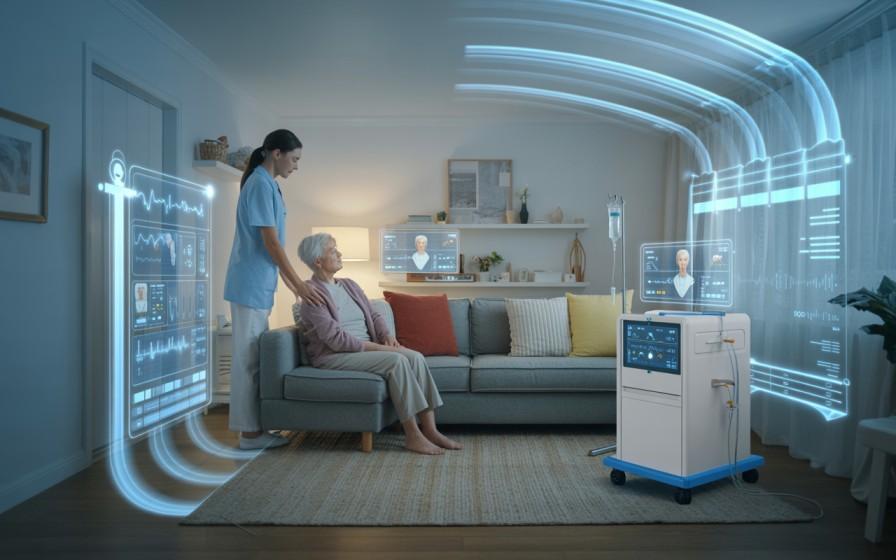
With 89% of home care agencies reporting staffing challenges, home health care scheduling software has become mission-critical. Modern solutions use AI to match caregivers with patients based on skills, personality compatibility, and geographic proximity.
Scheduling Software Impact:
- 34% reduction in missed visits
- 28% improvement in caregiver utilization
- 41% decrease in overtime costs
- 52% faster response to urgent care requests
3. Mobile IV Therapy Services: Healthcare on Demand
The mobile IV therapy market's remarkable growth reflects changing consumer expectations for healthcare delivery. Modern platforms integrate sophisticated logistics algorithms with clinical protocols to deliver safe, effective treatment anywhere.
Mobile IV Therapy Technology Stack:
- Real-time inventory management prevents stockouts
- Route optimization reduces delivery times by 37%
- Telehealth integration for physician oversight
- Automated documentation ensuring compliance
Case Study: HIPAA-Compliant IV Therapy Platform
The Role of Custom Software Development
While off-the-shelf solutions address many needs, the unique challenges of home healthcare often require custom software development. Organizations investing in tailored solutions report 2.3x better ROI compared to generic platforms.
When Custom Development Makes Sense:
- Integration with legacy systems requires specific protocols
- Unique regulatory requirements in specific markets
- Specialized patient populations with distinct needs
- Innovative care models not supported by existing platforms
Our custom software development services focus on creating solutions that seamlessly integrate with existing workflows while introducing transformative capabilities. We specialize in developing HIPAA-compliant platforms that balance security with usability, ensuring high adoption rates among healthcare professionals.
Workflow Automation: The Foundation of Efficient Care
Healthcare workflow automation software companies are revolutionizing how care is coordinated and delivered. By automating routine tasks, these systems free healthcare professionals to focus on patient interaction and complex decision-making.
Critical Automation Opportunities:
| Process | Manual Time | Automated Time | Efficiency Gain |
|---|---|---|---|
| Patient Intake | 45 minutes | 12 minutes | 73% |
| Insurance Verification | 25 minutes | 3 minutes | 88% |
| Care Plan Creation | 90 minutes | 35 minutes | 61% |
| Documentation | 120 minutes | 45 minutes/day | 63% |
N8n Integration: Building Connected Care Ecosystems
N8n workflow automation provides a powerful framework for connecting disparate healthcare systems. Our n8n development services help organizations create sophisticated automation workflows without extensive coding requirements.
N8n Healthcare Applications:
- Automated patient onboarding across multiple systems
- Real-time synchronization between EHR and billing platforms
- Triggered alerts for critical patient events
- Automated report generation for regulatory compliance
Organizations using n8n in healthcare report a 67% reduction in data entry errors and a 45% faster implementation compared to traditional integration methods. Hire n8n experts today!
Future of Home Healthcare Technologies
Emerging Technologies on the Horizon
The next wave of innovation in home healthcare will be driven by technologies currently in early adoption phases:
1. Augmented Reality (AR) in Healthcare:
- Remote surgical guidance for home procedures
- Interactive patient education reduces readmissions by 29%
- Virtual home visits save $142 per consultation
- AR-assisted medication management improves adherence by 47%
2. Quantum Computing Applications:
- Drug interaction modeling at the molecular level
- Personalized treatment optimization
- Complex care coordination across thousands of variables
- Predictive modeling with 95%+ accuracy
3. 5G-Enabled Healthcare:
- Real-time remote surgery capabilities
- Instantaneous large file transfers (MRI, CT scans)
- Ultra-low latency monitoring devices
- Massive IoT device connectivity
Market Projections and Opportunities
The convergence of demographic trends and technological advancement creates unprecedented market opportunities:
Growth Projections by Segment (2024-2030):
| Technology Segment | 2024 Market Size | 2030 Projection | CAGR |
|---|---|---|---|
| AI in Healthcare | $20.9B | $148.4B | 38.5% |
| Remote Patient Monitoring | $71.9B | $207.5B | 19.3% |
| Healthcare Analytics | $34.8B | $96.5B | 18.5% |
| Elderly Care Technology | $15.7B | $41.2B | 17.4% |
| Home Health Care App | $8.3B | $23.6B | 19% |
Partner With Us
The complexity of modern healthcare technology often necessitates strategic partnerships. Our custom software, AI, and n8n development services at Ciphernutz provide you with the technical expertise organizations need to navigate this transformation successfully. Book a Free Consultation today
Our Approach:
- Comprehensive needs assessment
- Custom solution architecture
- Agile development methodology
- Continuous support and optimization
We specialize in creating solutions that not only meet today's requirements but also anticipate tomorrow's challenges. Connect with us to learn how we make your technology investments deliver lasting value.
Conclusion
Home healthcare is entering a new era where technology isn’t a replacement for human compassion, but its strongest ally. From AI in home health care to workflow automation and mobile IV therapy services, the future of patient care is being reshaped across every region.
- In the United States, enterprises lead with large-scale telemedicine software and integrated care systems.
- In India, startups thrive with mobile-first healthcare apps and affordable automation.
- In the United Kingdom, hybrid innovation driven by the NHS and private players accelerates the adoption of palliative care software.
- In Saudi Arabia, government-led investment under Vision 2030 creates vast opportunities for custom telehealth solutions and AI-driven platforms.
What ties these markets together is the shared demand for personalized, efficient, and dignified care at home.
At Ciphernutz, we help healthcare organizations obtain these solutions with:
- Custom Software Development that adapts to unique workflows.
- AI-powered Care Solutions for patient engagement & care delivery.
- n8n Workflow Automation to streamline operations and scale with confidence.
The future of home healthcare belongs to those who can merge compassion with technology. Let’s build that future together!
FAQs
Q. How is AI improving home healthcare?
AI in home healthcare enables predictive monitoring, automated documentation, and personalized patient care management. For example, AI can detect early signs of health deterioration with up to 78% accuracy, reducing hospital readmissions and improving patient outcomes.
Q. What role does workflow automation play in home care services?
Workflow automation using tools like n8n helps reduce administrative burdens by automating scheduling, patient updates, and care reporting. This ensures caregivers spend more time with patients and less time on paperwork, benefiting both startups and enterprises.
Q. Why is mobile IV therapy growing in popularity?
Mobile IV therapy services meet the demand for convenient, at-home treatments such as hydration, vitamin infusions, and recovery support. The global market is projected to grow from $568.25M in 2024 to $1.56B by 2034, driven by patient preference for personalized wellness at home.
Q. How does hospice and palliative care software help patients and families?
Hospice and palliative care software enable dignified, compassionate end-of-life care by using predictive analytics to manage symptoms, pain relief, and family communication. This technology ensures patient comfort while keeping families informed and connected.
Q. What types of elderly care technology are being adopted globally?
Hospice and palliative care software enables dignified, compassionate end-of-life care by using predictive analytics to manage symptoms, pain relief, and family communication. This technology ensures patient comfort while keeping families informed and connected.