Why US Businesses Are Migrating to Next.js for Scale and Speed
Vijay Vamja
3-4 mins
If you ask a Senior Engineer about the current state of frontend development, they will likely point you toward Astro, React Router v7 (Remix), or Vite. Technically, they are correct. These alternatives often offer cleaner code, faster build times, and superior "Lighthouse scores" for their specific use cases.
However, factually, businesses optimize for risk mitigation, hiring velocity, and asset continuity, thereby not making infrastructure decisions based solely on engineering purity.
So while there exists a distinct "Usage vs. Satisfaction" paradox in the market currently: Developers are complaining about Next.js complexity, but still the enterprise adoption is accelerating. This is why the demand for a specialized NextJS development company continues to rise against all the technical critiques.
Here is the data-driven reality and the truth of why the US market still chooses NextJS above the available modern alternatives.
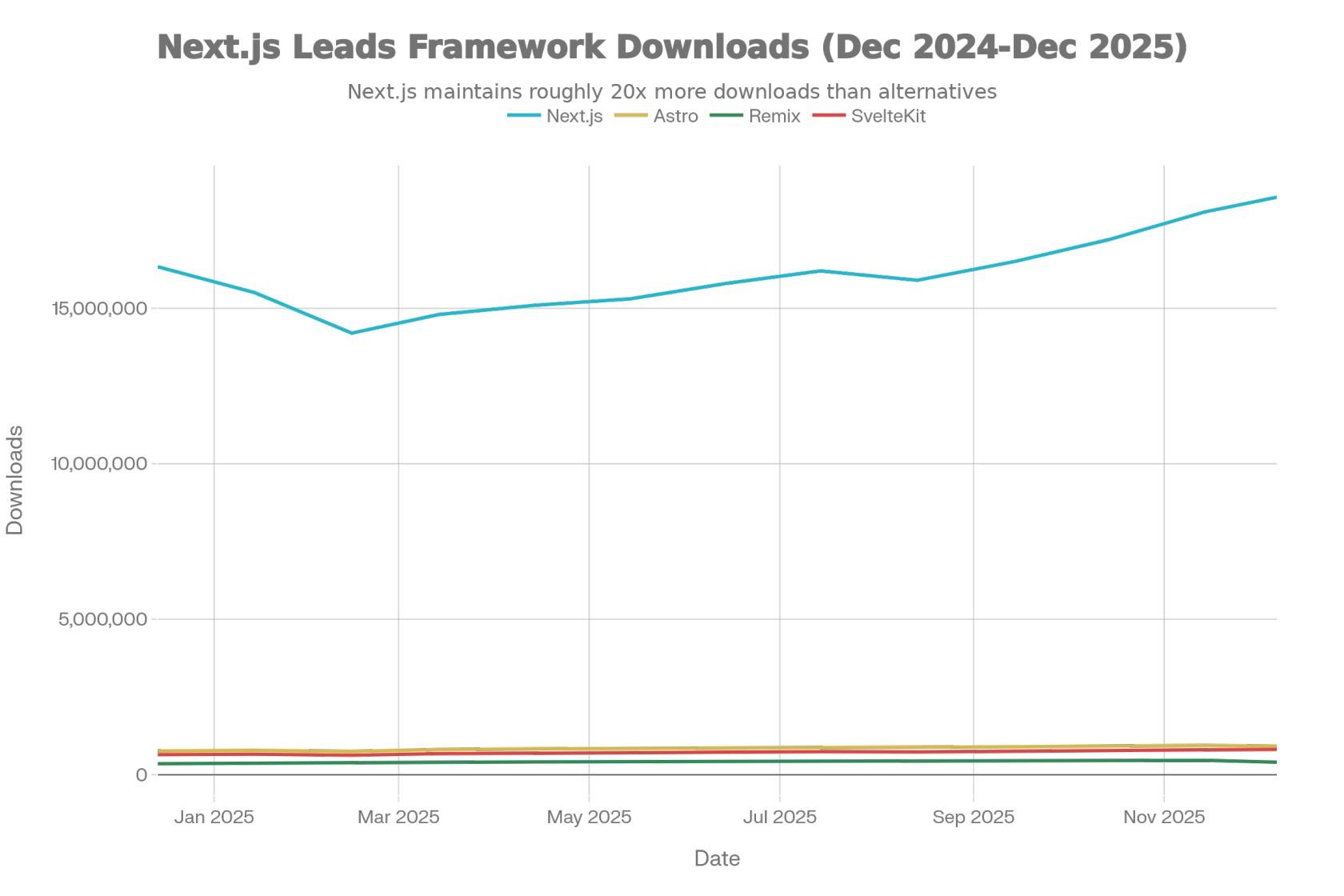
1. The Data: Are Businesses Actually Migrating from NextJS?
Yes, but perhaps not in the direction Twitter suggests. While independent developers are exploring new tools, the enterprise market is aggressively consolidating on Next.js.
- Market Dominance: Next.js currently holds a 54–65% market share among meta-frameworks. Since React powers ~80% of the modern web, Next.js effectively controls the market.
- The 20x Gap: For every single download of Astro (the "technically superior" content tool) or Remix, there are roughly 20 downloads of Next.js.
- Adoption Scale: It is currently used by over 34,000 US companies, including giants like Walmart, Netflix, Hulu, and Ticketmaster.
- Job Market Reality: A quick scan of US job postings (LinkedIn/Indeed) reveals ~25,000+ open roles. The demand to hire NextJS developers is roughly 25x higher than the demand for Remix, Astro, and Svelte developers combined.
Companies are betting their 5-year roadmaps on Next.js. The question is: Why?
2. The Strategic "Why": The Manager’s Perspective
If Astro is faster and Vite is simpler, why do CTOs and VPs of Engineering continue to force Next.js?
Why does the next js development agency almost always recommend this stack?
Well, the answer lies in three key business calculations.
A. The "Hiring Liquidity" Calculation
The single biggest cost in software is labor, not hosting. In this situation, the business velocity relies on replaceability.
- The Pool: There are millions of React developers who default to Next.js. In 2025, "React Developer" effectively means "Next.js Developer."
- The Risk: If you build your marketing site in Astro, your dashboard in Vite, and your app in Remix, you need engineers who understand the nuances of three different architectures.
- The Result: Businesses choose this framework because it guarantees hiring liquidity. When you need to hire NextJS developers, you can fill the seat instantly from a commoditized talent pool.
B. The "Good Enough" Consolidation
To an engineer, Next.js seems like it's trying to do everything (SSG, SSR, API routes) which ends up making the larger result look like "bloat." However, to a business, this is leverage.
- Unified Stack: A single next js development company can handle the marketing pages, the secure login flow, and the backend API routes in one repository.
- Cost of Fragmentation: Maintaining three "perfect" tools costs significantly more in DevOps complexity, CI/CD pipelines, and context switching than maintaining one "imperfect" tool that gets a 90/100 Lighthouse score instead of 100/100. Read more: The hidden costs of NextJS development.
C. The "IBM of the Frontend" (Ecosystem Safety)
Next.js has achieved "safe default" status, similar to Java in the 2000s or IBM in the 1980s.
- Vendor Accountability: Enterprises hate open-source ambiguity. Next.js is backed by Vercel (valued at billions). If a mission-critical US enterprise site goes down, stakeholders want a phone number to call for support, something a boutique next-js development agency cannot offer with community-driven frameworks.
- Batteries-Included Standardization: Next.js standardizes the chaotic parts of React (Routing, Image Optimization, Middleware). For large teams, this rigid structure prevents chaos and ensures that new features (like React Server Components) are supported on day one.
3. The Hidden Trade-Off: AI Dominance vs. The "Performance Tax"
One of the most compelling reasons businesses stay with Next.js is a factor often overlooked by performance purists: Feature Velocity is valued higher than Site Speed.
For perspective, data from the HTTP Archive (Core Web Vitals) reveals a startling gap between the best competitive alternative:
- Astro Sites: ~63% pass all Core Web Vitals (CWV).
- Next.js Sites: Only ~27% pass all Core Web Vitals.
Technically, this is a failure. Next.js sites are statistically twice as likely to fail Google's performance standards compared to Astro.
Yet still, a typical next.js website development agency will still advise clients to accept this "Performance Tax."
Why?
In 2024/2025, the number one priority for US tech companies is integrating AI (LLMs) into their products. Next.js has effectively cornered this market through the Vercel AI SDK.
- 74% Market Share: According to the State of AI report, 74% of developers building AI applications are using the Vercel AI SDK, which is designed to work seamlessly with Next.js Streaming and Server Actions.
- The "Streaming" Moat: AI responses are slow. Next.js pioneered the "Streaming UI" architecture that allows these responses to flow to the user instantly. To replicate this in a traditional SPA requires complex infrastructure. In Next.js, it is a default feature.
The "Server Actions" Hook
The shift to React Server Components (RSC) allows developers to write backend database logic directly inside their frontend button components.
- Old Way: Frontend Dev asks Backend Dev for an API → Waits 3 days → Connects it.
- Next.js Way: You hire NextJS developers who write a "Server Action" to save data to the DB directly in the component → Ships in 3 hours.
For a business, this 10x increase in shipping velocity justifies the poor Core Web Vitals score. They are trading milliseconds of load time for months of product roadmap acceleration.
4. The Migration Reality Check
There is a narrative that companies are "fleeing" Next.js. The data suggests a different story regarding where the migration tales are actually originating.
- The Legacy Pipeline: Most enterprise migrations right now are Legacy CMS (WordPress/Drupal) → Next.js or Plain React (SPA) → Next.js. Companies like The Washington Post and Nike didn't pick Next.js because it's trendy; they picked it to modernize legacy monoliths.
- Internal Migrations: A significant chunk of "migration" is actually internal. Teams moving from the Next.js Pages Router to the App Router. For example, Cal.com recently documented a massive migration to the App Router to handle complex server-side data fetching. Also, Explore our enterprise Next.js Migration Services today!
The Bottomline Truth on Migration to NextJS
The divide is clear: Developers are tired of the complexity and are looking for technically superior alternatives like Astro and Vite. Businesses, however, are doubling down on the stability, hiring pool, and ecosystem of Next.js.
If you are a startup building a simple blog, you might choose Astro. But if you are a business that’s building an AI-powered platform, you will likely partner with a Nextjs development company based in India, like Ciphernutz. All because - willingly paying the "Performance Tax" is currently the ideal way to gain the "Velocity Dividend."