AI Automation: From Process Optimization to Strategic Business Transformation
Vijay Vamja
12-15 mins
The Paradigm Shift Nobody Saw Coming
We're past the era where automation meant simple task elimination. The conversation around enterprise automation has fundamentally changed. What began a few years ago as rule-based systems executing predetermined sequences — if this happens, then do that — has evolved into something far more sophisticated: intelligent automation that learns, adapts, and makes autonomous decisions.
The market is speaking loudly. The global AI automation market is projected to hit $638 billion by 2025 with a compound annual growth rate of 19.2%, driven by enterprise urgency and proven economics. But here's what matters more than the headline number: 83% of enterprises now cite AI as a top strategic priority, and among those who've deployed AI solutions, 92% plan to significantly increase investment in the next three years. These aren't tentative exploratory pilots anymore. These are strategic bets.
What's fueling this momentum? It's not just technology maturity—though that's accelerating. It's the brutal calculus of modern business: cost pressures, talent shortages, and competitive necessity. Organizations that have successfully implemented AI-driven automation are seeing tangible results: 30% reduction in operational costs, 2-4x acceleration of core processes, and measurable improvements in customer satisfaction. These metrics aren't theoretical. They're real, they're being achieved today, and they're reshaping how enterprises think about their operational backbone.
But the shift isn't simply about doing the same things faster. The real transformation lies in where automation is taking root and how it's being deployed.
The Foundation: Understanding AI Automation's Architecture
Before we discuss strategy, we need to establish what AI automation actually is—and what it isn't.
Traditional workflow automation relied on explicit programming: humans defined every step, every condition, every possible branch. If you wanted the system to handle an exception, you had to code for it. This approach worked well for highly standardized, repetitive tasks with predictable outcomes. It's deterministic by design.
AI-driven automation inverts this model. Instead of programming every scenario upfront, the system learns patterns from data, develops decision-making logic, and adapts as conditions change. When exceptions occur—and they inevitably do—the system doesn't simply fail; it learns from the anomaly, refines its models, and improves its decision accuracy over time.
The technical architecture typically comprises four core components:
Data Processing and Pattern Recognition: The system ingests data from multiple sources, identifies patterns, and extracts relevant features. This isn't simple data extraction; it's intelligent interpretation of unstructured information. For instance, an AI automation platform processing customer service inquiries doesn't just read the ticket—it understands context, sentiment, intent, and relationship history.
Decision Intelligence: Using machine learning models and sometimes large language models (LLMs), the system evaluates options against predefined business objectives and makes recommendations or autonomous decisions. The sophistication here varies: basic classification tasks (routing inquiries to the right team), complex predictive decisions (forecasting which customers are at risk of churn), or even strategic optimization (dynamically adjusting resource allocation based on real-time demand).
Workflow Orchestration: This layer manages the execution of processes across systems, applications, and teams. It's the "conductor" that ensures tasks happen in the right order, waits for dependencies to complete, and escalates exceptions to human review when necessary. Modern workflow engines support both synchronous operations (direct API calls expecting immediate responses) and asynchronous patterns (event-driven architectures where tasks trigger subsequent workflows).
Monitoring, Governance, and Adaptation: The system continuously tracks performance, flags anomalies, maintains audit trails, and includes mechanisms for retraining and model updates. This is often overlooked in early implementation but becomes mission-critical at scale. Without it, degraded models, data drift, and undetected biases create operational and compliance risks.
These components don't exist in isolation. They're integrated into a cohesive system that balances autonomy with control, speed with accuracy, and innovation with governance.
Where the Economics Become Undeniable
Let's ground this in dollars and cents, because that's where strategic decisions get made.
The business case for AI automation rests on several quantifiable benefit drivers:
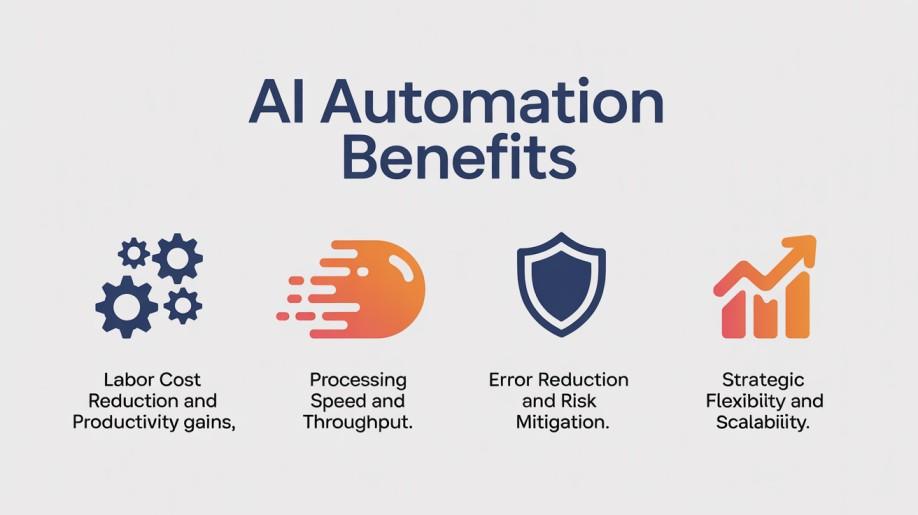
1. Labor Cost Reduction and Productivity Gains
This is the most intuitive benefit, and it's significant. According to research spanning multiple industries, companies implementing AI-powered automation report:
- 20-30% reduction in labor costs by automating repetitive, manual tasks that previously required human attention
- 25-40% increase in productivity when employees are freed from routine work and can focus on higher-value strategic activities
- Up to 90% reduction in errors compared to manual processes, directly reducing rework and associated costs
Let's make this concrete with sector examples. In healthcare, AI-driven document automation is reducing medical claims processing time by 60% while simultaneously boosting revenue capture by 18%—that's both a cost play and a revenue play. In financial services, conversational AI handling routine customer inquiries achieves 38% faster resolution times and cuts compliance audit costs by 22%. In real estate, AI chatbots are achieving 40% faster deal closures and 20% higher lead conversion rates.
These aren't marginal improvements. They're transformation-level impacts.
2. Processing Speed and Throughput
Beyond labor, there's operational throughput. When you can automate invoice processing from 5 days to 2 hours, or claims evaluation from weeks to minutes, the business implications cascade through the organization:
- Faster cash flow cycles reduce working capital requirements
- Accelerated decision-making improves customer experience and competitive responsiveness
- Higher throughput allows organizations to grow revenue without proportionally scaling headcount
Deloitte research found that organizations implementing AI and automation solutions experience:
- 25% faster processing times across automated workflows
- 50% improvement in operational efficiency when automation is integrated across related processes
- 30% reduction in compliance costs through systematic, auditable automation
3. Error Reduction and Risk Mitigation
One of AI automation's underestimated benefits is systematic accuracy. Manual processes are prone to fatigue-induced errors, inconsistent application of rules, and data entry mistakes. AI systems, once trained and validated, execute with consistent precision:
- 99.99% accuracy is achievable in structured tasks like invoice processing or data validation
- This directly translates to reduced rework costs, fewer disputes, and better regulatory compliance
- The ripple effect includes improved customer satisfaction (fewer mistakes reaching customers) and reduced audit and remediation costs
In heavily regulated industries like financial services and healthcare, this accuracy advantage also reduces compliance risk and the likelihood of costly regulatory penalties.
4. Strategic Flexibility and Scalability
Here's where the conversation shifts from operational efficiency to strategic capability. Organizations with mature AI automation platforms can:
- Scale operations without proportional cost increases: Adding 50% more transaction volume doesn't require hiring 50% more staff
- Rapidly adapt to market changes: When business rules change (new regulatory requirements, market shifts), the system can often be reconfigured faster than redesigning manual processes
- Enter new markets or customer segments with less operational friction: The automation infrastructure provides a scalable foundation
This is particularly valuable for growing companies or those in dynamic industries. Instead of layering on more headcount with each expansion, the automation infrastructure scales elastically.
The Strategic Shift: From Defend to Transform
Here's where the story gets interesting for decision-makers. The ROI calculation depends not just on technology, but on strategic intent.
Gartner's research identifies three distinct approaches to AI investment, each with different cost profiles and expected returns:
The Defend Strategy: Optimize What You Have
This approach targets existing processes for efficiency gains. Deploy AI-powered productivity assistants (think Microsoft Copilot, ChatGPT, or domain-specific copilots), automate routine document processing, and streamline internal workflows.
Investment profile: ~$500 per employee
Time to value: Typically less than one year
Expected ROI: ~10% productivity gains
Certainty level: High—proven use cases, lower execution risk
This is the right starting point for many organizations. It requires less operational transformation, generates quick wins, and builds internal capability and confidence.
The trade-off: The returns, while certain, are modest. You're capturing efficiency from existing processes but not fundamentally reshaping how value is created.
The Extend Strategy: Build Competitive Differentiation
This approach embeds AI into business processes more strategically to create meaningful competitive advantages. Think AI-powered customer personalization engines, predictive supply chain optimization, or intelligent risk scoring in financial services.
Investment profile: $2-5M for mid-market organizations, potentially more for enterpriseTime to value: 12-24 months to full deploymentExpected ROI: 25-40% cost reduction or revenue upliftCertainty level: Moderate-to-high with proper governance and execution
This requires deeper organizational change: new data pipelines, retraining teams to work alongside AI systems, and governance frameworks. But the payoff is substantial—you're not just doing the old thing faster; you're enabling new capabilities.
The Transform Strategy: Reimagine the Business Model
This is the ambitious play. Organizations use AI automation to fundamentally reshape how they operate—creating new revenue streams, entering new markets, or building AI-native business models. Think autonomous decision-making systems, AI-driven product personalization at scale, or agentic systems that operate with minimal human supervision.
Investment profile: $5-20M+, often multi-year
Time to value: 2-5 years to full realization
Expected ROI: 40-100%+ or new business model creation
Certainty level: Lower initially, but transformational if executed well
This is where the highest stakes and highest rewards converge. It demands organizational commitment, cultural change, and sophisticated governance. But companies that succeed here often establish defensible competitive moats.
For most organizations, the journey starts with Defend, moves through Extend, and—for the boldest—reaches Transform. Each phase builds on the previous one, reducing execution risk and building organizational capability.
The Technology Stack: Specialized Tools for Specialized Needs
Here's where the "one-size-fits-all" approach definitively fractures.
The proliferation of AI automation platforms reflects a market truth: different automation challenges require different architectural approaches. No single vendor owns the entire solution space anymore.
1. Rule-Based and Low-Code Automation
For relatively straightforward workflows—invoice approval, employee onboarding, leave requests—low-code platforms like n8n, Zapier, or Make provide accessible automation without extensive custom development. These platforms emphasize:
- Visual workflow builders
- Pre-built connectors to common business applications
- Rapid deployment (weeks, not months)
- Lower technical expertise requirements
When to choose this approach: Departmental automation, standardized processes, speed-to-value priorityLimitations: Scaling complex logic, handling sophisticated exception scenarios, and integrating deeply with legacy systems requires custom code.
2. Intelligent Document Processing and Extraction
Many automation bottlenecks live in document-centric workflows—invoice processing, contract analysis, compliance document review. Specialized vendors combining OCR, computer vision, and NLP technologies offer:
- Extraction of structured data from unstructured documents
- Classification and routing based on document type and content
- Continued learning from corrections (reducing error rates over time)
- Integration with downstream workflow systems
When to choose this approach: High-volume document processing, regulatory compliance requirements, significant manual data entry burdenKey consideration: These systems require clean training data and governance to maintain accuracy at scale
3. Conversational AI and Virtual Assistants
For customer-facing and employee-facing applications, conversational AI platforms provide:
- Natural language understanding and response generation
- Multi-turn conversation management
- Integration with CRM and knowledge systems
- Sentiment analysis and escalation routing
These have matured significantly. The latest generation combines large language models (for conversational fluency) with integration APIs (to take actions on behalf of users) and domain-specific training (to ensure responses are accurate and aligned with company policies).
4. Agentic AI Systems: The Next Frontier
The newest category emerging in 2025 is agentic AI—autonomous systems that can plan, decide, and execute complex workflows with minimal human intervention. Unlike conversational AI that responds to user queries, agentic systems:
- Operate goal-driven: They work toward defined business objectives and make decisions autonomously
- Handle multi-step processes: They can decompose complex tasks, identify dependencies, and orchestrate execution across systems
- Adapt and self-correct: They monitor outcomes, detect when expected results aren't achieved, and adjust approach
- Learn from feedback: They improve decision quality based on outcomes
Research from Gartner predicts that by 2028, 33% of enterprise software applications will incorporate agentic AI, a dramatic increase from less than 1% in 2024. Major vendors—Microsoft Copilot Agents, Salesforce Agentforce, Google Vertex AI Agents, IBM watsonx Agents—are investing heavily in this space. This isn't hype; it's a fundamental shift in how autonomous work gets done.
The governance challenge: Agentic systems introduce new risks. An autonomous system making the wrong decision at scale can cascade quickly. Organizations adopting agentic AI solutions and need:
- Clear frameworks defining what decisions can be automated vs. requiring human review
- Continuous monitoring and outcome validation
- Audit trails and explainability mechanisms
- Governance structures (who approves agent behavior changes? how do we handle exceptions?)
The Hidden Costs and Non-Negotiable Prerequisites
Here's what doesn't make it into vendor marketing decks but absolutely determines success or failure: the investment required to actually make AI automation work at scale.
1. Data: The Unsexy Necessity
AI automation systems are fundamentally data-driven. The quality, completeness, and governance of your data directly determines the performance of your automation. Yet many organizations underestimate this:
- Data collection and preparation costs often exceed the cost of the AI platform itself
- Data quality issues (incomplete records, inconsistent formatting, missing values) directly degrade automation accuracy
- Data governance and privacy compliance (GDPR, CCPA, industry-specific regulations) aren't optional; they're non-negotiable
Gartner research indicates that bad data costs organizations an average of $12.9 million annually in wasted resources and failed projects. Additionally, data accuracy has declined by 9% since 2021, even as organizations are investing more in AI. This gap between investment and data quality is a major contributor to AI project failures.
2. Integration and Legacy Systems
AI automation doesn't exist in a vacuum. It needs to integrate with existing business systems:
- ERP systems hold transactional data and need to accept automated decisions
- CRM systems contain customer data and need to feed into routing and personalization logic
- HR systems, accounting systems, supply chain platforms—each brings integration complexity
Legacy systems often lack modern APIs or require custom integration work. This integration labor can easily represent 30-50% of a project's total cost. Organizations often encounter undocumented systems, data silos, or architectural decisions that make integration harder than expected.
3. Change Management and Skills Development
Here's a hard truth: Technology is maybe 40% of the challenge; the remaining 60% is organizational.
When you automate a process, you're not just deploying software. You're fundamentally changing how people work. This requires:
- Training and upskilling: Teams need to understand how to work with AI systems, when to trust them, how to handle exceptions
- Process redesign: The old process won't simply map one-to-one to the automated version; workflows need to be rethought
- Cultural adaptation: Resistance from employees fearing displacement is real and needs to be addressed thoughtfully
- Governance transformation: Who approves automated decisions? How do we audit and monitor? What's the escalation path?
Organizations that treat this as a technology deployment (rather than an organizational transformation) consistently underperform. Those that invest in change management, clear communication, and reskilling see better outcomes and faster time-to-value.
4. Ongoing Model Maintenance and Retraining
This is often the biggest surprise for organizations new to AI: the work doesn't end at deployment.
- Data drift: As real-world conditions change, the patterns the model learned from become less relevant, causing accuracy degradation
- Regulatory and policy changes: What the model was trained to do might change based on new regulations or business decisions
- Model performance monitoring: You need systematic tracking of model accuracy, with alerts when performance drops below acceptable thresholds
- Retraining and updates: This requires ongoing investment in data annotation, model retraining, and deployment infrastructure
Budget-conscious organizations sometimes treat this as an afterthought. The ones that succeed budget for it as an ongoing operational expense.
The Decision Framework: What Leaders Actually Need to Know
For CTOs, engineering leads, and product owners evaluating AI automation opportunities, here's the framework that matters:
Step 1: Define Your Strategic Intent (Not Just Your Problem)
Don't start with "we have too many manual processes." Start with "what competitive advantage or cost structure do we want to achieve?" This shapes everything:
- Defending your current position? Focus on efficiency gains, quick wins, lower-risk automation
- Extending capabilities? You need deeper integration, more sophisticated models, more investment
- Transforming the business model? You're making a multi-year bet requiring significant resources and organizational change
Your answer determines the appropriate investment level, timeline expectations, and vendor/approach selection.
Step 2: Assess Automation Readiness Across Three Dimensions
Process readiness: Is the process standardized enough to automate? High-variation, judgment-heavy processes are poor automation candidates. (Though agentic AI is changing this somewhat.) Quantify: what % of cases follow the standard path? How many exceptions occur?
Data readiness: Do you have clean, complete, well-governed data to train models? Often the honest answer is "not yet." If so, factor in 3-6 months of data preparation before model training even begins.
Organizational readiness: Is leadership aligned on the change? Do you have executive sponsorship? Can you commit resources to change management and retraining? Organizations that are half-committed to organizational transformation often see mediocre results.
Step 3: Evaluate Vendor and Platform Fit
Don't fall into the trap of selecting vendors based on feature checklists. Instead, evaluate on these dimensions:
Clarity on use case and ROI: Can the vendor clearly articulate what they've successfully automated in your industry? Do they have concrete case studies, not just testimonials? Are they honest about limitations?
Integration architecture: How do they integrate with your existing systems? Do they require custom development or do they support your tech stack natively? Integration complexity directly affects timeline and cost.
Data governance and transparency: Do they have clear policies on data privacy, usage rights, and compliance? Will they sign strong IP and data protection agreements? In 2025, this isn't optional.
Governance and control: What tools do they provide for monitoring model performance, detecting drift, and maintaining audit trails? Can you control model behavior and set guardrails for autonomous decisions?
Support and ongoing partnership: Will they be a transactional vendor or a true partner? Do they have deep industry expertise? Are they committed to your success beyond initial deployment?
Step 4: Structure for Success with Phased Deployment
Rather than "big bang" implementations, structured organizations use a phased approach:
Phase 1 (Months 1-3): Pilot — Automated one defined process at limited scale. Goals: prove technical feasibility, validate ROI assumptions, build internal expertise, identify organizational change needs.
Phase 2 (Months 4-9): Extend — Expand automation to related processes, move to broader organizational adoption. Goals: refine processes based on pilot learnings, scale the automation infrastructure, deepen governance.
Phase 3 (Months 10+): Optimize and Transform — Continuously improve existing automations, layer in more sophisticated AI capabilities (predictive analytics, agentic systems), explore new use cases.
This phased approach reduces risk, allows learning and adjustment, and builds organizational capability progressively.
Industry-Specific Imperatives and Opportunities
While the core benefits of AI automation are universal, sector-specific dynamics create different optimization points:
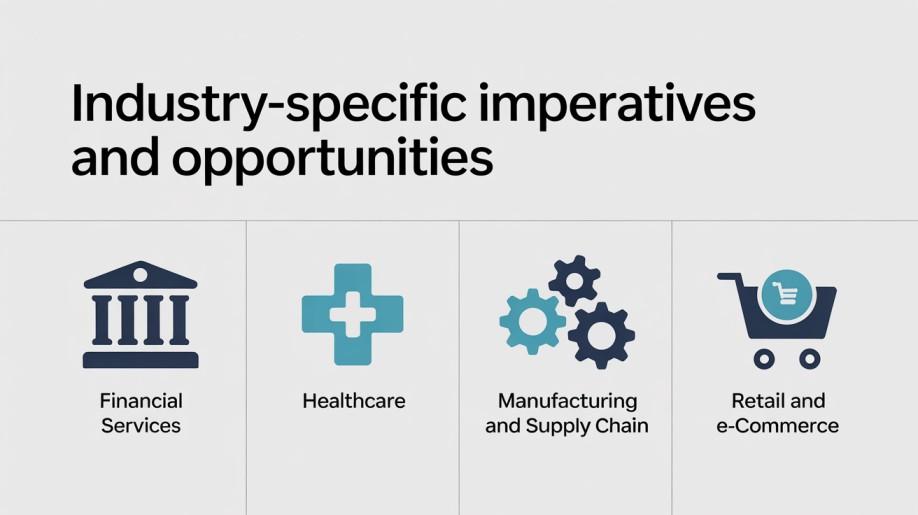
1. Financial Services
Opportunity: Fraud detection, risk assessment, regulatory compliance, and customer inquiry resolution—all mission-critical processes where accuracy and speed matter enormously.
Key metric: 38% faster resolution of customer inquiries when using conversational AI; 22% reduction in compliance audit costs through systematic, auditable automation.
Governance consideration: Regulatory bodies increasingly scrutinize automated decision-making in finance. You need explainability: if the system denies a loan, can you explain why in human terms? Can you demonstrate the decision wasn't discriminatory?
2. Healthcare
Opportunity: Claims processing, ai-powered appointment scheduling, medical records organization, and patient triage.
Key metric: 60% reduction in claims processing time with 18% boost in revenue capture by reducing rejected or delayed claims.
Governance consideration: Patient privacy (HIPAA) is non-negotiable. Your automation infrastructure must ensure patient data is handled according to strict protocols, with robust access controls and audit trails.
2. Manufacturing and Supply Chain
Opportunity: Predictive maintenance, demand forecasting, supply chain optimization, and quality control.
Key metric: 29% reduction in downtime through predictive maintenance techniques; 22% cost reduction in supply chain operations through optimization algorithms.
Governance consideration: Physical safety implications. If your automation system makes a wrong decision in production scheduling, it could affect worker safety or equipment integrity. Robust monitoring and manual escalation paths are essential.
3. Retail and E-Commerce
Opportunity: Personalized recommendations, demand forecasting, inventory optimization, and customer service.
Key metric: 56% increase in conversion rates through AI-powered personalization; 40% faster responsiveness to customer inquiries using conversational AI.
Governance consideration: Customer trust. Overly aggressive personalization or visible bias (e.g., showing lower prices to some customers than others) erodes brand trust. Transparency and fairness principles matter commercially, not just ethically.
Key Questions for Your Leadership Team
Before committing resources to an AI automation initiative, work through these questions as a team:
Strategic alignment:
- What competitive advantage or cost structure are we trying to achieve?
- How does this automation initiative support our broader business strategy?
- What's our multi-year investment capacity for AI initiatives?
Execution readiness:
- Which processes are candidates for automation? (Standardized, high-volume, low-exception rate?)
- Do we have the data infrastructure and governance to support AI systems?
- Does our technology stack support integration with modern AI platforms?
Organizational transformation:
- Do we have executive sponsorship for the organizational changes this will require?
- How will we address workforce concerns about automation and job displacement?
- Do we have the internal expertise, or do we need outsourcing solutions?
Risk and governance:
- What governance frameworks do we need for automated decision-making?
- How will we monitor, audit, and ensure bias-free operation of AI systems?
- What's our approach to regulatory compliance and liability?
Financial and operational:
- What's our expected ROI, and how confident are we in those assumptions?
- What's the realistic timeline from pilot to full deployment?
- What ongoing investment (in data, governance, model maintenance) should we budget?
Vendor strategy:
- Are we building custom AI capabilities or leveraging platform solutions?
- What's our criteria for vendor selection and partnership?
- How do we ensure we're not locked into a single vendor long-term?
The Competitive Imperative: Why This Matters Now
The data is unambiguous: organizations that successfully implement AI automation are gaining sustainable competitive advantages.
Consider the adoption trajectory:
- 78% of global companies are already using AI in their business operations
- 92% of companies plan to increase AI investment over the next three years
- 33% of enterprise software applications are projected to incorporate agentic AI by 2028 (up from <1% in 2024)
The winners aren't those experimenting with AI in isolated pockets. They're the organizations that are integrating AI automation systematically into their core operations, coupling it with strong governance and continuous improvement, and building it into their organizational DNA.
The laggards? They face a compounding disadvantage. As competitors automate repetitive work, they free up talent for higher-value strategic work. As competitors achieve 20-30% cost reductions, they can compete on price or invest in innovation. The gap widens.
The window for early-mover advantage is closing. It's no longer acceptable to be evaluating AI automation in 2025; serious organizations should already be in implementation or optimization phases.
Moving Forward: From Strategy to Execution
The journey to AI-driven automation isn't a sprint; it's a sustained commitment. Here's what success looks like:
Short term (0-6 months):
- Pilot one high-impact, relatively straightforward automation opportunity
- Build internal expertise and governance frameworks
- Establish baseline metrics for comparison
Medium term (6-18 months):
- Scale successful pilots to broader organizational adoption
- Layer in more sophisticated capabilities (predictive analytics, intelligent routing)
- Refine organizational processes and governance as you learn
Long term (18+ months):
- Evolve from reactive automation to proactive, agentic systems
- Create competitive differentiation through domain-specific AI capabilities
- Build organizational competency in continuous model improvement and adaptation
Organizations that take this journey seriously—that treat AI automation as a multi-year strategic initiative, not a one-time technology project—consistently achieve the most impressive results. They're reducing costs, accelerating processes, improving customer experience, and creating space for their teams to do higher-value work.
The question isn't whether your organization should pursue AI automation. In 2025, that's a given. The question is whether you're moving fast enough, with clear enough vision, and with sufficient governance to capture the advantage before your competitors do.
The tools exist. The business case is clear. The organizational imperative is undeniable. The next move is yours.
Takeaways: What Your Team Should Walk Away Understanding
- AI automation isn't about eliminating jobs; it's about redirecting human effort toward higher-value work. Organizations that succeed reframe automation as a productivity and capability multiplier, not a headcount reducer.
- The ROI is real, but it's not automatic. You get 20-30% cost reduction and 2-4x process acceleration only if you execute thoughtfully—with clear governance, strong data foundations, and organizational alignment.
- Technology is 40% of the challenge; organizational change is 60%. The vendors with the best platform don't win; the organizations that best manage change and build governance win.
- The strategic intent matters more than the technology choice. Are you optimizing existing processes (Defend), building competitive advantage (Extend), or reshaping your business model (Transform)? Your answer determines investment level and timeline.
- Agentic AI is the next frontier, and it's arriving faster than most organizations expect. Systems that make autonomous decisions will define competitive advantage in the next 24-36 months. Organizations that are not preparing now will be playing catch-up.
- Data governance is non-negotiable. The quality of your automation is directly proportional to the quality of your data. Invest in this foundation before you even think about deploying sophisticated models.
- Phased deployment reduces risk and accelerates learning. Pilot first, scale thoughtfully, measure rigorously. The organizations that try to do everything at once often stumble; those that methodically build capability progressively often exceed expectations.
The leaders who move decisively—with clear vision, organizational alignment, and rigorous governance—are the ones reshaping their competitive position right now. The time to act isn't next year. It's now.