AI & Automation in Real Estate For Lead Operations Management
Dharmesh Dave
4-6 minutes
AI in real estate is most valuable when it improves how leads are captured, routed, followed up, and converted. The 'generating more leads' is altogether another aspect of the entire lead operations management process. So, wouldn't you like to give your team a system that handles high lead volume, reduces response time, and follows-up consistently across agents and channels?
This guide breaks down a practical AI-driven real estate lead operations framework and the parts of lead management that automation should handle. Learn about the correct workflow design, tools, and common mistakes, including what should never be handled through automation.
What is Real Estate Lead Operations Management?
Lead operations management is the system behind how a brokerage or team handles every inbound lead from first touch to handoff, appointment, follow-up, and conversion. It is different from lead generation, which focuses on getting inquiries in, and different from lead nurturing, which focuses on staying in touch over time.
It can be built into an end‑to‑end system using AI as a fully-fledged real estate automation that performs distinctive functions beyond marketing and simple lead generation.
The lead operations management system in real estate powered by AI performs lead capturing, qualification, routing, multi‑channel engagement, scheduling, and handoff to agents. What’s more is that it also offers closed‑loop analytics, i.e., operationalizing SLAs, ownership, and audit trails.
Why Does Real Estate Need AI-Driven Lead Ops?
Real estate leads are highly time-sensitive, and several sources point to a sharp drop in conversion when response time slows down.
In practice, slow or inconsistent follow-up means more lost appointments, lower trust, and more deals going to the first responsive agent. The operational risks are ever evident within the business process, but they're possible to manage using AI tools or infrastructure. In real estate, these risks look like:
- Missed leads that never reach an agent due to form/phone failures or slow routing.
- Slow responses: buyers select first responders, so delays erode conversions.
- Scattered data across marketing platforms and CRMs causing inconsistent follow‑up.
- No SLA enforcement or audit logs, making process compliance unverifiable.
- High administrative load on agents, reducing selling time.
Here's how real estate businesses can benefit after implementing AI solutions:
- Higher conversion rates through faster, prioritized responses and intent scoring.
- Better routing by geography, availability, or property type with stronger lead scoring based on intent and behavior.
- Reduced admin overhead via automation of routine outreach and scheduling.
- Consistent SLA enforcement and routing fairness, improving agent productivity.
- Better visibility and reporting for continuous optimization.
To mitigate the aforementioned risks and acquire the benefits, developing a framework for AI lead Ops management is the ideal approach.
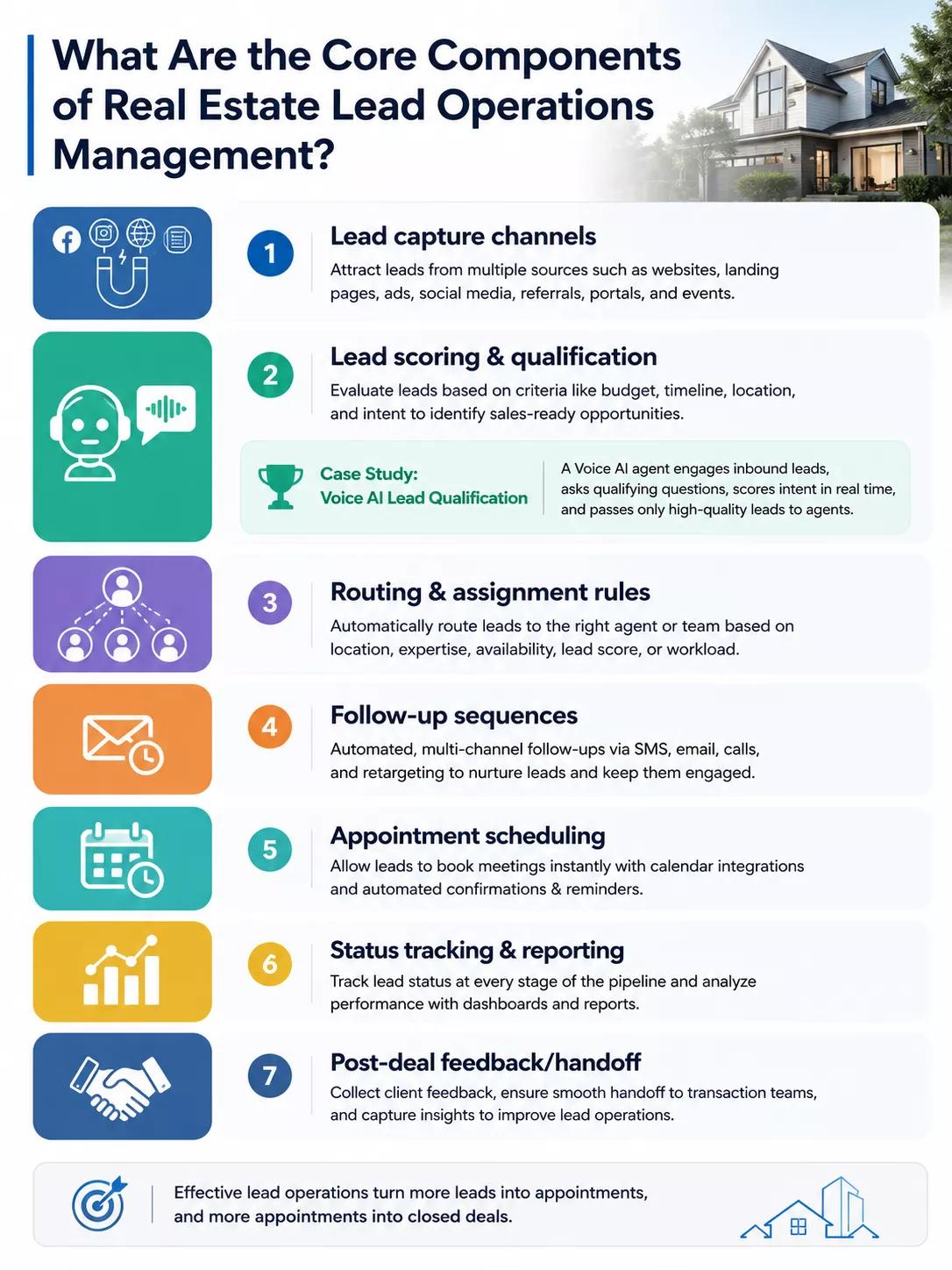
What Are the Core Components of Real Estate Lead Operations Management?
1. Lead capture channels
Lead capture is where inquiries enter your system from website forms, portals, ads, SMS, calls, chat, and social channels. Good lead operations unify these sources so no inquiry gets trapped in a separate inbox or spreadsheet.
2. Lead scoring & qualification
Lead scoring ranks leads by intent, fit, and urgency so sales teams know who to contact first. Platforms can score based on actions like pricing-page views, form completeness, property type, and engagement level.
Case Study: Voice AI Lead Qualification
3. Routing & assignment rules
Routing assigns the leads to the right person based on territory, price band, property type, round-robin logic, or current workload. This is especially important when multiple agents share a lead pool.
4. Follow-up sequences
Follow-up sequences are the timed calls, texts, emails, and reminders that happen after the first inquiry. NAR-related guidance and industry follow-up advice consistently emphasize quick, multi-touch outreach.
5. Appointment scheduling
Scheduling connects the lead to an available calendar slot without friction. AI scheduling tools can propose times, resolve conflicts, and send confirmations automatically.
6. Status tracking & reporting
Status tracking shows where each lead sits in the pipeline and whether the team met its SLA. Reporting helps measure response time, contact rate, appointment rate, and source performance.
7. Post-deal feedback / handoff
A strong process includes feedback after closing or disqualification so marketing and sales can improve. This closes the loop between lead generation, CRM lead management, and future conversion quality.
How AI & Automation Fits In Real Estate Lead Operations Management?
AI and automation are most useful when they remove delay, standardize decisions, and surface priorities. They should support the team’s real estate AI workflow, not replace judgment on high-value conversations.
Here is how they map to each stage:
- Auto-capture leads from forms, ads, portals, SMS, chat, and email into one CRM.
- AI-based scoring can rank leads by intent, property match, and engagement pattern.
- Smart routing can send leads by geography, property type, or rep capacity.
- Automated follow-up sequences can start immediately with SMS, email, and task creation.
- Auto-scheduling can sync calendars and propose appointment times instantly.
- AI-assisted reporting can summarize funnel performance and flag stalled leads.
Example: Within 60 seconds of a form submission, the system scores the lead, assigns it to the best-available agent, sends a personalized SMS, creates a CRM task, and offers two appointment times. That is the difference between basic CRM lead management and an AI-enabled operating model.
How Do You Design the Workflow?
1. Map your current lead journey
Start by tracing every source and every handoff from first inquiry to close. Note where leads are lost, where response time slows down, and which steps are manual.
- Example: website lead → marketing inbox → rep manually copies to CRM → call later that day.
- Fix: website lead → CRM webhook → instant assignment → follow-up sequence.
2. Define SLAs
Set service-level rules for first contact, follow-up intervals, and escalation. In real estate, first response should be measured in minutes, not hours, because response time affects conversion.
- Example SLA: contact every new inbound lead within 5 minutes.
- Example escalation: if no response after 15 minutes, notify the team lead.
3. Create lead-scoring rules
Build scores using both fit and behavior. High-intent actions such as repeated listing views, pricing-page visits, or form completion should score higher than passive activity.
- Example: hot lead = desired neighborhood + mortgage-ready + multiple page visits.
- Example: nurture lead = low engagement, incomplete form, unclear budget.
4. Set up routing logic
Routing should reflect business rules, not convenience. Good logic considers geography, language, property type, price band, lead source, and agent capacity.
- Example: luxury condo leads go to the luxury specialist.
- Example: overflow leads go to the next available rep in a round-robin queue.
5. Script follow-up sequences
Write short, helpful sequences for SMS, email, voicemail, and task reminders. The best sequences are fast, specific, and lightly personalized rather than overly promotional.
- Example SMS: “Thanks for reaching out about [property]. Are you looking to move in the next 30 days or just exploring?”
- Example email: include property details, availability, and one clear next step.
6. Define escalation paths
Every uncontacted lead needs an automatic escalation path. If the first agent does not respond, the system should notify a manager or reassign the lead.
- Example: 5 minutes no response → second SMS.
- Example: 30 minutes no response → reassignment or manager alert.
7. Measure and improve weekly
Review conversion metrics every week and tune the workflow based on what happens in the CRM. The goal is to improve lead response time, appointment rate, and conversion by source.
- Example: if SMS gets faster replies than email, prioritize SMS in the first-touch sequence.
- Example: if one source converts poorly, adjust scoring or routing.
Which Tools Fit Best?
| Type of tool | Strengths for AI lead ops | Limitations | Best for |
|---|---|---|---|
| Generic CRM | Contact storage, pipeline visibility, basic automation, simple reporting | Often needs manual setup and integrations for advanced AI workflows | Solo agents and small teams |
| AI-powered lead management platform | Lead scoring, automated follow-up, routing, segmentation, and faster first touch | Can be expensive or rigid if workflow needs are unique | Growing teams with high inbound volume |
| All-in-one real estate tech stack | Portal integrations, marketing automation, calendar sync, and full-funnel visibility | More complex implementation and change management | Brokerages and larger teams |
| Workflow automation layer | Connects CRM, forms, calendar, SMS, and AI logic into one system | Usually requires better process design and ongoing maintenance | Ops-led teams with custom workflows |
A simple rule is to choose the lightest stack that still supports your SLA, routing logic, and reporting needs. For many teams, that means a CRM plus a workflow automation layer, then adding AI scoring and scheduling as volume grows.
What Pitfalls Should You Avoid?
Over-automating human touchpoints
Keep the first reply fast, but preserve a human handoff for serious buyers and sellers.
Bad scoring rules
If scoring is too simplistic, your team will chase low-quality leads and ignore good ones.
No SLA enforcement
A workflow without timing rules usually turns back into a manual process.
Ignoring routing capacity
Assigning too many leads to one rep creates slow response and missed opportunities.
Fragmented tools
If the CRM, calendar, and messaging tools do not sync, reporting and handoffs break down.
Weak training
Even strong automation fails when agents do not understand the logic or trust the system.
Not reviewing outcomes
If you never check which follow-up path converts, automation stays static instead of improving.
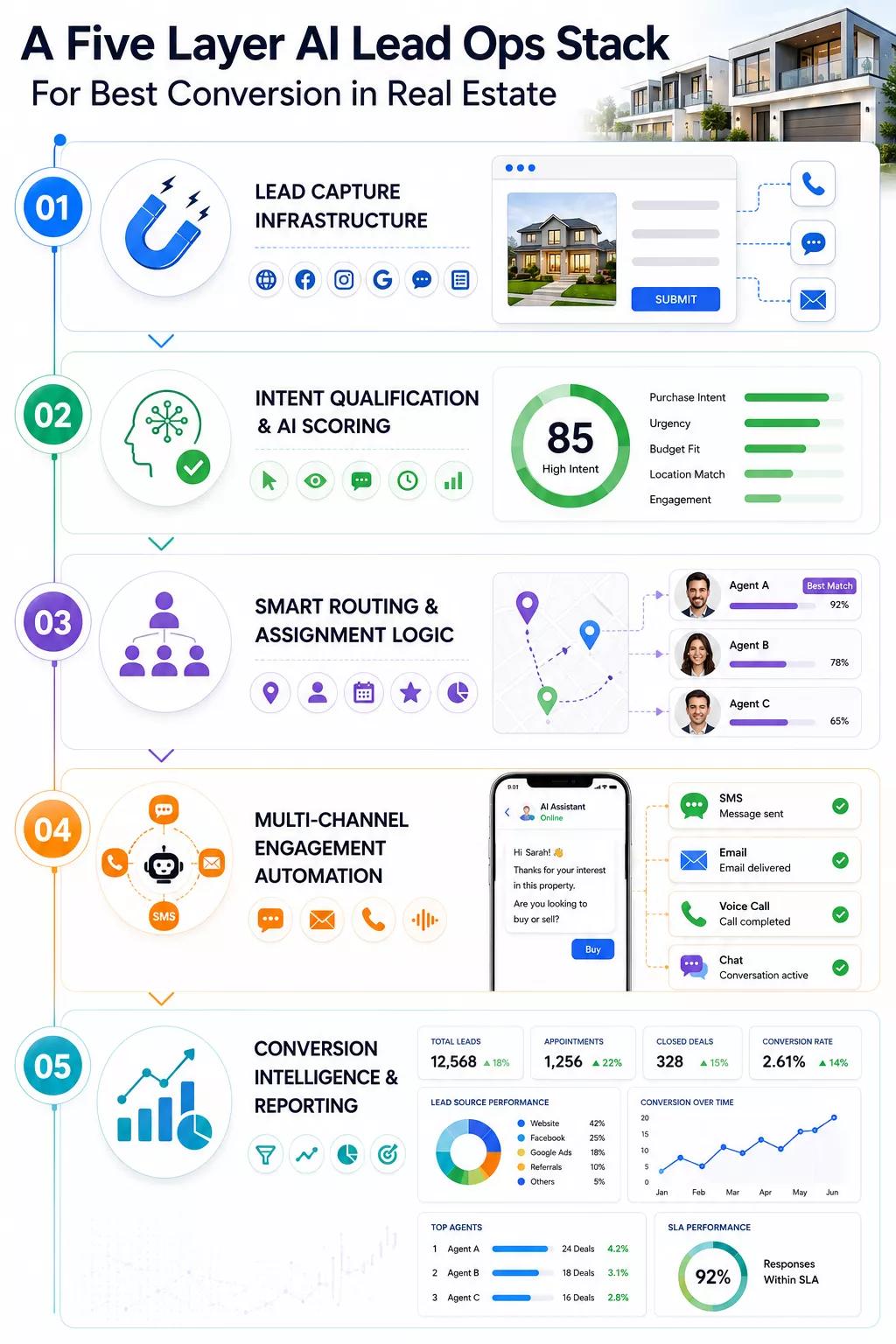
A Five Layer AI Lead Ops Stack For Best Conversion in Real Estate
A practical Response Velocity Architecture for real estate lead operations management must have the following:
Layer 1: Lead Capture Infrastructure
- Operational purpose: Reliable, signal‑rich capture across web forms, listing platforms, portals, phone, and chat.
- Where AI fits: Adaptive form prefill, spam/noise filtering, and speech‑to‑text enrichment for calls.
- Business impact: Fewer lost leads and richer input features for scoring.
- Workflow dependencies: Source tags, standardized event payloads, and real‑time webhooks.
- Implementation guidance: Use standardized JSON payloads, immediate webhook push to an ingest API, and a lightweight queuing tier to prevent drops.
Layer 2: Intent Qualification & AI Scoring
- Operational purpose: Rapidly prioritize leads by purchase intent, urgency, and match to inventory.
- Where AI fits: Models that combine behavioral signals (pages viewed, time on listing), conversational cues, and historical conversion features to produce a composite score.
- Business impact: Higher contact efficiency and better allocation of seller/buyer leads.
- Workflow dependencies: Feature enrichment (MLS data, listing metadata), frequent model refresh cadence, and feedback loops from closed deals.
- Implementation guidance: Start with a logistic/regression baseline, add transformer‑based text classification for messages, and retrain models weekly or monthly depending on volume.
Layer 3: Smart Routing & Assignment Logic
- Operational purpose: Assign leads to the best available agent based on geography, specialty, availability, capacity, and performance.
- Where AI fits: Dynamic scoring for routing fairness and predicted conversion lift by agent.
- Business impact: Faster first contact, improved response SLAs, and balanced workloads.
- Workflow dependencies: Real‑time availability/status, agent quotas, geo‑lookups, and escalation rules.
- Implementation guidance: Implement deterministic rules (geo + language) layered with AI decisions that break ties or optimize for predicted revenue. Use retry and failover queues for unassigned leads.
Layer 4: Multi-Channel Engagement Automation
- Operational purpose: Orchestrate first‑minute outreach and sustained nurture across SMS, email, voice, and chat without damaging trust.
- Where AI fits: Automated, context-aware messages, conversational AI for qualifying dialogues, and voice bots for out‑of‑hours contact.
- Business impact: Rapid response, consistent messaging, and reduced agent interrupt.
- Workflow dependencies: Provider APIs (SMS gateways, telephony/SIP, email), template management, and opt‑in compliance.
- Implementation guidance: Use templates with variable substitution, limit automated message frequency, and route to humans on ambiguous intents or high‑value leads.
Layer 5: Conversion Intelligence & Reporting
- Operational purpose: Measure funnel leakage, SLA adherence, agent performance, and campaign ROI.
- Where AI fits: Attribution modeling, anomaly detection, and automated recommendations for process tweaks.
- Business impact: Data‑driven optimizations, lower CAC, and clearer operations KPIs.
- Workflow dependencies: Unified event store, identity stitching, and scheduled model retraining.
- Implementation guidance: Build dashboards with drilldowns by source, agent, and campaign; automate weekly reports and alerts for SLA breaches.
Technical Architecture of The AI-Driven Lead Ops System
Example tactical workflow:
Lead Source → Webhook/API → CRM Ingest → AI Scoring Engine → Routing Layer → SMS/Email Automation → Scheduler → Agent Handoff → Analytics Dashboard.
Implementation commentary:
- Webhooks and event‑based automation: Use idempotent webhooks and a small queuing buffer (e.g., Kafka, SQS) to absorb spikes and guarantee delivery.
- API integrations with CRMs and comms: Use standardized connectors or middleware to maintain sync; prefer incremental sync over full dumps.
- CRM synchronization patterns: Adopt soft ownership flags, conflict resolution policies, and last‑write timestamps to avoid duplication.
- AI scoring models: Define thresholds mapped to routing and SLA tiers; use explainable features (source, intent, pages viewed); refresh cadence depends on daily lead volumes.
- SLA enforcement and queue management: Implement timed queues, escalation paths, and automated reassignment if SLAs breach.
- Workflow orchestration: Evaluate n8n, Zapier, or an orchestration engine for non‑dev teams, but adopt a custom orchestration layer for enterprise scale.
- Calendar automation: Use provider APIs to check availability windows and apply buffer windows for travel and prep time.
- Data visibility and audit trails: Persist events to an append‑only store for traceability and compliance.
Implementation Maturity Stages of AI & Automation in Real Estate
- Stage 1: Manual CRM workflows - spreadsheets and manual assignment; small teams, low lead volume.
- Stage 2: Basic automation - templates, basic routing, scheduled follow‑ups; one‑to‑two person ops.
- Stage 3: AI‑assisted workflows - lead scoring and simple bots; teams scaling to dozens of agents.
- Stage 4: Intelligent orchestration systems - dynamic routing, multi‑channel AI agents, SLA enforcement.
- Stage 5: Predictive response architecture - proactive outreach, predictive inventory matching, near‑real‑time optimization.
Each stage increases automation, reduces manual labor, and requires stronger data governance and model monitoring.
Choose Operational Transformation Over Linear AI Adoption
Redesign your lead operations stack with Ciphernutz, an AI & Automation development company to reduce leakage, enforce SLAs, and deliver consistent first contact. Deploy AI‑driven lead workflows that extend your team and learn how our AI lead operations consulting and implementation services redesign routing logic.
Contact us to 'Redesign your lead operations stack' using proven orchestration patterns and implement AI‑powered real estate CRM syncs with conversational + voice agents for scalable response velocity.
FAQ
Can AI fully replace human agents in lead follow-up?
No. AI can automate first touch, qualification, reminders, and scheduling, but human agents are still needed for trust-building, negotiation, and complex objections. The strongest model is AI for speed and consistency, humans for relationship and judgment.
How should modular AI lead ops architecture be designed?
Design modular layers (capture, scoring, routing, engagement, analytics) with event streams between them and clear contracts (JSON schema) for each event. Use feature stores and idempotent endpoints to ensure data consistency.
How does AI lead scoring work operationally?
Combine source metadata, behavioral signals, message text embeddings, and historical conversion labels into a calibrated score; map scores to routing and SLA tiers with explainable features.
What workflows should remain human‑led?
Negotiation, local market expertise, legal disclosures, and complex objections should remain human‑led; automation should assist but not replace these tasks.
How should AI automation be monitored and tuned?
Monitor model drift, precision/recall by segment, SLA compliance, and human handoff quality; schedule retraining based on drift thresholds and business KPIs.
What are the risks of over‑automation?
Over‑automation can damage trust, cause regulatory breaches, and mishandle edge cases; always provide clear escalation paths and human review windows.
How do token costs affect AI‑driven follow‑up systems?
Token costs scale with message complexity and throughput; use hybrid approaches (lightweight classifiers + occasional generative replies) to manage costs while preserving quality.